
Sheet Metal Fabrication Course
This Sheet Metal Fabrication Course gives you the hands-on knowledge to cut, form, join, and finish metal parts the right way. From reading blueprints to operating press brakes and welding thin-gauge steel, you'll build real, job-ready skills. Get trained for the shop floor from day one.
What you'll learn:
You'll start with metal materials, measurement tools, and workshop safety before moving into layout and pattern development for cylinders, cones, and transitions. From there, you'll master cutting with hand snips, power shears, and plasma equipment, then move into bending operations using press brakes and roll formers. You'll learn mechanical joining, seam fabrication, and welding processes including MIG, TIG, and spot welding. Surface finishing, corrosion protection, and quality inspection round out the core curriculum. Supplementary content covers CNC plasma and laser cutting, CAD-based flat pattern generation, HVAC ductwork fabrication, and workshop estimating.
How you study in practice Sheet Metal Fabrication Course
How you practise Sheet Metal Fabrication Course
For businesses looking to train their team
With Dedika for businesses, the course includes exercises and examples tailored to your own business and the way your company needs.

Course content
8 Chapters • 40 LessonsDuration between 4 and 360 hours (you decide)
Chapter 1HideHide detailsSee detailsFoundations of Sheet Metal Work
Foundations of Sheet Metal Work
Lesson 1 • Sheet Metal Materials Overview
Covers common metals used in fabrication: steel, aluminium, copper, and stainless. Establishes material selection criteria central to all subsequent chapters.
Lesson 2 • Measurement and Layout Tools
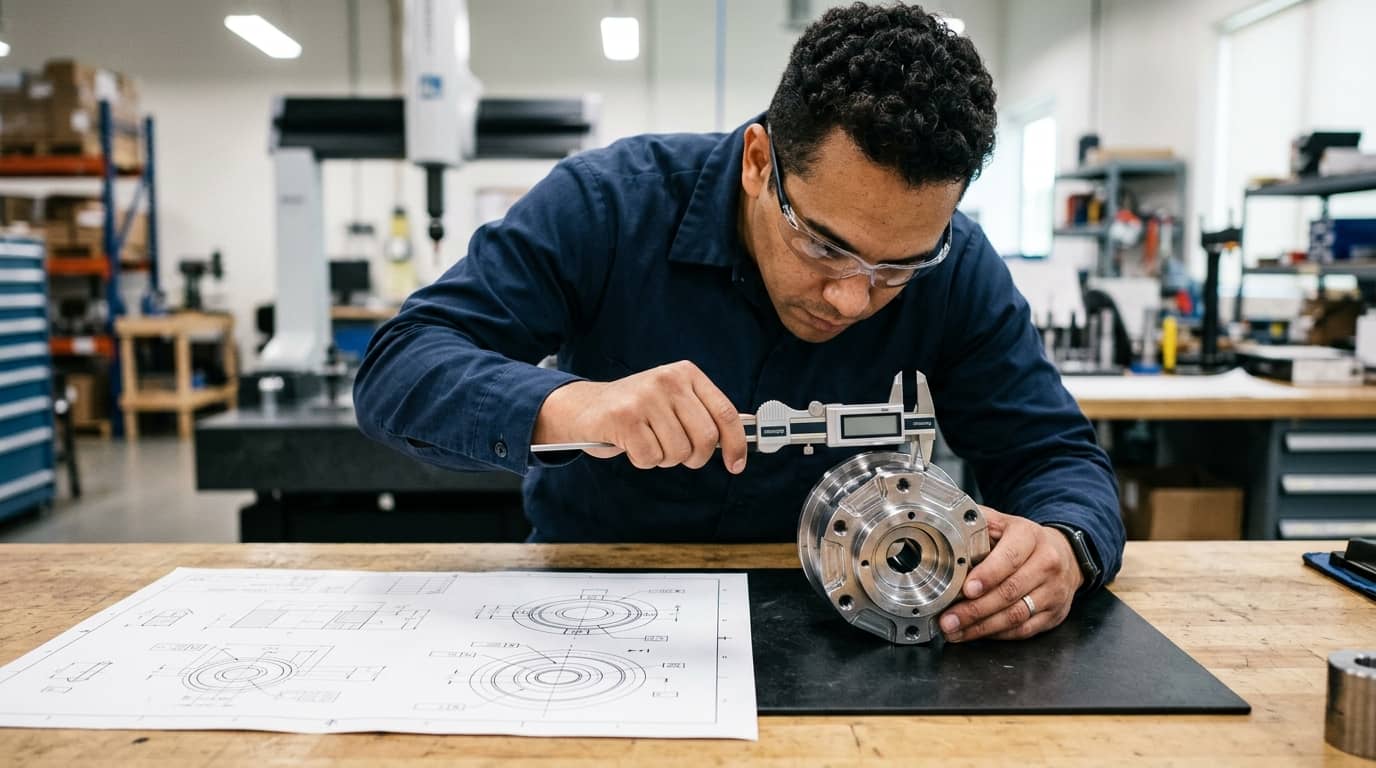
Introduces rules, squares, scribers, dividers, and digital calipers for precise layout. Accurate measurement is prerequisite to every cutting and forming operation.
Lesson 3 • Reading Blueprints and Drawings
Teaches interpretation of orthographic views, dimensions, and tolerances on fabrication drawings. Blueprint literacy underpins accurate layout and cutting in later chapters.
Lesson 4 • Shop Equipment Identification
Surveys major machines: shears, brakes, rolls, and welders at an introductory level. Familiarity with equipment names and functions prepares students for hands-on chapters.
Lesson 5 • Shop Safety and Personal Protection
Establishes mandatory safety protocols, PPE requirements, and hazard recognition. Safe habits introduced here apply throughout every hands-on chapter.
Chapter 2HideHide detailsSee detailsLayout and Pattern Development
Layout and Pattern Development
Lesson 1 • Pattern Allowances and Seam Design
Covers bend allowances, hem widths, and lap seam dimensions added to developed patterns. Correct allowances ensure parts assemble to final dimensions after forming.
Lesson 2 • Triangulation Development
Introduces triangulation for irregular transitions between rectangular and round openings. This advanced layout method handles shapes not solvable by parallel or radial methods.
Lesson 3 • Parallel Line Development
Uses parallel line method to develop patterns for prisms and cylinders. Students apply this technique to produce flat blanks that fold into correct three-dimensional shapes.
Lesson 4 • Geometric Construction Techniques
Applies compass, divider, and straightedge methods to construct angles, arcs, and bisectors. Geometric accuracy directly determines pattern quality in this chapter.
Lesson 5 • Radial Line Development
Applies radial line method to develop cone and pyramid patterns. Mastery enables students to lay out tapered ductwork and funnel shapes accurately.
Chapter 3HideHide detailsSee detailsCutting and Shearing Operations
Cutting and Shearing Operations
Lesson 1 • Cutting Quality and Edge Finishing
Addresses deburring, filing, and grinding cut edges to remove burrs and achieve dimensional accuracy. Clean edges are essential for safe handling and quality joint fit-up.
Lesson 2 • Power Shear Operation
Teaches setup, blade clearance adjustment, and safe operation of bench and foot-operated power shears. Shear operation produces straight cuts faster and more consistently than hand tools.
Lesson 3 • Nibblers and Throatless Shears
Introduces nibblers and throatless rotary shears for curved and irregular cuts without distortion. These tools extend cutting capability beyond straight-line shear limitations.
Lesson 4 • Plasma Arc Cutting Fundamentals
Covers plasma cutter setup, consumable selection, and hand-guided cutting technique on sheet metal. Plasma cutting enables fast, precise cuts on thicker gauges and complex profiles.
Lesson 5 • Hand Snips and Aviation Shears
Covers straight-cut, left-cut, and right-cut snip selection and proper cutting technique. Hand snips are the entry-level cutting tool used before machine operations are introduced.
Chapter 4HideHide detailsSee detailsForming and Bending Operations
Forming and Bending Operations
Lesson 1 • Box and Pan Brake Techniques
Applies the box and pan brake to form boxes, pans, and multi-bend parts with finger segments. Finger selection and sequencing determine whether complex parts can be formed.
Lesson 2 • Hand Bending and Folding Tools
Covers bar folders, hand seamers, and mallet techniques for forming flanges and hems manually. Hand tools develop tactile understanding of metal behaviour before machine work.
Lesson 3 • Roll Forming and Curving
Introduces slip rolls and plate rolls for forming cylinders, cones, and curved panels. Rolling complements brake bending for parts requiring continuous curvature.
Lesson 4 • Press Brake Setup and Operation
Teaches punch and die selection, back-gauge setup, and tonnage calculation for press brake bending. The press brake is the primary production bending machine in fabrication shops.
Lesson 5 • Bend Allowance and K-Factor
Explains the maths behind material stretch during bending, including K-factor and bend deduction. Accurate calculations prevent dimensional errors in formed parts.
Chapter 5HideHide detailsSee detailsJoining Methods: Seams and Fasteners
Joining Methods: Seams and Fasteners
Lesson 1 • Riveting Techniques
Teaches solid and blind rivet installation, hole sizing, and rivet spacing for structural joints. Riveting provides permanent mechanical fastening without heat distortion.
Lesson 2 • Joint Design and Selection Criteria
Synthesizes seam, rivet, fastener, and adhesive options into a decision framework based on load, environment, and code requirements. Students select optimal joints for given applications.
Lesson 3 • Threaded Fasteners and Hardware
Covers screws, bolts, nuts, and clinch fasteners used in sheet metal assemblies. Threaded fasteners allow disassembly and are selected based on load and material thickness.
Lesson 4 • Hand-Formed Sheet Metal Seams
Covers grooved, Pittsburgh, and standing seams formed with hand tools and a groover. Seam selection affects joint strength, appearance, and airtightness in ductwork.
Lesson 5 • Adhesives and Sealants
Introduces structural adhesives, gasket sealants, and duct sealants for leak-free and bonded joints. Adhesives supplement mechanical fasteners in vibration-prone or dissimilar-metal assemblies.
Chapter 6HideHide detailsSee detailsWelding Sheet Metal
Welding Sheet Metal
Lesson 1 • Heat and Distortion Control
Explains how heat input causes warping and teaches backstep, skip, and clamping strategies. Distortion control is the central challenge distinguishing sheet metal welding from structural welding.
Lesson 2 • Resistance Spot Welding
Covers electrode selection, pressure, current, and weld time settings for spot welding sheet steel. Spot welding joins overlapping sheets rapidly without filler material or visible seams.
Lesson 3 • TIG Welding Aluminium and Stainless
Teaches AC TIG for aluminium and DC TIG for stainless steel sheet, including filler rod selection. TIG provides the precision and cleanliness required for visible and food-grade surfaces.
Lesson 4 • Weld Inspection and Finishing
Addresses visual inspection criteria, grinding, and planishing to restore surface flatness after welding. Finished welds must meet both structural and cosmetic standards for professional work.
Lesson 5 • MIG Welding Thin Gauge Steel
Covers wire selection, shielding gas, voltage, and travel speed settings for MIG welding 18–24 gauge steel. MIG is the most common production process for mild steel sheet assemblies.
Chapter 7HideHide detailsSee detailsSurface Finishing and Corrosion Protection
Surface Finishing and Corrosion Protection
Lesson 1 • Surface Preparation Methods
Covers grinding, sanding, wire brushing, and chemical cleaning to achieve the surface profile required for coating adhesion. Preparation quality is the primary determinant of coating life.
Lesson 2 • Polishing and Brushed Finishes
Covers belt sanding, scotch-brite, and buffing techniques to achieve decorative brushed and mirror finishes. Decorative finishing is required for architectural, food-service, and consumer products.
Lesson 3 • Primers and Protective Coatings
Introduces epoxy, zinc-rich, and etch primers and their compatibility with topcoats. Primer selection is driven by substrate metal, service environment, and topcoat chemistry.
Lesson 4 • Spray Painting and Powder Coating
Teaches HVLP spray gun technique and powder coat application and cure cycles. Both processes deliver durable, uniform finishes on fabricated sheet metal parts.
Lesson 5 • Galvanising and Plating Processes
Explains hot-dip galvanising, electroplating, and anodising as factory-applied corrosion barriers. Students specify these processes correctly and understand their effect on dimensions.
Chapter 8HideHide detailsSee detailsQuality Control and Professional Standards
Quality Control and Professional Standards
Lesson 1 • Industry Standards and Codes
Introduces fabrication standards for ductwork, structural sheet metal, and pressure-containing parts. Awareness of applicable standards guides design decisions and inspection criteria.
Lesson 2 • Tolerance Analysis and Fit-Up
Teaches how individual part tolerances accumulate in assemblies and how to plan for fit-up. Tolerance stack-up analysis prevents costly rework during final assembly.
Lesson 3 • Weld and Joint Inspection Standards
Applies visual inspection criteria from recognised fabrication standards to welds and mechanical joints. Students identify and document nonconforming conditions for corrective action.
Lesson 4 • Quality Documentation and Traceability
Covers inspection records, material certifications, and traveller documents used in production shops. Traceability links finished parts to raw material and process records for accountability.
Lesson 5 • Dimensional Inspection Techniques
Covers calipers, height gauges, squares, and coordinate measurement for verifying part dimensions. Inspection confirms that fabricated parts meet drawing tolerances before assembly.
Your valid completion certificate
This course is for you:
Career changers: seeking a skilled trade with strong, stable employment demand.
Recent graduates: looking to enter manufacturing with a competitive technical foundation.
Hobbyist metalworkers: ready to move beyond trial and error into structured technique.
HVAC apprentices: needing deeper fabrication skills to advance in ductwork installation.
Welders: wanting to broaden their capabilities into full sheet metal production work.
Maintenance technicians: aiming to fabricate replacement parts and enclosures in-house.
What our students say
Your lessons are perfect. I purchased the one-year package and finally have the opportunity to follow various topics of interest without needing to change platforms... I'm grateful for everything you do, I've already recommended you to other people...

I like how the lessons are straight to the point and how I can change chapters and skip content I don't need.

I like the content and the way videos are presented and transcribed, which speeds up the process!

The platform is fast and simple to use. The diversity of content and complementary videos really help with learning.

Top upskilling courses




FAQ
Who is Dedika?
Is the certificate valid in Australia?
Are the courses free?
What is the course workload?
What are the courses like?
How do the courses work?
What is the duration of the courses?
What is the cost or price of the courses?
What is an EAD or online course and how does it work?
PDF Course