
Augmentative and Alternative Communication Course
This course gives speech and language therapists, educators, and AAC specialists the clinical knowledge and practical tools to assess, implement, and advance augmentative and alternative communication across diverse populations. From foundational frameworks to high-tech devices and partner training, every module is built for real-world application. Expand your competency and make a measurable difference for individuals with complex communication needs.
What you'll learn:
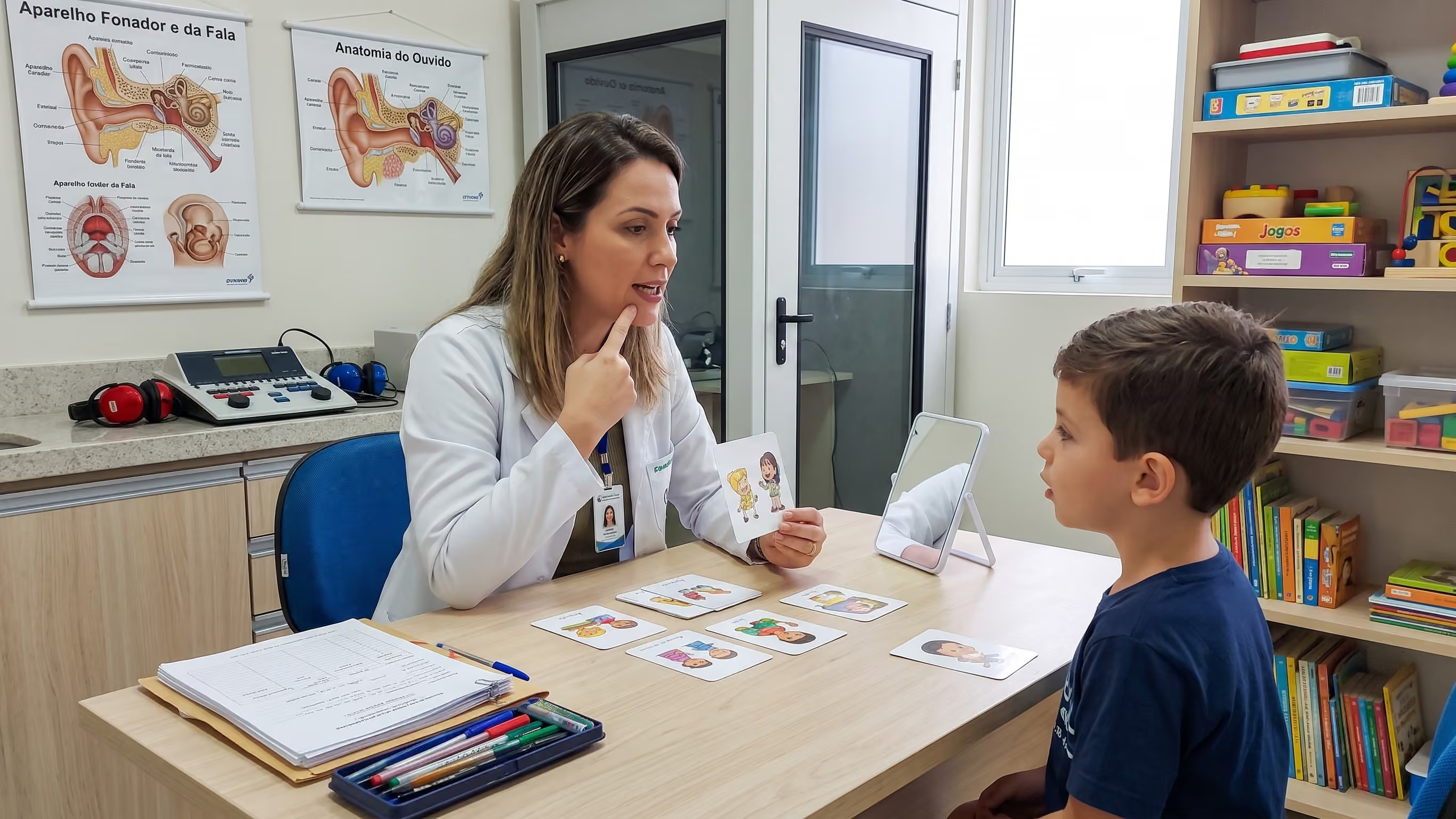
You will build a thorough understanding of AAC systems, from unaided strategies and low-tech boards to high-tech speech-generating devices and emerging eye-gaze technology. You will learn how to conduct person-centred assessments, apply feature-matching methodology, and write evaluation reports that drive funding and intervention decisions. The course covers evidence-based intervention strategies, prompting hierarchies, and naturalistic teaching approaches for all age groups. You will also develop skills in partner training, interprofessional collaboration, and culturally responsive practice. By the end, you will be equipped to lead AAC services with confidence and clinical precision.
How you study in practice Augmentative and Alternative Communication Course
How you practise Augmentative and Alternative Communication Course
For businesses looking to train their team
With Dedika for businesses, the course includes exercises and examples tailored to your own business and the way your company needs.

Course content
8 Chapters • 39 LessonsDuration between 4 and 360 hours (you decide)
Chapter 1HideHide detailsSee detailsFoundations of AAC: Core Concepts
Foundations of AAC: Core Concepts
Lesson 1 • Populations Who Use AAC
Profiles diagnostic groups commonly served by AAC, including developmental and acquired conditions. Builds awareness of diverse user needs across the lifespan.
Lesson 2 • Defining AAC and Its Scope
Introduces the definition, purpose, and boundaries of AAC as a field. Grounds all subsequent learning in shared terminology and conceptual clarity.
Lesson 3 • Communication Models and Frameworks
Presents theoretical models guiding AAC practice, including participation and social models. Provides the conceptual lens used throughout the course.
Lesson 4 • Barriers and Facilitators to AAC Use
Examines opportunity and access barriers that limit AAC adoption. Prepares students to identify and address real-world implementation obstacles.
Chapter 2HideHide detailsSee detailsAAC System Types and Components
AAC System Types and Components
Lesson 1 • Low-Tech and Mid-Tech AAC
Examines picture boards, communication books, and simple voice-output devices. Demonstrates cost-effective options suitable for many users.
Lesson 2 • Symbol Systems and Representation
Reviews major symbol sets and the continuum from concrete to abstract representation. Guides symbol selection based on user cognitive and visual abilities.
Lesson 3 • Vocabulary Selection and Organisation
Teaches core and fringe vocabulary concepts and layout design principles. Directly informs how practitioners populate and organise AAC systems.
Lesson 4 • Unaided AAC Systems
Covers manual signs, gestures, and body-based communication strategies. Establishes the no-technology end of the AAC continuum.
Lesson 5 • High-Tech Speech-Generating Devices
Surveys dedicated SGDs and tablet-based AAC applications with robust vocabulary. Connects device features to functional communication outcomes.
Chapter 3HideHide detailsSee detailsAAC Assessment: Process and Tools
AAC Assessment: Process and Tools
Lesson 1 • Feature Matching and Trials
Applies feature-matching methodology to narrow system options and conduct trials. Bridges assessment data to evidence-based system recommendations.
Lesson 2 • Assessment Principles and Team Roles
Establishes collaborative, person-centred assessment philosophy and team composition. Sets the ethical and procedural foundation for all evaluation activities.
Lesson 3 • Gathering Background Information
Covers case history, records review, and structured interviews with stakeholders. Ensures evaluators enter direct assessment with sufficient contextual knowledge.
Lesson 4 • Assessing Communication Skills
Guides evaluation of receptive language, expressive communication, and literacy skills. Provides the skill baseline needed to match users to appropriate AAC systems.
Lesson 5 • Motor and Access Assessment
Evaluates physical access abilities including motor control, vision, and positioning. Determines the access method that enables the most efficient AAC use.
Chapter 4HideHide detailsSee detailsAccess Methods and Positioning
Access Methods and Positioning
Lesson 1 • Seating, Positioning, and Mounting
Addresses optimal body positioning and device mounting to maximise access efficiency. Integrates occupational therapy principles into AAC access planning.
Lesson 2 • Direct Selection Techniques
Covers finger, hand, and head-pointer direct selection methods and their prerequisites. Establishes the most common access pathway before introducing alternatives.
Lesson 3 • Eye Gaze Technology
Examines dedicated eye-tracking hardware and software for AAC access. Addresses calibration, environmental factors, and fatigue management.
Lesson 4 • Keyguards and Display Modifications
Reviews physical and digital display modifications that improve selection accuracy. Supports users with tremor, spasticity, or reduced motor precision.
Lesson 5 • Scanning Access Methods
Teaches automatic, step, and directed scanning patterns and their configuration. Prepares students to implement scanning for users with severe motor limitations.
Chapter 5HideHide detailsSee detailsLanguage Development and AAC
Language Development and AAC
Lesson 1 • Core Vocabulary in Language Development
Demonstrates how core vocabulary supports early and expanding language use. Guides practitioners in prioritising vocabulary that maximises communicative power.
Lesson 2 • Language Acquisition Principles
Reviews typical language development stages and their relevance to AAC users. Anchors intervention design in evidence-based developmental theory.
Lesson 3 • Language Sample Analysis for AAC
Applies language sample analysis methods to AAC-mediated communication. Enables data-driven decisions about vocabulary expansion and system updates.
Lesson 4 • Aided Language Stimulation
Teaches the aided language stimulation technique for modelling AAC use during interaction. Provides the primary instructional strategy for language input in AAC contexts.
Lesson 5 • Literacy and AAC Integration
Explores the relationship between emergent literacy and AAC system design. Prepares students to support reading and writing alongside AAC use.
Chapter 6HideHide detailsSee detailsAAC Intervention Strategies and Techniques
AAC Intervention Strategies and Techniques
Lesson 1 • Prompting Hierarchies for AAC
Teaches least-to-most and most-to-least prompting systems applied to AAC use. Ensures systematic fading of support to build independent communication.
Lesson 2 • Goal Writing and Progress Monitoring
Guides writing measurable AAC goals and selecting data collection methods. Connects intervention planning to accountability and outcome documentation.
Lesson 3 • Social Communication and Pragmatics
Addresses turn-taking, topic initiation, repair, and conversational management via AAC. Extends intervention beyond vocabulary to functional social communication.
Lesson 4 • Script Training and Routine-Based Intervention
Uses scripted routines to build predictable communication opportunities. Supports generalisation by embedding AAC practice in daily activities.
Lesson 5 • Naturalistic Teaching Approaches
Covers milieu teaching, incidental teaching, and embedded instruction in natural contexts. Prioritises communication in authentic environments over isolated drill.
Chapter 7HideHide detailsSee detailsPartner Training and Team Collaboration
Partner Training and Team Collaboration
Lesson 1 • Family-Centred Practice
Applies family-centred principles to AAC planning, goal setting, and carryover. Ensures intervention is embedded in family routines and priorities.
Lesson 2 • Communication Partner Roles
Defines the critical role of partners in enabling or limiting AAC success. Motivates the need for systematic partner training as a core intervention component.
Lesson 3 • Interprofessional Team Collaboration
Addresses roles, communication, and conflict resolution within AAC teams. Builds skills for effective collaboration across disciplines and settings.
Lesson 4 • Designing Partner Training Programmes
Covers adult learning principles and structured training programme design for partners. Prepares students to create effective, context-specific training curricula.
Lesson 5 • School-Based AAC Collaboration
Focuses on IEP processes, classroom integration, and educator training for AAC. Prepares students for the most common AAC service delivery context.
Chapter 8HideHide detailsSee detailsAdvanced AAC Practice and Outcomes
Advanced AAC Practice and Outcomes
Lesson 1 • Professional Development and Leadership
Guides ongoing professional growth, mentorship, and leadership in the AAC field. Positions graduates as contributors to the broader AAC professional community.
Lesson 2 • Outcome Measurement in AAC
Reviews standardised and functional outcome tools used to evaluate AAC effectiveness. Enables evidence-based reporting of communication gains to stakeholders.
Lesson 3 • Evidence-Based Practice in AAC
Teaches how to locate, evaluate, and apply AAC research to clinical decisions. Builds the habit of integrating evidence with clinical expertise and user values.
Lesson 4 • Funding and Advocacy for AAC
Covers funding pathways, documentation requirements, and advocacy strategies for AAC access. Prepares students to navigate funding systems on behalf of users.
Lesson 5 • Complex Communication Needs Cases
Applies clinical reasoning to complex, multi-factor AAC cases through case analysis. Develops advanced problem-solving for users with layered challenges.
Your valid completion certificate
This course is for you:
Speech and language therapist: seeking structured clinical depth in AAC practice.
Special education teacher: supporting students who rely on communication devices daily.
Occupational therapist: expanding scope to include AAC access and positioning.
Early intervention specialist: introducing AAC strategies to very young children.
Graduate student in communication sciences: building AAC competency before entering the field.
Rehabilitation professional: serving adults with acquired conditions affecting communication.
What our students say
Your lessons are perfect. I purchased the one-year package and finally have the opportunity to follow various topics of interest without needing to change platforms... I'm grateful for everything you do, I've already recommended you to other people...

I like how the lessons are straight to the point and how I can change chapters and skip content I don't need.

I like the content and the way videos are presented and transcribed, which speeds up the process!

The platform is fast and simple to use. The diversity of content and complementary videos really help with learning.

Top upskilling courses





FAQ
Who is Dedika?
Is the certificate valid in Australia?
Are the courses free?
What is the course workload?
What are the courses like?
How do the courses work?
What is the duration of the courses?
What is the cost or price of the courses?
What is an EAD or online course and how does it work?
PDF Course