
Psychometrist Training Course
Launch your career as a psychometrist with the comprehensive training you need to administer, score, and report psychological assessments confidently. This course covers everything from foundational psychometric theory to hands-on administration of cognitive, neuropsychological, and behavioral instruments. You will graduate ready to work alongside licensed psychologists in clinical, educational, and research settings.
What you will learn:
This course provides a solid grounding in psychometric theory, professional ethics, and standardized test administration across cognitive, neuropsychological, behavioral, and academic domains. You will learn to prepare testing environments, build rapport with examinees, and follow protocols with the precision required for valid scores. You will also develop scoring and data‑entry skills to produce accurate protocols and organized summaries for supervising psychologists. The curriculum covers cultural competence, special‑population accommodations, and digital assessment tools so you are ready for diverse testing situations. By the end, you will be able to clearly communicate assessment findings to families, educators, and interdisciplinary teams.
How you study in practice Psychometrist Training Course
How you practise Psychometrist Training Course
For companies looking to train their team
With Dedika for Business, the course includes exercises and examples tailored to your own business and the way your company needs.

Course Content
8 Chapters • 36 LessonsDuration between 4 and 360 hours (you decide)
Chapter 1HideHide detailsSee detailsIntroduction to Psychometrics and Testing
Introduction to Psychometrics and Testing
Lesson 1 • Overview of Assessment Domains
Surveys cognitive, neuropsychological, academic, and behavioral assessment domains. Students gain a map of the testing landscape before studying specific instruments.
Lesson 2 • Core Measurement Concepts
Introduces reliability, validity, standardization, and norms as foundational constructs. These concepts underpin every subsequent chapter in the course.
Lesson 3 • The Psychometrist's Professional Role
Defines the psychometrist's scope of practice, responsibilities, and boundaries. Clarifies how the role differs from that of a psychologist or other clinicians.
Lesson 4 • History and Purpose of Psychometrics
Traces psychometrics from early mental measurement to modern practice. Provides context for why standardized testing exists and how it guides clinical decisions.
Chapter 2HideHide detailsSee detailsProfessional Ethics and Legal Foundations
Professional Ethics and Legal Foundations
Lesson 1 • Ethical Principles in Assessment
Covers beneficence, nonmaleficence, autonomy, and justice as applied to testing. Students connect abstract principles to concrete assessment scenarios.
Lesson 2 • Informed Consent and Confidentiality
Explains procedures for obtaining valid consent and protecting examinee privacy. Addresses special considerations for minors and individuals with diminished capacity.
Lesson 3 • Regulatory and Credentialing Requirements
Reviews credentialing bodies, certification standards, and continuing education obligations. Students understand the regulatory landscape governing psychometrist practice.
Lesson 4 • Ethical Decision-Making Frameworks
Provides structured models for resolving ethical conflicts encountered during assessment. Students practice applying frameworks to case-based scenarios.
Chapter 3HideHide detailsSee detailsPsychometric Theory and Score Interpretation
Psychometric Theory and Score Interpretation
Lesson 1 • Norm-Referenced Score Interpretation
Teaches conversion of raw scores to standard scores, percentiles, and age equivalents. Students learn to compare individual performance to normative reference groups.
Lesson 2 • Classical Test Theory Fundamentals
Explains the true score model, observed scores, and error variance. Provides the theoretical basis for understanding reliability and measurement precision.
Lesson 3 • Confidence Intervals and Score Ranges
Demonstrates how to calculate and communicate confidence intervals around obtained scores. Reduces overinterpretation of point estimates in clinical reporting.
Lesson 4 • Introduction to Item Response Theory
Provides a conceptual overview of IRT models and their advantages over classical approaches. Prepares students to understand modern adaptive testing platforms.
Lesson 5 • Item Analysis and Test Quality
Introduces item difficulty, discrimination, and distractor analysis as quality indicators. Students evaluate whether test items function as intended across populations.
Chapter 4HideHide detailsSee detailsStandardized Test Administration Procedures
Standardized Test Administration Procedures
Lesson 1 • Preparing the Testing Environment
Specifies physical, sensory, and interpersonal conditions required for valid testing. Students learn to identify and eliminate environmental threats to standardization.
Lesson 2 • Following Standardized Protocols
Covers verbatim instruction delivery, timing, querying, and prompting rules. Deviations from protocol compromise standardization and score validity.
Lesson 3 • Establishing Rapport with Examinees
Teaches techniques for building trust and reducing test anxiety before and during assessment. Rapport directly affects examinee motivation and score validity.
Lesson 4 • Managing Challenging Administration Situations
Prepares students to handle refusals, fatigue, emotional distress, and behavioral disruptions. Provides decision rules for pausing, resuming, or discontinuing testing.
Chapter 5HideHide detailsSee detailsCognitive and Intellectual Assessment
Cognitive and Intellectual Assessment
Lesson 1 • Administering Nonverbal and Spatial Subtests
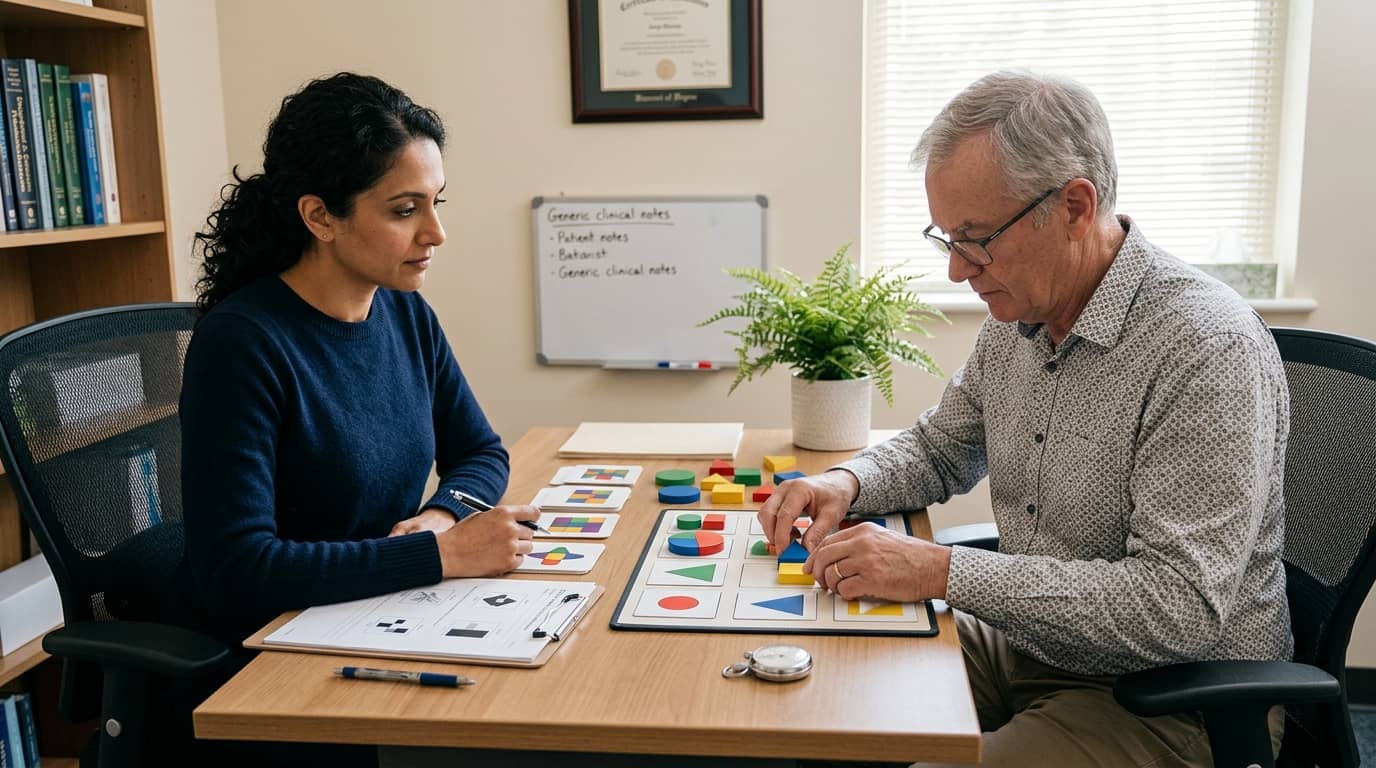
Teaches administration of block design, matrix reasoning, and visual puzzles subtests. Timing precision and material handling are critical skills in this section.
Lesson 2 • Scoring and Deriving Composite Scores
Guides students through raw-to-scaled score conversion and composite score derivation. Emphasizes accuracy checks and common scoring errors to avoid.
Lesson 3 • Administering Verbal Comprehension Subtests
Covers administration and scoring of vocabulary, similarities, and comprehension subtests. Accurate scoring of open-ended verbal responses is emphasized.
Lesson 4 • Working Memory and Processing Speed Subtests
Addresses digit span, coding, symbol search, and related subtests requiring precise timing. Students practice maintaining standardization under time pressure.
Lesson 5 • Structure of Cognitive Assessment Batteries
Explains the theoretical models underlying major intelligence batteries and their subtest organization. Students understand what each index measures before administering it.
Chapter 6HideHide detailsSee detailsNeuropsychological and Specialized Assessment
Neuropsychological and Specialized Assessment
Lesson 1 • Executive Function Assessment
Addresses sorting tasks, verbal fluency, and planning measures that assess frontal lobe functions. Students apply specific timing and discontinuation rules unique to each task.
Lesson 2 • Sensorimotor and Adaptive Behavior Measures
Introduces grip strength, finger tapping, and adaptive behavior rating scale administration. Students learn to collect third-party ratings and integrate them with direct testing.
Lesson 3 • Language and Academic Achievement Batteries
Covers administration of reading, writing, math, and oral language subtests within achievement batteries. Students distinguish between timed and untimed subtest requirements.
Lesson 4 • Attention and Processing Speed Measures
Teaches administration of continuous performance tests, trail making, and reaction time tasks. Accurate timing and error recording are essential for valid scores.
Lesson 5 • Memory Assessment Instruments
Covers administration of verbal and visual memory batteries including immediate and delayed recall. Students learn trial-by-trial recording and recognition trial procedures.
Chapter 7HideHide detailsSee detailsBehavioral, Emotional, and Adaptive Assessment
Behavioral, Emotional, and Adaptive Assessment
Lesson 1 • Validity Scales and Response Style Detection
Teaches interpretation of validity indicators embedded in rating scales and inventories. Students identify overreporting, underreporting, and inconsistent response patterns.
Lesson 2 • Behavioral Rating Scale Administration
Explains how to select, distribute, and collect behavioral rating scales from parents, teachers, and caregivers. Multi-informant consistency is a key validity consideration.
Lesson 3 • Self-Report Inventory Administration
Covers administration of personality and emotional functioning inventories to adolescents and adults. Reading level screening and response monitoring are emphasized.
Lesson 4 • Adaptive Behavior Assessment Procedures
Addresses structured interview and rating scale methods for measuring daily living skills. Students learn to select informants and document adaptive behavior findings.
Chapter 8HideHide detailsSee detailsScoring, Reporting, and Feedback Delivery
Scoring, Reporting, and Feedback Delivery
Lesson 1 • Communicating Results to Stakeholders
Prepares students to explain assessment findings in plain language to examinees, families, and educators. Emphasizes accuracy, empathy, and appropriate scope of communication.
Lesson 2 • Preparing Score Summaries for Supervisors
Guides students in organizing score tables, index profiles, and behavioral notes for supervising psychologists. Clear summaries accelerate the interpretive report-writing process.
Lesson 3 • Writing Behavioral Observations
Teaches objective, behaviorally specific documentation of examinee conduct during testing. Observations contextualize scores and inform validity judgments.
Lesson 4 • Accurate Protocol Scoring and Review
Establishes systematic procedures for scoring completed protocols and conducting accuracy checks. Scoring errors at this stage propagate into all subsequent interpretation.
Lesson 5 • Data Entry and Score Compilation
Covers entry of scores into scoring software, spreadsheets, and electronic health records. Students learn data verification procedures to prevent transcription errors.
Your valid completion certificate
This course is for you:
Psychology graduates: seeking a specialized clinical role beyond general counseling.
Mental health technicians: looking to expand their scope into formal assessment work.
Special education paraprofessionals: wanting to deepen their understanding of student testing.
Career changers: transitioning from healthcare or social services into psychological assessment.
Graduate students: building practical testing skills to complement their academic training.
Rehabilitation specialists: aiming to add psychometric competencies to their clinical toolkit.
What our students say
Your classes are perfect. I purchased the one-year package and finally have the opportunity to follow various topics of interest without needing to switch platforms... I thank you for everything you do, I've already recommended you to other people...

I like how the lessons are straight to the point and how I can change chapters and skip content I don't need.

I like the content and the presentation style and video transcription, which speeds up the process!

The platform is fast, simple to use. The diversity of content and complementary videos really help with learning.

Top training programs



















FAQ
Who is Dedika?
Is the certificate valid in Canada?
Are the courses free?
What is the course workload?
What are the courses like?
How do the courses work?
What is the duration of the courses?
What is the cost or price of the courses?
What is an EAD or online course and how does it work?
PDF Course