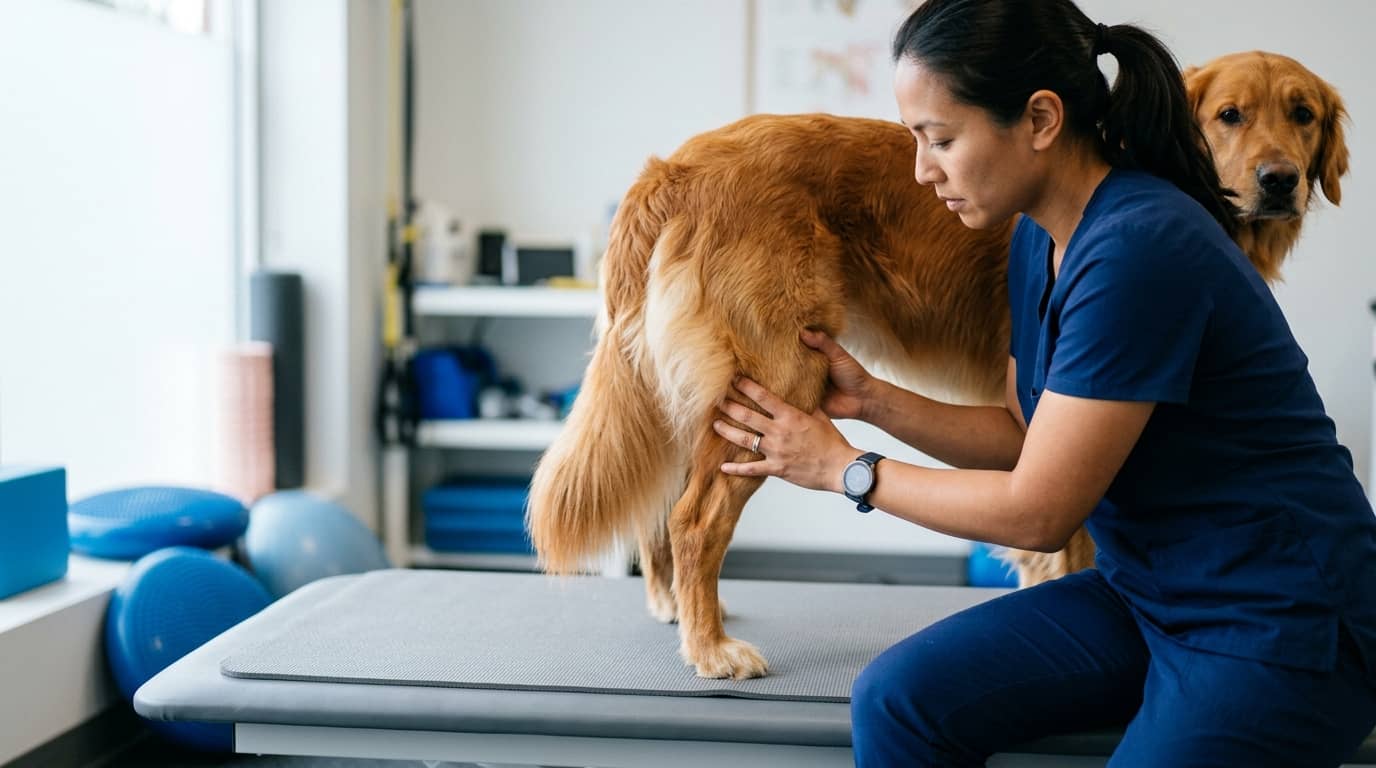
Canine Physiotherapy Course
The Canine Physiotherapy Course gives you the clinical knowledge and hands-on techniques to assess, treat, and rehabilitate dogs with musculoskeletal, neurological, and post-surgical conditions. From anatomy and pathology to therapeutic exercise and professional practice, every module is built around real-world application. Whether you're entering the field or expanding your veterinary career, this course delivers the skills that matter.
What you will learn:
You will develop a thorough understanding of canine anatomy, biomechanics, and physiology as the foundation for all clinical work. You will learn to assess pain, gait, posture, and joint function using validated tools and systematic examination methods. The course covers therapeutic modalities including laser therapy, ultrasound, electrical stimulation, and hydrotherapy, along with manual therapy and targeted exercise prescription. You will also study common orthopedic and neurological conditions, post-surgical rehabilitation protocols, and chronic pain management strategies. Professional topics including documentation, ethics, interprofessional collaboration, and evidence-based practice are fully integrated throughout.
How you study in practice Canine Physiotherapy Course
How you practise Canine Physiotherapy Course
For companies looking to train their team
With Dedika for Business, the course includes exercises and examples tailored to your own business and the way your company needs.

Course Content
8 Chapters • 40 LessonsDuration between 4 and 360 hours (you decide)
Chapter 1HideHide detailsSee detailsFoundations of Canine Anatomy and Physiology
Foundations of Canine Anatomy and Physiology
Lesson 1 • Neurological and Vascular Anatomy
Introduces the peripheral nervous system, spinal cord pathways, and circulatory supply to muscles. Establishes the basis for understanding neurological deficits and tissue healing.
Lesson 2 • Muscular System and Soft Tissue
Examines muscle fiber types, major muscle groups, tendons, and ligaments. Connects tissue properties to injury risk and rehabilitation planning.
Lesson 3 • Skeletal System and Bone Structure
Covers bone classification, joint types, and spinal column organization in dogs. Provides the structural map that underpins every manual and exercise-based intervention.
Lesson 4 • Biomechanics of Canine Movement
Analyzes gait cycles, force transmission, and joint loading during locomotion. Grounds students in movement science needed for gait analysis and exercise prescription.
Lesson 5 • Physiological Responses to Exercise
Describes cardiovascular, respiratory, and metabolic adaptations to physical activity. Prepares students to design safe, progressive rehabilitation programs.
Chapter 2HideHide detailsSee detailsPathology and Common Canine Conditions
Pathology and Common Canine Conditions
Lesson 1 • Aging, Obesity, and Systemic Influences
Explores how age-related degeneration, excess body weight, and systemic disease modify rehabilitation needs. Teaches risk stratification for complex patients.
Lesson 2 • Post-Surgical Rehabilitation Contexts
Reviews common orthopedic and neurological surgeries and their tissue consequences. Prepares students to collaborate with veterinary surgeons on recovery protocols.
Lesson 3 • Orthopedic Conditions and Joint Disease
Covers osteoarthritis, hip and elbow dysplasia, and osteochondrosis. Links disease progression to functional deficits that physiotherapy targets.
Lesson 4 • Neurological Conditions Affecting Mobility
Addresses intervertebral disc disease, degenerative myelopathy, and peripheral neuropathies. Connects neurological deficits to physiotherapy goals and precautions.
Lesson 5 • Soft Tissue Injuries and Disorders
Examines ligament ruptures, muscle strains, tendinopathies, and myofascial pain. Establishes tissue-specific healing timelines that govern treatment progression.
Chapter 3HideHide detailsSee detailsPatient Assessment and Clinical Reasoning
Patient Assessment and Clinical Reasoning
Lesson 1 • Outcome Measures and Goal Setting
Introduces validated canine-specific outcome tools and SMART goal frameworks. Ensures treatment plans are measurable and aligned with owner expectations.
Lesson 2 • History Taking and Case Intake
Structures the clinical interview to gather signalment, medical history, and owner concerns. Establishes the information baseline that directs all subsequent assessment steps.
Lesson 3 • Gait Analysis and Locomotion Scoring
Applies validated lameness and gait scoring systems during walk and trot evaluation. Provides objective locomotion data to track treatment progress.
Lesson 4 • Observational and Postural Assessment
Teaches static posture analysis, weight-bearing symmetry, and muscle mass comparison. Develops the visual skills that precede hands-on examination.
Lesson 5 • Palpation and Manual Examination
Develops palpation skills for joint effusion, muscle tension, pain localization, and range of motion. Integrates findings with observational data to confirm clinical hypotheses.
Chapter 4HideHide detailsSee detailsPain Assessment and Management Strategies
Pain Assessment and Management Strategies
Lesson 1 • Canine Pain Science Fundamentals
Explains nociception, central sensitization, and chronic pain mechanisms in dogs. Provides the neurobiological foundation for selecting pain-targeted interventions.
Lesson 2 • Physiotherapy Interventions for Pain Relief
Applies modalities, manual therapy, and exercise as evidence-based pain management tools. Teaches selection logic based on pain type, duration, and patient tolerance.
Lesson 3 • Behavioral Pain Assessment Tools
Trains use of validated observational pain scales and owner-reported questionnaires. Enables objective pain monitoring across treatment sessions.
Lesson 4 • Chronic Pain Rehabilitation Planning
Designs long-term management plans for dogs with persistent pain conditions. Integrates owner education, home exercise, and regular reassessment into sustainable care models.
Lesson 5 • Pharmacological Collaboration and Awareness
Outlines common analgesic drug classes and their interaction with physiotherapy outcomes. Prepares students to communicate effectively with veterinarians about pain management.
Chapter 5HideHide detailsSee detailsTherapeutic Modalities and Electrophysical Agents
Therapeutic Modalities and Electrophysical Agents
Lesson 1 • Thermal Agents: Heat and Cold Therapy
Covers physiological effects, indications, and contraindications of superficial heat and cryotherapy. Teaches correct application duration and tissue depth considerations.
Lesson 2 • Therapeutic Ultrasound
Explains thermal and non-thermal ultrasound effects on soft tissue healing and pain. Trains students in parameter selection, coupling, and treatment area calculation.
Lesson 3 • Shockwave and Emerging Modalities
Introduces extracorporeal shockwave therapy and other emerging physical agents. Evaluates current evidence and appropriate patient selection criteria.
Lesson 4 • Electrical Stimulation Modalities
Addresses TENS, NMES, and interferential therapy for pain relief and muscle re-education. Connects waveform selection to specific clinical goals.
Lesson 5 • Photobiomodulation and Laser Therapy
Reviews low-level laser and LED therapy mechanisms, dosimetry, and tissue penetration. Guides safe protocol design for wound healing and musculoskeletal pain.
Chapter 6HideHide detailsSee detailsManual Therapy Techniques
Manual Therapy Techniques
Lesson 1 • Principles of Manual Therapy
Establishes the neurophysiological and biomechanical rationale for manual therapy in dogs. Frames graded dosing, patient positioning, and safety considerations.
Lesson 2 • Joint Mobilization Techniques
Teaches oscillatory and sustained joint mobilization for the spine and peripheral joints. Develops skill in selecting grade and direction based on assessment findings.
Lesson 3 • Soft Tissue Mobilization Methods
Covers effleurage, petrissage, myofascial release, and trigger point therapy. Connects each technique to specific tissue targets identified during assessment.
Lesson 4 • Passive Range of Motion and Stretching
Instructs passive joint movement, static stretching, and proprioceptive neuromuscular facilitation for dogs. Teaches dosing parameters to restore flexibility without tissue damage.
Lesson 5 • Neurodynamic and Spinal Techniques
Introduces neural tissue mobilization and spinal manipulation concepts adapted for canine patients. Addresses indications, contraindications, and evidence for spinal techniques.
Chapter 7HideHide detailsSee detailsTherapeutic Exercise and Rehabilitation Programs
Therapeutic Exercise and Rehabilitation Programs
Lesson 1 • Range of Motion and Flexibility Exercises
Teaches active-assisted and active range of motion exercises for joint mobility restoration. Bridges passive techniques from manual therapy into active patient participation.
Lesson 2 • Hydrotherapy and Aquatic Rehabilitation
Explains buoyancy, hydrostatic pressure, and resistance properties of water in canine rehab. Trains students in underwater treadmill and pool swimming protocols.
Lesson 3 • Functional and Sport-Specific Training
Advances rehabilitation toward real-world tasks, agility, and working dog performance demands. Prepares students to bridge clinical recovery with return-to-activity milestones.
Lesson 4 • Principles of Exercise Prescription
Applies FITT principles, tissue healing timelines, and load management to canine exercise design. Establishes the framework for safe, progressive rehabilitation programming.
Lesson 5 • Strengthening and Neuromuscular Training
Covers resistance exercises, proprioceptive challenges, and coordination drills for muscle rebuilding. Targets specific muscle groups identified as weak or atrophied during assessment.
Chapter 8HideHide detailsSee detailsProfessional Practice and Clinical Integration
Professional Practice and Clinical Integration
Lesson 1 • Interprofessional Collaboration
Defines the physiotherapist's role within the veterinary healthcare team. Trains effective referral communication, case conferencing, and scope of practice boundaries.
Lesson 2 • Ethics, Consent, and Animal Welfare
Applies ethical principles, informed consent processes, and animal welfare standards to clinical practice. Prepares students to navigate ethical dilemmas with professional integrity.
Lesson 3 • Evidence-Based Practice in Canine Physiotherapy
Teaches critical appraisal of research literature and integration of evidence into clinical decisions. Builds the habit of reflective, research-informed practice.
Lesson 4 • Case-Based Clinical Integration
Applies all course competencies to complex, multi-condition canine case studies. Consolidates clinical reasoning, treatment planning, and professional communication skills.
Lesson 5 • Treatment Planning and Documentation
Structures problem-oriented treatment plans, session notes, and progress reports. Establishes documentation standards that support continuity of care and professional accountability.
Your valid completion certificate
This course is for you:
Veterinary nurses ready to specialize in canine rehabilitation and recovery.
Dog trainers wanting clinical depth behind movement and injury prevention.
Human physiotherapists transitioning their expertise into animal health care.
Animal care workers seeking a structured path into therapeutic practice.
Career changers drawn to working hands-on with dogs in a health setting.
Kennel and shelter staff aiming to better support dogs with mobility challenges.
What our students say
Your classes are perfect. I purchased the one-year package and finally have the opportunity to follow various topics of interest without needing to switch platforms... I thank you for everything you do, I've already recommended you to other people...

I like how the lessons are straight to the point and how I can change chapters and skip content I don't need.

I like the content and the presentation style and video transcription, which speeds up the process!

The platform is fast, simple to use. The diversity of content and complementary videos really help with learning.

Top training programs


FAQ
Who is Dedika?
Is the certificate valid in Canada?
Are the courses free?
What is the course workload?
What are the courses like?
How do the courses work?
What is the duration of the courses?
What is the cost or price of the courses?
What is an EAD or online course and how does it work?
PDF Course