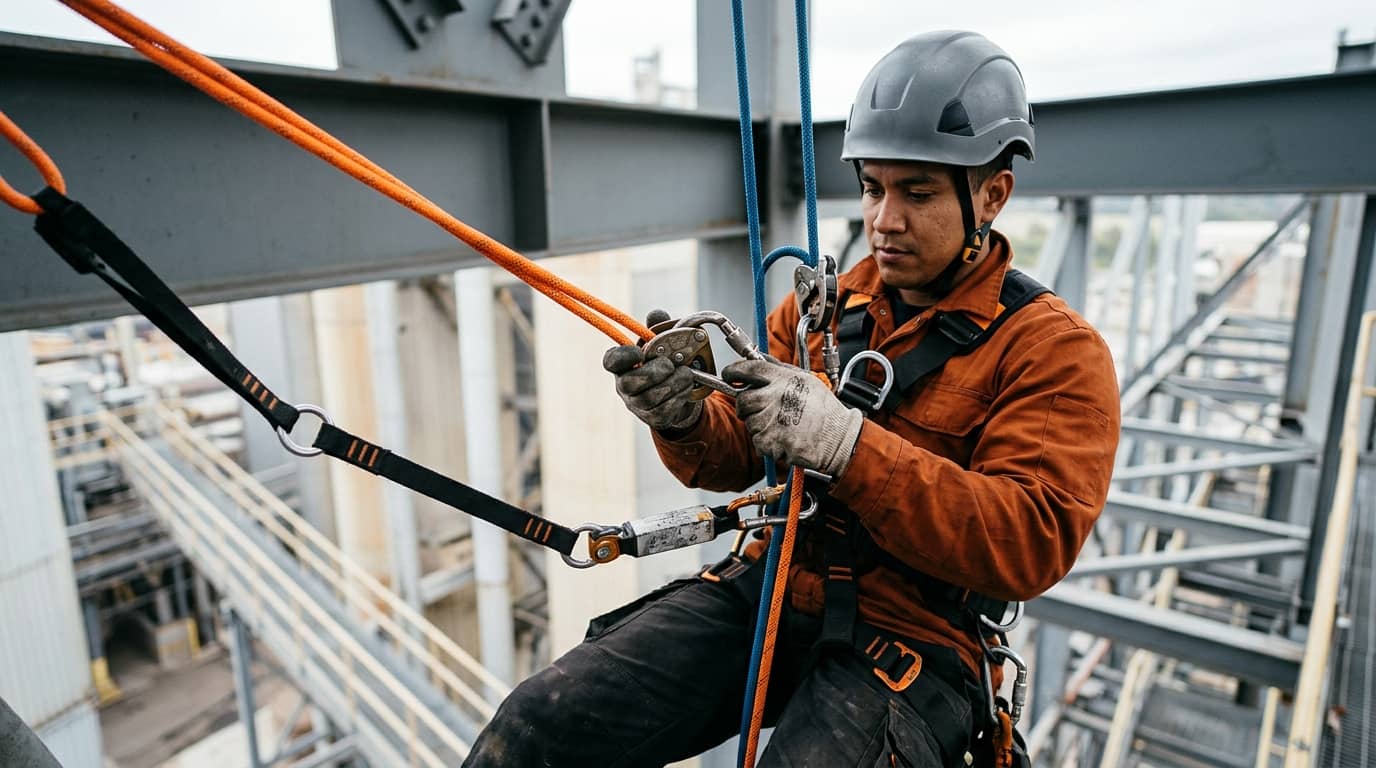
Rope Access Technician Course
Master the technical skills, safety protocols, and rescue techniques required to work confidently at height using rope access systems. This training covers everything from rigging and equipment inspection to descent, ascent, and emergency rescue. Whether you're entering the trade or advancing toward supervision, this course builds the real-world competency employers demand.
What you will learn:
Apply physics principles to select equipment and manage load in rope systems.
Rig independent working and safety lines using industry-standard anchor techniques.
Inspect, log, and retire rope access hardware according to regulatory standards.
Execute controlled descents and ascents on vertical, overhanging, and complex terrain.
Perform assisted and self-rescue operations, including 3:1 and 6:1 haul systems.
Write compliant risk assessments and method statements for live rope access tasks.
How you study in practice Rope Access Technician Course
How you practise Rope Access Technician Course
For companies looking to train their team
With Dedika for Business, the course includes exercises and examples tailored to your own business and the way your company needs.

Course Content
8 Chapters • 36 LessonsDuration between 4 and 360 hours (you decide)
Chapter 1HideHide detailsSee detailsFoundations of Rope Access Work
Foundations of Rope Access Work
Lesson 1 • Physics of Rope and Load
Introduces force, friction, and mechanical advantage as applied to rope systems. Provides the quantitative basis for all equipment selection decisions.
Lesson 2 • Safety Culture and Risk Mindset
Builds a proactive safety culture through hazard recognition and near-miss reporting. Establishes behavioral norms that underpin every subsequent chapter.
Lesson 3 • Personal Protective Equipment Basics
Identifies mandatory PPE categories for rope access and explains correct donning and inspection. Prepares students for hands-on equipment use in later chapters.
Lesson 4 • Industry Overview and Regulatory Framework
Covers the history, scope, and governing bodies of rope access work. Connects regulatory expectations to daily on-site decision-making.
Chapter 2HideHide detailsSee detailsEquipment Identification and Inspection
Equipment Identification and Inspection
Lesson 1 • Pre-Use Inspection and Equipment Logs
Establishes a systematic pre-use inspection routine and documentation practice. Consistent logging supports traceability and regulatory compliance.
Lesson 2 • Harness Types and Fit
Explains full-body harness design, attachment points, and correct sizing. Proper fit is prerequisite to safe suspension and rescue operations.
Lesson 3 • Connectors, Carabiners, and Maillon Rapides
Covers gate types, locking mechanisms, and load-axis requirements for connectors. Ensures correct orientation and loading in all rigging configurations.
Lesson 4 • Ropes: Types, Construction, and Ratings
Distinguishes dynamic, semi-static, and static ropes by construction and rated performance. Directly informs rope selection for working and safety lines.
Lesson 5 • Descenders, Ascenders, and Positioning Devices
Identifies the function and limitations of friction devices, rope grabs, and work-positioning lanyards. Bridges equipment knowledge to technique chapters.
Chapter 3HideHide detailsSee detailsKnots, Hitches, and Terminations
Knots, Hitches, and Terminations
Lesson 1 • Hitches for Friction and Backup
Introduces friction hitches used as progress-capture and backup devices on rope systems. Students apply hitches correctly to both working and safety lines.
Lesson 2 • Essential Working Knots
Covers figure-eight family, bowline, and overhand knots used for anchor attachment and rope termination. Each knot is practiced to a timed competency standard.
Lesson 3 • Knot Theory and Strength Reduction
Explains how knots reduce rope strength and introduces efficiency ratings. Provides the rationale for choosing specific knots in rated systems.
Lesson 4 • Mechanical Terminations and Splices
Covers swaged fittings, rope-to-anchor plates, and eye splices for permanent terminations. Complements knot skills with hardware-based solutions.
Chapter 4HideHide detailsSee detailsAnchor Systems and Rigging
Anchor Systems and Rigging
Lesson 1 • Anchor Point Assessment
Develops criteria for evaluating structural anchor points on buildings, towers, and natural features. Correct assessment prevents catastrophic anchor failure.
Lesson 2 • Principles of Anchor System Design
Applies EARNEST and similar frameworks to build redundant, equalized anchor systems. Students calculate resultant forces at anchor legs for varying angles.
Lesson 3 • Rigging on Structures and Edges
Addresses edge friction, rope damage, and load transfer when rigging over building edges and structural members. Practical scenarios reinforce edge management skills.
Lesson 4 • Rigging Documentation and Handover
Establishes a formal rigging check and handover process between technicians. Documentation ensures accountability and supports incident investigation.
Lesson 5 • Rigging for Working and Safety Lines
Covers independent rigging of working and safety lines from separate anchor systems. Reinforces the two-rope principle central to rope access standards.
Chapter 5HideHide detailsSee detailsRope Access Descent Techniques
Rope Access Descent Techniques
Lesson 1 • Passing Knots and Intermediate Anchors
Teaches the sequence for passing a knot or re-anchor point while maintaining continuous protection. A critical skill for multi-pitch and long descents.
Lesson 2 • Descender Setup and Control
Covers loading, locking, and controlling assisted-braking and manual descenders. Correct setup is the prerequisite for all descent operations.
Lesson 3 • Safety Line Management During Descent
Explains how to manage the safety line device during descent to maintain continuous fall protection. Integrates safety line use with working line control.
Lesson 4 • Descending on Varied Terrain
Applies descent skills to overhangs, re-entrants, and sloped surfaces. Students adapt body position and device settings to each terrain type.
Chapter 6HideHide detailsSee detailsRope Access Ascent Techniques
Rope Access Ascent Techniques
Lesson 1 • Ascender Mechanics and Setup
Explains cam action, load limits, and correct attachment of chest and hand ascenders. Proper setup prevents cam failure and rope damage.
Lesson 2 • Changeover: Ascent to Descent
Teaches the controlled transition from ascent to descent configuration while maintaining continuous protection. Changeover errors are a leading cause of incidents.
Lesson 3 • Basic Ascent Sequence
Introduces the sit-stand ascent cycle and footloop management for efficient upward progress. Students practice until movement is fluid and fatigue is minimized.
Lesson 4 • Safety Line Management During Ascent
Covers continuous safety line protection during ascent, including device positioning and slack management. Mirrors descent safety line discipline.
Lesson 5 • Ascending Difficult Configurations
Applies ascent skills to overhangs, deviations, and ropes with intermediate anchors. Builds problem-solving ability for non-standard ascent scenarios.
Chapter 7HideHide detailsSee detailsWork Positioning and Task Execution
Work Positioning and Task Execution
Lesson 1 • Tool and Material Management at Height
Establishes tool-tethering, bag management, and material-handling protocols to prevent dropped objects. Dropped-object prevention is a critical site safety requirement.
Lesson 2 • Work-Positioning Lanyard Techniques
Covers adjustable lanyard use to create a stable, hands-free work position on rope. Correct positioning reduces fatigue and improves task quality.
Lesson 3 • Simulated Work Tasks on Rope
Applies positioning and communication skills to realistic inspection, painting, and installation scenarios. Evaluates task quality alongside rope access technique.
Lesson 4 • Communication at Height
Develops standardized verbal and signal-based communication between technicians and ground crew. Clear communication prevents misunderstandings during critical operations.
Chapter 8HideHide detailsSee detailsRescue Techniques and Emergency Response
Rescue Techniques and Emergency Response
Lesson 1 • Self-Rescue Techniques
Covers methods for a technician to escape a compromised position without external assistance. Self-rescue is the fastest response when a colleague is unavailable.
Lesson 2 • Suspension Trauma and Casualty Care
Addresses recognition and immediate management of suspension trauma and other height-related injuries. Bridges rope access rescue with first-aid handover.
Lesson 3 • Assisted Raising Rescue
Covers mechanical advantage systems for raising a casualty when lowering is not feasible. Students build and operate a 3:1 and 6:1 haul system.
Lesson 4 • Emergency Planning and Rescue Readiness
Establishes site-specific emergency plans, rescue equipment staging, and communication with emergency services. Preparation reduces rescue time and improves outcomes.
Lesson 5 • Assisted Lowering Rescue
Teaches the sequence for lowering an incapacitated technician from the working position to the ground. Lowering is the preferred rescue method when anchor access is possible.
Your valid completion certificate
This course is for you:
Construction workers: ready to specialize beyond standard fall-protection practices.
Wind energy technicians: seeking structured rope skills for turbine and blade access.
Industrial maintenance workers: needing certified access methods for complex plant structures.
Military or emergency services veterans: translating rope skills into civilian trade credentials.
Career changers: drawn to high-demand, physically engaging skilled-trades work outdoors.
Experienced climbers: looking to convert recreational rope skills into paid professional work.
What our students say
Your classes are perfect. I purchased the one-year package and finally have the opportunity to follow various topics of interest without needing to switch platforms... I thank you for everything you do, I've already recommended you to other people...

I like how the lessons are straight to the point and how I can change chapters and skip content I don't need.

I like the content and the presentation style and video transcription, which speeds up the process!

The platform is fast, simple to use. The diversity of content and complementary videos really help with learning.

Top training programs


FAQ
Who is Dedika?
Is the certificate valid in Canada?
Are the courses free?
What is the course workload?
What are the courses like?
How do the courses work?
What is the duration of the courses?
What is the cost or price of the courses?
What is an EAD or online course and how does it work?
PDF Course