
Basic First Aid Course
Emergencies do not wait, and neither should your training. This Basic First Aid Course gives you the hands-on knowledge to assess any emergency, control bleeding, perform CPR, use an AED, and manage medical crises before professional help arrives. Whether you are protecting your family, your colleagues, or a stranger on the street, this course prepares you to act fast and act right.
What you will learn:
You'll start with the core principles of first aid, including scene safety, legal responsibilities, and the ABCDE assessment framework. From there, you'll master CPR and AED use for adults, children, and infants, plus airway management and choking relief techniques. The course covers bleeding control, fracture care, and how to recognise and respond to medical emergencies like heart attacks, strokes, and anaphylaxis. You'll also learn to handle environmental emergencies such as burns, heat stroke, and hypothermia. Supplementary modules cover infection control, first aid kit preparation, mental health crises, and effective communication with emergency services.
How you study in practice Basic First Aid Course
How you practise Basic First Aid Course
For businesses looking to train their team
With Dedika for businesses, the course includes exercises and examples tailored to your own business and the way your company needs.

Course content
8 Chapters • 33 LessonsDuration between 4 and 360 hours (you decide)
Chapter 1HideHide detailsSee detailsFoundations of First Aid
Foundations of First Aid
Lesson 1 • Personal Safety and Scene Assessment
Teaches responders to evaluate hazards before approaching a victim. Safe scene entry is the prerequisite for all subsequent first aid actions.
Lesson 2 • What First Aid Is and Why It Matters
Defines first aid, its purpose, and its impact on survival outcomes. Establishes the responder's role within the broader emergency care chain.
Lesson 3 • Legal and Ethical Responsibilities
Covers duty of care, consent, and Good Samaritan protections. Ensures responders act within ethical and legal boundaries during emergencies.
Lesson 4 • Primary Survey: ABCDE Approach
Introduces the systematic ABCDE framework for rapid victim assessment. Provides the clinical logic that organises all hands-on interventions taught later.
Chapter 2HideHide detailsSee detailsAirway Management and Choking
Airway Management and Choking
Lesson 1 • Choking in Infants and Children
Adapts relief techniques to infant and child anatomy to avoid injury. Responders apply back blows and chest thrusts safely for small victims.
Lesson 2 • Airway Opening Techniques
Covers head-tilt chin-lift and jaw thrust for unconscious victims. Correct technique maintains a patent airway for rescue breathing and ongoing assessment.
Lesson 3 • Airway Anatomy and Obstruction Types
Reviews upper airway anatomy and classifies obstructions as partial or complete. Understanding anatomy guides selection of the correct relief technique.
Lesson 4 • Choking Relief in Conscious Adults
Teaches back blows and abdominal thrusts for conscious adult victims. Correct sequencing and force application dislodge foreign body obstructions effectively.
Chapter 3HideHide detailsSee detailsCardiopulmonary Resuscitation Essentials
Cardiopulmonary Resuscitation Essentials
Lesson 1 • CPR Quality and Fatigue Management
Addresses common errors that reduce CPR effectiveness and strategies for sustaining quality over time. Responders learn to rotate roles and self-monitor performance.
Lesson 2 • Adult CPR Technique
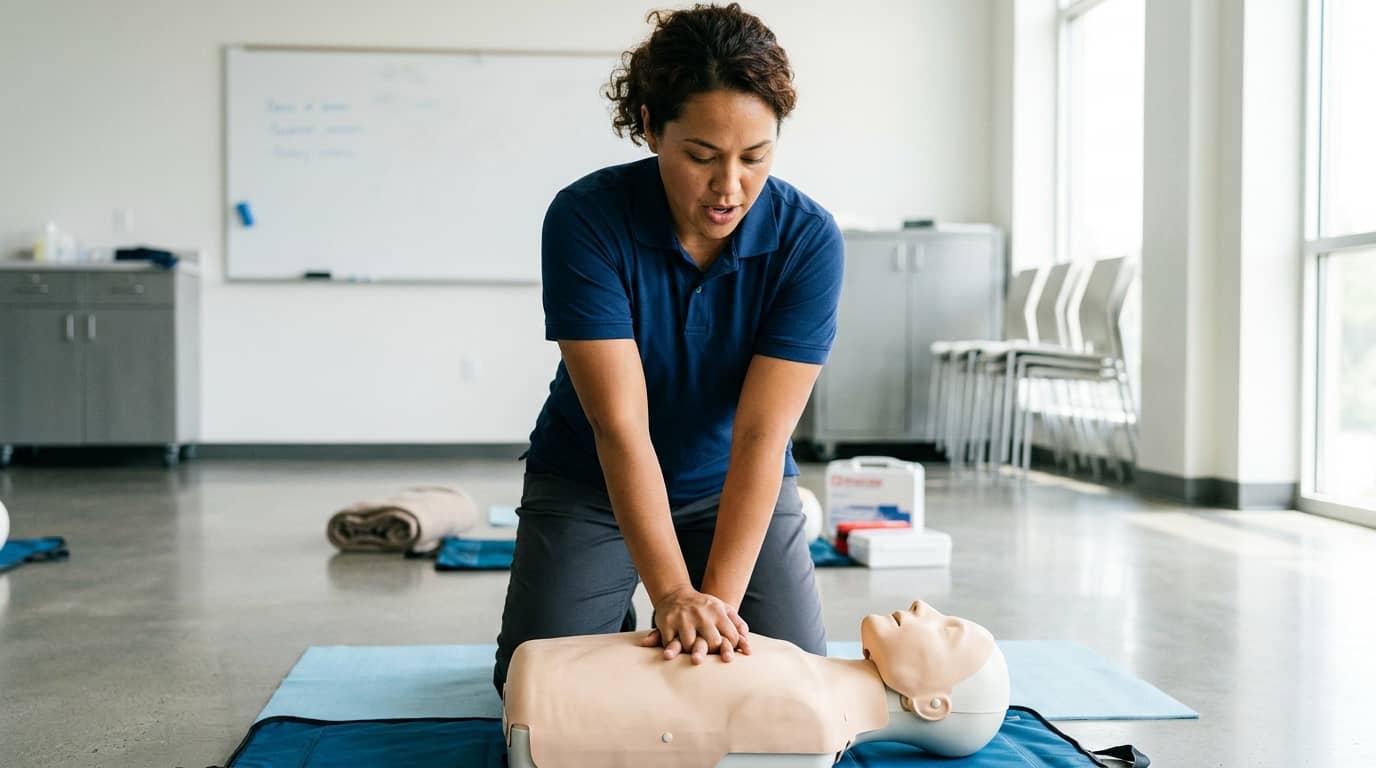
Teaches correct hand placement, compression depth, rate, and recoil for adult victims. Proper technique maximises perfusion pressure during cardiac arrest.
Lesson 3 • CPR for Children and Infants
Adapts CPR technique to paediatric anatomy and physiology. Responders apply age-appropriate compression force and airway management for small victims.
Lesson 4 • Recognising Cardiac Arrest
Identifies the signs of cardiac arrest and distinguishes them from fainting or seizure. Accurate recognition triggers the correct emergency response sequence.
Chapter 4HideHide detailsSee detailsAutomated External Defibrillation
Automated External Defibrillation
Lesson 1 • Special AED Considerations
Addresses pad placement modifications for children, pacemakers, wet surfaces, and implanted devices. Responders adapt standard protocol to real-world victim conditions.
Lesson 2 • How AEDs Work
Explains the electrical mechanism of defibrillation and how AEDs analyse cardiac rhythm. Builds the conceptual foundation for safe and confident device use.
Lesson 3 • AED Operation Step by Step
Walks through powering on, pad placement, rhythm analysis, and shock delivery. Correct sequencing ensures both victim safety and device effectiveness.
Lesson 4 • Integrating AED with CPR Team
Coordinates two-rescuer CPR with AED operation to minimise hands-off time. Effective team roles improve overall resuscitation outcomes.
Chapter 5HideHide detailsSee detailsBleeding Control and Wound Care
Bleeding Control and Wound Care
Lesson 1 • Minor Wound Cleaning and Dressing
Addresses irrigation, antiseptic use, and dressing selection for minor wounds. Proper technique reduces infection risk and supports natural healing.
Lesson 2 • Tourniquet Application
Covers tourniquet use for life-threatening limb haemorrhage uncontrolled by pressure. Correct placement and documentation prevent complications and aid handoff.
Lesson 3 • Direct Pressure and Wound Packing
Teaches sustained direct pressure and wound packing for deep lacerations. These are the primary techniques for controlling severe external haemorrhage.
Lesson 4 • Understanding Bleeding and Shock Risk
Classifies bleeding by vessel type and severity and links blood loss to shock progression. Responders prioritise interventions based on haemorrhage severity.
Chapter 6HideHide detailsSee detailsFractures, Sprains, and Musculoskeletal Injuries
Fractures, Sprains, and Musculoskeletal Injuries
Lesson 1 • Splinting Principles and Techniques
Covers rigid, soft, and improvised splint construction and application. Effective splinting immobilises the injury site and adjacent joints to prevent movement.
Lesson 2 • Spinal Injury Precautions
Identifies mechanisms of injury suggesting spinal involvement and teaches manual stabilisation. Responders minimise spinal movement until professional care is available.
Lesson 3 • Sling and Swathe for Upper Limb Injuries
Teaches triangular bandage sling and swathe for shoulder, arm, and collarbone injuries. Proper support reduces pain and prevents secondary injury during transport.
Lesson 4 • Recognising Musculoskeletal Injuries
Distinguishes fractures, dislocations, sprains, and strains by signs and symptoms. Accurate identification determines the appropriate immobilisation strategy.
Chapter 7HideHide detailsSee detailsMedical Emergencies: Recognition and Response
Medical Emergencies: Recognition and Response
Lesson 1 • Heart Attack Recognition and Care
Identifies classic and atypical heart attack symptoms and the immediate response steps. Early recognition and aspirin administration can limit myocardial damage.
Lesson 2 • Stroke Recognition Using FAST
Applies the FAST acronym to identify stroke symptoms rapidly. Time-sensitive recognition enables faster hospital intervention and better neurological outcomes.
Lesson 3 • Seizure Management
Covers safe seizure management, post-ictal care, and when to call EMS. Responders protect victims from injury without restraining convulsive movements.
Lesson 4 • Allergic Reactions and Anaphylaxis
Identifies mild allergic reactions versus life-threatening anaphylaxis and teaches epinephrine auto-injector use. Rapid intervention prevents airway compromise and cardiovascular collapse.
Lesson 5 • Diabetic Emergencies
Distinguishes hypoglycaemia from hyperglycaemia and provides appropriate first aid for each. Correct glucose management prevents deterioration to unconsciousness.
Chapter 8HideHide detailsSee detailsEnvironmental and Situational Emergencies
Environmental and Situational Emergencies
Lesson 1 • Cold-Related Emergencies
Covers hypothermia and frostbite recognition, field rewarming, and transport precautions. Improper rewarming can worsen tissue damage and trigger cardiac arrhythmias.
Lesson 2 • Heat-Related Illnesses
Differentiates heat cramps, heat exhaustion, and heat stroke by severity and symptom profile. Cooling interventions are matched to illness severity to prevent organ damage.
Lesson 3 • Poisoning and Toxic Exposure
Identifies routes of toxic exposure and provides initial decontamination and supportive care. Responders gather substance information critical for poison control guidance.
Lesson 4 • Burn Assessment and First Aid
Classifies burns by depth and extent and applies appropriate cooling and dressing techniques. Correct initial care reduces pain, infection risk, and tissue destruction.
Your valid completion certificate
This course is for you:
Parents and caregivers: prepared to protect children and family members at home
Teachers and school staff: responsible for student safety during school hours
Coaches and athletic trainers: regularly present when physical injuries occur
Office managers and HR professionals: accountable for workplace safety compliance
Outdoor enthusiasts and hikers: often far from professional help in remote settings
Community volunteers: expected to assist during local events or emergencies
What our students say
Your lessons are perfect. I purchased the one-year package and finally have the opportunity to follow various topics of interest without needing to change platforms... I'm grateful for everything you do, I've already recommended you to other people...

I like how the lessons are straight to the point and how I can change chapters and skip content I don't need.

I like the content and the way videos are presented and transcribed, which speeds up the process!

The platform is fast and simple to use. The diversity of content and complementary videos really help with learning.

Top qualifications






FAQ
Who is Dedika?
Is the certificate valid in the United Kingdom?
Are the courses free?
What is the course workload?
What are the courses like?
How do the courses work?
What is the duration of the courses?
What is the cost or price of the courses?
What is an EAD or online course and how does it work?
PDF Course