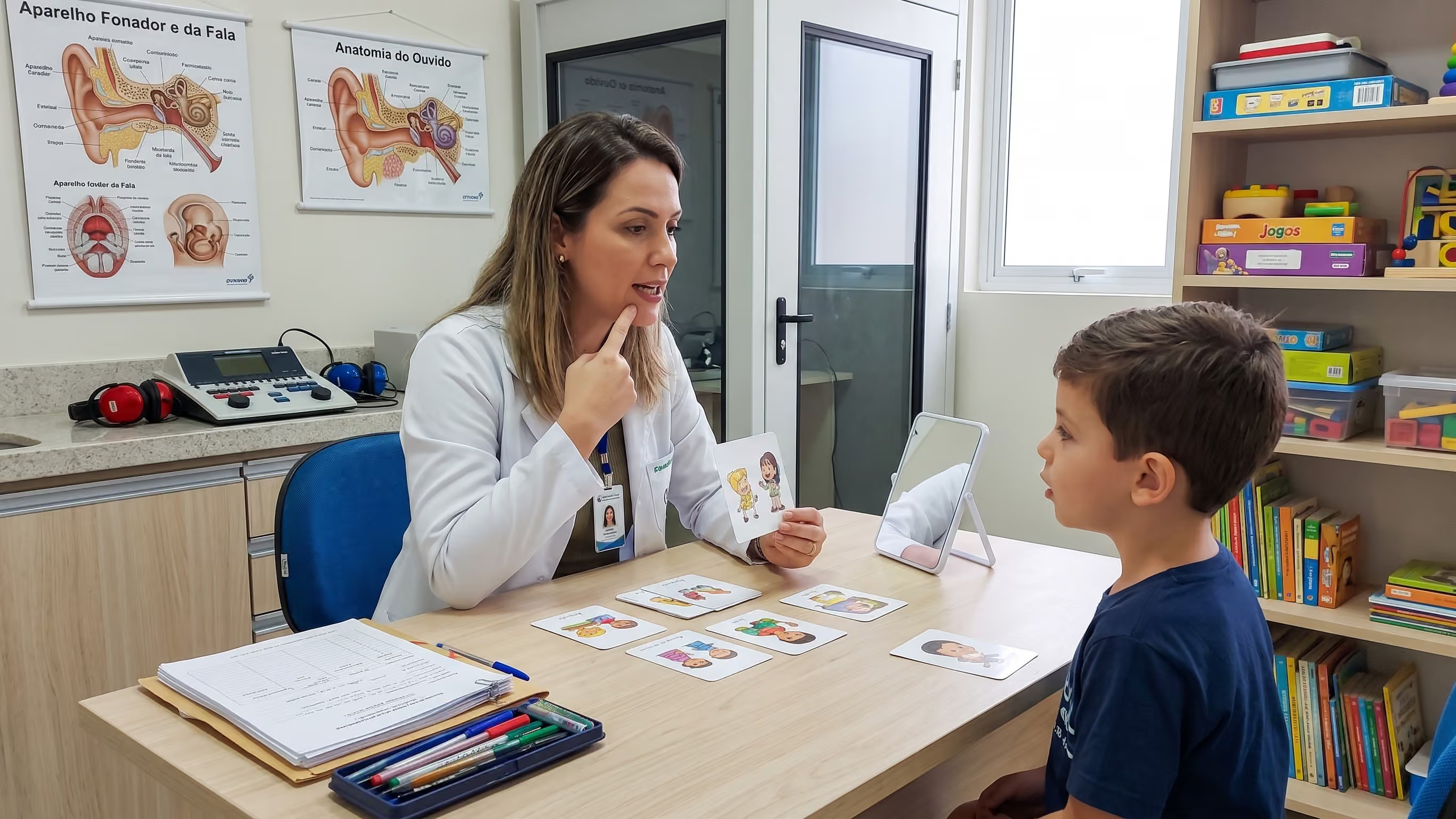
Speech and Hearing Course
Master the full scope of speech-language pathology and audiology with a curriculum built on anatomy, assessment, and evidence-based intervention. From hearing science to fluency disorders, this course prepares you for real clinical practice across every major disorder area. Whether you are entering the field or strengthening your foundation, this is the comprehensive training you need.
What you will learn:
You will build a thorough understanding of speech and hearing science, covering the anatomy and physiology of both the speech mechanism and the auditory system. You will learn to assess and diagnose speech sound disorders, language delays, voice disorders, fluency disorders, and dysphagia across the lifespan. The course covers audiological testing procedures including pure-tone audiometry, tympanometry, and electrophysiological measures. You will also develop skills in culturally responsive assessment, augmentative and alternative communication, and interprofessional collaboration. Ethical principles, clinical documentation, and evidence-based practice are integrated throughout every section of the curriculum.
How you study in a practical way Speech and Hearing Course
How you practise Speech and Hearing Course
For companies looking to train their teams
With Dedika for businesses, the course includes exercises and examples tailored to your own business and the way your company needs.

Course content
8 Chapters • 37 LessonsDuration between 4 and 360 hours (you decide)
Chapter 1HideHide detailsSee detailsFoundations of Speech and Hearing Science
Foundations of Speech and Hearing Science
Lesson 1 • Physiology of Hearing
Details transduction from sound waves to neural signals within the cochlea. Links mechanical and electrochemical processes to auditory perception.
Lesson 2 • Anatomy of the Speech Mechanism
Covers respiratory, laryngeal, and articulatory structures supporting speech production. Builds the anatomical baseline for all subsequent clinical content.
Lesson 3 • Physiology of Voice Production
Explains aerodynamic and myoelastic principles governing vocal fold vibration. Connects physiology to voice quality and clinical voice assessment.
Lesson 4 • Introduction to Acoustics
Introduces frequency, intensity, and waveform concepts essential for interpreting audiograms and speech spectrograms. Grounds clinical measurement in physics.
Lesson 5 • Anatomy of the Auditory System
Examines outer, middle, and inner ear structures plus central auditory pathways. Provides structural grounding for understanding hearing disorders.
Chapter 2HideHide detailsSee detailsSpeech Sound Development and Phonology
Speech Sound Development and Phonology
Lesson 1 • Phonological Awareness Skills
Covers rhyme, syllable, onset-rime, and phoneme-level awareness skills. Links phonological awareness to literacy development and reading outcomes.
Lesson 2 • Phoneme Acquisition Sequences
Presents age-of-acquisition norms for consonants and vowels across developmental stages. Enables clinicians to set evidence-based treatment targets.
Lesson 3 • Phonological Processes and Patterns
Identifies common simplification processes such as stopping and cluster reduction. Distinguishes age-appropriate processes from persistent disorders.
Lesson 4 • Prelinguistic Vocal Development
Describes cooing, babbling, and jargon stages preceding first words. Establishes the developmental timeline used in early intervention screening.
Chapter 3HideHide detailsSee detailsLanguage Development Across the Lifespan
Language Development Across the Lifespan
Lesson 1 • Adolescent and Adult Language
Explores continued pragmatic refinement, abstract reasoning, and aging effects on language. Prepares students for adult and geriatric caseloads.
Lesson 2 • Preschool Language Expansion
Examines morphosyntactic development, narrative emergence, and pragmatic skills in ages three to five. Connects growth to school readiness outcomes.
Lesson 3 • Early Language Milestones
Covers joint attention, first words, and two-word combinations in toddlers. Provides the normative baseline for early language screening.
Lesson 4 • School-Age Language and Literacy
Addresses metalinguistic skills, complex syntax, and expository discourse in school-age children. Links language competence to academic achievement.
Chapter 4HideHide detailsSee detailsHearing Disorders and Audiological Assessment
Hearing Disorders and Audiological Assessment
Lesson 1 • Immittance and Tympanometry
Covers tympanogram types, acoustic reflex testing, and middle ear pressure assessment. Connects immittance findings to conductive pathology identification.
Lesson 2 • Pure-Tone Audiometry
Teaches air and bone conduction testing procedures and audiogram interpretation. Develops competency in threshold determination and masking principles.
Lesson 3 • Classification of Hearing Loss
Defines conductive, sensorineural, and mixed hearing loss by site of lesion. Establishes the diagnostic framework for all audiological assessment content.
Lesson 4 • Speech Audiometry
Introduces speech recognition threshold and word recognition score testing. Links speech audiometry results to audiogram configuration and hearing aid candidacy.
Lesson 5 • Electrophysiological and Otoacoustic Testing
Explains auditory brainstem response, otoacoustic emissions, and newborn hearing screening. Prepares students to interpret objective hearing measures.
Chapter 5HideHide detailsSee detailsSpeech Sound Disorders: Assessment and Diagnosis
Speech Sound Disorders: Assessment and Diagnosis
Lesson 1 • Differential Diagnosis of Motor Speech
Distinguishes childhood apraxia of speech from dysarthria and phonological disorder. Applies diagnostic features to guide treatment planning decisions.
Lesson 2 • Standardized Articulation Assessment
Reviews norm-referenced articulation tests, scoring procedures, and score interpretation. Grounds clinical decision-making in psychometric principles.
Lesson 3 • Phonological Analysis Procedures
Teaches independent and relational analysis of connected speech samples. Enables identification of phonological patterns beyond single-word testing.
Lesson 4 • Culturally Responsive Assessment
Addresses dialect variation, bilingual phonology, and bias reduction in assessment. Ensures accurate diagnosis across diverse linguistic backgrounds.
Chapter 6HideHide detailsSee detailsLanguage Disorders: Assessment and Intervention
Language Disorders: Assessment and Intervention
Lesson 1 • Acquired Language Disorders in Adults
Covers aphasia classification, assessment, and treatment approaches following neurological injury. Prepares students for adult neurogenic language caseloads.
Lesson 2 • Augmentative and Alternative Communication
Introduces AAC systems, feature matching, and implementation for complex communication needs. Connects AAC to language intervention goals across settings.
Lesson 3 • Standardized Language Testing
Reviews comprehensive language batteries and domain-specific tests for children and adults. Develops skill in selecting, administering, and interpreting norm-referenced tools.
Lesson 4 • Intervention Approaches for Children
Presents naturalistic, hybrid, and structured intervention models for paediatric language disorders. Matches approach selection to child profile and evidence base.
Lesson 5 • Language Sample Analysis
Teaches elicitation, transcription, and analysis of spontaneous language samples. Provides a naturalistic complement to standardised language testing.
Chapter 7HideHide detailsSee detailsVoice, Fluency, and Swallowing Disorders
Voice, Fluency, and Swallowing Disorders
Lesson 1 • Voice Disorder Assessment
Covers perceptual, acoustic, aerodynamic, and laryngoscopic evaluation of voice disorders. Builds a multidimensional assessment framework for clinical voice practice.
Lesson 2 • Dysphagia Evaluation
Teaches clinical swallowing examination and instrumental assessment procedures. Develops skill in identifying aspiration risk and swallowing physiology deficits.
Lesson 3 • Fluency Disorders Assessment and Treatment
Addresses stuttering and cluttering evaluation, severity measurement, and treatment approaches. Integrates affective and behavioural dimensions of fluency intervention.
Lesson 4 • Voice Disorder Treatment
Presents behavioural, resonant, and physiological voice therapy approaches. Matches treatment selection to disorder type and patient profile.
Lesson 5 • Dysphagia Management
Covers diet texture modification, compensatory strategies, and rehabilitative swallowing exercises. Connects management decisions to patient safety and quality of life.
Chapter 8HideHide detailsSee detailsClinical Practice, Ethics, and Professional Roles
Clinical Practice, Ethics, and Professional Roles
Lesson 1 • Supervision and Professional Development
Addresses clinical supervision models, mentorship, and continuing education requirements. Supports lifelong professional growth and competency maintenance.
Lesson 2 • Ethical Principles in Practice
Examines core ethical principles including beneficence, autonomy, and confidentiality. Applies ethical frameworks to common clinical dilemmas.
Lesson 3 • Clinical Reasoning and Decision-Making
Develops hypothesis-driven diagnostic reasoning and evidence-based treatment selection. Bridges foundational knowledge to integrated clinical judgment.
Lesson 4 • Interprofessional Collaboration
Defines roles within healthcare and education teams and effective communication strategies. Prepares students for collaborative practice across clinical settings.
Lesson 5 • Documentation and Report Writing
Covers evaluation reports, treatment plans, progress notes, and discharge summaries. Develops professional writing skills aligned with clinical and billing standards.
Your valid completion certificate
This course is for you:
Undergraduate student: building a competitive application for graduate SLP programmes.
Career changer: transitioning from education or healthcare into communication sciences.
Audiology assistant: seeking broader clinical context beyond hearing testing procedures.
Early intervention specialist: deepening knowledge of speech and language development norms.
International graduate: aligning prior training with North American clinical practice standards.
Special education teacher: strengthening understanding of communication disorders in students.
What our students say
Your classes are perfect. I purchased the one-year package and finally have the opportunity to follow various topics of my interest without needing to change platforms... I thank you for everything you do, I've already recommended you to other people...

I like how the lessons are straight to the point and how I can change chapters and skip content that I don't need.

I like the content and the way of presentation and video transcription, which speeds up the process!

The platform is fast, simple to use. The diversity of content and complementary videos help a lot in learning.

Top qualifications


FAQs
Who is Dedika?
Is the certificate valid in India?
Are the courses free?
What is the course workload?
What are the courses like?
How do the courses work?
What is the duration of the courses?
What is the cost or price of the courses?
What is an EAD or online course and how does it work?
PDF Course