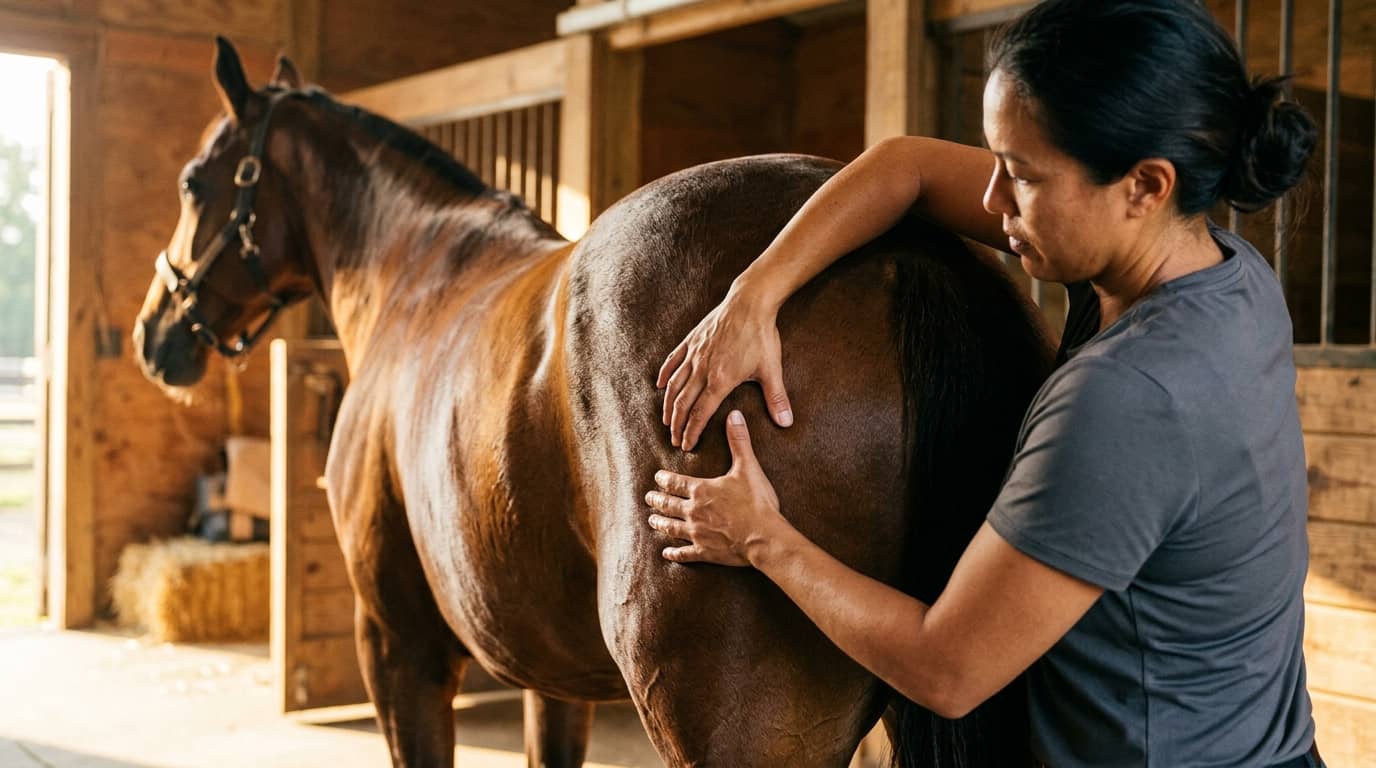
Equine Shiatsu Training
Equine Shiatsu Training gives you the anatomy knowledge, hands-on techniques, and professional skills to deliver safe, effective shiatsu sessions to horses. From meridian theory to full-body treatment sequences, every module is built for real-world practice. Whether you work with sport horses, seniors, or rehabilitation cases, this course prepares you to make a genuine difference.
What you will learn:
You will master equine anatomy and meridian pathways, learning to locate key acupressure points and assess tissue quality through skilled palpation. You will develop safe horse-handling techniques and learn to read behavioural signals that guide every session. The course walks you through a complete head-to-tail shiatsu sequence and condition-specific meridian protocols. You will also learn to adapt your approach for senior horses, pregnant mares, performance horses, and rehabilitation cases. Finally, you will build the professional foundations needed to take on clients, document outcomes, and grow a credible equine shiatsu practice.
How you study in a practical way Equine Shiatsu Training
How you practise Equine Shiatsu Training
For companies looking to train their teams
With Dedika for businesses, the course includes exercises and examples tailored to your own business and the way your company needs.

Course content
8 Chapters • 40 LessonsDuration between 4 and 360 hours (you decide)
Chapter 1HideHide detailsSee detailsFoundations of Equine Anatomy and Energy
Foundations of Equine Anatomy and Energy
Lesson 1 • Equine Meridian Pathways
Maps the twelve primary meridians onto the horse's body using anatomical reference points. Students gain spatial understanding needed for accurate point location.
Lesson 2 • Tsubo Points on the Horse
Identifies key acupressure points (tsubo) along equine meridians and their associated functions. Prepares students to locate and assess points during practical sessions.
Lesson 3 • Equine Nervous System Basics
Explains the autonomic and peripheral nervous systems as they relate to shiatsu responses. Connects neurological concepts to observable horse behaviour during treatment.
Lesson 4 • Equine Skeletal and Muscular Overview
Covers major bones, joints, and muscle groups relevant to shiatsu work. Establishes anatomical vocabulary used throughout all subsequent hands-on chapters.
Lesson 5 • Introduction to Meridian Theory
Introduces the concept of meridians as energy channels adapted to equine physiology. Provides the theoretical basis for all pressure-point work in the course.
Chapter 2HideHide detailsSee detailsHorse Behaviour and Safe Handling
Horse Behaviour and Safe Handling
Lesson 1 • Safe Approach and Positioning
Teaches correct angles of approach, safe zones, and body positioning around horses. These protocols protect both practitioner and horse throughout every session.
Lesson 2 • Haltering, Leading, and Restraint
Covers proper haltering, leading techniques, and minimal-restraint methods appropriate for shiatsu. Emphasises voluntary cooperation over forced compliance.
Lesson 3 • Recognising Stress and Discomfort
Identifies behavioural and physiological signs that a horse is stressed or in pain during a session. Enables practitioners to modify or stop treatment appropriately.
Lesson 4 • Herd Dynamics and Social Behaviour
Examines how herd hierarchy and social bonds influence individual horse behaviour. Understanding herd context helps practitioners anticipate reactions during sessions.
Lesson 5 • Equine Communication and Body Language
Decodes ear, tail, eye, and postural signals that indicate a horse's emotional state. Accurate reading of these signals is essential for safe and effective shiatsu practice.
Chapter 3HideHide detailsSee detailsCore Shiatsu Principles and Touch
Core Shiatsu Principles and Touch
Lesson 1 • Practitioner Posture and Body Mechanics
Teaches correct posture, weight transfer, and movement to deliver effective pressure without injury. Proper body mechanics sustain practitioner health across a full career.
Lesson 2 • Connecting Touch and Transitions
Teaches how to maintain energetic continuity between techniques and body regions. Smooth transitions keep the horse relaxed and the session therapeutically coherent.
Lesson 3 • Hand and Thumb Techniques
Introduces the primary hand tools used in equine shiatsu: palms, thumbs, fingers, and forearms. Each technique is linked to specific body regions and treatment goals.
Lesson 4 • Pressure Quality and Depth
Defines the spectrum of pressure from light holding to deep perpendicular compression. Students learn to calibrate pressure to each horse's sensitivity and clinical condition.
Lesson 5 • Philosophy of Shiatsu Practice
Introduces the Japanese therapeutic tradition underlying shiatsu and its adaptation to equine work. Grounds students in the mindset and ethics required for effective veterinary practice.
Chapter 4HideHide detailsSee detailsAssessment and Treatment Planning
Assessment and Treatment Planning
Lesson 1 • Creating a Treatment Plan
Synthesises assessment data into a structured, goal-oriented treatment plan with prioritised meridians and techniques. Introduces session documentation and progress tracking.
Lesson 2 • Visual Postural Assessment
Trains the eye to detect asymmetry, muscle atrophy, and postural compensation patterns. Visual assessment forms the first layer of every treatment plan.
Lesson 3 • Movement and Gait Observation
Observes the horse in walk and trot to identify stiffness, irregularity, and compensatory movement. Gait data correlates with meridian imbalances found during palpation.
Lesson 4 • Meridian Hara Diagnosis Basics
Introduces simplified hara-style diagnosis adapted for equine abdominal and flank palpation. Connects internal organ meridian states to surface findings.
Lesson 5 • Palpation and Diagnostic Touch
Develops sensitivity to tissue texture, temperature, tension, and tsubo reactivity through palpation. Palpation findings guide point selection and pressure decisions.
Chapter 5HideHide detailsSee detailsFull-Body Equine Shiatsu Sequence
Full-Body Equine Shiatsu Sequence
Lesson 1 • Back, Topline, and Hindquarter Sequence
Works the bladder meridian along the back and addresses gluteal and hamstring tension. This region holds the most common compensatory patterns in horses.
Lesson 2 • Opening and Grounding the Session
Establishes initial contact, assesses the horse's readiness, and sets the energetic tone. A strong opening builds trust and prepares the horse for deeper work.
Lesson 3 • Head, Neck, and Shoulder Work
Applies shiatsu techniques to the poll, neck, and shoulder region using appropriate pressure and point work. Addresses common tension patterns in performance and leisure horses.
Lesson 4 • Closing and Integration Techniques
Completes the session with integrating strokes, energy balancing, and a calm withdrawal of contact. Proper closure consolidates treatment effects and leaves the horse settled.
Lesson 5 • Forelimb and Hindlimb Meridian Work
Traces limb meridians from proximal to distal, addressing joints, tendons, and key tsubo. Limb work supports circulation, flexibility, and recovery.
Chapter 6HideHide detailsSee detailsMeridian-Specific Therapeutic Protocols
Meridian-Specific Therapeutic Protocols
Lesson 1 • Stomach and Spleen Protocols
Addresses the digestive meridians running through the face, neck, and hindlimbs. Supports horses with digestive sensitivity, muscle weakness, or poor condition.
Lesson 2 • Lung and Large Intestine Protocols
Works the forelimb meridians associated with respiratory function and immune vitality. Relevant for horses with respiratory sensitivity or forelimb stiffness.
Lesson 3 • Liver and Gallbladder Protocols
Targets the wood element meridians linked to tendon health, lateral movement, and emotional tension. Particularly relevant for performance horses with stiffness or irritability.
Lesson 4 • Heart, Pericardium, and Triple Heater
Works the fire element meridians governing circulation, emotional balance, and thermoregulation. Addresses anxiety, circulatory sluggishness, and emotional reactivity.
Lesson 5 • Bladder and Kidney Meridian Protocols
Addresses the primary back and hindlimb meridians governing structural support and vitality. Protocols target back stiffness, hindlimb weakness, and fatigue patterns.
Chapter 7HideHide detailsSee detailsSpecial Populations and Conditions
Special Populations and Conditions
Lesson 1 • Horses with Behavioural Challenges
Adapts session structure and technique for horses with fear, trauma history, or handling difficulties. Builds trust progressively using minimal-pressure introductory approaches.
Lesson 2 • Performance and Sport Horse Protocols
Designs pre-competition and post-competition shiatsu protocols for horses in active work. Targets warm-up preparation, recovery acceleration, and performance maintenance.
Lesson 3 • Pregnant and Postpartum Mares
Identifies contraindicated points and adapts positioning for pregnant mares at each trimester. Postpartum protocols support recovery and milk production meridians.
Lesson 4 • Rehabilitation and Recovery Support
Applies shiatsu to support horses recovering from injury, surgery, or illness alongside veterinary care. Focuses on circulation, pain modulation, and psychological recovery.
Lesson 5 • Working with Senior Horses
Modifies pressure, duration, and point selection for aged horses with reduced tissue resilience. Addresses arthritis, muscle atrophy, and reduced energy common in seniors.
Chapter 8HideHide detailsSee detailsProfessional Practice and Client Communication
Professional Practice and Client Communication
Lesson 1 • Client Intake and Case History
Designs a thorough intake process covering the horse's health history, management, and owner goals. Accurate intake data directly improves treatment planning and outcome tracking.
Lesson 2 • Scope of Practice and Professional Boundaries
Defines what equine shiatsu practitioners may and may not do relative to veterinary medicine. Clear scope boundaries protect clients, horses, and the practitioner's professional standing.
Lesson 3 • Professional Ethics and Standards
Covers confidentiality, professional conduct, continuing education obligations, and ethical dilemmas. Grounds students in the values that sustain long-term professional credibility.
Lesson 4 • Building a Sustainable Practice
Introduces practical steps for establishing, marketing, and sustaining an equine shiatsu business. Covers pricing, scheduling, insurance, and professional network development.
Lesson 5 • Communicating Findings to Owners
Teaches clear, non-diagnostic language for reporting session observations and recommendations. Effective communication builds owner trust and supports ongoing care compliance.
Your valid completion certificate
This course is for you:
Equestrian enthusiasts: eager to deepen their contribution to horse health.
Riding instructors: wanting a therapeutic skill set beyond coaching and training.
Human massage therapists: ready to extend their bodywork practice to horses.
Barn managers and grooms: seeking structured knowledge to support daily horse care.
Career changers: drawn to animal wellness and looking for a credible entry point.
Veterinary technicians: interested in complementary approaches that support clinical care.
What our students say
Your classes are perfect. I purchased the one-year package and finally have the opportunity to follow various topics of my interest without needing to change platforms... I thank you for everything you do, I've already recommended you to other people...

I like how the lessons are straight to the point and how I can change chapters and skip content that I don't need.

I like the content and the way of presentation and video transcription, which speeds up the process!

The platform is fast, simple to use. The diversity of content and complementary videos help a lot in learning.

Top qualifications




FAQs
Who is Dedika?
Is the certificate valid in India?
Are the courses free?
What is the course workload?
What are the courses like?
How do the courses work?
What is the duration of the courses?
What is the cost or price of the courses?
What is an EAD or online course and how does it work?
PDF Course