
Motorcycle Course
This motorcycle course takes you from the basics of bike components and safety gear all the way through advanced cornering, emergency manoeuvres, and varied riding conditions. Whether you are a new rider or looking to sharpen your skills, you will build the knowledge and technique to ride with confidence. Every module is designed to make you a safer, smarter, and more capable motorcyclist.
What you will learn:
You will learn how to inspect your motorcycle before every ride, control your bike at low speeds, and execute smooth gear shifts and braking across all conditions. The course covers cornering physics, countersteering, and how to read road hazards before they become problems. You will develop emergency braking and swerving skills that can prevent crashes when it matters most. Riding in rain, at night, on highways, and in groups is covered with condition-specific strategies. Advanced topics include trail braking, body steering, and a structured plan for continuous skill improvement.
How you study in a practical way Motorcycle Course
How you practise Motorcycle Course
For companies looking to train their teams
With Dedika for businesses, the course includes exercises and examples tailored to your own business and the way your company needs.

Course content
8 Chapters • 39 LessonsDuration between 4 and 360 hours (you decide)
Chapter 1HideHide detailsSee detailsMotorcycle Fundamentals and Safety Mindset
Motorcycle Fundamentals and Safety Mindset
Lesson 1 • Rider Psychology and Risk Awareness
Examines cognitive biases, complacency, and risk perception that cause crashes. Develops a proactive safety mindset essential for all riding decisions.
Lesson 2 • Traffic Laws and Rider Responsibilities
Reviews licensing requirements, lane rules, speed limits, and right-of-way principles applicable to motorcyclists. Grounds legal obligations in practical riding behaviour.
Lesson 3 • Motorcycle Types and Their Uses
Covers cruisers, sport bikes, touring, dual-sport, and scooters by design purpose. Establishes context for all subsequent equipment and technique decisions.
Lesson 4 • Protective Gear Selection and Use
Details helmet ratings, jacket armour, gloves, boots, and high-visibility gear. Connects proper gear selection to injury reduction outcomes.
Lesson 5 • Key Motorcycle Components Overview
Identifies engine, frame, suspension, brakes, and drivetrain as interconnected systems. Provides vocabulary needed for maintenance and control chapters.
Chapter 2HideHide detailsSee detailsPre-Ride Inspection and Bike Setup
Pre-Ride Inspection and Bike Setup
Lesson 1 • Tyre Condition and Pressure Management
Explains tyre wear patterns, sidewall damage, and correct inflation for load and temperature. Directly impacts traction and handling covered in later chapters.
Lesson 2 • Ergonomic Adjustment and Rider Fit
Covers handlebar, mirror, lever reach, and footpeg adjustments for rider comfort and control. Proper fit reduces fatigue and improves input precision.
Lesson 3 • The T-CLOCS Inspection Method
Teaches the Tyres, Controls, Lights, Oil, Chassis, and Stands checklist as a structured pre-ride routine. Ensures no safety-critical item is overlooked before departure.
Lesson 4 • Fuel, Fluids, and Chain Maintenance
Addresses fuel reserve awareness, brake fluid condition, coolant levels, and chain slack and lubrication. Prevents mechanical failures that cause loss of control.
Chapter 3HideHide detailsSee detailsBasic Motorcycle Control Skills
Basic Motorcycle Control Skills
Lesson 1 • Starting, Stopping, and Neutral Finding
Teaches ignition sequence, clutch engagement, and controlled stops from low speed. Forms the entry-level skill set for all subsequent riding exercises.
Lesson 2 • Low-Speed Balance and Manoeuvring
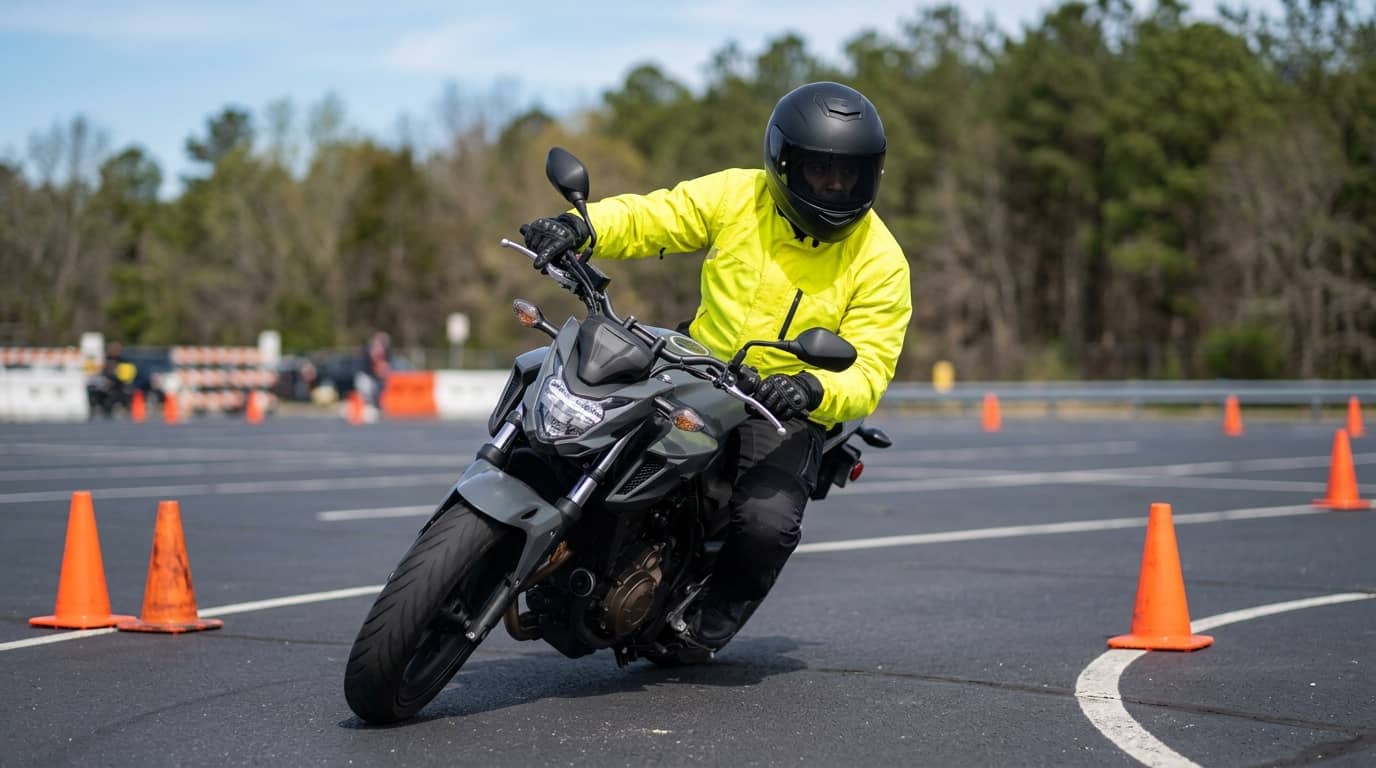
Practices slow-speed straight-line riding, tight turns, and figure-eight patterns using counterbalance and friction zone. Builds the balance skills needed for parking lot manoeuvres.
Lesson 3 • Throttle and Clutch Coordination
Develops smooth power delivery through friction zone mastery and throttle modulation. Prevents stalls, lurching, and wheel spin during acceleration.
Lesson 4 • Gear Shifting and Speed Management
Integrates clutch, throttle, and gear selection for smooth acceleration and deceleration across all gears. Prepares riders for open-road speed transitions.
Lesson 5 • Braking Technique and Stopping Distance
Covers front and rear brake application ratios, progressive braking, and stopping distance factors. Builds the braking foundation required for emergency stops later.
Chapter 4HideHide detailsSee detailsCornering and Turning Techniques
Cornering and Turning Techniques
Lesson 1 • Lean Angle and Traction Management
Covers the relationship between lean angle, speed, and available traction. Riders learn to stay within traction limits through smooth inputs.
Lesson 2 • Corner Entry, Apex, and Exit Lines
Applies outside-inside-outside line selection to maximise visibility and safety margin. Connects vision and countersteering into a complete cornering sequence.
Lesson 3 • Countersteering Mechanics
Explains the physics of countersteering and how handlebar input initiates lean at speed. Mastery of this concept is prerequisite for all advanced cornering work.
Lesson 4 • Cornering in Adverse Conditions
Adapts cornering technique for wet roads, gravel, and decreasing-radius curves. Builds judgment for when to reduce speed and widen lines.
Lesson 5 • Vision and Path Planning in Curves
Teaches target fixation avoidance, look-through technique, and entry point selection. Vision strategy directly determines line quality and exit speed.
Chapter 5HideHide detailsSee detailsTraffic Strategies and Hazard Avoidance
Traffic Strategies and Hazard Avoidance
Lesson 1 • Intersection and Merge Hazard Management
Addresses left-turn vehicle threats, merging conflicts, and intersection approach strategies. Intersections represent the highest collision risk zone for motorcyclists.
Lesson 2 • Lane Positioning for Visibility and Safety
Covers left, centre, and right lane positions and when each maximises visibility and buffer space. Directly reduces the risk of being in a driver's blind spot.
Lesson 3 • Road Surface and Environmental Hazards
Identifies pavement cracks, railway tracks, oil slicks, sand, and debris as traction threats. Teaches avoidance lines and speed adjustments for each hazard type.
Lesson 4 • Systematic Scanning and Awareness
Teaches the SEE strategy (Search, Evaluate, Execute) and mirror-check frequency for continuous hazard detection. Forms the perceptual foundation for all traffic decisions.
Lesson 5 • Managing Space and Following Distance
Establishes minimum following distances, escape route planning, and buffer zone maintenance in traffic. Provides time and space to react to sudden stops.
Chapter 6HideHide detailsSee detailsEmergency Manoeuvres and Crash Avoidance
Emergency Manoeuvres and Crash Avoidance
Lesson 1 • ABS-Equipped Bike Emergency Braking
Explains ABS operation, correct brake application technique, and common rider errors that reduce ABS effectiveness. Riders apply maximum pressure confidently on ABS bikes.
Lesson 2 • Emergency Swerving Technique
Teaches rapid countersteering inputs to swerve around obstacles while maintaining control. Combines countersteering from Chapter 4 with emergency-level reaction speed.
Lesson 3 • Maximum Braking Without ABS
Practices threshold braking to the edge of wheel lockup using progressive front brake pressure. Builds the skill to stop in the shortest possible distance without crashing.
Lesson 4 • Crash Mitigation and Post-Crash Actions
Addresses fall technique, sliding posture, and immediate post-crash safety steps. Reduces injury severity when a crash cannot be avoided.
Lesson 5 • Skid Recovery and Traction Loss
Covers front and rear wheel skid recognition and recovery inputs for both ABS and non-ABS bikes. Prevents panic responses that escalate a skid into a crash.
Chapter 7HideHide detailsSee detailsRiding in Varied Conditions and Environments
Riding in Varied Conditions and Environments
Lesson 1 • Highway and High-Speed Riding
Addresses wind buffeting, lane change strategy, and fatigue management at sustained highway speeds. Requires mastery of lane positioning and space management from Chapter 5.
Lesson 2 • Group Riding Formation and Protocol
Teaches staggered formation, hand signals, and group communication for safe multi-bike rides. Adds a social coordination layer to individual riding competencies.
Lesson 3 • Night Riding Techniques
Covers headlight aim, reduced visibility speed adjustment, and reflective gear use for night conditions. Builds on hazard scanning skills from Chapter 5.
Lesson 4 • Wet Weather and Rain Riding
Applies reduced lean angle, increased following distance, and smooth inputs to wet-road riding. Extends cornering and braking skills from earlier chapters to rain conditions.
Lesson 5 • Urban and Stop-and-Go Traffic
Develops filtering awareness, intersection timing, and low-speed control in dense urban traffic. Integrates slow-speed skills from Chapter 3 with traffic strategies from Chapter 5.
Chapter 8HideHide detailsSee detailsAdvanced Riding Skills and Continuous Improvement
Advanced Riding Skills and Continuous Improvement
Lesson 1 • Structured Practice and Lifelong Learning
Designs a progressive practice curriculum using parking lot drills, track days, and advanced courses. Establishes habits that sustain skill growth beyond initial training.
Lesson 2 • Self-Assessment and Skill Gap Analysis
Introduces structured ride debriefs, video review, and peer feedback to identify personal skill gaps. Transforms each ride into a deliberate practice opportunity.
Lesson 3 • Body Steering and Weight Shifting
Covers hanging off, body steering inputs, and weight transfer to complement countersteering at higher lean angles. Reduces handlebar input needed for tight corners.
Lesson 4 • Trail Braking Into Corners
Extends braking into corner entry to manage speed and increase front tyre load for better grip. Requires solid mastery of braking and cornering from Chapters 4 and 6.
Lesson 5 • Throttle Steering and Chassis Balance
Teaches how throttle application affects chassis attitude, weight transfer, and line adjustment mid-corner. Builds fine-grained control over bike behaviour at speed.
Your valid completion certificate
This course is for you:
New rider: wants a structured path from zero experience to road-ready confidence.
Daily commuter: needs reliable skills to navigate city traffic on two wheels.
Returning rider: took a long break and wants to rebuild safe riding habits.
Adventure traveler: plans multi-day tours and needs preparation beyond basic operation.
Fitness enthusiast: trades four wheels for two as a lifestyle and sport choice.
Career-focused driver: pursues motorcycle licensing to expand delivery or transport work.
What our students say
Your classes are perfect. I purchased the one-year package and finally have the opportunity to follow various topics of my interest without needing to change platforms... I thank you for everything you do, I've already recommended you to other people...

I like how the lessons are straight to the point and how I can change chapters and skip content that I don't need.

I like the content and the way of presentation and video transcription, which speeds up the process!

The platform is fast, simple to use. The diversity of content and complementary videos help a lot in learning.

Top qualifications




FAQs
Who is Dedika?
Is the certificate valid in India?
Are the courses free?
What is the course workload?
What are the courses like?
How do the courses work?
What is the duration of the courses?
What is the cost or price of the courses?
What is an EAD or online course and how does it work?
PDF Course