
Toolmaker Training
Master the complete toolmaking trade from shop fundamentals to advanced CNC machining, EDM, die fabrication, and mould making. This comprehensive training covers every skill a professional toolmaker needs to produce precision tooling to exact specifications. Build the hands-on expertise and technical knowledge that manufacturers demand.
What your team will master:
This course covers the full scope of professional toolmaking, starting with engineering drawing interpretation, precision measurement, and materials science. You will develop hands-on skills in manual lathe machine, milling, and grinding operations before advancing to CNC turning, milling, and CAM programming. Die and punch tooling, jigs, fixtures, and injection mould fabrication are covered in dedicated chapters. Supplementary training includes EDM techniques, additive manufacturing, advanced metrology, and toolroom management. You will also build technical communication skills and learn how to plan your career through apprenticeships and industry certifications.
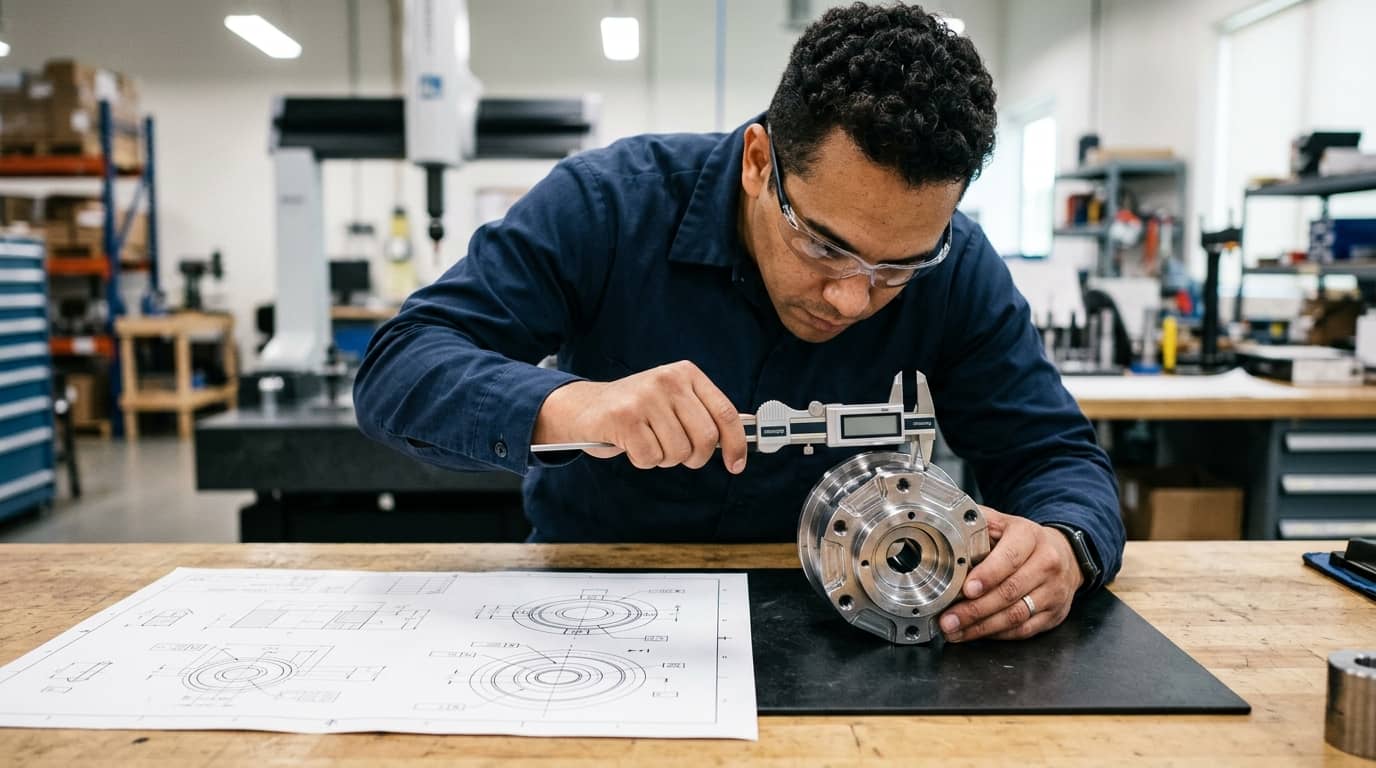
How your team learns practically Toolmaker Training
How your team practises Toolmaker Training
Professionals from these companies study at Dedika



Course content
8 Chapters • 40 LessonsDuration between 4 and 360 hours (you decide)
Chapter 1HideHide detailsSee detailsIntroduction to Toolmaking Fundamentals
Introduction to Toolmaking Fundamentals
Lesson 1 • Core Toolmaking Terminology
Introduces vocabulary for tools, materials, tolerances, and processes. Shared language enables precise communication on the shop floor.
Lesson 2 • The Toolmaker's Role and Trade
Defines the toolmaker's position within manufacturing and the scope of the trade. Establishes context for all subsequent technical skill development.
Lesson 3 • Shop Safety and Housekeeping
Covers personal protective equipment, machine guarding, and hazard identification. Safe habits introduced here apply throughout every hands-on chapter.
Lesson 4 • Reading Basic Engineering Drawings
Teaches orthographic projection, title blocks, and basic dimensioning. Drawing literacy is prerequisite to every fabrication task ahead.
Lesson 5 • Introduction to Toolroom Equipment
Surveys hand tools, bench equipment, and major machine types found in a toolroom. Familiarity with equipment layout prepares students for safe operation.
Chapter 2HideHide detailsSee detailsPrecision Measurement and Inspection
Precision Measurement and Inspection
Lesson 1 • Measurement Principles and Units
Establishes SI and inch measurement systems, significant figures, and error sources. Accurate measurement underpins every quality decision in toolmaking.
Lesson 2 • Hand Measuring Instruments
Covers vernier calipers, micrometers, and dial indicators in detail. Correct technique prevents measurement error on critical tool dimensions.
Lesson 3 • Inspection Documentation and Reporting
Covers inspection records, first-article reports, and nonconformance procedures. Proper documentation ensures traceability and supports continuous improvement.
Lesson 4 • Surface Finish and Hardness Measurement
Teaches surface roughness parameters and hardness testing methods. These properties directly affect tool performance and service life.
Lesson 5 • Geometric Dimensioning and Tolerancing Basics
Introduces GD&T symbols, datums, and feature control frames. Understanding GD&T allows students to interpret modern tooling drawings accurately.
Chapter 3HideHide detailsSee detailsMaterials Science for Toolmakers
Materials Science for Toolmakers
Lesson 1 • Material Testing and Verification
Introduces spark testing, chemical analysis, and mechanical testing methods. Verification prevents incorrect material use in critical tool components.
Lesson 2 • Heat Treatment Processes
Details annealing, hardening, tempering, and case-hardening cycles. Correct heat treatment transforms raw steel into functional, wear-resistant tooling.
Lesson 3 • Coatings and Surface Treatments
Surveys PVD, CVD, nitriding, and plating processes applied to tooling. Surface treatments extend tool life and reduce friction in service.
Lesson 4 • Non-Ferrous and Specialty Materials
Covers aluminium, copper alloys, carbide, and ceramics used in tooling. Specialty materials enable performance beyond the limits of steel.
Lesson 5 • Ferrous Metals in Toolmaking
Examines carbon steels, alloy steels, and tool steels by grade and application. Material selection directly determines tool durability and machinability.
Chapter 4HideHide detailsSee detailsManual Machining Operations
Manual Machining Operations
Lesson 1 • Surface and Cylindrical Grinding
Introduces wheel selection, dressing, and grinding of flat and round surfaces. Grinding achieves the fine tolerances and finishes required in precision tooling.
Lesson 2 • Vertical Milling Machine Operations
Teaches setup, cutter selection, and milling of flats, slots, and contours. Milling expands the range of features a toolmaker can produce.
Lesson 3 • Engine Lathe Fundamentals
Covers lathe setup, tooling selection, and turning operations including facing and boring. Lathe proficiency is the cornerstone of manual toolroom practice.
Lesson 4 • Bench Work and Hand Finishing
Teaches filing, scraping, lapping, and polishing to achieve final dimensions and finish. Bench skills complement machine operations for tight-tolerance tooling.
Lesson 5 • Drilling, Reaming, and Tapping
Covers hole-making operations from layout through finished threads. Accurate holes are fundamental to die sets, fixtures, and mould components.
Chapter 5HideHide detailsSee detailsCNC Machining for Toolmakers
CNC Machining for Toolmakers
Lesson 1 • G-Code and M-Code Programming
Teaches manual G-code and M-code writing for turning and milling operations. Manual programming builds understanding that supports CAM verification.
Lesson 2 • CNC Fundamentals and Coordinate Systems
Establishes Cartesian coordinates, machine axes, and CNC control architecture. This foundation is required before any programming or setup task.
Lesson 3 • CNC Setup and Workholding
Covers tool presetting, work offsets, and fixture design for CNC machines. Proper setup prevents crashes and ensures repeatable part accuracy.
Lesson 4 • CAM Software for Toolroom Parts
Introduces CAM toolpath generation, simulation, and post-processing for toolroom components. CAM accelerates programming of complex profiles and 3D surfaces.
Lesson 5 • CNC Process Optimization
Addresses cutting parameters, cycle time reduction, and in-process gauging. Optimization balances tool life, surface quality, and production efficiency.
Chapter 6HideHide detailsSee detailsDie and Punch Tooling Design and Fabrication
Die and Punch Tooling Design and Fabrication
Lesson 1 • Die Set Components and Standards
Covers die shoes, guide posts, bushings, and standard purchased components. Standardised components reduce lead time and ensure interchangeability.
Lesson 2 • Die Assembly, Tryout, and Debugging
Covers assembly sequence, press tryout procedures, and corrective adjustments. Systematic tryout converts a fabricated die into a production-ready tool.
Lesson 3 • Progressive Die Layout and Strip Design
Teaches strip layout, pilot hole placement, and station sequencing for progressive dies. Efficient strip design minimises material waste and die complexity.
Lesson 4 • Stamping Die Fundamentals
Introduces die types, press tonnage, and the mechanics of metal cutting and forming. Understanding die mechanics guides every design and fabrication decision.
Lesson 5 • Punch and Die Fabrication
Details machining, grinding, and EDM processes used to produce punches and die inserts. Fabrication sequence affects accuracy and heat treatment outcomes.
Chapter 7HideHide detailsSee detailsJigs, Fixtures, and Workholding Devices
Jigs, Fixtures, and Workholding Devices
Lesson 1 • Fixture Verification and Maintenance
Covers CMM verification, wear monitoring, and repair procedures for fixtures. Regular verification ensures fixtures continue to produce conforming parts.
Lesson 2 • Welding and Assembly Fixtures
Teaches fixture design for holding parts during welding and assembly operations. Weld fixtures control distortion and maintain critical assembly dimensions.
Lesson 3 • Milling and Turning Fixture Design
Addresses fixture design for milling and lathe operations including modular systems. Fixtures enable repeatable setups across multiple parts and operations.
Lesson 4 • Drill Jig Design and Construction
Covers bushing types, jig body design, and construction methods for drill jigs. Drill jigs guide cutting tools to precise locations without layout.
Lesson 5 • Locating and Clamping Principles
Establishes the 3-2-1 locating principle, degrees of freedom, and clamping force analysis. Sound locating theory prevents part movement and dimensional variation.
Chapter 8HideHide detailsSee detailsMould and Form Tooling Fabrication
Mould and Form Tooling Fabrication
Lesson 1 • Mould Tryout and Qualification
Covers first-shot evaluation, dimensional verification, and mould correction procedures. Systematic qualification confirms the mould produces conforming parts consistently.
Lesson 2 • Mould Component Fitting and Assembly
Teaches fitting of slides, lifters, and inserts to achieve proper clearances and alignment. Precise fitting prevents flash, sticking, and premature wear.
Lesson 3 • Cooling and Venting Systems
Addresses cooling channel layout, drilling, and vent placement for mould performance. Effective cooling and venting reduce cycle time and part defects.
Lesson 4 • Injection Mould Fundamentals
Introduces mould types, parting lines, draft angles, and gating systems. Mould design knowledge guides every machining and fitting decision in mould fabrication.
Lesson 5 • Core and Cavity Machining
Covers high-speed milling, EDM, and grinding strategies for core and cavity blocks. Accurate core and cavity machining determines part dimensional quality.
Your valid completion certificate
This course is for you:
Machinist: wishes to advance into higher-skilled toolroom positions.
Manufacturing student: building a foundation for a trade career in tool making.
Career changer: drawn to precision work and skilled trades from another field.
Apprentice tool maker: needs structured knowledge to complement on-the-job training.
Maintenance technician: looking to expand capabilities into fabricating custom tooling.
Hobbyist machinist: ready to take shop skills to a professional, production-level standard.
Related Courses



FAQs
Who is Dedika?
Is the certificate valid in India?
Are the courses free?
What is the course workload?
What are the courses like?
How do the courses work?
What is the duration of the courses?
What is the cost or price of the courses?
What is an EAD or online course and how does it work?
PDF Course