
Outdoor First Aid Course
When something goes wrong miles from the nearest hospital, your training is the only thing standing between a bad situation and a fatal one. This Outdoor First Aid Course gives you the hands-on skills to assess injuries, manage life-threatening emergencies, and get patients safely out of the backcountry. Be the person your group can count on when it matters most.
What you will learn:
This course covers everything from CPR and airway management to splinting fractures, controlling severe bleeding, and treating environmental emergencies like hypothermia and heat stroke. You will learn how to assess any patient using a structured, repeatable system and make sound evacuation decisions based on injury severity and available resources. The curriculum also addresses medical emergencies such as anaphylaxis, seizures, and diabetic crises in remote settings. You will practise building improvised litters, packaging patients for transport, and coordinating with rescue teams. By the end, you will have the knowledge and confidence to respond effectively in any wilderness emergency.
How you study practically Outdoor First Aid Course
How you practise Outdoor First Aid Course
For companies looking to train their teams
With Dedika for businesses, the course includes exercises and examples tailored to your own business and the way your company needs.

Course content
8 Chapters • 35 LessonsDuration between 4 and 360 hours (you decide)
Chapter 1HideHide detailsSee detailsFoundations of Outdoor First Aid
Foundations of Outdoor First Aid
Lesson 1 • The Outdoor First Aid Mindset
Defines the wilderness responder's role versus urban EMS and establishes core decision-making principles. Sets the mental framework for all subsequent skills.
Lesson 2 • Patient Assessment System Overview
Introduces the structured primary and secondary survey framework used throughout the course. Provides a repeatable process for evaluating any patient.
Lesson 3 • Scene Safety and Situational Awareness
Teaches systematic hazard identification before approaching any patient. Directly reduces responder injury and enables effective care.
Lesson 4 • Communication and Evacuation Decisions
Covers methods for summoning help in remote settings and criteria for urgent versus non-urgent evacuation. Connects scene assessment to actionable rescue planning.
Chapter 2HideHide detailsSee detailsLife-Threatening Emergencies and CPR
Life-Threatening Emergencies and CPR
Lesson 1 • Airway Management Fundamentals
Covers manual airway techniques and positioning for unconscious patients in outdoor environments. Establishes airway control as the first priority in life-threatening care.
Lesson 2 • Automated External Defibrillator Use
Trains students to operate an AED safely and integrate it into CPR sequences. Addresses moisture, cold, and terrain challenges unique to outdoor settings.
Lesson 3 • Rescue Breathing Techniques
Teaches mouth-to-mouth and barrier device ventilation for non-breathing patients. Builds on airway management to deliver effective rescue breaths.
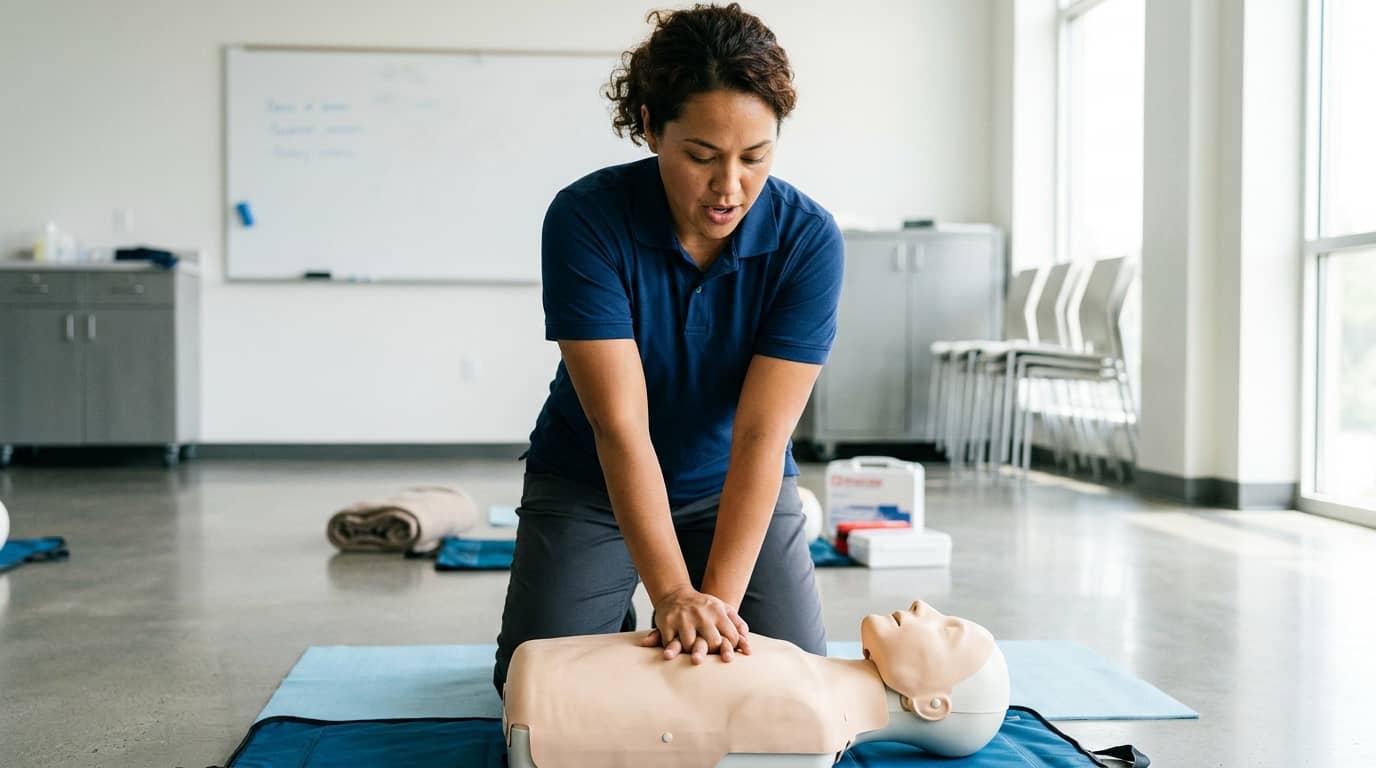
Lesson 4 • Cardiopulmonary Resuscitation Skills
Develops hands-on CPR technique for adults, children, and infants in remote settings. Integrates airway and breathing skills into a complete resuscitation sequence.
Chapter 3HideHide detailsSee detailsBleeding Control and Wound Management
Bleeding Control and Wound Management
Lesson 1 • Direct Pressure and Wound Packing
Teaches manual pressure and gauze packing for controlling severe wounds. Builds from basic pressure techniques to advanced packing for deep lacerations.
Lesson 2 • Tourniquet Application and Improvisation
Covers commercial tourniquet use and improvised alternatives for extremity haemorrhage. Addresses common errors and field-specific challenges.
Lesson 3 • Haemorrhage Recognition and Classification
Identifies arterial, venous, and capillary bleeding and assesses severity. Provides the diagnostic foundation for selecting appropriate bleeding control methods.
Lesson 4 • Infection Recognition and Prevention
Identifies early signs of wound infection and teaches preventive measures in austere environments. Prepares students to make evacuation decisions based on infection progression.
Lesson 5 • Wound Cleaning and Dressing
Establishes irrigation, debridement, and dressing protocols for field wound care. Connects haemorrhage control to infection prevention over extended evacuations.
Chapter 4HideHide detailsSee detailsMusculoskeletal Injuries in the Field
Musculoskeletal Injuries in the Field
Lesson 1 • Upper Extremity Injury Management
Addresses shoulder, elbow, wrist, and hand injuries common in outdoor activities. Applies splinting principles to specific upper extremity anatomical challenges.
Lesson 2 • Lower Extremity Injury Management
Covers femur, tibia, ankle, and foot injuries with emphasis on weight-bearing assessment. Connects lower extremity management to evacuation planning and patient mobility.
Lesson 3 • Assessing Musculoskeletal Injuries
Teaches the six P's assessment and neurovascular checks for extremity injuries. Provides the diagnostic framework used before any splinting or reduction attempt.
Lesson 4 • Splinting Principles and Techniques
Covers rigid, soft, and traction splinting methods using commercial and improvised materials. Builds on injury assessment to immobilise fractures safely for transport.
Chapter 5HideHide detailsSee detailsSpine and Head Injury Management
Spine and Head Injury Management
Lesson 1 • Spinal Anatomy and Injury Mechanisms
Reviews relevant spinal anatomy and identifies mechanisms that produce spinal injury. Provides the anatomical foundation for selective immobilisation decision-making.
Lesson 2 • Selective Spinal Immobilisation Criteria
Applies evidence-based criteria to clear or immobilise the spine without imaging in the field. Reduces unnecessary immobilisation while protecting high-risk patients.
Lesson 3 • Head Injury Assessment and Monitoring
Teaches Glasgow Coma Scale scoring and serial neurological assessments for traumatic brain injury. Identifies deterioration patterns requiring immediate evacuation.
Lesson 4 • Cervical Collar and Immobilisation Techniques
Covers cervical collar sizing, application, and improvised alternatives for spinal protection. Connects clearance decisions to appropriate immobilisation methods.
Chapter 6HideHide detailsSee detailsEnvironmental Emergencies
Environmental Emergencies
Lesson 1 • Altitude Illness Recognition and Treatment
Covers acute mountain sickness, high-altitude pulmonary oedema, and high-altitude cerebral oedema. Teaches descent decisions and portable hyperbaric chamber use.
Lesson 2 • Hypothermia Recognition and Rewarming
Classifies hypothermia severity and applies field rewarming strategies matched to patient condition. Addresses the afterdrop phenomenon and cardiac risks during rewarming.
Lesson 3 • Heat-Related Illness Management
Distinguishes heat cramps, heat exhaustion, and heat stroke and applies appropriate cooling interventions. Emphasises rapid cooling as the life-saving priority in heat stroke.
Lesson 4 • Lightning and Electrical Injuries
Addresses lightning strike triage, reverse triage principles, and field treatment priorities. Connects scene safety to patient assessment in ongoing storm conditions.
Lesson 5 • Frostbite and Cold Injuries
Identifies frostbite stages and applies field thawing protocols when evacuation is delayed. Distinguishes frostbite from frostnip and trench foot for appropriate treatment.
Chapter 7HideHide detailsSee detailsMedical Emergencies in Remote Settings
Medical Emergencies in Remote Settings
Lesson 1 • Seizure Management
Covers seizure types, patient protection during an episode, and post-ictal care in the field. Identifies red flags requiring urgent evacuation versus observation.
Lesson 2 • Diabetic Emergencies
Differentiates hypoglycaemia from hyperglycaemia and applies appropriate field interventions. Emphasises glucose administration as a diagnostic and therapeutic tool.
Lesson 3 • Chest Pain and Cardiac Events
Teaches recognition of acute coronary syndrome and differentiates cardiac from non-cardiac chest pain. Applies aspirin therapy and positions patients for optimal cardiac function.
Lesson 4 • Anaphylaxis and Allergic Reactions
Distinguishes mild allergic reactions from life-threatening anaphylaxis and administers epinephrine auto-injectors. Addresses repeat dosing and monitoring during prolonged evacuation.
Lesson 5 • Abdominal and Urological Emergencies
Identifies serious abdominal conditions requiring urgent evacuation and provides supportive field care. Covers urinary tract emergencies common in wilderness settings.
Chapter 8HideHide detailsSee detailsPatient Packaging and Field Evacuation
Patient Packaging and Field Evacuation
Lesson 1 • Improvised and Commercial Litter Construction
Teaches construction of improvised litters from field materials and use of commercial rescue litters. Addresses load distribution and structural integrity for varied terrain.
Lesson 2 • Litter Carry Techniques and Team Coordination
Develops multi-person carry techniques for flat, steep, and technical terrain. Emphasises communication and role assignment within the carry team.
Lesson 3 • Evacuation Decision-Making and Planning
Applies urgency criteria to determine evacuation method, route, and timing. Synthesises patient assessment, environmental factors, and available resources into an evacuation plan.
Lesson 4 • Patient Packaging Principles
Covers systematic preparation of a patient for transport, including insulation, padding, and securing. Integrates injury management skills into a complete pre-transport protocol.
Your valid completion certificate
This course is for you:
Hikers and backpackers: who venture far beyond cell service regularly.
Outdoor educators: responsible for student safety on multi-day expeditions.
Search and rescue volunteers: seeking structured medical training for field operations.
Camp counsellors: who supervise youth in remote or wilderness environments.
Adventure travel guides: leading clients through terrain with no nearby medical facilities.
Hunters and anglers: who spend extended solo time in isolated backcountry settings.
What our students say
Your lessons are perfect. I purchased the one-year package and finally have the opportunity to follow various topics of my interest without needing to change platforms... I thank you for everything you do, I've already recommended you to other people...

I like how the lessons are straight to the point and how I can change chapters and skip content I don't need.

I like the content and the way videos are presented and transcribed, which speeds up the process!

The platform is fast, simple to use. The diversity of content and complementary videos help a lot with learning.

Top training programmes




FAQ
Who is Dedika?
Is the certificate valid in Kenya?
Are the courses free?
What is the course workload?
What are the courses like?
How do the courses work?
What is the duration of the courses?
What is the cost or price of the courses?
What is an EAD or online course and how does it work?
PDF Course