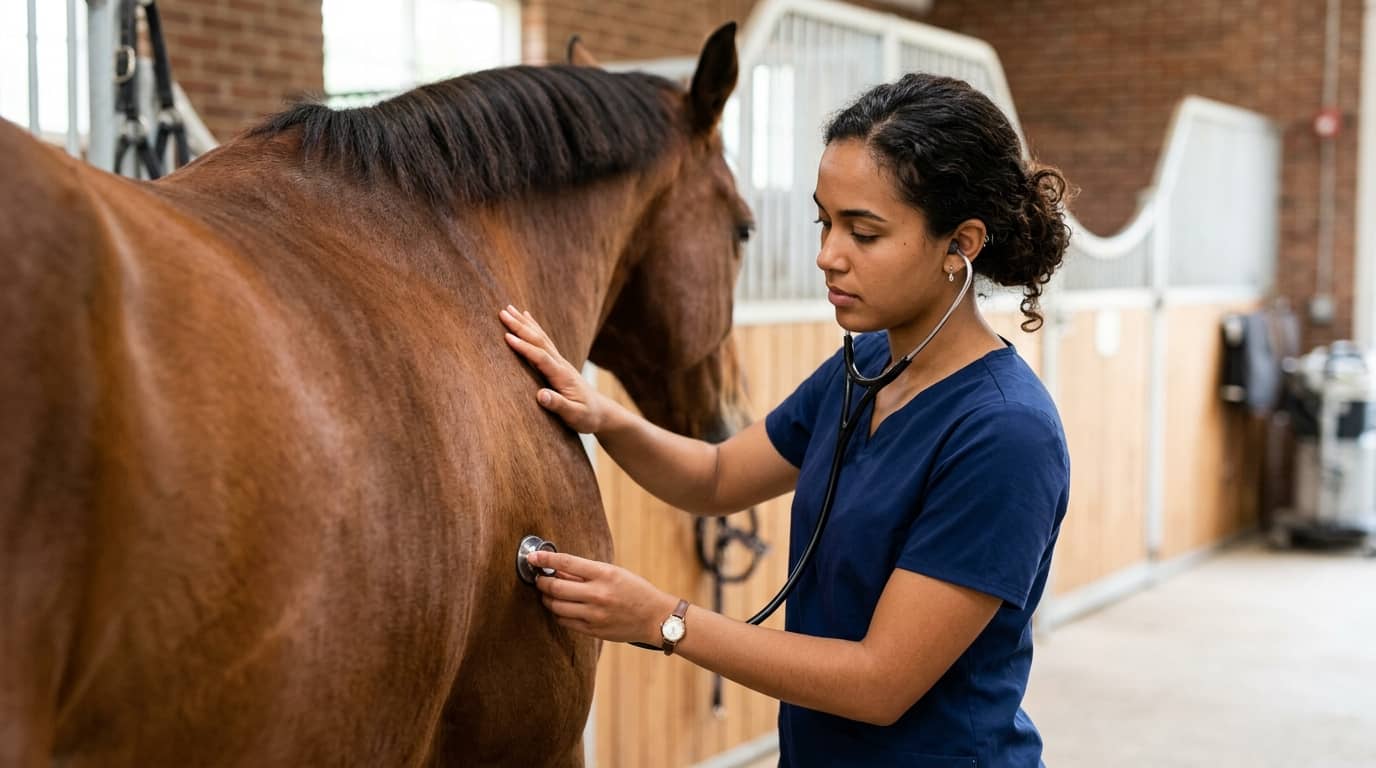
Equine Veterinary Assistant Course
Launch your career working alongside horses and the veterinarians who care for them. This course gives you the hands-on clinical knowledge and professional skills employers expect from a qualified equine veterinary assistant. From anatomy and vital signs to surgical support and emergency triage, every topic prepares you for real work in a real equine practice.
What you will learn:
You will build a complete skill set covering equine anatomy, behaviour, nutrition, disease prevention, and clinical procedures. You will learn how to assess vital signs, assist with physical exams, collect blood samples, and support surgical and emergency cases. The course also covers medication administration, wound care, vaccination programmes, and biosecurity protocols. You will gain practical knowledge of reproductive monitoring, diagnostic imaging support, and client communication. By the end, you will be ready to step into an equine veterinary practice and contribute from day one.
How you study in practice Equine Veterinary Assistant Course
How you practise Equine Veterinary Assistant Course
For companies looking to train their team
With Dedika for businesses, the course includes exercises and examples tailored to your own business and the specific needs of your company.

Course content
8 Chapters • 36 LessonsDuration between 4 and 360 hours (you decide)
Chapter 1HideHide detailsSee detailsIntroduction to Equine Veterinary Assisting
Introduction to Equine Veterinary Assisting
Lesson 1 • Equine Industry Overview
Surveys horse breeds, disciplines, and ownership contexts assistants encounter. Connects industry diversity to varied clinical demands.
Lesson 2 • Workplace Safety and Protocols
Covers personal protective equipment, zoonotic disease awareness, and facility safety rules. Prepares students to work safely before any hands-on contact.
Lesson 3 • Professional Communication Standards
Teaches verbal, written, and digital communication with clients and colleagues. Supports accurate record-keeping and client trust from day one.
Lesson 4 • The Equine Veterinary Assistant Role
Defines daily duties, scope of practice, and ethical boundaries for assistants. Establishes the professional identity students carry throughout the course.
Chapter 2HideHide detailsSee detailsEquine Anatomy and Physiology
Equine Anatomy and Physiology
Lesson 1 • Reproductive and Endocrine Systems
Outlines male and female reproductive anatomy and key hormonal cycles. Prepares students for reproductive monitoring tasks in advanced chapters.
Lesson 2 • Digestive System Anatomy
Maps the equine gastrointestinal tract from mouth to rectum, emphasising colic-prone regions. Directly prepares students for nutrition and colic recognition topics.
Lesson 3 • Skeletal and Muscular Systems
Identifies bones, joints, and major muscle groups relevant to lameness and injury assessment. Provides the structural map used in all subsequent clinical chapters.
Lesson 4 • Cardiovascular and Respiratory Systems
Explains heart function, circulation, and respiratory mechanics in horses. Supports vital sign assessment taught in the next chapter.
Lesson 5 • Integumentary and Hoof Anatomy
Describes skin layers, coat structures, and internal hoof anatomy. Grounds students in wound care and hoof health topics covered later.
Chapter 3HideHide detailsSee detailsEquine Behaviour and Safe Handling
Equine Behaviour and Safe Handling
Lesson 1 • Handling Difficult and Fearful Horses
Addresses desensitisation strategies and escalation protocols for reactive horses. Prepares students to maintain safety when standard techniques are insufficient.
Lesson 2 • Basic Haltering and Leading
Teaches correct halter fitting, approach techniques, and leading in varied environments. These skills are prerequisites for all restraint and examination procedures.
Lesson 3 • Understanding Equine Behaviour
Explains herd dynamics, flight instinct, and sensory perception that drive horse reactions. Builds the behavioural foundation required for safe handling decisions.
Lesson 4 • Restraint Techniques for Examination
Covers manual restraint, twitching, and positioning for routine veterinary procedures. Ensures student competency before assisting with clinical exams.
Chapter 4HideHide detailsSee detailsVital Signs and Physical Examination
Vital Signs and Physical Examination
Lesson 1 • Normal Vital Sign Parameters
Establishes normal ranges for temperature, pulse, respiration, and gut sounds. Provides the baseline reference used throughout all clinical assessment chapters.
Lesson 2 • Recognising Abnormal Findings
Trains students to identify and prioritise abnormal vital signs and physical findings. Connects observation skills to appropriate escalation and documentation actions.
Lesson 3 • Examination Documentation and Reporting
Covers accurate charting of exam findings using standard veterinary terminology. Ensures records support diagnosis, treatment planning, and legal compliance.
Lesson 4 • Systematic Physical Examination Assistance
Outlines the head-to-tail examination sequence and the assistant's support role. Reinforces anatomy knowledge by applying it to live examination scenarios.
Chapter 5HideHide detailsSee detailsEquine Nutrition and Feeding Management
Equine Nutrition and Feeding Management
Lesson 1 • Concentrates, Supplements, and Water
Reviews grain types, commercial feeds, and supplement roles in balancing rations. Addresses water quality and intake requirements critical to digestive health.
Lesson 2 • Feeding Management and Colic Prevention
Establishes feeding schedules, portion control, and management practices that reduce colic risk. Directly links nutrition management to the gastrointestinal anatomy covered earlier.
Lesson 3 • Nutritional Requirements by Life Stage
Compares energy, protein, and mineral needs for foals, adults, seniors, and breeding stock. Grounds feeding decisions in physiological requirements established in anatomy chapters.
Lesson 4 • Forage Types and Quality Assessment
Evaluates hay, pasture, and alternative forages for nutritional value and safety. Teaches students to assess forage quality before recommending feeding programmes.
Chapter 6HideHide detailsSee detailsClinical Procedures and Medication Administration
Clinical Procedures and Medication Administration
Lesson 1 • Nasogastric Intubation Assistance
Explains the assistant's role in preparing equipment and restraining horses during tubing. Connects digestive anatomy knowledge to this critical colic intervention procedure.
Lesson 2 • Medication Routes and Administration
Covers intramuscular, intravenous, subcutaneous, and oral medication delivery methods. Emphasises dose verification and adverse reaction recognition for patient safety.
Lesson 3 • Pharmacy and Controlled Substance Protocols
Covers drug storage, labelling, controlled substance logging, and dispensing regulations. Ensures students maintain legal and ethical compliance in medication management.
Lesson 4 • Wound Assessment and Basic Care
Trains students to classify wounds, perform irrigation, and apply bandages correctly. Applies integumentary anatomy knowledge to real clinical wound management.
Lesson 5 • Venepuncture and Sample Collection
Teaches jugular and cephalic venepuncture technique and proper sample handling. Builds on restraint skills to ensure safe, accurate specimen collection.
Chapter 7HideHide detailsSee detailsEquine Disease Recognition and Preventive Care
Equine Disease Recognition and Preventive Care
Lesson 1 • Vaccination Programmes and Administration
Outlines core and risk-based vaccine schedules and correct administration technique. Connects medication administration skills to preventive herd health management.
Lesson 2 • Biosecurity Principles and Practices
Establishes isolation protocols, disinfection procedures, and traffic control for disease prevention. Reinforces workplace safety concepts with disease-specific application.
Lesson 3 • Internal and External Parasite Control
Covers faecal egg count interpretation, anthelmintic rotation, and ectoparasite management. Applies nutrition and digestive anatomy knowledge to parasite impact assessment.
Lesson 4 • Dental and Hoof Care Coordination
Describes routine dental floating assistance and hoof care scheduling with farriers. Integrates anatomy knowledge with preventive maintenance tasks in daily practice.
Lesson 5 • Common Infectious Diseases
Describes clinical signs, transmission routes, and assistant roles for key equine infectious diseases. Builds on vital sign and physical exam skills to support early detection.
Chapter 8HideHide detailsSee detailsSurgical and Emergency Assistance
Surgical and Emergency Assistance
Lesson 1 • Intraoperative Assistance Techniques
Defines instrument passing, suction, retraction, and sterile technique during surgery. Ensures students contribute effectively without compromising the sterile field.
Lesson 2 • Surgical Suite Preparation
Covers sterile field setup, instrument organisation, and pre-surgical patient preparation. Builds on clinical procedure skills to meet the higher standards of surgical environments.
Lesson 3 • Anaesthesia Monitoring Assistance
Trains students to monitor anaesthetic depth, vital signs, and equipment during procedures. Applies vital sign assessment skills to the high-stakes surgical context.
Lesson 4 • Emergency Triage and First Response
Prepares students to assess and prioritise colic, lacerations, fractures, and foaling emergencies. Integrates all prior clinical skills into rapid, organised emergency response.
Lesson 5 • Post-Operative Care and Anaesthetic Recovery
Covers recovery stall preparation, anaesthetic recovery monitoring, and wound care post-surgery. Connects surgical assistance to the ongoing clinical care skills developed earlier.
Your valid completion certificate
This course is for you:
Barn workers: ready to move into a formal veterinary support role.
Horse owners: wanting clinical knowledge to better advocate for their animals.
Veterinary receptionists: looking to expand into hands-on clinical responsibilities.
Career changers: drawn to equine health after working in unrelated fields.
Vet tech students: seeking a specialised equine foundation before clinical placement.
Riding instructors: aiming to broaden their professional value within the horse industry.
What our students say
Your classes are perfect. I purchased the one-year package and finally have the opportunity to follow various topics of my interest without needing to change platforms... I thank you for everything you do, I've already recommended you to other people...

I like how the lessons are straight to the point and how I can change chapters and skip content I don't need.

I like the content and the way videos are presented and transcribed, which speeds up the process!

The platform is fast, simple to use. The diversity of content and complementary videos help a lot with learning.

Top trainings


FAQ
Who is Dedika?
Is the certificate valid in Nigeria?
Are the courses free?
What is the course workload?
What are the courses like?
How do the courses work?
What is the duration of the courses?
What is the cost or price of the courses?
What is an EAD or online course and how does it work?
PDF Course