
Injection Molding Machine Course
Master every stage of injection molding — from machine anatomy and mold setup to scientific process optimization and automation. This course gives you the hands-on technical knowledge to run production confidently, troubleshoot defects fast, and deliver consistent part quality. Whether you're new to the press or looking to sharpen your skills, this is the training that moves your career forward.
What you will learn:
You'll build a complete understanding of injection molding machines, covering all major systems including injection, clamping, hydraulic, and electrical controls. You'll learn how to set up molds correctly, select process parameters from material data sheets, and verify first-article parts against specifications. The course covers defect identification and root cause analysis using proven methods like 5-Why and fishbone diagrams. You'll apply scientific molding principles to develop robust process windows backed by real data. Quality control tools including SPC, control charts, and inspection techniques are covered in full. Advanced topics include servo-driven machines, robotic part handling, cavity pressure sensing, and Industry 4.0 connectivity.
How you study in a practical way Injection Molding Machine Course
How you practice Injection Molding Machine Course
For companies who want to train their team
With Dedika for businesses, the course includes exercises and examples tailored to your own business and the way your company needs.

Course content
8 Chapters • 41 LessonsDuration between 4 and 360 hours (you decide)
Chapter 1HideHide detailsSee detailsFundamentals of Injection Molding
Fundamentals of Injection Molding
Lesson 1 • Safety and Workplace Standards
Covers machine guarding, lockout/tagout, PPE, and hot-surface hazards. Safe practices are enforced as non-negotiable prerequisites before hands-on work.
Lesson 2 • The Injection Molding Cycle
Breaks the cycle into discrete phases: mold close, inject, pack, cool, open, and eject. Understanding cycle phases is prerequisite to process optimization.
Lesson 3 • History and Industry Overview
Traces injection molding from early thermoplastics to modern automation. Establishes industry context and motivates deeper technical study.
Lesson 4 • Machine Anatomy and Major Systems
Identifies every major subsystem: injection, clamping, hydraulic, electrical, and control. Provides the vocabulary needed for all subsequent chapters.
Lesson 5 • Plastics Materials Basics
Introduces thermoplastics vs. thermosets, polymer structure, and melt behavior. Material knowledge underpins correct parameter selection throughout the course.
Chapter 2HideHide detailsSee detailsMachine Setup and Configuration
Machine Setup and Configuration
Lesson 1 • Pre-Setup Inspection and Planning
Reviews job orders, material data sheets, and mold documentation before touching the machine. Proper planning prevents costly setup errors.
Lesson 2 • Barrel and Nozzle Preparation
Addresses barrel purging, nozzle selection, and temperature zone setup. Proper barrel preparation ensures consistent melt quality from the first shot.
Lesson 3 • Mold Installation and Alignment
Covers crane and hoist use, mold clamping methods, and platen alignment verification. Correct installation prevents mold damage and flash defects.
Lesson 4 • First-Shot Verification
Establishes a systematic approach to evaluating the first part for dimensional and visual conformance. Links setup quality to downstream process control.
Lesson 5 • Initial Parameter Entry
Guides entry of starting temperatures, pressures, speeds, and times from process sheets. Accurate initial parameters reduce first-article scrap.
Chapter 3HideHide detailsSee detailsMold Design and Tooling Fundamentals
Mold Design and Tooling Fundamentals
Lesson 1 • Ejection System Design
Covers ejector pins, blades, sleeves, and stripper plates and their effect on part release. Ejection design directly impacts surface quality and cycle time.
Lesson 2 • Mold Construction and Components
Identifies core, cavity, runner system, and support plates within a two-plate and three-plate mold. Structural knowledge enables accurate troubleshooting.
Lesson 3 • Venting and Cooling Channels
Explains vent placement, depth, and land length alongside cooling channel layout. Proper venting and cooling prevent burns, short shots, and warpage.
Lesson 4 • Runner and Gating Systems
Compares cold runner, hot runner, and valve gate systems and their effect on material waste and cycle time. Gate selection drives part quality and economics.
Lesson 5 • Mold Maintenance Basics
Introduces preventive maintenance schedules, cleaning methods, and corrosion protection. Routine maintenance extends mold life and sustains part quality.
Chapter 4HideHide detailsSee detailsProcess Parameters and Control
Process Parameters and Control
Lesson 1 • Cooling System Management
Explains coolant flow, mold temperature uniformity, and cooling time calculation. Adequate cooling is essential for dimensional accuracy and cycle efficiency.
Lesson 2 • Pack, Hold, and Cushion
Covers packing pressure, hold time, and cushion management to control part weight and sink. These parameters directly govern dimensional stability.
Lesson 3 • Screw Recovery and Back Pressure
Details screw RPM, back pressure, and decompression settings and their effect on melt homogeneity. Proper recovery ensures consistent shot size.
Lesson 4 • Injection Speed and Pressure
Analyzes fill speed profiles, injection pressure limits, and velocity-to-pressure transfer. Correct speed and pressure settings prevent short shots and flash.
Lesson 5 • Temperature Control in Depth
Examines barrel zone temperatures, mold temperature, and their effects on flow and crystallinity. Temperature mastery is the single largest lever for part quality.
Chapter 5HideHide detailsSee detailsDefect Identification and Root Cause Analysis
Defect Identification and Root Cause Analysis
Lesson 1 • Material-Related Defect Causes
Links moisture, contamination, degradation, and regrind ratio to specific defect signatures. Material discipline is often the fastest path to defect elimination.
Lesson 2 • Tooling-Related Defect Causes
Connects worn vents, damaged gates, and misaligned ejectors to recurring defect patterns. Tooling diagnosis requires collaboration with the mold maintenance team.
Lesson 3 • Root Cause Analysis Methods
Applies fishbone diagrams, 5-Why analysis, and process variable mapping to defect investigation. Structured methods prevent recurrence and reduce scrap.
Lesson 4 • Visual Defect Classification
Catalogs sink marks, flash, short shots, weld lines, and surface blemishes with photographic criteria. Accurate classification is the first step in corrective action.
Lesson 5 • Dimensional and Structural Defects
Addresses warpage, shrinkage variation, sink, and stress cracking as dimensional failures. These defects require measurement data to diagnose accurately.
Chapter 6HideHide detailsSee detailsProcess Optimization and Scientific Molding
Process Optimization and Scientific Molding
Lesson 1 • Design of Experiments in Molding
Applies factorial and Taguchi DOE methods to identify critical process factors and interactions. DOE accelerates optimization and quantifies parameter sensitivity.
Lesson 2 • Viscosity and Fill Studies
Conducts viscosity curves and fill studies to establish optimal injection speed and transfer point. These studies reveal material behavior independent of machine variation.
Lesson 3 • Gate Seal and Pack Studies
Determines gate seal time and optimal pack pressure through weight-based studies. Correct pack settings eliminate sink and dimensional variation.
Lesson 4 • Scientific Molding Principles
Introduces decoupled molding philosophy, separating fill, pack, and recovery stages for independent control. This framework is the basis for all optimization studies.
Lesson 5 • Process Window Documentation
Formalizes optimized parameters into a process sheet and establishes acceptable operating ranges. Documented windows enable consistent production across shifts.
Lesson 6 • Cooling Time Optimization
Uses part temperature and dimensional data to find the minimum acceptable cooling time. Reducing cooling time improves cycle efficiency without sacrificing quality.
Chapter 7HideHide detailsSee detailsQuality Control and Inspection
Quality Control and Inspection
Lesson 1 • Quality Documentation and Traceability
Manages inspection records, nonconformance reports, and corrective action logs for full traceability. Documentation supports audits and continuous improvement initiatives.
Lesson 2 • Measurement Tools and Techniques
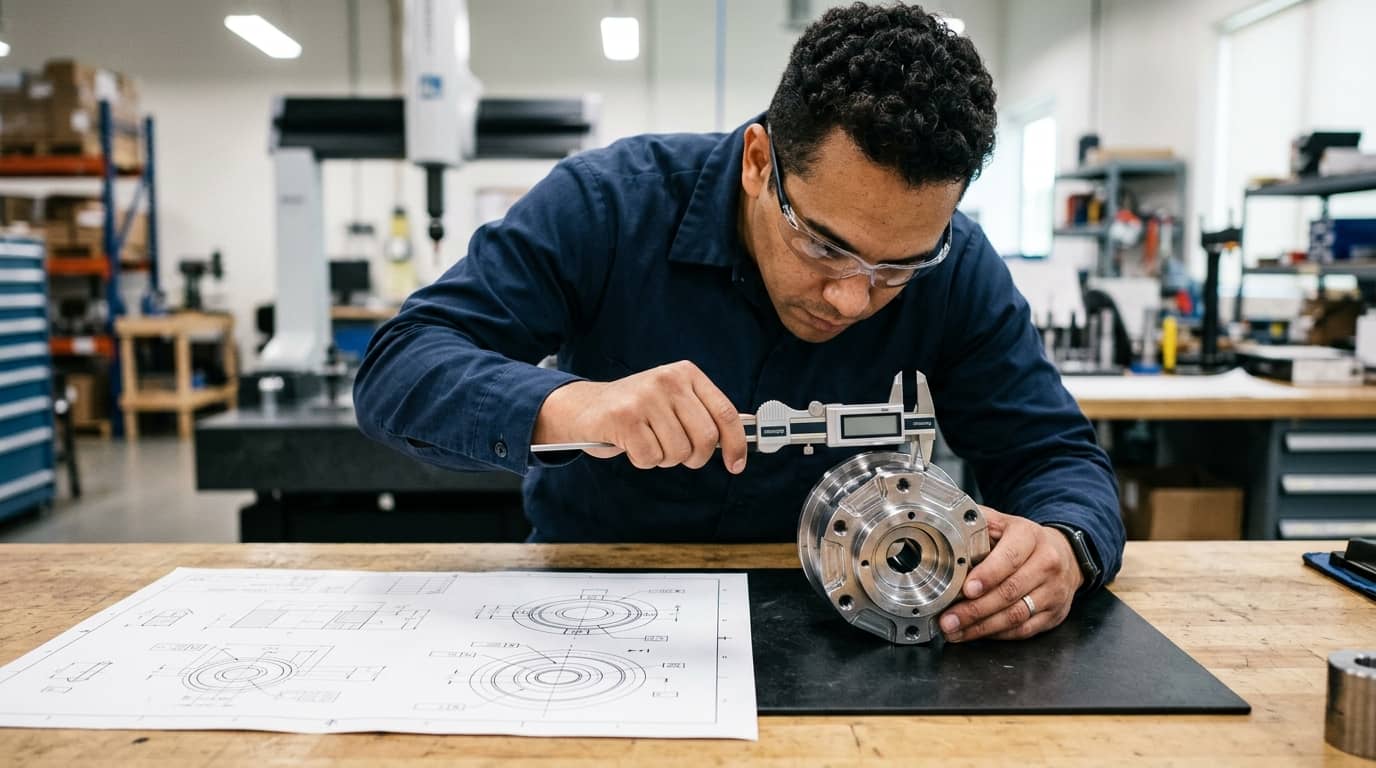
Covers calipers, micrometers, CMM basics, and optical comparators for part measurement. Correct tool selection and technique are prerequisites for valid data.
Lesson 3 • First Article Inspection
Structures a first article inspection report covering all drawing dimensions and material certifications. FAI validates that setup produces conforming parts before full production.
Lesson 4 • In-Process Sampling and Inspection
Establishes sampling frequency, inspection criteria, and operator inspection routines during production. Consistent in-process checks catch drift before scrap accumulates.
Lesson 5 • Statistical Process Control
Applies control charts, Cp, and Cpk indices to monitor process stability and capability. SPC converts measurement data into actionable process intelligence.
Chapter 8HideHide detailsSee detailsAdvanced Machine Systems and Automation
Advanced Machine Systems and Automation
Lesson 1 • Industry 4.0 and Machine Connectivity
Connects machines to MES and SCADA systems for real-time data collection and OEE tracking. Digital integration enables predictive maintenance and remote process monitoring.
Lesson 2 • Hot Runner Controllers and Valve Gates
Programs sequential valve gate timing and zone-by-zone temperature control for multi-cavity tools. Advanced hot runner control eliminates weld lines and balances fill.
Lesson 3 • Robotic Part Removal and Handling
Covers Cartesian and articulated robot integration, end-of-arm tooling, and safety interlocks. Robots reduce cycle time variation and eliminate manual handling damage.
Lesson 4 • Servo-Driven Machine Technology
Compares hydraulic, hybrid, and all-electric servo machines on energy use, precision, and repeatability. Servo technology is now the dominant platform in precision molding.
Lesson 5 • Cavity Pressure Sensing
Installs and interprets cavity pressure sensors to monitor fill, pack, and gate seal in real time. Cavity pressure data enables closed-loop quality control.
Your valid completion certificate
This course is for you:
Press operator: ready to move beyond button-pushing into real process ownership.
Maintenance technician: wants to understand molding processes that affect machine performance.
Quality inspector: needs deeper process knowledge to trace defects to their source.
Recent trade school graduate: entering plastics manufacturing and building a strong technical base.
Career changer: transitioning from general manufacturing into a specialized, higher-paying molding role.
Production supervisor: seeking technical credibility to lead and coach a molding team effectively.
What our students say
Your classes are perfect. I purchased the one-year package and finally have the opportunity to follow various topics of my interest without needing to change platforms... I thank you for everything you do, I've already recommended you to other people...

I like how the lessons are straight to the point and how I can switch chapters and skip content I don't need.

I like the content and the way videos are presented and transcribed, which speeds up the process!

The platform is fast, simple to use. The diversity of content and complementary videos really help with learning.

Top trainings



FAQs
Who is Dedika?
Is the certificate valid in the Philippines?
Are the courses free?
What is the course workload?
What are the courses like?
How do the courses work?
What is the duration of the courses?
What is the cost or price of the courses?
What is an EAD or online course and how does it work?
PDF Course