
Injection Molding Training
Master injection molding from the ground up — materials, machine setup, mold design, and quality control. This training gives you the hands-on knowledge to run production efficiently, troubleshoot defects fast, and keep equipment in top condition. Built for technicians who want real results on the shop floor.
What you will learn:
This course covers every critical area of injection molding, starting with process fundamentals and machine components, then moving into plastics materials, mold design, and machine setup. You will learn how to optimize process parameters using scientific molding methods and apply statistical process control to maintain consistent part quality. Defect identification and troubleshooting chapters walk you through diagnosing and correcting the most common production problems. Mold and machine maintenance modules teach you how to extend tooling life and reduce unplanned downtime. Advanced topics include lean manufacturing, simulation tools, and specialty molding processes.
How you study in a practical way Injection Molding Training
How you practice Injection Molding Training
For companies who want to train their team
With Dedika for businesses, the course includes exercises and examples tailored to your own business and the way your company needs.

Course content
8 Chapters • 41 LessonsDuration between 4 and 360 hours (you decide)
Chapter 1HideHide detailsSee detailsFundamentals of Injection Molding
Fundamentals of Injection Molding
Lesson 1 • Workplace Safety Essentials
Covers mandatory safety practices specific to injection molding environments. Ensures students can work safely before operating any equipment.
Lesson 2 • The Injection Molding Cycle
Breaks down each phase of the production cycle with timing and sequence logic. Prepares students to optimize cycle time in later chapters.
Lesson 3 • Major Machine Components
Identifies and explains the function of each machine subsystem. Connects component knowledge to process behavior and troubleshooting logic.
Lesson 4 • Overview of the Injection Molding Process
Introduces the complete injection molding cycle and its industrial applications. Establishes context for all subsequent technical content in the chapter.
Lesson 5 • Material Flow and Phase Changes
Explains how polymer pellets melt, flow, and solidify inside the machine and mold. Provides the physical basis for understanding process parameters.
Chapter 2HideHide detailsSee detailsPlastics Materials for Injection Molding
Plastics Materials for Injection Molding
Lesson 1 • Common Thermoplastic Families
Surveys the most widely molded thermoplastic resins and their key properties. Enables material identification and basic selection for given part requirements.
Lesson 2 • Polymer Chemistry Basics
Introduces molecular structure concepts that govern material behavior during processing. Links chemistry to practical processing decisions made on the shop floor.
Lesson 3 • Material Drying and Handling
Covers proper drying methods and material handling to prevent defects caused by moisture. Establishes pre-process quality control habits.
Lesson 4 • Material Data Sheets and Specifications
Teaches how to read and apply technical data sheets to set process parameters. Directly supports parameter setup covered in the next chapter.
Lesson 5 • Additives, Fillers, and Reinforcements
Explains how compounding agents modify base resin properties and processing behavior. Prepares students to interpret material data sheets accurately.
Chapter 3HideHide detailsSee detailsMold Design and Construction
Mold Design and Construction
Lesson 1 • Mold Materials and Surface Treatments
Reviews steel grades, aluminum tooling, and surface coatings used in mold construction. Helps students match tooling choices to production volume and material requirements.
Lesson 2 • Cavity and Core Design Principles
Covers geometry features that enable part formation and release. Links design decisions to shrinkage, warpage, and surface quality outcomes.
Lesson 3 • Runner and Gate Systems
Explains how melt is delivered from the machine nozzle to the cavity. Connects runner and gate design to fill balance, pressure loss, and cycle time.
Lesson 4 • Ejection Systems and Venting
Describes mechanisms for part removal and gas escape from the mold cavity. Connects ejection and venting design to common defects such as sticking and burning.
Lesson 5 • Cooling System Design
Teaches cooling channel layout strategies and their effect on cycle time and part quality. Directly supports cooling optimization in the process parameters chapter.
Lesson 6 • Mold Bases and Plate Systems
Identifies standard mold base configurations and the role of each plate. Provides the structural framework for understanding all other mold components.
Chapter 4HideHide detailsSee detailsMachine Setup and Process Parameters
Machine Setup and Process Parameters
Lesson 1 • Temperature Parameter Setup
Guides students through setting barrel zones, nozzle, and mold temperatures. Links temperature settings to material data sheets reviewed in Chapter 2.
Lesson 2 • Mold Installation and Alignment
Covers safe mold mounting, alignment, and connection of utilities. Ensures mold integrity and machine safety before the first shot.
Lesson 3 • Cooling and Cycle Time Setup
Establishes cooling time, mold open timing, and ejection parameters. Completes the full cycle setup sequence started in previous sections.
Lesson 4 • Injection and Pack Parameter Setup
Teaches how to set injection speed, pressure, and pack profiles. Connects these parameters to fill behavior and part density.
Lesson 5 • Machine Selection and Tonnage Calculation
Explains how to match machine size to mold and part requirements. Prevents under-clamping and over-clamping errors before setup begins.
Chapter 5HideHide detailsSee detailsProcess Optimization and Control
Process Optimization and Control
Lesson 1 • Establishing and Documenting Process Windows
Defines acceptable parameter ranges and formalizes them in process documentation. Creates the foundation for statistical process control in the next chapter.
Lesson 2 • Fill and Pack Optimization
Uses short-shot studies and pack sweeps to optimize fill and pack stages. Directly reduces sink marks, flash, and short shots.
Lesson 3 • Design of Experiments for Molding
Introduces structured experimental methods to identify key process variables efficiently. Enables students to optimize multiple parameters simultaneously.
Lesson 4 • Cooling Optimization
Applies cooling studies to minimize cycle time without sacrificing part quality. Builds on cooling system design knowledge from Chapter 3.
Lesson 5 • Scientific Molding Principles
Introduces the data-driven approach to process development and control. Establishes the methodology used throughout this chapter and in advanced troubleshooting.
Chapter 6HideHide detailsSee detailsQuality Control and Inspection
Quality Control and Inspection
Lesson 1 • Visual and Surface Quality Standards
Defines acceptance criteria for surface defects, color, and cosmetic appearance. Enables consistent pass-fail decisions at the press and inspection station.
Lesson 2 • Statistical Process Control Fundamentals
Introduces control charts and capability indices for monitoring process stability. Builds directly on the process windows established in Chapter 5.
Lesson 3 • First Article and Production Inspection Plans
Guides students through first article approval and ongoing inspection planning. Formalizes quality checkpoints within the production workflow.
Lesson 4 • Measurement System Analysis
Evaluates the reliability of measurement tools and operators through gauge studies. Ensures that inspection data accurately reflects true part variation.
Lesson 5 • Dimensional Measurement Techniques
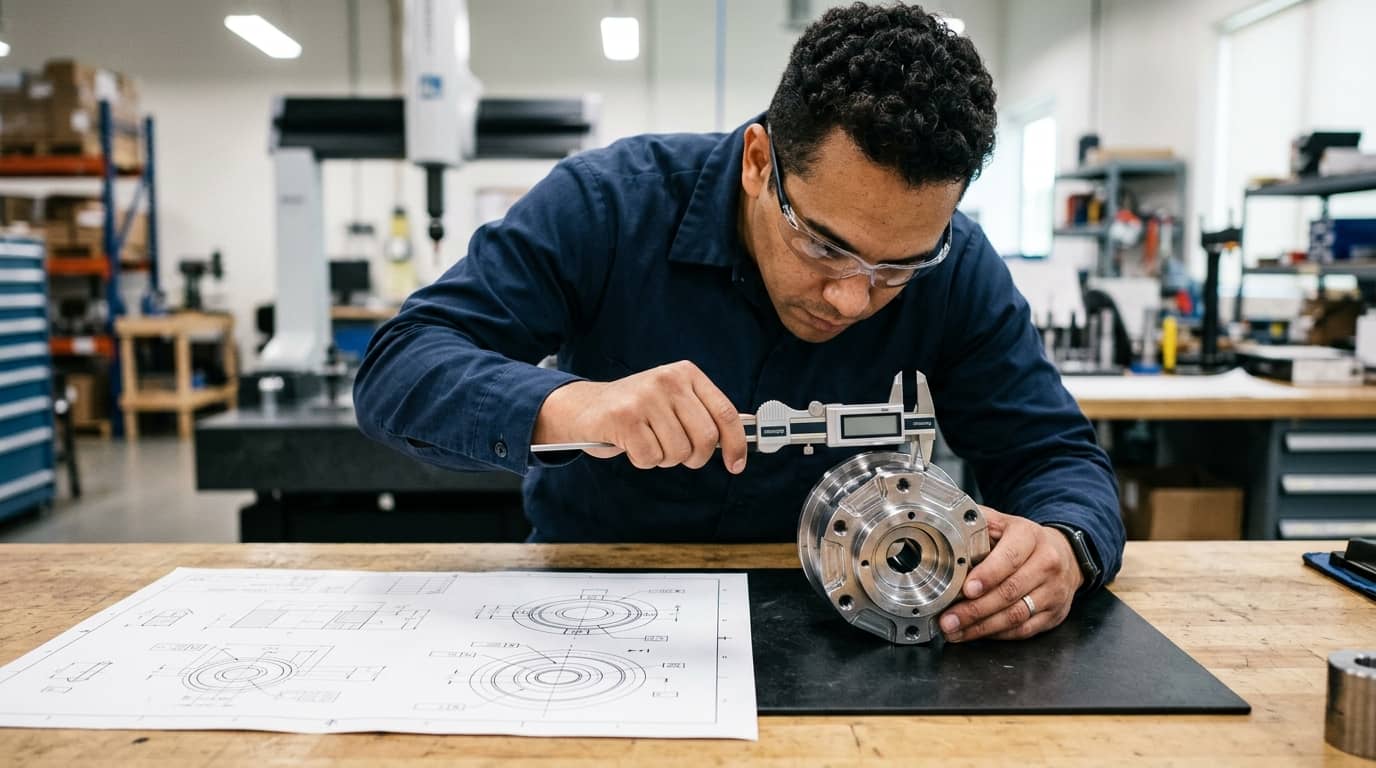
Covers hand tools and coordinate measurement methods used to verify part dimensions. Connects measurement accuracy to process parameter adjustments.
Chapter 7HideHide detailsSee detailsDefect Identification and Troubleshooting
Defect Identification and Troubleshooting
Lesson 1 • Ejection and Dimensional Defects
Resolves sticking, drag marks, and out-of-tolerance dimensions linked to ejection and mold wear. Integrates mold design knowledge from Chapter 3.
Lesson 2 • Packing and Shrinkage Defects
Covers sink marks, voids, and warpage resulting from inadequate pack or uneven cooling. Links defect correction to pack and cooling parameter adjustments.
Lesson 3 • Surface and Cosmetic Defects
Diagnoses weld lines, splay, delamination, and discoloration affecting part appearance. Connects surface defects to material handling, temperature, and mold condition.
Lesson 4 • Defect Classification and Root Causes
Categorizes defects by origin: material, machine, mold, and process. Provides the diagnostic framework applied throughout this chapter.
Lesson 5 • Fill-Related Defects
Addresses short shots, flash, and burn marks caused by improper fill conditions. Applies fill optimization knowledge from Chapter 5 to real defect scenarios.
Chapter 8HideHide detailsSee detailsMold Maintenance and Machine Care
Mold Maintenance and Machine Care
Lesson 1 • Preventive Maintenance Fundamentals
Establishes the principles and scheduling logic of preventive maintenance programs. Provides the management framework for all maintenance activities in this chapter.
Lesson 2 • Mold Repair and Component Replacement
Guides students through common mold repair tasks and component replacement procedures. Builds on mold construction knowledge from Chapter 3.
Lesson 3 • Machine Preventive Maintenance
Details lubrication, hydraulic, and electrical maintenance tasks for injection molding machines. Reduces machine-related process variation and unplanned stoppages.
Lesson 4 • Mold Cleaning and Inspection
Covers cleaning methods, inspection checkpoints, and condition assessment for production molds. Prevents defects caused by contamination and mold wear.
Lesson 5 • Maintenance Records and Continuous Improvement
Establishes documentation practices and uses maintenance data to drive reliability improvements. Closes the loop between maintenance execution and process quality.
Your valid completion certificate
This course is for you:
Machine operators ready to move beyond button-pushing into process ownership.
Recent manufacturing graduates seeking specialized, industry-ready technical credentials.
Quality inspectors who want to understand root causes behind the defects they flag.
Maintenance technicians looking to expand their expertise into mold care and machine upkeep.
Career changers from general manufacturing who are entering the plastics industry.
Junior process engineers who need structured, shop-floor-grounded molding knowledge.
What our students say
Your classes are perfect. I purchased the one-year package and finally have the opportunity to follow various topics of my interest without needing to change platforms... I thank you for everything you do, I've already recommended you to other people...

I like how the lessons are straight to the point and how I can switch chapters and skip content I don't need.

I like the content and the way videos are presented and transcribed, which speeds up the process!

The platform is fast, simple to use. The diversity of content and complementary videos really help with learning.

Top trainings



FAQs
Who is Dedika?
Is the certificate valid in the Philippines?
Are the courses free?
What is the course workload?
What are the courses like?
How do the courses work?
What is the duration of the courses?
What is the cost or price of the courses?
What is an EAD or online course and how does it work?
PDF Course