
Sheet Metal Worker Training
Master every core skill of the sheet metal trade, from layout and cutting to welding, duct fabrication, and architectural applications. This comprehensive training covers hand tools, power equipment, pattern development, and HVAC systems in one structured program. Whether you're entering the trade or sharpening your existing skills, this course gives you the technical foundation employers demand.
What you will learn:
You will learn to read shop drawings, develop flat patterns using parallel line, radial, and triangulation methods, and operate hand brakes, press brakes, and roll-forming machines with precision. The course covers manual and powered cutting, MIG and TIG welding on thin-gauge metal, and mechanical joining with seams, rivets, and fasteners. You will fabricate and install rectangular and round HVAC ductwork, produce architectural roofing panels and flashing, and apply surface finishing and coating techniques. Supplementary modules introduce CNC plasma and laser cutting, shop math, and career development pathways to help you advance in the trade.
How you study in a practical way Sheet Metal Worker Training
How you practice Sheet Metal Worker Training
For companies who want to train their team
With Dedika for businesses, the course includes exercises and examples tailored to your own business and the way your company needs.

Course content
8 Chapters • 42 LessonsDuration between 4 and 360 hours (you decide)
Chapter 1HideHide detailsSee detailsFoundations of Sheet Metal Work
Foundations of Sheet Metal Work
Lesson 1 • Reading Basic Shop Drawings
Teaches interpretation of orthographic views, dimensions, and symbols on shop drawings. Blueprint literacy is required for all fabrication tasks ahead.
Lesson 2 • Workplace Safety and Hazard Awareness
Introduces safety regulations, personal protective equipment, and hazard identification. Safe habits established here underpin every hands-on chapter.
Lesson 3 • Introduction to the Sheet Metal Trade
Covers the history, scope, and career pathways of sheet metal work. Establishes context for all subsequent technical training.
Lesson 4 • Sheet Metal Materials Overview
Examines common metals, their properties, and selection criteria for different applications. Material knowledge informs cutting, forming, and joining decisions throughout the course.
Lesson 5 • Hand Tools and Basic Equipment
Identifies and demonstrates proper use of essential hand tools. Correct tool handling reduces injury risk and improves work quality.
Chapter 2HideHide detailsSee detailsMeasurement, Layout, and Pattern Development
Measurement, Layout, and Pattern Development
Lesson 1 • Layout Tools and Marking Methods
Introduces scribers, squares, protractors, and chalk lines for transferring measurements to metal. Accurate layout prevents material waste and rework.
Lesson 2 • Radial Line Pattern Development
Covers radial line development for cones and pyramids. Mastery enables fabrication of tapered fittings used in HVAC and architectural work.
Lesson 3 • Precision Measurement Techniques
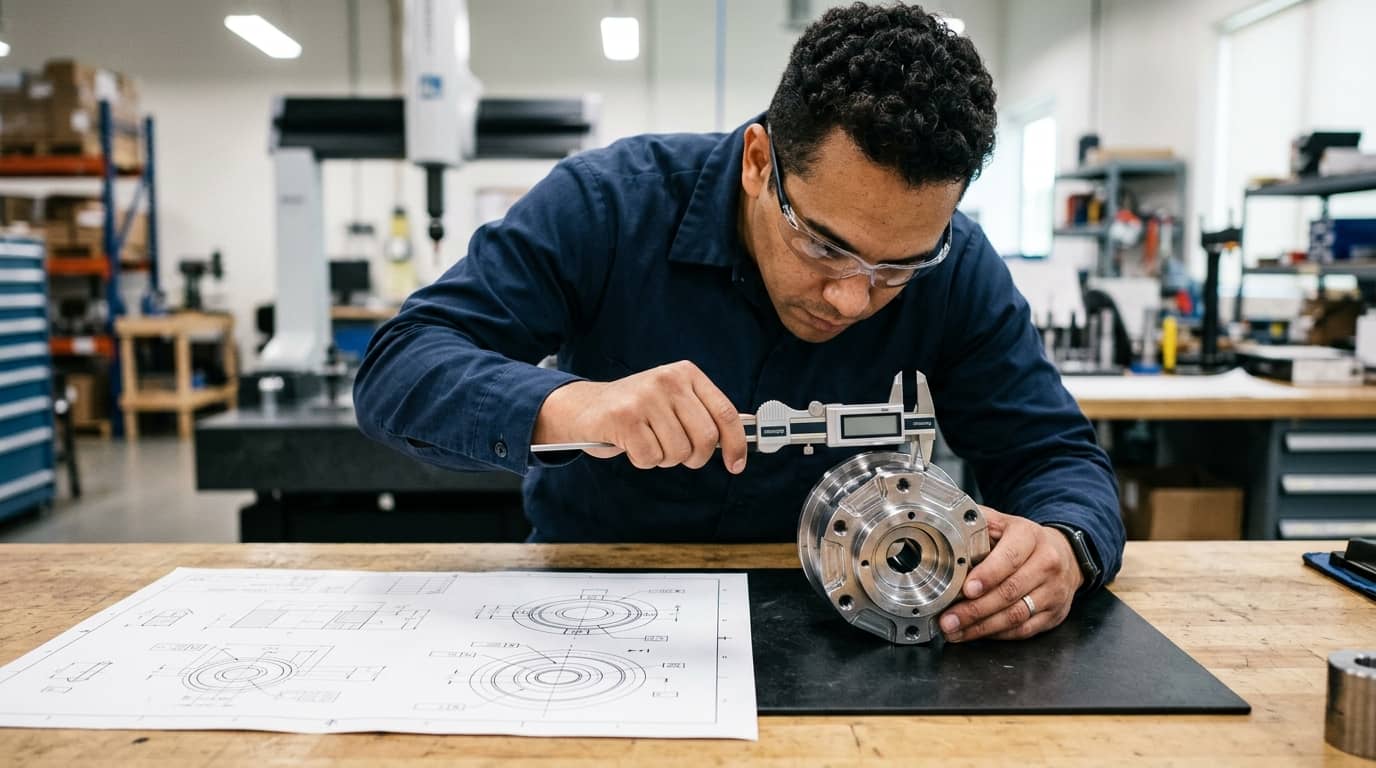
Covers rules, tapes, calipers, and micrometers for accurate measurement. Precision here directly affects fit and finish in all fabricated parts.
Lesson 4 • Parallel Line Pattern Development
Teaches the parallel line method for developing flat patterns of prisms and cylinders. Students produce stretchout patterns ready for cutting and forming.
Lesson 5 • Geometric Construction Principles
Applies geometric constructions—bisecting angles, drawing arcs, and dividing lines—to layout work. These skills are the basis for all pattern development.
Lesson 6 • Triangulation Pattern Development
Introduces triangulation for transitional pieces connecting different shapes. This advanced layout method completes the pattern development toolkit.
Chapter 3HideHide detailsSee detailsCutting and Shearing Operations
Cutting and Shearing Operations
Lesson 1 • Power Shear and Nibbler Operation
Covers electric and pneumatic shears and nibblers for high-volume cutting. Students learn setup, feed rates, and safe operating procedures.
Lesson 2 • Cutting Quality and Inspection
Establishes standards for cut quality, including squareness, burr height, and dimensional accuracy. Inspection skills connect cutting to downstream fabrication steps.
Lesson 3 • Plasma Cutting Fundamentals
Introduces plasma arc cutting for fast, precise cuts on ferrous and non-ferrous metals. Safe setup and torch technique are emphasized.
Lesson 4 • Manual Cutting with Snips and Shears
Demonstrates straight, curved, and combination cuts using hand snips and bench shears. Proper technique minimizes distortion and burr formation.
Lesson 5 • Angle Grinder and Cutting Wheel Use
Teaches safe use of angle grinders for cutting, grinding, and deburring sheet metal. Wheel selection and guard positioning are critical safety topics.
Chapter 4HideHide detailsSee detailsForming and Bending Techniques
Forming and Bending Techniques
Lesson 1 • Hand Brake and Box-and-Pan Brake Operation
Covers setup, adjustment, and operation of hand brakes and box-and-pan brakes for straight and box bends. Proper clamping and back-gauge use ensure repeatability.
Lesson 2 • Press Brake Fundamentals
Introduces hydraulic and mechanical press brakes for high-precision bending. Students learn tooling selection, tonnage calculation, and safe operation.
Lesson 3 • Roll Forming and Slip Rolling
Teaches use of slip rolls and roll-forming machines to produce cylinders, cones, and curved panels. Roller gap and feed angle control the resulting radius.
Lesson 4 • Folding, Hemming, and Edge Stiffening
Covers folding machine operation and hand-forming techniques for hems, flanges, and stiffening beads. Edge treatment improves part strength and safety.
Lesson 5 • Bend Allowance and Setback Calculations
Explains the math behind bend allowance, setback, and K-factor for accurate blank sizing. Correct calculations prevent scrap and rework on formed parts.
Chapter 5HideHide detailsSee detailsJoining Methods: Seams and Fasteners
Joining Methods: Seams and Fasteners
Lesson 1 • Clinching and Staking Methods
Introduces tool-free clinching and staking for joining sheet metal without fasteners. These methods are common in high-volume fabrication environments.
Lesson 2 • Sheet Metal Seam Types and Applications
Identifies grooved, Pittsburgh, snap-lock, and standing seams and their structural roles. Seam selection affects both strength and airtightness of assemblies.
Lesson 3 • Sheet Metal Screws and Clips
Teaches selection and installation of self-tapping screws, drive clips, and S-clips for duct and panel assembly. Fastener torque and spacing affect joint performance.
Lesson 4 • Riveting Techniques and Rivet Selection
Covers solid and blind rivet installation for permanent mechanical joints. Correct rivet size, spacing, and edge distance ensure joint integrity.
Lesson 5 • Sealants and Gaskets for Airtight Joints
Covers mastic sealants, foil tape, and gasket materials used to seal mechanical joints. Proper application ensures compliance with air-leakage performance standards.
Chapter 6HideHide detailsSee detailsWelding and Soldering for Sheet Metal
Welding and Soldering for Sheet Metal
Lesson 1 • TIG Welding for Precision Joints
Introduces TIG welding for stainless steel, aluminum, and decorative sheet metal work. Precise heat control and filler rod technique produce clean, high-quality welds.
Lesson 2 • MIG Welding Thin Sheet Metal
Covers MIG setup, wire selection, and technique for welding thin-gauge steel and aluminum. Controlling heat input prevents burn-through and warping.
Lesson 3 • Soldering and Brazing Sheet Metal
Covers soft soldering and silver brazing for copper, stainless, and galvanized sheet. Flux selection and heat application determine joint strength and appearance.
Lesson 4 • Resistance Spot Welding
Teaches spot welder setup and electrode maintenance for joining overlapping sheet metal panels. Consistent nugget size and spacing ensure structural performance.
Lesson 5 • Welding Safety and Preparation
Establishes welding-specific safety practices including fume control, fire prevention, and arc flash protection. Safe setup is mandatory before any welding operation.
Chapter 7HideHide detailsSee detailsHVAC Duct Fabrication and Installation
HVAC Duct Fabrication and Installation
Lesson 1 • Duct Hanging, Support, and Installation
Covers hanger types, spacing standards, and installation sequence for suspended ductwork. Proper support prevents sagging, vibration, and joint failure.
Lesson 2 • Fittings: Transitions, Tees, and Reducers
Applies pattern development skills to fabricate transitions, tees, wyes, and reducers. Accurate fittings minimize turbulence and pressure loss in the system.
Lesson 3 • HVAC System Fundamentals for Fabricators
Introduces airflow principles, system components, and duct classifications relevant to fabricators. Understanding system function guides correct material and gauge selection.
Lesson 4 • Round and Oval Duct Fabrication
Teaches spiral and longitudinal seam round duct production and oval duct forming. Round duct offers lower resistance and is common in commercial systems.
Lesson 5 • Rectangular Duct Fabrication
Covers layout, cutting, forming, and seaming of rectangular duct sections. Dimensional accuracy and seam integrity are verified against shop drawings.
Lesson 6 • Duct Testing and Commissioning
Introduces pressure testing, leakage measurement, and balancing procedures for completed duct systems. Testing confirms performance before system handover.
Chapter 8HideHide detailsSee detailsArchitectural and Industrial Sheet Metal Applications
Architectural and Industrial Sheet Metal Applications
Lesson 1 • Roofing and Standing Seam Panels
Covers layout, forming, and installation of standing seam metal roofing panels. Thermal expansion, drainage, and weathertightness are key design considerations.
Lesson 2 • Gutters, Downspouts, and Drainage Systems
Covers layout, forming, and installation of gutters, downspouts, and conductor heads. Proper sizing and slope ensure effective stormwater management.
Lesson 3 • Industrial Enclosures and Equipment Guards
Covers fabrication of machine guards, enclosures, and housings for industrial equipment. Structural rigidity, access panels, and safety compliance are primary requirements.
Lesson 4 • Flashing and Counterflashing Fabrication
Teaches design and fabrication of base flashing, counterflashing, and through-wall flashing. Correct flashing prevents water infiltration at roof penetrations and walls.
Lesson 5 • Wall Cladding and Fascia Panels
Introduces fabrication and installation of metal wall cladding, fascia, and soffit panels. Panel alignment, fastening, and joint treatment affect appearance and weatherproofing.
Your valid completion certificate
This course is for you:
Career changers: seeking stable, hands-on trade work with strong earning potential.
Recent high school graduates: exploring skilled trades instead of a four-year degree.
Construction laborers: ready to specialize and move into a higher-paying craft role.
HVAC helpers: wanting to understand ductwork fabrication beyond basic installation tasks.
Hobbyist metalworkers: looking to bring professional-grade techniques into their workshop.
Military veterans: translating mechanical aptitude into a recognized civilian trade credential.
What our students say
Your classes are perfect. I purchased the one-year package and finally have the opportunity to follow various topics of my interest without needing to change platforms... I thank you for everything you do, I've already recommended you to other people...

I like how the lessons are straight to the point and how I can switch chapters and skip content I don't need.

I like the content and the way videos are presented and transcribed, which speeds up the process!

The platform is fast, simple to use. The diversity of content and complementary videos really help with learning.

Top trainings



FAQs
Who is Dedika?
Is the certificate valid in the Philippines?
Are the courses free?
What is the course workload?
What are the courses like?
How do the courses work?
What is the duration of the courses?
What is the cost or price of the courses?
What is an EAD or online course and how does it work?
PDF Course