
Cooking for Beginners Course
Learn the real fundamentals of cooking — from knife skills and heat control to sauces, baking, and plating — all grounded in food science and culinary tradition. This course takes you from a blank cutting board to a fully executed three-course menu. Whether you cook at home or aim for a professional kitchen, you'll build skills that last a lifetime.
What you will learn:
In this course, you will master essential knife techniques, core cooking methods, and the science behind flavor development. You will learn how to build stocks and classical sauces, bake bread and pastry from scratch, and design balanced menus. Food safety, kitchen organization, and proper equipment use are covered before any cooking begins. You will also explore global culinary traditions, sustainable sourcing, and professional plating techniques. By the end, you will have the practical knowledge and hands-on skills to cook with confidence and consistency.
How you study in a practical way Cooking for Beginners Course
How you practice Cooking for Beginners Course
For companies who want to train their team
With Dedika for businesses, the course includes exercises and examples tailored to your own business and the way your company needs.

Course content
8 Chapters • 38 LessonsDuration between 4 and 360 hours (you decide)
Chapter 1HideHide detailsSee detailsIntroduction to Gastronomy and Food Culture
Introduction to Gastronomy and Food Culture
Lesson 1 • Defining Gastronomy as a Discipline
Gastronomy is framed as the study of food's relationship to culture, science, and art. This context anchors all subsequent technical and creative learning in the course.
Lesson 2 • Global Culinary Traditions Overview
Major world cuisines are surveyed to reveal how geography, climate, and history shape flavor profiles. Students gain a comparative lens used throughout the course.
Lesson 3 • Sensory Perception and Taste
The five basic tastes and the role of aroma, texture, and appearance in flavor perception are introduced. Students develop vocabulary for evaluating food throughout the course.
Lesson 4 • Food Systems and Supply Chains
The journey from farm to table is mapped, highlighting how production and distribution affect ingredient quality. This knowledge informs sourcing decisions in later chapters.
Chapter 2HideHide detailsSee detailsKitchen Safety, Hygiene, and Organization
Kitchen Safety, Hygiene, and Organization
Lesson 1 • Fire Safety and Emergency Procedures
Common kitchen fire hazards, extinguisher types, and emergency response steps are outlined. Students practice prevention habits that protect people and equipment throughout training.
Lesson 2 • Kitchen Layout and Station Organization
Mise en place philosophy and ergonomic station setup are introduced to maximize efficiency and minimize accidents. An organized station is the foundation of every technique chapter ahead.
Lesson 3 • Personal Hygiene in the Kitchen
Handwashing protocols, protective clothing, and illness policies are covered as the first line of food safety defense. Proper habits here prevent contamination at every cooking stage.
Lesson 4 • Proper Food Storage Techniques
Refrigeration, freezing, and dry-storage principles are taught alongside labeling and rotation systems. Correct storage directly extends ingredient quality used in recipe work.
Lesson 5 • Food Safety and Contamination Prevention
Cross-contamination, temperature danger zones, and safe food handling are examined using recognized food hygiene standards. Students apply these rules when storing and preparing ingredients.
Chapter 3HideHide detailsSee detailsEssential Kitchen Tools and Equipment
Essential Kitchen Tools and Equipment
Lesson 1 • Measuring and Portioning Tools
Dry and liquid measuring tools, kitchen scales, and portioning devices are introduced for accuracy. Precise measurement is the prerequisite skill for recipe execution covered next.
Lesson 2 • Cookware and Bakeware Essentials
Pans, pots, and baking vessels are categorized by material and heat-transfer properties. Matching cookware to cooking method prevents common beginner errors in later technique chapters.
Lesson 3 • Knives: Types, Selection, and Care
Chef's, paring, serrated, and boning knives are distinguished by design and function. Proper honing, sharpening, and storage habits extend blade life and ensure safe use.
Lesson 4 • Thermometers and Temperature Tools
Instant-read, probe, and candy thermometers are matched to specific cooking applications. Accurate temperature monitoring ties directly to food safety and cooking precision.
Lesson 5 • Small Appliances and Power Tools
Blenders, food processors, stand mixers, and immersion blenders are evaluated for their culinary applications. Students learn safe operation and cleaning to integrate these tools into recipes.
Chapter 4HideHide detailsSee detailsFoundational Knife Skills and Prep Techniques
Foundational Knife Skills and Prep Techniques
Lesson 1 • Classical Vegetable Cuts
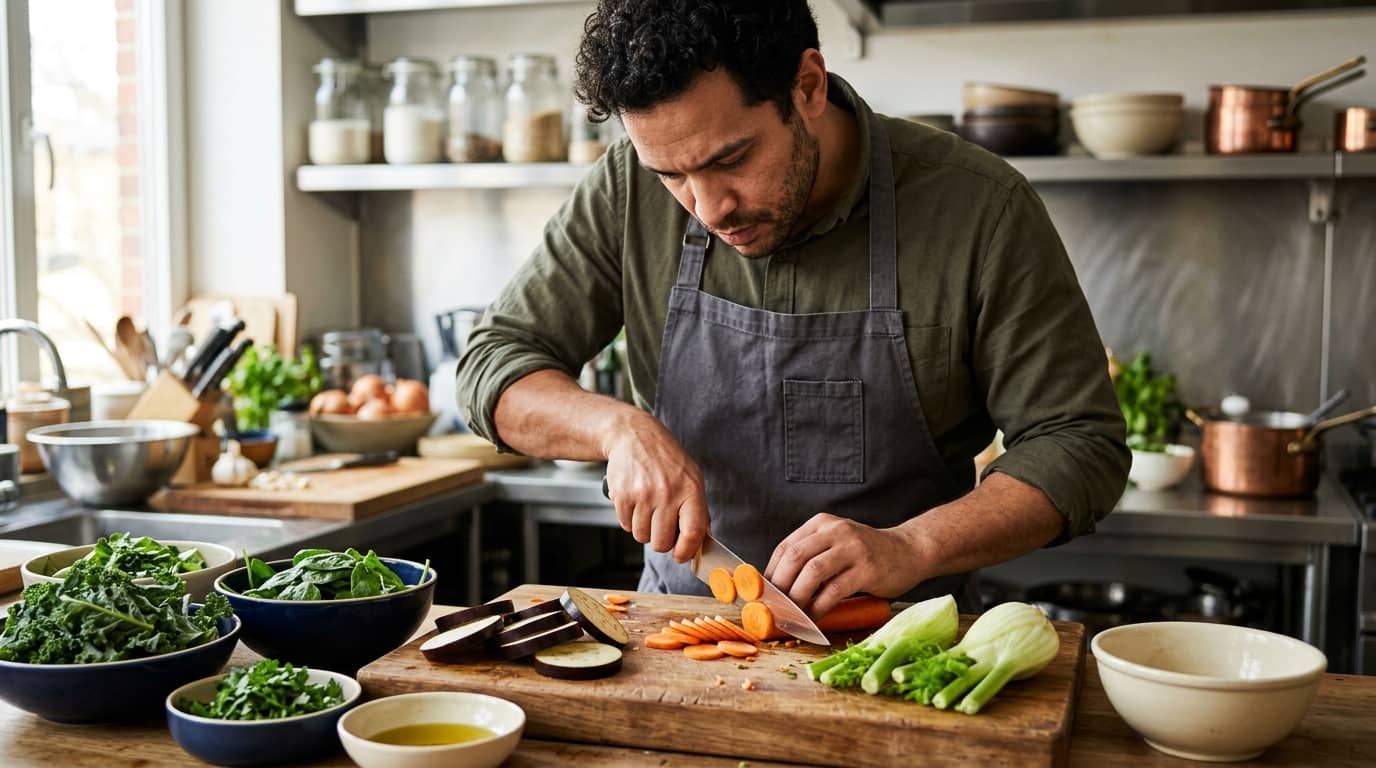
Julienne, brunoise, dice, chiffonade, and tourné cuts are demonstrated and practiced on common vegetables. Uniform cuts ensure even cooking, a principle applied in every subsequent recipe.
Lesson 2 • Breaking Down Proteins
Techniques for fabricating chicken, fish fillets, and beef cuts are introduced with safety emphasis. Proper butchery reduces waste and prepares students for protein cooking chapters.
Lesson 3 • Herb and Aromatics Preparation
Mincing garlic, bruising lemongrass, and chiffonading herbs are practiced as flavor-building prep steps. These skills feed directly into sauce and seasoning work in later chapters.
Lesson 4 • Knife Grip and Body Mechanics
The pinch grip, guide hand position, and stable cutting-board posture are drilled before any cutting begins. Correct mechanics prevent injury and build speed over time.
Chapter 5HideHide detailsSee detailsCore Cooking Methods and Heat Transfer
Core Cooking Methods and Heat Transfer
Lesson 1 • Moist-Heat Methods: Boil, Steam, and Poach
Boiling, simmering, steaming, and poaching are contrasted by temperature and texture outcomes. Students apply these methods to vegetables, eggs, and delicate proteins.
Lesson 2 • Principles of Heat Transfer in Cooking
Conduction, convection, and radiation are explained as the physical basis of all cooking methods. Understanding heat transfer helps students troubleshoot uneven cooking in practice.
Lesson 3 • Deep-Frying and Shallow-Frying
Oil temperature management, breading procedures, and safe frying practices are covered for both methods. Proper frying technique produces crisp, grease-free results and prevents burns.
Lesson 4 • Dry-Heat Methods: Sauté, Roast, and Grill
Sautéing, roasting, grilling, and broiling are practiced with attention to Maillard reaction and crust development. These methods form the backbone of most savory recipes ahead.
Lesson 5 • Combination Methods: Braise and Stew
Braising and stewing combine searing with slow moist cooking to tenderize tough cuts. Students build on knife and sauté skills to execute complete one-pot dishes.
Chapter 6HideHide detailsSee detailsFlavor Building: Stocks, Sauces, and Seasoning
Flavor Building: Stocks, Sauces, and Seasoning
Lesson 1 • Building Flavor Foundations with Stocks
Chicken, beef, fish, and vegetable stocks are made from scratch using proper ratios and skimming technique. Stocks serve as the liquid base for sauces and braises throughout the course.
Lesson 2 • Seasoning Principles and Balancing Flavors
Salt, acid, fat, and heat are applied as the four levers of flavor balance. Students taste and adjust dishes systematically rather than relying on guesswork.
Lesson 3 • Classical Mother Sauces
Béchamel, velouté, espagnole, hollandaise, and tomato sauce are prepared as the five mother sauces. Mastery here unlocks the derivative sauces used in advanced recipe work.
Lesson 4 • Herbs, Spices, and Aromatics
Fresh vs. dried herbs, spice blooming, and aromatic layering are explored to deepen flavor complexity. Students build spice intuition applied in every recipe from this point forward.
Lesson 5 • Pan Sauces and Deglazing
Fond development, deglazing, and reduction are practiced to create quick, flavorful pan sauces. This technique directly extends the sauté and roasting skills from the previous chapter.
Chapter 7HideHide detailsSee detailsBaking and Pastry Fundamentals
Baking and Pastry Fundamentals
Lesson 1 • Pastry Doughs: Shortcrust and Pâte Brisée
Fat-cutting technique, resting, and blind baking are used to produce flaky, tender pastry shells. These doughs form the base for tarts and pies in applied recipe sessions.
Lesson 2 • Baking Science: Ingredients and Their Roles
Flour, leaveners, fats, sugars, and eggs are analyzed for their structural and flavor functions. Understanding ingredient roles prevents common baking failures in all subsequent pastry work.
Lesson 3 • Yeast Breads and Fermentation Basics
Yeast activation, kneading, proofing, and shaping are practiced to produce a basic white loaf. Fermentation science introduced here supports advanced bread and pastry techniques.
Lesson 4 • Quick Breads and Muffin Method
The muffin method is applied to pancakes, muffins, and quick loaves as an entry point to baking. Students practice folding technique and learn how overmixing affects texture.
Lesson 5 • Basic Custards and Creams
Crème anglaise, pastry cream, and panna cotta are made using controlled heat and tempering. These preparations underpin dessert plating and advanced pastry work ahead.
Chapter 8HideHide detailsSee detailsMenu Planning, Plating, and Culinary Creativity
Menu Planning, Plating, and Culinary Creativity
Lesson 1 • Principles of Menu Design
Nutritional balance, flavor contrast, seasonal availability, and cost are applied to build a structured menu. Students integrate ingredient knowledge from all previous chapters into a unified plan.
Lesson 2 • Garnishing and Finishing Touches
Edible garnishes, microgreens, herb oils, and finishing salts are used to add flavor and visual polish. Garnishes must be purposeful, connecting to the dish's flavor profile.
Lesson 3 • Capstone: Full-Course Menu Execution
Students plan, prep, cook, and plate a three-course menu under timed conditions using all course skills. This practical assessment validates readiness for real-world culinary environments.
Lesson 4 • Developing a Personal Culinary Style
Flavor preferences, cultural influences, and technique mastery are synthesized into a recognizable cooking identity. Students articulate their culinary point of view through a signature dish.
Lesson 5 • Plating Techniques and Visual Composition
Rule of thirds, height, color contrast, and negative space are applied to plate food attractively. Visual presentation reinforces the flavor and technique work of every prior chapter.
Your valid completion certificate
This course is for you:
Home cooks: ready to move beyond recipes and understand why techniques work.
Career changers: exploring culinary work after leaving an unrelated professional field.
Food enthusiasts: passionate about global cuisines and eager to cook them authentically.
Hospitality students: building a practical foundation before entering formal culinary programs.
Parents and caregivers: wanting to prepare nutritious, varied meals with real skill.
Aspiring food entrepreneurs: developing culinary credibility before launching a food-based business.
What our students say
Your classes are perfect. I purchased the one-year package and finally have the opportunity to follow various topics of my interest without needing to change platforms... I thank you for everything you do, I've already recommended you to other people...

I like how the lessons are straight to the point and how I can switch chapters and skip content I don't need.

I like the content and the way videos are presented and transcribed, which speeds up the process!

The platform is fast, simple to use. The diversity of content and complementary videos really help with learning.

Top trainings




FAQs
Who is Dedika?
Is the certificate valid in the Philippines?
Are the courses free?
What is the course workload?
What are the courses like?
How do the courses work?
What is the duration of the courses?
What is the cost or price of the courses?
What is an EAD or online course and how does it work?
PDF Course