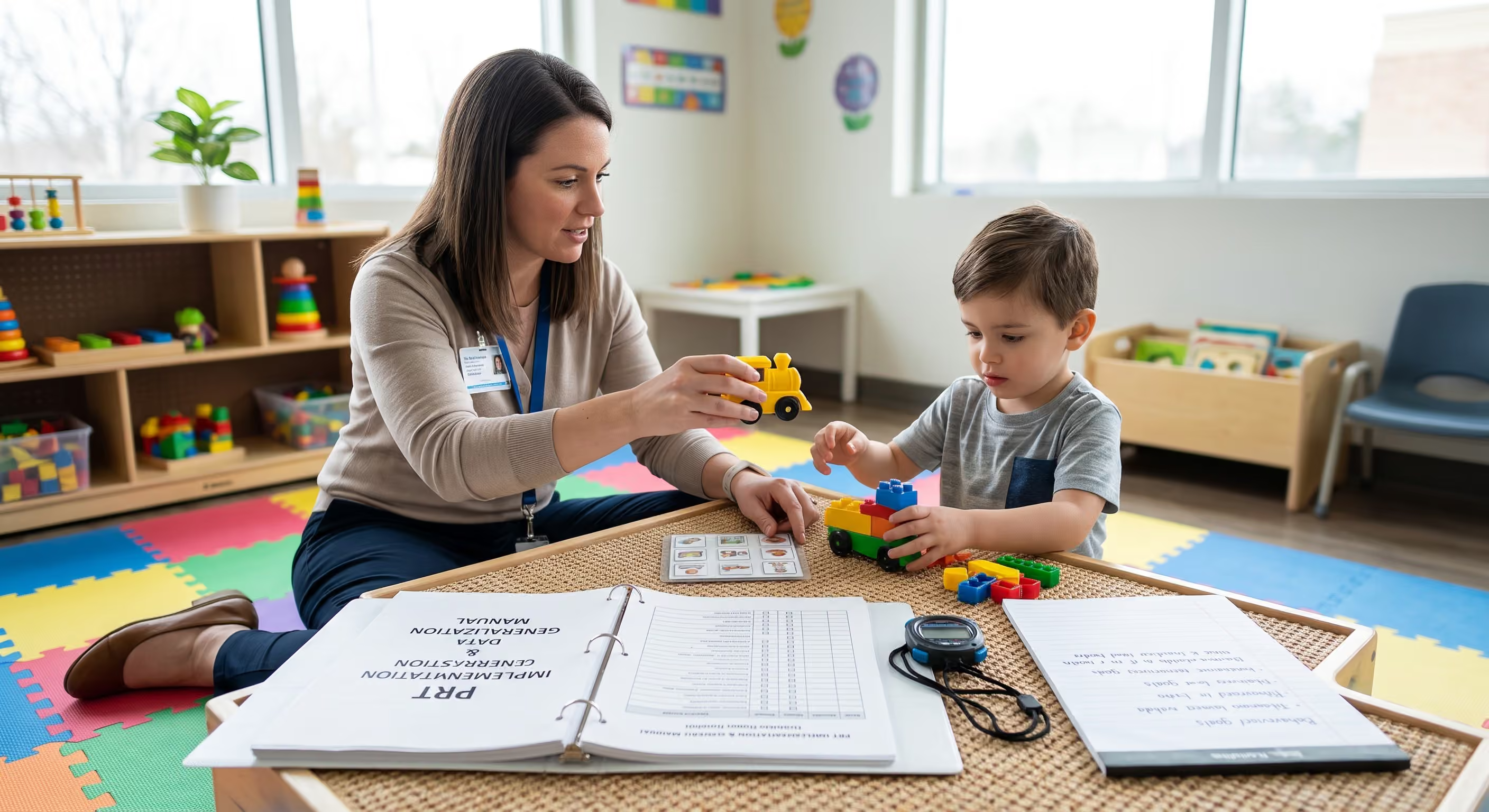
Pivotal Response Training for Autism Course
Master Pivotal Response Training and gain the clinical skills needed to make a real difference for autistic learners and their families. This comprehensive course covers everything from foundational ABA principles to advanced generalization strategies, caregiver coaching, and ethical practice. Whether you're new to PRT or looking to sharpen your existing skills, this course gives you the evidence-based tools to deliver effective, naturalistic intervention.
What you will learn:
This course gives you a thorough grounding in Pivotal Response Training, from its behavioral foundations and research base to hands-on implementation across communication, social skills, and daily routines. You will learn how to assess learners, write measurable goals, collect meaningful data, and apply all seven core PRT components with fidelity. The curriculum also covers caregiver training, multidisciplinary collaboration, cultural responsiveness, and the use of technology in PRT delivery. You will finish prepared to support autistic learners across a wide range of profiles and settings.
How you study in a practical way Pivotal Response Training for Autism Course
How you practice Pivotal Response Training for Autism Course
For companies who want to train their team
With Dedika for businesses, the course includes exercises and examples tailored to your own business and the way your company needs.

Course content
8 Chapters • 33 LessonsDuration between 4 and 360 hours (you decide)
Chapter 1HideHide detailsSee detailsFoundations of Autism and PRT
Foundations of Autism and PRT
Lesson 1 • Understanding Autism Spectrum Disorder
Covers ASD diagnostic criteria, prevalence, and heterogeneity of presentation. Grounds PRT rationale in the behavioral and developmental profile of autistic individuals.
Lesson 2 • Core Theoretical Principles of PRT
Explains the behavioral learning principles underlying PRT, including reinforcement and motivation. Connects theory to the practical design of PRT sessions.
Lesson 3 • History and Development of PRT
Traces PRT's origins from discrete trial training to naturalistic intervention. Contextualizes PRT within the broader evolution of applied behavior analysis.
Lesson 4 • Evidence Base and Research Support
Reviews peer-reviewed studies and meta-analyses validating PRT outcomes. Equips practitioners to justify PRT selection to families and stakeholders.
Chapter 2HideHide detailsSee detailsPivotal Areas and Their Significance
Pivotal Areas and Their Significance
Lesson 1 • Responsivity to Multiple Cues
Addresses stimulus overselectivity and teaches learners to respond to multiple environmental cues. Links cue responsivity to real-world generalization outcomes.
Lesson 2 • Motivation as the Primary Pivot
Defines motivation within PRT and distinguishes it from general engagement. Demonstrates how motivation drives acquisition across all other skill domains.
Lesson 3 • Self-Initiations and Social Engagement
Focuses on increasing spontaneous initiations toward peers and adults. Connects initiation skills to broader social competence and friendship development.
Lesson 4 • Self-Management Skills
Teaches learners to monitor and regulate their own behavior independently. Positions self-management as a pivotal area that reduces reliance on external prompts.
Chapter 3HideHide detailsSee detailsAssessment, Goal Setting, and Data Collection
Assessment, Goal Setting, and Data Collection
Lesson 1 • Writing Measurable PRT Goals
Teaches construction of observable, measurable goals aligned with pivotal areas. Well-written goals enable consistent data collection and progress monitoring.
Lesson 2 • Graphing and Interpreting Progress
Teaches visual analysis of line graphs to evaluate learner progress and treatment effects. Data interpretation guides decisions to modify, maintain, or discontinue targets.
Lesson 3 • Data Collection Methods in PRT
Introduces frequency, duration, interval, and probe data systems suited to PRT. Efficient data collection is balanced with maintaining naturalistic session flow.
Lesson 4 • Conducting Comprehensive Learner Assessments
Covers standardized and informal tools used to profile learner strengths and needs. Assessment results directly inform PRT target selection and program design.
Chapter 4HideHide detailsSee detailsCore PRT Techniques and Components
Core PRT Techniques and Components
Lesson 1 • Reinforcing Attempts and Shaping
Covers reinforcing reasonable attempts to prevent learned helplessness and build persistence. Shaping procedures are applied to move learners toward target responses.
Lesson 2 • Task Variation and Maintenance Tasks
Explains interspersing mastered tasks with new acquisition targets to reduce frustration. Variation sustains engagement and supports fluency building.
Lesson 3 • Natural and Direct Reinforcement
Distinguishes natural reinforcers from arbitrary rewards and explains how to use them. Direct reinforcement strengthens the functional relationship between behavior and outcome.
Lesson 4 • Clear and Appropriate Opportunities
Defines what constitutes a clear, unambiguous learning opportunity in PRT. Proper opportunity structure prevents prompt dependency and ensures valid responses.
Lesson 5 • Child Choice and Shared Control
Teaches practitioners to follow the learner's lead in selecting activities and materials. Shared control increases motivation and reduces escape-maintained behavior.
Chapter 5HideHide detailsSee detailsLanguage and Communication Targets
Language and Communication Targets
Lesson 1 • Expanding Expressive Language
Addresses increasing utterance length, vocabulary, and grammatical complexity. Targets are embedded in naturalistic play and daily routines.
Lesson 2 • Building First Words and Requests
Targets mand training as the first communication priority in PRT. Establishing requesting reduces problem behavior driven by communication deficits.
Lesson 3 • Augmentative and Alternative Communication
Integrates AAC systems within PRT for minimally verbal learners. Ensures AAC use is reinforced naturally and does not replace vocal development goals.
Lesson 4 • Assessing Communication Repertoire
Guides assessment of a learner's current communicative functions and forms. Baseline data inform goal selection and modality decisions.
Chapter 6HideHide detailsSee detailsSocial Skills Development Through PRT
Social Skills Development Through PRT
Lesson 1 • Joint Attention and Social Referencing
Targets responding to and initiating joint attention as foundational social skills. Joint attention predicts language and social outcomes in autistic learners.
Lesson 2 • Play Skills and Peer Interaction
Develops parallel, associative, and cooperative play through structured PRT routines. Peer-mediated strategies are introduced to promote natural social exchanges.
Lesson 3 • Emotion Recognition and Regulation
Teaches identification of emotions in self and others as a social competence foundation. Regulation strategies are paired with PRT reinforcement to build coping skills.
Lesson 4 • Conversation and Pragmatic Skills
Targets topic maintenance, turn-taking, and perspective-taking in conversation. Pragmatic goals are embedded in naturalistic dialogue during PRT sessions.
Chapter 7HideHide detailsSee detailsFamily Training and Caregiver Involvement
Family Training and Caregiver Involvement
Lesson 1 • Embedding PRT in Daily Routines
Guides caregivers to identify and use naturally occurring teaching opportunities at home. Routine-based intervention increases dosage without adding structured sessions.
Lesson 2 • Rationale for Family-Centered PRT
Explains why caregiver implementation is essential for generalization and maintenance. Research on parent-implemented PRT outcomes is reviewed to build buy-in.
Lesson 3 • Coaching Caregivers in PRT Components
Applies behavioral skills training to teach caregivers each PRT component. Coaching follows a structured sequence of instruction, modeling, rehearsal, and feedback.
Lesson 4 • Measuring Caregiver Fidelity
Introduces fidelity checklists and observation tools to assess caregiver implementation quality. Fidelity data guide ongoing coaching and identify areas needing additional support.
Chapter 8HideHide detailsSee detailsAdvanced PRT Implementation and Generalization
Advanced PRT Implementation and Generalization
Lesson 1 • Transitioning and Fading PRT Supports
Plans systematic reduction of PRT intensity as learners achieve independence. Transition planning ensures skills are maintained in less structured environments.
Lesson 2 • Addressing Challenging Behavior in PRT
Integrates functional behavior assessment with PRT to reduce escape and attention-maintained behavior. PRT components are adjusted to prevent and respond to challenging behavior.
Lesson 3 • Programming for Generalization
Covers systematic strategies to ensure skills transfer across people, settings, and materials. Generalization is planned from the outset rather than assumed to occur naturally.
Lesson 4 • PRT for Learners with Complex Profiles
Adapts PRT for learners with co-occurring intellectual disability, sensory needs, or limited verbal skills. Modifications maintain fidelity while accommodating individual differences.
Your valid completion certificate
This course is for you:
Registered behavior technicians: ready to deepen their naturalistic intervention skill set.
Special education teachers: seeking structured ABA strategies for inclusive classroom settings.
Speech-language pathology assistants: wanting to align communication goals with behavioral frameworks.
Early intervention specialists: looking to strengthen family coaching and generalization planning skills.
Career changers entering autism services: motivated to build a credible, evidence-based clinical foundation.
Occupational therapists: aiming to coordinate sensory and behavioral goals within PRT frameworks.
What our students say
Your classes are perfect. I purchased the one-year package and finally have the opportunity to follow various topics of my interest without needing to change platforms... I thank you for everything you do, I've already recommended you to other people...

I like how the lessons are straight to the point and how I can switch chapters and skip content I don't need.

I like the content and the way videos are presented and transcribed, which speeds up the process!

The platform is fast, simple to use. The diversity of content and complementary videos really help with learning.

Top trainings



















FAQs
Who is Dedika?
Is the certificate valid in the Philippines?
Are the courses free?
What is the course workload?
What are the courses like?
How do the courses work?
What is the duration of the courses?
What is the cost or price of the courses?
What is an EAD or online course and how does it work?
PDF Course