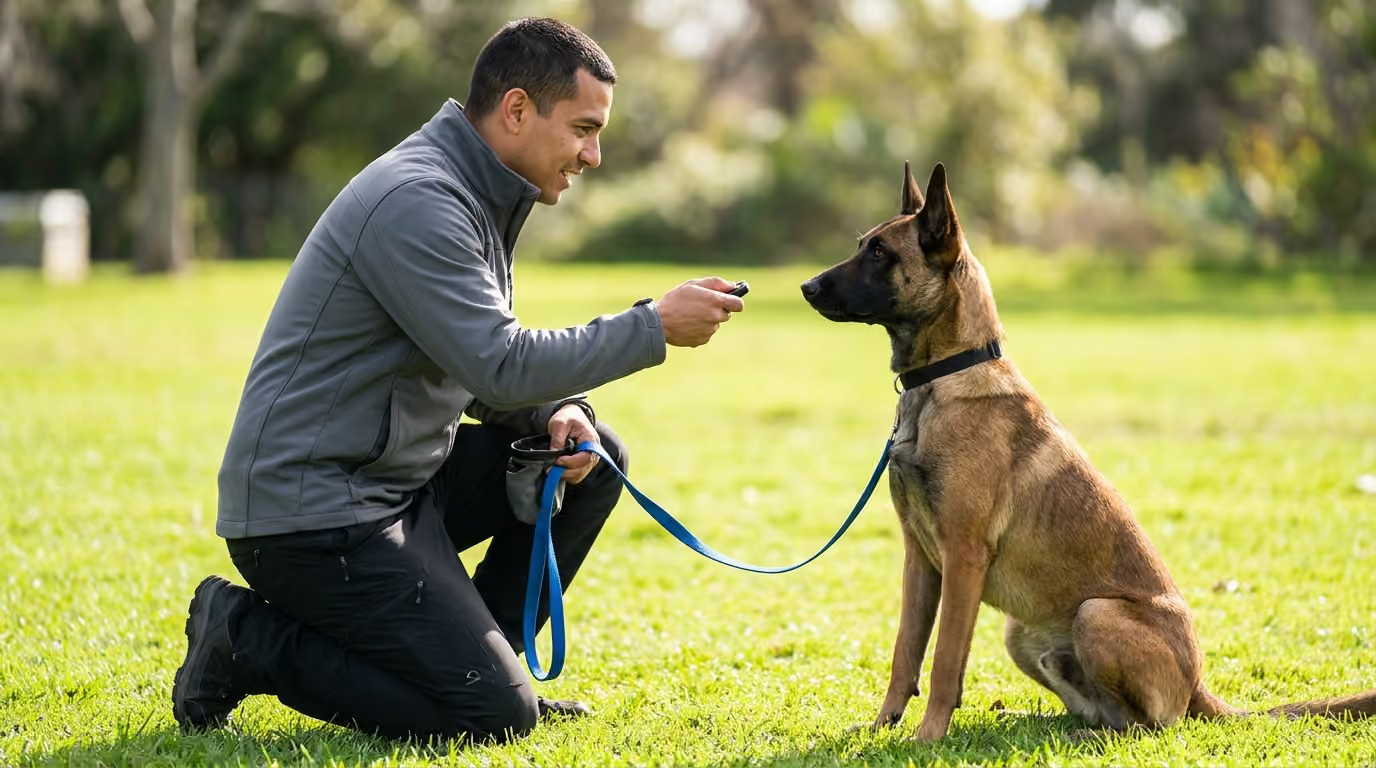
Professional Dog Trainer Course
Turn your passion for dogs into a professional career with a comprehensive training program built on behavioral science. Learn to assess, train, and modify behavior across all breeds, ages, and difficulty levels. From puppy socialization to aggression management, this course gives you the tools to work confidently with real clients and real dogs.
What you will learn:
You will master the science of how dogs learn, communicate, and respond to their environment. You will develop hands-on skills in operant and classical conditioning, marker training, and reinforcement-based behavior modification. The curriculum covers core obedience, leash reactivity, separation distress, resource guarding, and advanced shaping techniques. You will also learn how to design structured training programs, conduct intake assessments, and coach clients effectively. Supplementary modules address canine health, dog sports, service dog foundations, professional ethics, and business development. By the end, you will be equipped to launch and grow a credible dog training practice.
How you study in a practical way Professional Dog Trainer Course
How you practice Professional Dog Trainer Course
For companies who want to train their team
With Dedika for businesses, the course includes exercises and examples tailored to your own business and the way your company needs.

Course content
8 Chapters • 37 LessonsDuration between 4 and 360 hours (you decide)
Chapter 1HideHide detailsSee detailsFoundations of Canine Behavior
Foundations of Canine Behavior
Lesson 1 • Ethology and Natural Dog Behavior
Examines species-typical behaviors including predatory sequence, social hierarchy, and play. Trainers use ethological context to set realistic behavioral expectations.
Lesson 2 • Emotional States and Arousal Regulation
Identifies how fear, frustration, and excitement affect learning capacity. Trainers learn to modulate arousal before and during sessions.
Lesson 3 • Canine Sensory and Perceptual World
Covers how dogs process smell, sound, vision, and touch relative to humans. Establishes why sensory context shapes training environment design.
Lesson 4 • Canine Communication and Body Language
Teaches reading of posture, facial signals, and vocalizations as a complete communication system. Accurate reading prevents misinterpretation during sessions.
Chapter 2HideHide detailsSee detailsLearning Theory and Behavioral Science
Learning Theory and Behavioral Science
Lesson 1 • Reinforcement Schedules and Behavior Maintenance
Covers continuous, fixed, and variable schedules and their effects on response rate and extinction resistance. Trainers use schedule knowledge to build durable behaviors.
Lesson 2 • Operant Conditioning and the Four Quadrants
Defines positive reinforcement, negative reinforcement, positive punishment, and negative punishment with real training examples. Clarifies ethical and practical trade-offs of each quadrant.
Lesson 3 • Cognitive Learning and Social Learning
Introduces observational learning, insight, and problem-solving in dogs. Expands trainer toolkit beyond stimulus-response models.
Lesson 4 • Behavior Analysis and Functional Assessment
Teaches the ABC model (antecedent, behavior, consequence) for analyzing any behavior. Functional assessment guides targeted intervention planning.
Lesson 5 • Classical Conditioning Principles
Explains stimulus-response associations, acquisition, extinction, and spontaneous recovery. Provides the foundation for understanding emotional responses to cues.
Chapter 3HideHide detailsSee detailsReinforcement Tools and Marker Training
Reinforcement Tools and Marker Training
Lesson 1 • Non-Food Reinforcers and Life Rewards
Identifies play, social interaction, environmental access, and activity as reinforcers. Diversifying reinforcers reduces food dependency and increases real-world reliability.
Lesson 2 • Clicker and Marker Training Mechanics
Teaches conditioned reinforcer creation, click timing, and marker word alternatives. Precise marking accelerates behavior acquisition and reduces trainer error.
Lesson 3 • Selecting and Using Food Reinforcers
Covers reinforcer hierarchy, value assessment, and food delivery mechanics. Proper reinforcer selection maximizes motivation and training efficiency.
Lesson 4 • Equipment Selection and Fitting
Reviews collars, harnesses, leashes, and long lines with fitting and safety criteria. Correct equipment prevents injury and supports humane training outcomes.
Chapter 4HideHide detailsSee detailsCore Obedience Skills and Cue Training
Core Obedience Skills and Cue Training
Lesson 1 • Stay and Duration Behaviors
Builds duration, distance, and distraction (the three Ds) systematically. Trainers learn to proof stay without creating anxiety or confusion.
Lesson 2 • Shaping and Luring Techniques
Compares free shaping, luring, and capturing as behavior-building strategies. Choosing the right technique for each behavior accelerates learning.
Lesson 3 • Recall Training and Emergency Cues
Develops a reliable recall using high-value reinforcement and progressive distraction. A strong recall is the most critical safety behavior a dog can have.
Lesson 4 • Leash Manners and Loose-Leash Walking
Addresses pulling mechanics and teaches loose-leash walking through reinforcement placement and direction changes. Leash manners are among the most common client requests.
Lesson 5 • Sit, Down, and Stand Positions
Teaches position behaviors with multiple training approaches and position discrimination. Position fluency is the gateway to all advanced obedience work.
Chapter 5HideHide detailsSee detailsSocialization and Developmental Training
Socialization and Developmental Training
Lesson 1 • Critical Periods of Canine Development
Maps neonatal, socialization, juvenile, and adolescent periods with their behavioral implications. Timing interventions to developmental windows maximizes long-term outcomes.
Lesson 2 • Adolescent Dog Training Challenges
Addresses impulse control deficits, increased reactivity, and selective responsiveness common in adolescence. Trainers adapt techniques to maintain progress through this difficult phase.
Lesson 3 • Puppy Class Design and Management
Covers class structure, play group management, and age-appropriate skill progression. Well-run puppy classes are a primary client acquisition and retention tool.
Lesson 4 • Puppy Socialization Protocols
Provides structured exposure plans for people, animals, surfaces, sounds, and handling. Systematic socialization prevents fear-based behavior problems in adulthood.
Chapter 6HideHide detailsSee detailsBehavior Problem Prevention and Management
Behavior Problem Prevention and Management
Lesson 1 • Antecedent Arrangement and Management
Teaches environmental modification to prevent problem behavior before it occurs. Antecedent management reduces rehearsal of unwanted behaviors and speeds modification.
Lesson 2 • Resource Guarding Prevention and Modification
Covers the spectrum of guarding behavior and applies desensitization and counterconditioning protocols. Early intervention prevents escalation to dangerous guarding.
Lesson 3 • Leash Reactivity and Frustration-Based Behavior
Explains the frustration-aggression pathway underlying leash reactivity and applies BAT and LAT protocols. Reactive dog cases are among the most common referrals trainers receive.
Lesson 4 • Destructive Behavior and Separation Distress
Distinguishes boredom-based destruction from separation anxiety and applies appropriate interventions. Accurate diagnosis prevents ineffective or harmful treatment.
Lesson 5 • Jumping, Mouthing, and Attention-Seeking
Analyzes the reinforcement history of common nuisance behaviors and applies extinction and DRI strategies. These are the most frequent complaints from pet dog owners.
Chapter 7HideHide detailsSee detailsAdvanced Training and Behavior Modification
Advanced Training and Behavior Modification
Lesson 1 • Multi-Dog Household Training
Addresses inter-dog dynamics, resource competition, and training logistics in multi-dog homes. Trainers provide practical management and training plans for complex households.
Lesson 2 • Aggression Assessment and Safe Handling
Provides a framework for assessing aggression type, severity, and prognosis without triggering dangerous responses. Safe handling protocols protect trainers, clients, and dogs.
Lesson 3 • Counterconditioning and Emotional Reconditioning
Pairs feared stimuli with high-value reinforcers to change underlying emotional responses. Emotional change is the prerequisite for lasting behavioral change in fear cases.
Lesson 4 • Advanced Shaping and Behavior Chains
Applies precise shaping plans and backward chaining to build complex multi-step behaviors. Behavior chains are essential for service dog tasks and sport dog routines.
Lesson 5 • Systematic Desensitization Protocols
Teaches gradient construction, session pacing, and progress measurement for fear-based cases. Proper desensitization prevents sensitization and treatment failure.
Chapter 8HideHide detailsSee detailsTraining Program Design and Client Coaching
Training Program Design and Client Coaching
Lesson 1 • Intake Assessment and Goal Setting
Covers structured intake interviews, behavioral history forms, and SMART goal formulation. Thorough assessment aligns trainer and client expectations from the first session.
Lesson 2 • Group Class Instruction and Management
Covers class curriculum design, participant management, and safety protocols for group settings. Group classes are a scalable service model requiring distinct instructional skills.
Lesson 3 • Client Communication and Adult Learning
Applies adult learning principles to coach owners with varied skill levels and learning styles. Effective client coaching determines whether training gains transfer to daily life.
Lesson 4 • Structuring Training Plans and Session Flow
Teaches session structure, warm-up and cool-down protocols, and progress checkpoints. Consistent session structure maximizes learning and client confidence.
Lesson 5 • Measuring Progress and Adjusting Programs
Introduces behavioral metrics, data collection methods, and decision rules for program adjustment. Data-driven decisions replace guesswork and demonstrate professional accountability.
Your valid completion certificate
This course is for you:
Career changers: seeking a meaningful profession centered on animal behavior.
Kennel and shelter workers: ready to formalize hands-on experience into credentials.
Veterinary assistants: wanting to expand their scope into behavior support services.
Dedicated pet owners: committed to turning deep dog knowledge into paid work.
Hobby trainers: looking to move from informal help to structured client services.
Recent graduates: entering the animal care field with a professional training focus.
What our students say
Your classes are perfect. I purchased the one-year package and finally have the opportunity to follow various topics of my interest without needing to change platforms... I thank you for everything you do, I've already recommended you to other people...

I like how the lessons are straight to the point and how I can switch chapters and skip content I don't need.

I like the content and the way videos are presented and transcribed, which speeds up the process!

The platform is fast, simple to use. The diversity of content and complementary videos really help with learning.

Top trainings


FAQs
Who is Dedika?
Is the certificate valid in the Philippines?
Are the courses free?
What is the course workload?
What are the courses like?
How do the courses work?
What is the duration of the courses?
What is the cost or price of the courses?
What is an EAD or online course and how does it work?
PDF Course