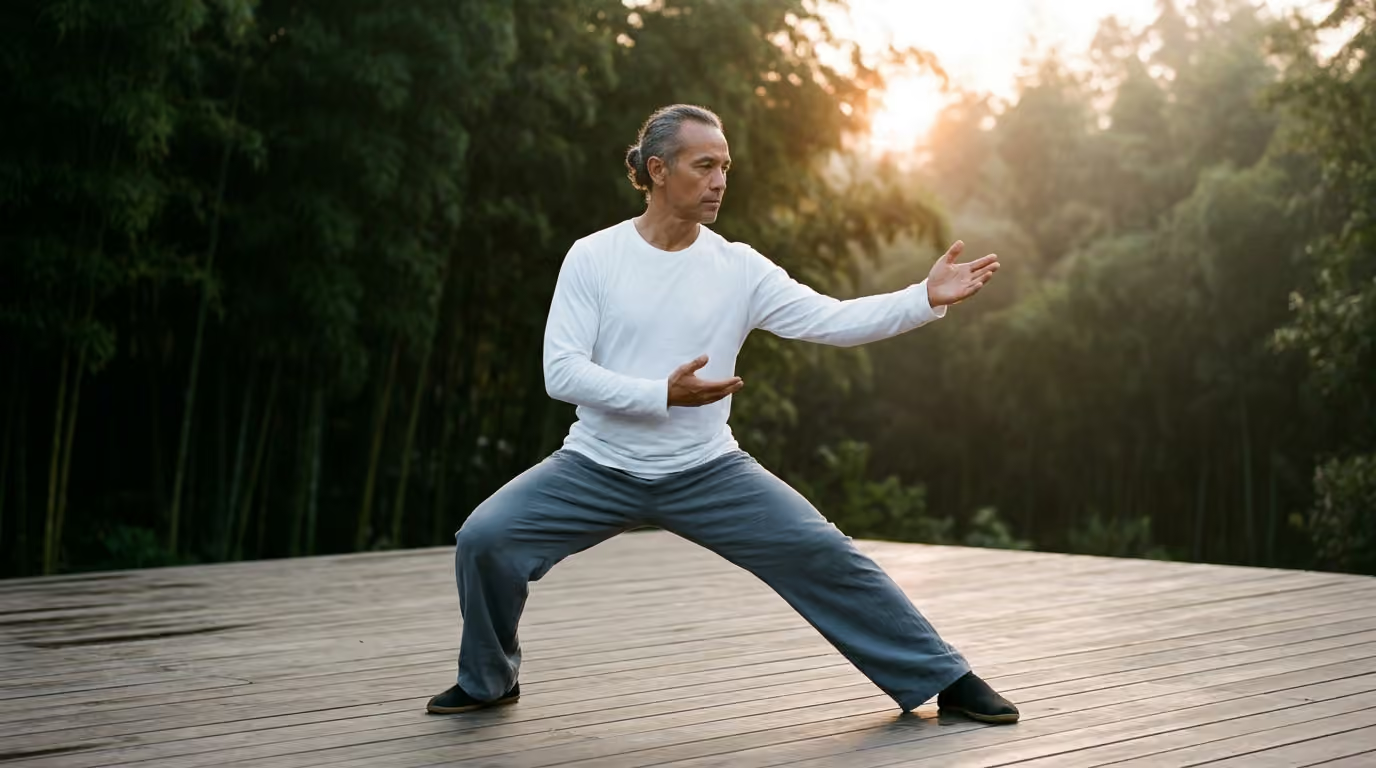
Tai Chi Chuan Course
Master the art of Tai Chi Chuan from the ground up, building a solid foundation in philosophy, body mechanics, and internal energy cultivation. This comprehensive course guides you through stances, short and long forms, push hands, martial applications, and qigong. Whether you seek better health, stress relief, or martial depth, you will find a clear, structured path forward.
What you will learn:
This course covers the complete spectrum of Tai Chi Chuan practice, starting with core philosophy, breathing fundamentals, and safe body mechanics. You will learn primary stances, stepping patterns, and upper-body coordination before progressing to a structured short form and a full long form. Internal energy concepts, including qi, dan tian awareness, and silk-reeling exercises, are taught in practical, accessible terms. Push hands training develops partner sensitivity and a real understanding of martial arts. Supplementary modules address qigong, weapons forms, health applications, and teaching methodology. By the end, you will have the knowledge and skills to maintain a consistent, purposeful Tai Chi practice.
How you study in a practical way Tai Chi Chuan Course
How you practice Tai Chi Chuan Course
For companies who want to train their team
With Dedika for businesses, the course includes exercises and examples tailored to your own business and the way your company needs.

Course content
8 Chapters • 40 LessonsDuration between 4 and 360 hours (you decide)
Chapter 1HideHide detailsSee detailsFoundations of Tai Chi Chuan
Foundations of Tai Chi Chuan
Lesson 1 • Relaxation and Song Gong
Develops conscious muscular release through song gong exercises. Relaxation without collapse is the prerequisite skill for all Tai Chi postures.
Lesson 2 • Core Philosophical Principles
Introduces yin-yang theory, wu wei, and qi as conceptual pillars. These principles guide every movement decision made in later chapters.
Lesson 3 • History and Origins of Tai Chi
Traces Tai Chi from Chen Village origins through major family styles. Provides cultural context that informs movement principles throughout the course.
Lesson 4 • Breathing Fundamentals
Teaches diaphragmatic breathing and its coordination with movement. Proper breath control is the physiological foundation for qi cultivation.
Lesson 5 • Anatomy and Body Mechanics
Covers joint alignment, spinal neutrality, and weight distribution relevant to Tai Chi. Safe mechanics prevent injury and support efficient movement learning.
Chapter 2HideHide detailsSee detailsStances, Footwork, and Stepping
Stances, Footwork, and Stepping
Lesson 1 • Primary Tai Chi Stances
Introduces bow stance, horse stance, empty stance, and single-leg stance. Each stance trains specific weight distribution and structural alignment skills.
Lesson 2 • Basic Stepping Patterns
Covers heel-toe stepping, toe-heel stepping, and side stepping sequences. Correct stepping prevents knee strain and enables smooth form transitions.
Lesson 3 • Weight Shifting Mechanics
Trains smooth transfer of weight between legs without bobbing or collapsing. Controlled shifting is the engine of all Tai Chi locomotion.
Lesson 4 • Rooting and Ground Connection
Cultivates the sensation of rooting through visualization and pressure drills. Rooting underpins stability when applying push hands and form techniques.
Lesson 5 • Turning and Pivoting
Develops waist-led turning on the heel and ball of the foot. Pivoting skill directly enables directional changes within form sequences.
Chapter 3HideHide detailsSee detailsUpper Body Coordination and Hand Forms
Upper Body Coordination and Hand Forms
Lesson 1 • Core Hand Positions
Teaches the open palm, fist, hook hand, and crane's beak positions. Correct hand forms express internal energy and define technique identity.
Lesson 2 • Waist-Driven Upper Body Motion
Trains the waist as the initiator of all arm and hand movements. Waist-driven motion creates whole-body integration rather than isolated arm action.
Lesson 3 • Eye Focus and Gaze Direction
Establishes correct gaze direction and peripheral awareness during practice. Proper eye focus enhances balance, intention, and martial awareness.
Lesson 4 • Basic Push and Ward-Off Shapes
Introduces peng, lu, ji, and an as the four primary energies. Understanding these shapes prepares students for form sequences and push hands.
Lesson 5 • Arm Movement Principles
Covers rounded arm structure, elbow sinking, and shoulder relaxation. These principles prevent tension and allow qi to flow through the limbs.
Chapter 4HideHide detailsSee detailsInternal Energy and Qi Cultivation
Internal Energy and Qi Cultivation
Lesson 1 • Dan Tian Activation and Awareness
Focuses attention on the lower dan tian as the center of qi storage and movement initiation. Dan tian awareness deepens form quality and internal power.
Lesson 2 • Understanding Qi in Tai Chi
Defines qi functionally as bio-electric sensation, warmth, and tingling. Demystifies the concept so students can observe and work with it practically.
Lesson 3 • Zhan Zhuang Standing Practice
Introduces standing post meditation to build internal strength and qi awareness. Regular zhan zhuang accelerates progress in all other Tai Chi skills.
Lesson 4 • Applying Internal Energy to Form
Integrates qi awareness into the short form learned in Chapter 4. Students practice moving from internal sensation rather than external shape alone.
Lesson 5 • Silk-Reeling Energy Exercises
Teaches chan si jin through spiral arm and leg exercises. Silk-reeling integrates the whole body into a single connected movement unit.
Chapter 5HideHide detailsSee detailsShort Form Introduction and Practice
Short Form Introduction and Practice
Lesson 1 • Transitions and Flow Between Postures
Focuses on the connecting movements between named postures. Smooth transitions are where form quality is most visibly expressed.
Lesson 2 • Opening Sequence and Preparation
Teaches the opening posture, weight settling, and initial arm raise. The opening sets the mental and physical tone for the entire form.
Lesson 3 • Closing Sequence and Cool-Down
Teaches the closing posture, return to wuji, and post-form standing meditation. Proper closing consolidates qi and completes the practice session.
Lesson 4 • Core Postures of the Short Form
Covers Grasp the Bird's Tail, Single Whip, Wave Hands, and Brush Knee. Each posture is broken into components before being linked into sequence.
Lesson 5 • Form Structure and Memorization
Explains how forms are segmented into sections for progressive memorization. Chunking the sequence reduces cognitive load and accelerates retention.
Chapter 6HideHide detailsSee detailsPush Hands Fundamentals
Push Hands Fundamentals
Lesson 1 • Listening and Neutralizing Skills
Develops ting jin through sensitivity drills and slow-motion partner exercises. Listening skill is the foundation of all advanced push hands and application.
Lesson 2 • Single-Hand Fixed-Step Push Hands
Teaches the basic single-hand ward-off and push cycle with stationary feet. Fixed-step practice isolates upper-body sensitivity before adding footwork.
Lesson 3 • Principles of Push Hands Training
Establishes the purpose, etiquette, and safety rules of push hands practice. Clear principles prevent injury and create a productive training environment.
Lesson 4 • Double-Hand Fixed-Step Push Hands
Expands to both hands using the peng-lu-ji-an cycle. Double-hand practice develops bilateral coordination and fuller energy expression.
Lesson 5 • Moving-Step Push Hands Introduction
Adds stepping to push hands, requiring coordination of footwork with upper-body sensitivity. Moving-step practice bridges push hands toward free application.
Chapter 7HideHide detailsSee detailsLong Form and Advanced Sequences
Long Form and Advanced Sequences
Lesson 1 • Rhythm, Tempo, and Expression
Develops the dynamic contrast between fast and slow, light and heavy within the form. Expressive rhythm distinguishes competent performance from mechanical repetition.
Lesson 2 • Self-Correction and Video Review
Uses video recording and checklist-based self-assessment to identify errors. Systematic self-correction accelerates improvement between instructor sessions.
Lesson 3 • Directional Changes and Orientation
Trains the multiple directional changes embedded in the long form. Spatial orientation prevents disorientation and maintains form integrity.
Lesson 4 • Structure of the Long Form
Maps the long form into three sections with distinct character and pacing. Understanding structure enables strategic practice and efficient memorization.
Lesson 5 • Advanced Postures and Kicks
Introduces heel kicks, lotus kicks, and low postures such as Snake Creeps Down. These postures demand greater flexibility, balance, and body control.
Chapter 8HideHide detailsSee detailsMartial Applications and Self-Defense Principles
Martial Applications and Self-Defense Principles
Lesson 1 • Reading Martial Intent in Postures
Analyzes each major posture for its primary and secondary martial applications. Understanding intent transforms form practice from exercise into purposeful movement.
Lesson 2 • Distance, Timing, and Positioning
Trains awareness of optimal range, entry timing, and body positioning. These tactical elements determine whether a technique succeeds or fails.
Lesson 3 • Fa Jin and Explosive Power
Introduces fa jin as the release of stored internal energy in a short burst. Fa jin training develops whole-body coordination and power generation.
Lesson 4 • Strikes, Locks, and Throws
Covers palm strikes, joint locks, and off-balancing throws derived from form postures. Each technique is practiced slowly with a cooperative partner.
Lesson 5 • Integrating Applications into Form
Practices the long form with martial intent visualized throughout each posture. Integration ensures form practice remains connected to its functional purpose.
Your valid completion certificate
This course is for you:
Fitness enthusiasts: seeking low-impact movement that builds balance and body awareness.
Older adults: wanting a safe, structured practice to support mobility and stability.
Yoga practitioners: ready to explore a complementary discipline rooted in martial tradition.
Healthcare workers: looking for a personal stress-management tool grounded in mindful movement.
Martial artists: curious about internal energy principles absent from their current training.
Aspiring instructors: planning to teach Tai Chi or mind-body wellness to community groups.
What our students say
Your classes are perfect. I purchased the one-year package and finally have the opportunity to follow various topics of my interest without needing to change platforms... I thank you for everything you do, I've already recommended you to other people...

I like how the lessons are straight to the point and how I can switch chapters and skip content I don't need.

I like the content and the way videos are presented and transcribed, which speeds up the process!

The platform is fast, simple to use. The diversity of content and complementary videos really help with learning.

Top trainings


FAQs
Who is Dedika?
Is the certificate valid in the Philippines?
Are the courses free?
What is the course workload?
What are the courses like?
How do the courses work?
What is the duration of the courses?
What is the cost or price of the courses?
What is an EAD or online course and how does it work?
PDF Course