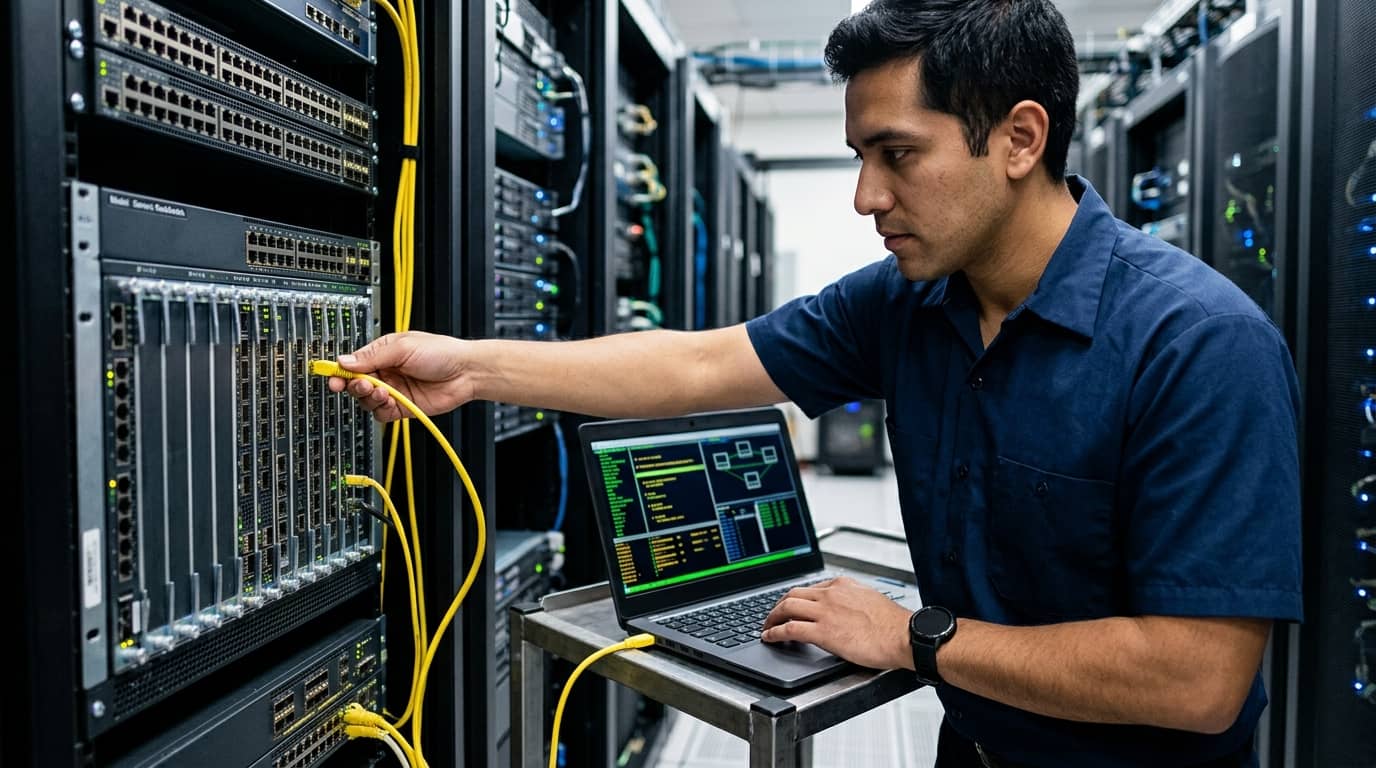
Network Course
Master every layer of modern networking, from physical cabling and IP addressing to routing protocols, VLANs, security, and cloud connectivity. This course gives you the hands-on skills employers look for in network engineers and systems administrators. Whether you are starting out or filling critical knowledge gaps, you will finish ready to design, configure, and troubleshoot real networks.
What you will learn:
You will build a complete understanding of how networks are designed, configured, secured, and maintained. The course covers the OSI and TCP/IP models, IPv4 and IPv6 addressing, subnetting, VLANs, spanning tree, and routing protocols such as OSPF and RIP. You will also study network security fundamentals including ACLs, firewalls, and encryption standards. Additional topics include wireless networking, WAN technologies, cloud and virtual networking, and network automation using Ansible and REST APIs. By the end, you will have the technical knowledge and practical skills to manage enterprise-grade network infrastructure.
How you study in practice Network Course
How you practise Network Course
For companies looking to train their teams
With Dedika for Businesses, the course includes exercises and examples tailored to your own business and the specific needs of your company.

Course content
8 Chapters • 32 LessonsDuration between 4 and 360 hours (you decide)
Chapter 1HideHide detailsSee detailsFoundations of Computer Networking
Foundations of Computer Networking
Lesson 1 • Binary, Hexadecimal, and Addressing Basics
Provides the mathematical foundation for IP and MAC addressing. Fluency in number conversion is required for subnetting in later chapters.
Lesson 2 • Network Topologies and Media Types
Covers physical and logical arrangements of network devices and the media that carry signals. Students evaluate topology trade-offs for given scenarios.
Lesson 3 • The OSI and TCP/IP Models
Introduces layered communication models as frameworks for understanding protocols. Students map real traffic to specific layers.
Lesson 4 • What Networks Are and Why They Matter
Defines a network, its purpose, and real-world applications. Establishes the vocabulary needed for all subsequent technical content.
Chapter 2HideHide detailsSee detailsNetwork Devices and Their Roles
Network Devices and Their Roles
Lesson 1 • Layer 2 Devices: Bridges and Switches
Details MAC address learning, forwarding tables, and collision domain segmentation. Students trace a frame through a switch's decision process.
Lesson 2 • Layer 1 Devices: Hubs and Repeaters
Explains signal regeneration and broadcast behaviour at the physical layer. Establishes why Layer 1 devices are insufficient for modern networks.
Lesson 3 • Firewalls, Access Points, and Other Appliances
Surveys security and connectivity appliances that complement routers and switches. Students place each device correctly in a network diagram.
Lesson 4 • Layer 3 Devices: Routers
Introduces routing as the process of forwarding packets between networks. Students distinguish routing from switching and identify router components.
Chapter 3HideHide detailsSee detailsIP Addressing and Subnetting
IP Addressing and Subnetting
Lesson 1 • Subnetting Practice and Design
Applies subnet math to real design problems requiring multiple subnets. Students allocate address space efficiently using VLSM.
Lesson 2 • Subnet Mask Math and CIDR
Teaches binary AND operations to derive network addresses and introduces prefix-length notation. Students calculate usable host counts per subnet.
Lesson 3 • IPv4 Address Classes and Structure
Breaks down the 32-bit address into network and host portions. Students classify addresses and identify public vs. private ranges.
Lesson 4 • IPv6 Addressing Fundamentals
Introduces 128-bit addressing, notation rules, and address types. Students convert and abbreviate IPv6 addresses correctly.
Chapter 4HideHide detailsSee detailsCore Protocols and Services
Core Protocols and Services
Lesson 1 • TCP vs. UDP: Transport Layer Protocols
Contrasts connection-oriented and connectionless transport, including handshake, flow control, and error recovery. Students choose the right protocol for given applications.
Lesson 2 • DHCP: Dynamic Address Assignment
Covers the DORA process, lease lifecycle, and scope configuration. Students configure a basic DHCP scope and identify common lease failures.
Lesson 3 • DNS: Domain Name System
Explains hierarchical name resolution from root servers to authoritative zones. Students interpret DNS query flows and common record types.
Lesson 4 • HTTP, FTP, SMTP, and Application Protocols
Surveys widely used application-layer protocols and their port assignments. Students map each protocol to its transport and identify secure variants.
Chapter 5HideHide detailsSee detailsRouting Concepts and Protocols
Routing Concepts and Protocols
Lesson 1 • Link-State Routing Protocols
Covers LSA flooding, SPF calculation, and OSPF area design. Students configure single-area OSPF and verify neighbour adjacencies.
Lesson 2 • Static Routing Configuration
Teaches manual route entry syntax, next-hop selection, and default routes. Students build a fully routed lab topology using only static routes.
Lesson 3 • Path Selection and Route Redistribution
Examines how routers choose among competing routes and how routes are shared between protocols. Students implement basic redistribution between two routing domains.
Lesson 4 • Distance-Vector Routing Protocols
Explains hop-count metrics, periodic updates, and loop-prevention mechanisms. Students configure RIP and analyse convergence behaviour.
Chapter 6HideHide detailsSee detailsSwitching, VLANs, and Spanning Tree
Switching, VLANs, and Spanning Tree
Lesson 1 • Trunk Links and Inter-VLAN Routing
Explains 802.1Q tagging, native VLANs, and router-on-a-stick configuration. Students enable inter-VLAN communication across a trunk link.
Lesson 2 • EtherChannel and Link Aggregation
Teaches bundling multiple physical links into a single logical channel for bandwidth and redundancy. Students configure LACP-based EtherChannel.
Lesson 3 • Spanning Tree Protocol Deep Dive
Covers STP port states, root bridge election, and path cost calculation. Students manipulate STP to control traffic paths in a redundant topology.
Lesson 4 • VLAN Concepts and Configuration
Defines VLANs as logical broadcast domain segments and covers access port assignment. Students create VLANs and assign ports on a managed switch.
Chapter 7HideHide detailsSee detailsNetwork Security Fundamentals
Network Security Fundamentals
Lesson 1 • Encryption and Secure Protocols
Introduces symmetric and asymmetric encryption, PKI basics, and TLS handshake. Students identify where encryption is applied in common network services.
Lesson 2 • Common Network Threats and Attack Vectors
Catalogues reconnaissance, spoofing, DoS, and man-in-the-middle attacks. Students map each threat to the OSI layer where it operates.
Lesson 3 • Network Monitoring and Incident Response
Covers syslog, SNMP traps, NetFlow, and IDS/IPS placement. Students configure basic logging and interpret alerts to identify anomalous behaviour.
Lesson 4 • Access Control Lists and Firewall Rules
Teaches standard and extended ACL syntax, placement strategy, and stateful firewall logic. Students write and apply ACLs to filter specific traffic flows.
Chapter 8HideHide detailsSee detailsNetwork Troubleshooting and Optimisation
Network Troubleshooting and Optimisation
Lesson 1 • Troubleshooting Methodologies
Introduces top-down, bottom-up, and divide-and-conquer approaches. Students select and apply the most efficient method for a given symptom set.
Lesson 2 • Performance Optimisation and QoS
Introduces bandwidth management, queuing strategies, and traffic classification. Students configure basic QoS policies to prioritise latency-sensitive traffic.
Lesson 3 • Diagnosing Layer 1 and Layer 2 Issues
Addresses physical connectivity failures, duplex mismatches, and VLAN misconfiguration. Students resolve common switch and cabling faults in lab scenarios.
Lesson 4 • Diagnostic Tools and Commands
Covers ping, traceroute, nslookup, netstat, and packet capture tools. Students use each tool to isolate faults at specific OSI layers.
Your valid completion certificate
This course is for you:
IT support technicians ready to advance into dedicated networking roles.
College students pursuing computer science or information technology degrees.
Career changers from unrelated fields drawn to infrastructure and systems work.
System administrators who need stronger foundational networking knowledge.
Hobbyists building home labs who want structured, professional-grade instruction.
Junior help desk staff aiming to qualify for network technician positions.
What our students say
Your lessons are perfect. I purchased the one-year package and finally have the opportunity to follow various topics of my interest without needing to change platforms... I'm grateful for everything you do, I've already recommended you to other people...

I like how the lessons are straight to the point and how I can change chapters and skip content I don't need.

I like the content and the way videos are presented and transcribed, which speeds up the process!

The platform is fast, simple to use. The diversity of content and complementary videos help a lot with learning.

Top trainings


FAQs
Who is Dedika?
Is the certificate valid in Pakistan?
Are the courses free?
What is the course workload?
What are the courses like?
How do the courses work?
What is the duration of the courses?
What is the cost or price of the courses?
What is an EAD or online course and how does it work?
PDF Course