
Cook Training Course
This Cook Training Course gives you the hands-on skills to work confidently in a professional kitchen, from knife handling and stock-making to live line service. You will master classical techniques, food safety standards, and menu execution that employers actually look for. Whether you are starting fresh or levelling up, this course builds the real-world foundation your culinary career needs.
What you will learn:
You will start with kitchen safety, sanitation, and professional conduct, then move into knife skills, classical cuts, and essential equipment use. From there, you will build stocks, master the five mother sauces, and cook with both dry-heat and moist-heat methods. You will also cover vegetables, grains, pasta, and starches before applying everything to real menu planning and line service. Supplementary content includes baking fundamentals, global cuisines, nutrition, modern techniques like sous vide, and kitchen leadership skills. By the end, you will have the technical range and professional habits to perform in a commercial kitchen.
How you study in practice Cook Training Course
How you practise Cook Training Course
For companies looking to train their teams
With Dedika for Businesses, the course includes exercises and examples tailored to your own business and the specific needs of your company.

Course content
8 Chapters • 39 LessonsDuration between 4 and 360 hours (you decide)
Chapter 1HideHide detailsSee detailsKitchen Safety and Professional Standards
Kitchen Safety and Professional Standards
Lesson 1 • Personal Hygiene and Grooming
Covers handwashing protocols, uniform standards, and illness policies. Sets the baseline for safe food handling throughout the course.
Lesson 2 • Sanitation Procedures and Cleaning
Covers cleaning versus sanitizing, surface protocols, and dishwashing standards. Ensures students maintain a compliant, hygienic workspace.
Lesson 3 • Food Safety and Temperature Control
Teaches danger zone temperatures, safe storage, and cross-contamination prevention. Directly supports every cooking task in later chapters.
Lesson 4 • Professional Conduct in the Kitchen
Defines teamwork, communication, and punctuality expectations in a brigade environment. Builds the professional mindset required for all practical work ahead.
Lesson 5 • Kitchen Hazard Awareness
Identifies physical, chemical, and biological hazards common in kitchens. Prepares students to recognize and mitigate risks before they cause harm.
Chapter 2HideHide detailsSee detailsEssential Tools and Equipment
Essential Tools and Equipment
Lesson 1 • Knife Types and Their Uses
Introduces the chef's knife, paring knife, serrated knife, and specialty blades. Connects tool selection to precision and efficiency in food preparation.
Lesson 2 • Safe Knife Handling and Grip
Teaches pinch grip, claw technique, and safe passing methods. Reduces injury risk and builds the foundation for accurate cutting.
Lesson 3 • Cookware and Large Equipment
Covers pots, pans, ovens, and ranges used in commercial kitchens. Prepares students to select and operate equipment correctly in upcoming cooking chapters.
Lesson 4 • Small Equipment and Hand Tools
Introduces peelers, graters, mandolines, and measuring tools. Expands students' ability to execute a wider range of prep tasks accurately.
Lesson 5 • Knife Sharpening and Maintenance
Covers honing steel use, whetstone sharpening, and proper storage. Maintains blade performance and extends equipment lifespan.
Chapter 3HideHide detailsSee detailsKnife Skills and Basic Cuts
Knife Skills and Basic Cuts
Lesson 1 • Classical Vegetable Cuts
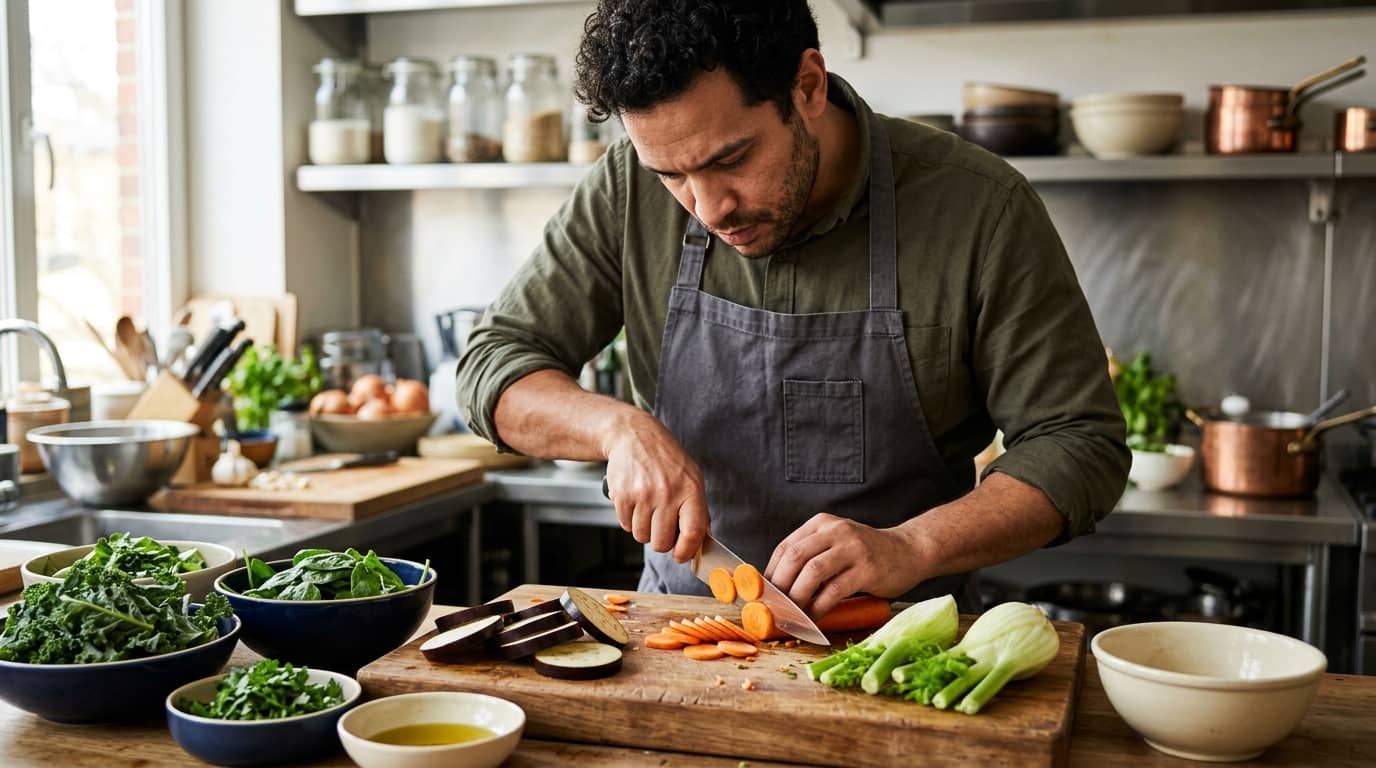
Covers julienne, brunoise, dice, and chiffonade with precise dimensions. Uniform cuts are essential for consistent cooking times and plate aesthetics.
Lesson 2 • Breaking Down Vegetables and Fruits
Applies cutting techniques to onions, garlic, citrus, and root vegetables. Builds speed and confidence with real ingredients used in later recipes.
Lesson 3 • Butchering Proteins for Prep
Introduces trimming, portioning, and deboning poultry and fish. Prepares students to handle proteins correctly before applying heat in cooking chapters.
Lesson 4 • Foundational Cutting Techniques
Teaches rocking, push-cut, and pull-cut motions for efficient knife work. Establishes the mechanical foundation for all cuts covered in this chapter.
Chapter 4HideHide detailsSee detailsStocks, Sauces, and Soups
Stocks, Sauces, and Soups
Lesson 1 • Derivative and Pan Sauces
Builds on mother sauces to create derivatives and quick pan sauces using fond. Expands sauce repertoire and teaches deglazing and reduction techniques.
Lesson 2 • The Five Mother Sauces
Teaches béchamel, velouté, espagnole, hollandaise, and tomato sauce preparation. These sauces form the basis for hundreds of derivative sauces in professional kitchens.
Lesson 3 • Seasoning and Balancing Flavors
Teaches salt, acid, fat, and heat as tools for flavor balance in sauces and soups. Develops the palate judgment students need for all subsequent cooking.
Lesson 4 • Classic and Contemporary Soups
Covers consommé, cream soups, bisques, and purée soups using stock bases. Connects stock-making skills to finished, platable soup preparations.
Lesson 5 • Building Stocks from Scratch
Covers white, brown, fish, and vegetable stocks using proper ratios and technique. Stocks are the flavor foundation for sauces and soups in this chapter.
Chapter 5HideHide detailsSee detailsDry-Heat Cooking Methods
Dry-Heat Cooking Methods
Lesson 1 • Roasting and Baking Savory Foods
Teaches oven roasting of meats, poultry, and vegetables with correct temperatures. Connects to stock and sauce skills through pan drippings and resting technique.
Lesson 2 • Sautéing and Pan-Frying
Covers high-heat fat cooking for proteins and vegetables with proper pan control. Builds the most frequently used stovetop skill in professional kitchens.
Lesson 3 • Finishing and Plating Dry-Heat Dishes
Applies sauce, garnish, and plating principles to dry-heat preparations. Bridges cooking technique with professional presentation standards.
Lesson 4 • Deep-Frying and Shallow-Frying
Teaches oil temperature management, breading procedures, and safe frying practices. Produces crisp, properly cooked results while minimizing oil hazards.
Lesson 5 • Grilling and Broiling Techniques
Covers direct and indirect heat, grill marks, and broiler use for proteins and vegetables. Develops skill in managing high-heat equipment safely and precisely.
Chapter 6HideHide detailsSee detailsMoist-Heat and Combination Cooking
Moist-Heat and Combination Cooking
Lesson 1 • Braising Meats and Vegetables
Teaches sear-then-braise technique for tough cuts using aromatics and liquid. Develops understanding of collagen conversion and long-cook flavor development.
Lesson 2 • Stewing and Slow Cooking
Covers stew construction with uniform cuts, thickening agents, and long simmering. Builds on braising principles and expands students' repertoire of hearty dishes.
Lesson 3 • Steaming and En Papillote
Teaches direct steam and parchment-packet cooking for vegetables and fish. Preserves nutrients and natural flavors while building gentle cooking skills.
Lesson 4 • Poaching and Simmering
Covers shallow and deep poaching of eggs, fish, and poultry at controlled temperatures. Develops precision in liquid temperature management for delicate proteins.
Lesson 5 • Blanching and Parboiling
Covers blanching for color retention, texture, and prep efficiency in a professional kitchen. Connects to mise en place workflows used throughout service.
Chapter 7HideHide detailsSee detailsVegetables, Grains, and Starches
Vegetables, Grains, and Starches
Lesson 1 • Cooking Vegetables to Order
Covers roasting, sautéing, steaming, and glazing vegetables for service. Builds speed and consistency in producing vegetable sides across multiple methods.
Lesson 2 • Pasta and Noodle Cookery
Covers cooking dried and fresh pasta to al dente and pairing with appropriate sauces. Connects to sauce skills from Chapter 4 for complete dish assembly.
Lesson 3 • Legumes and Dried Beans
Teaches soaking, cooking, and seasoning dried legumes for use in soups and sides. Builds understanding of protein-rich plant ingredients and their cooking behavior.
Lesson 4 • Potatoes and Root Starches
Covers boiling, mashing, roasting, and frying potatoes and other root starches. Develops versatility with the most common starch component on professional menus.
Lesson 5 • Rice and Pilaf Method
Teaches absorption and pilaf methods for long-grain, short-grain, and specialty rice. Produces fluffy, properly seasoned rice as a versatile menu component.
Chapter 8HideHide detailsSee detailsMenu Planning and Line Cooking
Menu Planning and Line Cooking
Lesson 1 • Mise en Place and Station Setup
Covers organizing ingredients, tools, and prep lists for efficient service readiness. Translates all prior prep skills into a structured pre-service workflow.
Lesson 2 • Plating for Service Speed
Applies plating standards to high-volume service with consistency and speed. Bridges individual dish quality with the demands of a full service period.
Lesson 3 • Ticket Management and Timing
Covers reading orders, prioritizing tasks, and coordinating timing across stations. Develops the multitasking ability essential for live service performance.
Lesson 4 • Menu Costing and Portion Control
Introduces food cost percentage, portion weights, and waste reduction strategies. Connects cooking skills to the financial accountability expected of professional cooks.
Lesson 5 • Reading and Executing Recipes
Teaches recipe scaling, yield calculation, and consistent execution under pressure. Ensures students can reproduce dishes accurately across multiple covers.
Your valid completion certificate
This course is for you:
Aspiring cook: ready to turn a passion for food into a profession.
Career changer: leaving another field to pursue a culinary career seriously.
Recent high school graduate: exploring a hands-on trade before committing to college.
Home cook: wanting to close the gap between amateur habits and professional standards.
Restaurant worker: currently in front-of-house and eager to transition into the kitchen.
Culinary student: supplementing formal schooling with structured, practical technique training.
What our students say
Your lessons are perfect. I purchased the one-year package and finally have the opportunity to follow various topics of my interest without needing to change platforms... I'm grateful for everything you do, I've already recommended you to other people...

I like how the lessons are straight to the point and how I can change chapters and skip content I don't need.

I like the content and the way videos are presented and transcribed, which speeds up the process!

The platform is fast, simple to use. The diversity of content and complementary videos help a lot with learning.

Top trainings




FAQs
Who is Dedika?
Is the certificate valid in Pakistan?
Are the courses free?
What is the course workload?
What are the courses like?
How do the courses work?
What is the duration of the courses?
What is the cost or price of the courses?
What is an EAD or online course and how does it work?
PDF Course