
Endoscopy Technician Course
Launch a hands-on healthcare career with the skills employers demand in modern endoscopy units. This course takes you from GI anatomy fundamentals to advanced procedure assistance, infection control, and emergency response. Every module is built around what you will actually do on the job.
What you will learn:
This course covers everything an entry-level endoscopy technician needs to perform confidently in a clinical setting. You will learn gastrointestinal anatomy, infection control, and endoscope reprocessing from the ground up. You will develop hands-on skills for assisting with upper and lower GI procedures, including colonoscopy, EGD, ERCP, and EUS. Patient preparation, sedation awareness, vital sign monitoring, and emergency response are all covered in detail. You will also build competency in medical terminology, digital health documentation, and quality improvement practices. By the end, you will have the knowledge and practical skills to pursue national certification and advance your career in endoscopy.
How you study in practice Endoscopy Technician Course
How you practise Endoscopy Technician Course
For companies looking to train their teams
With Dedika for Businesses, the course includes exercises and examples tailored to your own business and the specific needs of your company.

Course content
8 Chapters • 39 LessonsDuration between 4 and 360 hours (you decide)
Chapter 1HideHide detailsSee detailsIntroduction to Endoscopy and GI Anatomy
Introduction to Endoscopy and GI Anatomy
Lesson 1 • Regulatory and Ethical Foundations
Covers patient rights, informed consent, and applicable healthcare compliance standards. Grounds technicians in ethical obligations before clinical exposure.
Lesson 2 • Types of Endoscopic Procedures
Introduces diagnostic and therapeutic endoscopy categories and their clinical indications. Provides context for equipment and technique chapters that follow.
Lesson 3 • Role of the Endoscopy Technician
Defines technician responsibilities, interdisciplinary relationships, and professional boundaries. Clarifies how the technician supports physicians and nursing staff during procedures.
Lesson 4 • Overview of the GI Tract
Covers anatomical structures from oesophagus to rectum and their clinical relevance. Establishes the anatomical baseline required for all subsequent procedural learning.
Chapter 2HideHide detailsSee detailsInfection Control and Sterile Technique
Infection Control and Sterile Technique
Lesson 1 • Automated Endoscope Reprocessors
Covers operation, validation, and troubleshooting of automated reprocessing equipment. Builds on manual cleaning knowledge to introduce machine-assisted workflows.
Lesson 2 • Endoscope Reprocessing Fundamentals
Teaches the sequential steps of manual cleaning, disinfection, and sterilisation of endoscopes. Directly prepares students for competency in the reprocessing room.
Lesson 3 • Principles of Infection Control
Explains transmission routes, chain of infection, and standard precautions. Forms the theoretical basis for all reprocessing and sterile technique practices.
Lesson 4 • Storage and Transport of Endoscopes
Addresses proper drying, storage conditions, and transport protocols to prevent recontamination. Completes the reprocessing cycle from cleaning through safe deployment.
Lesson 5 • Quality Assurance in Reprocessing
Introduces audit tools, biological indicators, and documentation practices for reprocessing compliance. Ensures students can verify and record process integrity.
Chapter 3HideHide detailsSee detailsEndoscopy Equipment and Instrumentation
Endoscopy Equipment and Instrumentation
Lesson 1 • Video Imaging and Light Systems
Covers video processors, light sources, and monitor calibration used in modern endoscopy suites. Connects equipment knowledge to image quality and procedural safety.
Lesson 2 • Endoscope Design and Components
Examines flexible and rigid endoscope anatomy, including insertion tubes, control heads, and channels. Provides the structural knowledge needed for safe handling and reprocessing.
Lesson 3 • Equipment Troubleshooting and Maintenance
Addresses common equipment malfunctions, preventive maintenance schedules, and repair escalation. Builds technician confidence in maintaining procedural readiness.
Lesson 4 • Accessory Instruments and Devices
Identifies biopsy forceps, snares, dilators, clips, and injection needles used during procedures. Prepares students to anticipate and deliver correct instruments to the physician.
Lesson 5 • Equipment Setup and Room Preparation
Teaches systematic pre-procedure room setup, scope leak testing, and equipment checks. Ensures students can prepare a fully functional endoscopy suite independently.
Chapter 4HideHide detailsSee detailsPatient Preparation and Safety
Patient Preparation and Safety
Lesson 1 • Sedation Awareness and Airway Safety
Introduces sedation levels, reversal agents, and airway management support roles. Defines the technician's supportive role during moderate and deep sedation cases.
Lesson 2 • Patient Positioning and Comfort
Teaches correct positioning for each procedure type and pressure injury prevention strategies. Ensures patient safety and optimal procedural access throughout the case.
Lesson 3 • Monitoring and Vital Signs During Procedures
Covers continuous monitoring of oxygen saturation, blood pressure, and cardiac rhythm. Prepares technicians to recognise and report abnormal values promptly.
Lesson 4 • Bowel Preparation and Dietary Instructions
Explains preparation regimens for upper and lower endoscopy and patient education techniques. Directly impacts procedure quality and patient safety outcomes.
Lesson 5 • Pre-Procedure Patient Assessment
Covers medical history review, allergy verification, and ASA classification basics. Establishes the assessment skills needed before any patient contact in the suite.
Chapter 5HideHide detailsSee detailsAssisting with Upper GI Endoscopy
Assisting with Upper GI Endoscopy
Lesson 1 • EGD Procedure Workflow
Outlines the sequential steps of oesophagogastroduodenoscopy from scope insertion to withdrawal. Provides the procedural map technicians follow during upper endoscopy cases.
Lesson 2 • Haemostasis Procedure Assistance
Teaches technician support for injection therapy, thermal coagulation, and clip application. Builds on accessory instrument knowledge to address active bleeding scenarios.
Lesson 3 • Foreign Body Retrieval Assistance
Addresses retrieval device selection, technique support, and airway protection during foreign body cases. Applies instrument knowledge to urgent upper GI scenarios.
Lesson 4 • Oesophageal Dilation Assistance
Covers balloon and bougie dilation setup, fluoroscopy awareness, and post-dilation monitoring. Prepares technicians for a common therapeutic upper GI health intervention.
Lesson 5 • Biopsy and Tissue Sampling Assistance
Covers biopsy forceps delivery, specimen handling, and pathology labelling protocols. Ensures accurate specimen integrity from collection through laboratory submission.
Chapter 6HideHide detailsSee detailsAssisting with Lower GI Endoscopy
Assisting with Lower GI Endoscopy
Lesson 1 • Flexible Sigmoidoscopy Assistance
Teaches setup, patient positioning, and instrument support specific to flexible sigmoidoscopy. Distinguishes this procedure's workflow from full colonoscopy for accurate technician preparation.
Lesson 2 • Polypectomy Assistance
Covers snare selection, electrosurgical unit preparation, and polyp retrieval for polypectomy cases. Directly applies accessory instrument skills to the most common therapeutic colonoscopy health intervention.
Lesson 3 • Colonoscopy Procedure Workflow
Details caecal intubation sequence, loop reduction techniques, and withdrawal examination standards. Provides the procedural framework for lower GI technician assistance.
Lesson 4 • Chromoendoscopy and Advanced Imaging Support
Introduces dye spray techniques, narrow-band imaging, and documentation for enhanced mucosal visualization. Expands technician support skills for advanced diagnostic colonoscopy.
Lesson 5 • Post-Procedure Patient Recovery
Covers recovery room handoff, gas discomfort management, and discharge criteria assessment. Completes the lower GI procedural episode from scope withdrawal to patient discharge.
Chapter 7HideHide detailsSee detailsAdvanced Endoscopic Procedures
Advanced Endoscopic Procedures
Lesson 1 • Biliary Stenting and Stone Extraction
Teaches stent delivery system preparation, balloon catheter use, and stone retrieval basket handling. Applies ERCP fundamentals to the most common therapeutic biliary health interventions.
Lesson 2 • Endoscopic Mucosal Resection Support
Covers submucosal injection preparation, cap-assisted resection setup, and specimen retrieval for EMR. Extends polypectomy skills to advanced resection techniques.
Lesson 3 • Endoscopic Ultrasound Assistance
Introduces echoendoscope setup, ultrasound processor operation, and FNA needle handling for EUS. Prepares technicians for diagnostic and therapeutic EUS case support.
Lesson 4 • ERCP Assistance Fundamentals
Covers duodenoscope setup, contrast injection support, and fluoroscopy coordination for ERCP. Builds on upper GI skills to address biliary and pancreatic health interventions.
Lesson 5 • Endoscopic Submucosal Dissection Support
Addresses ESD knife selection, electrosurgical settings, and traction device assistance for ESD cases. Represents the highest complexity level of technician procedural support.
Chapter 8HideHide detailsSee detailsEmergency Response and Complication Management
Emergency Response and Complication Management
Lesson 1 • Emergency Equipment Readiness
Covers crash cart contents, emergency oxygen systems, and suction readiness in the endoscopy suite. Ensures technicians maintain life-safety equipment in constant procedural readiness.
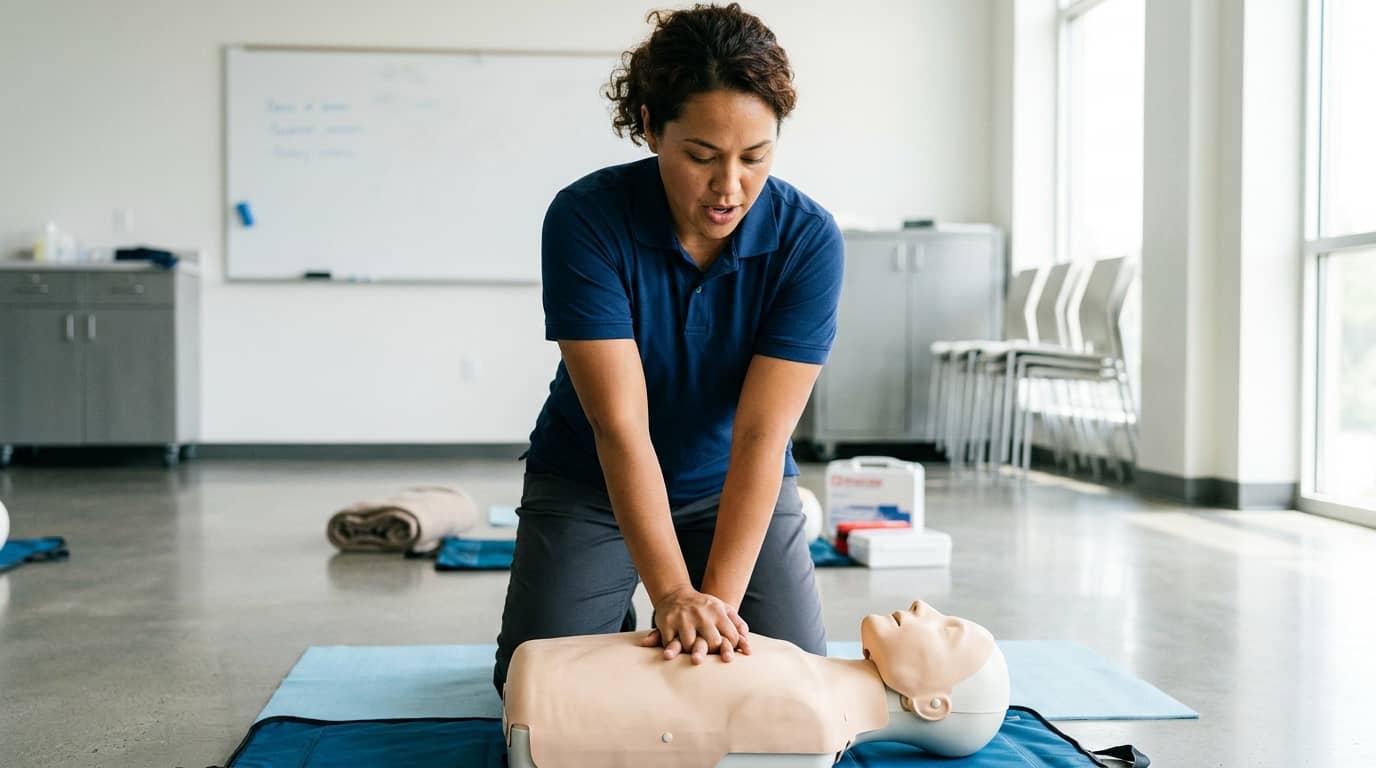
Lesson 2 • Cardiopulmonary Resuscitation Support
Reviews BLS principles, team CPR roles, and technician-specific duties during a cardiac arrest. Defines the technician's active role within the resuscitation team.
Lesson 3 • Recognising Procedural Complications
Identifies signs of perforation, haemorrhage, aspiration, and adverse sedation reactions. Establishes the recognition skills that trigger appropriate emergency responses.
Lesson 4 • Incident Reporting and Debriefing
Teaches accurate incident report completion, root cause analysis participation, and team debriefing. Closes the emergency response cycle with systematic learning and accountability.
Lesson 5 • Anaphylaxis and Allergic Reaction Response
Covers recognition of anaphylaxis, epinephrine auto-injector awareness, and escalation protocols. Prepares technicians to act immediately when contrast or medication reactions occur.
Your valid completion certificate
This course is for you:
Medical assistants ready to specialise in a procedure-focused clinical role.
CNA holders seeking a higher-paying allied health career path.
Recent high school graduates exploring structured entry points into healthcare.
Sterile processing technicians wanting to expand into direct procedural support.
Career changers drawn to a stable, in-demand clinical support speciality.
Hospital support staff aiming to move into the endoscopy suite.
What our students say
Your lessons are perfect. I purchased the one-year package and finally have the opportunity to follow various topics of my interest without needing to change platforms... I'm grateful for everything you do, I've already recommended you to other people...

I like how the lessons are straight to the point and how I can change chapters and skip content I don't need.

I like the content and the way videos are presented and transcribed, which speeds up the process!

The platform is fast, simple to use. The diversity of content and complementary videos help a lot with learning.

Top trainings


FAQs
Who is Dedika?
Is the certificate valid in Pakistan?
Are the courses free?
What is the course workload?
What are the courses like?
How do the courses work?
What is the duration of the courses?
What is the cost or price of the courses?
What is an EAD or online course and how does it work?
PDF Course