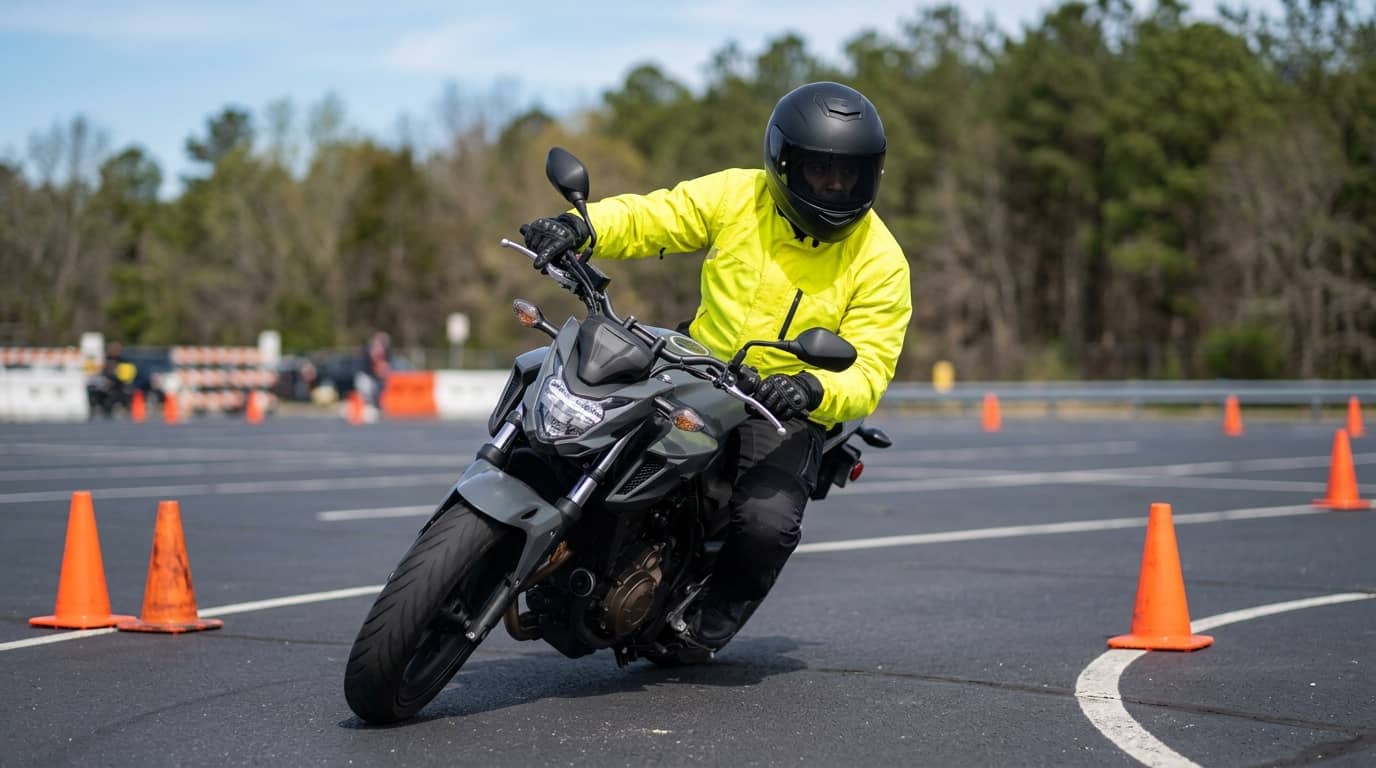
Light Motorcycle Riding Course
This Light Motorcycle Riding Course takes you from zero knowledge to confident, road-ready rider. You'll master essential controls, safe braking, cornering technique, and hazard response through a structured, skill-by-skill progression. Whether you're preparing for your license or building a solid foundation, this course gives you the practical knowledge to ride smart and stay safe.
What you will learn:
You'll start with motorcycle anatomy, licensing requirements, and protective gear selection, then move into hands-on control skills covering clutch, throttle, braking, and gear shifting. From there, you'll develop low-speed maneuvering, traffic integration, and cornering technique using countersteering and proper vision. The course also covers emergency braking, evasive swerving, and hazard recognition so you can respond fast when it counts. You'll finish with challenging conditions like rain, night riding, and highway speeds, plus maintenance basics to keep your bike reliable.
How you study in practice Light Motorcycle Riding Course
How you practice Light Motorcycle Riding Course
For companies that want to train their team
With Dedika for Business, the course includes exercises and examples tailored to your own business and the way your company needs.

Course content
8 Chapters • 39 LessonsDuration between 4 and 360 hours (you decide)
Chapter 1HideHide detailsSee detailsMotorcycle Fundamentals and Safety Mindset
Motorcycle Fundamentals and Safety Mindset
Lesson 1 • Protective Gear and Equipment
Details helmet ratings, jacket materials, gloves, boots, and high-visibility gear. Proper selection and fit are established as non-negotiable prerequisites to riding practice.
Lesson 2 • Pre-Ride Inspection Procedures
Teaches a systematic T-CLOCS-style walk-around covering tires, controls, lights, oil, chassis, and stands. Riders develop a repeatable habit that prevents mechanical failures on the road.
Lesson 3 • Motorcycle Anatomy and Components
Covers engine types, frame geometry, and drivetrain layout specific to light motorcycles. Builds the vocabulary needed for all subsequent mechanical and control discussions.
Lesson 4 • Rider Psychology and Risk Awareness
Examines how attitude, complacency, and stress affect riding decisions. Connects mental readiness directly to crash-prevention strategies introduced later.
Lesson 5 • Regulatory and Licensing Requirements
Surveys licensing classes, mandatory endorsements, registration, and insurance obligations applicable to light motorcycles. Riders understand compliance requirements before operating on public roads.
Chapter 2HideHide detailsSee detailsMotorcycle Controls and Basic Operation
Motorcycle Controls and Basic Operation
Lesson 1 • Braking Systems and Techniques
Explains front and rear brake function, progressive application, and brake bias. Riders practice controlled stops that form the basis for emergency braking in later chapters.
Lesson 2 • Clutch and Throttle Coordination
Teaches friction-zone identification, smooth engagement, and throttle roll-on timing. Mastery here is the foundation for all gear changes and low-speed control exercises.
Lesson 3 • Gear Shifting Fundamentals
Introduces upshifting and downshifting sequences, rev-matching concepts, and neutral location. Smooth shifting reduces mechanical wear and keeps the rider in control during acceleration.
Lesson 4 • Starting and Stopping the Engine
Covers ignition sequence, choke or fuel-injection warm-up, and proper shutdown. Correct procedures prevent stalls and mechanical stress during early practice sessions.
Lesson 5 • Mounting, Dismounting, and Balancing
Covers proper mounting side, kickstand use, and static balance with feet on pegs. These foundational habits prevent tip-overs and build rider confidence at zero speed.
Chapter 3HideHide detailsSee detailsLow-Speed Maneuvering and Control
Low-Speed Maneuvering and Control
Lesson 1 • Cone Weave and Obstacle Navigation
Uses cone courses to develop rhythmic steering inputs and precise path selection. Translates directly to navigating traffic, parked cars, and road debris.
Lesson 2 • Tight Turns and U-Turns
Teaches countersteering initiation at low speed, lean angle management, and throttle-brake coordination through confined turns. Prepares riders for real-world parking and intersection scenarios.
Lesson 3 • Controlled Slow-Speed Stops
Refines simultaneous front-rear brake application to achieve smooth, balanced stops from low speed. Builds the muscle memory needed for emergency stops introduced in the next chapter.
Lesson 4 • Straight-Line Slow Riding
Practices maintaining balance and throttle control while riding at near-walking speed in a straight line. Develops the fine motor coordination required for parking lots and congested areas.
Chapter 4HideHide detailsSee detailsRoad Riding Skills and Traffic Integration
Road Riding Skills and Traffic Integration
Lesson 1 • Intersection Management
Covers approach speed, scanning patterns, right-of-way decisions, and left-turn hazard awareness. Intersections represent the highest crash risk for motorcyclists and demand deliberate technique.
Lesson 2 • Riding in Traffic Groups
Introduces staggered formation, communication signals, and group-stop procedures. Riders understand how group dynamics affect individual decision-making and spacing.
Lesson 3 • Merging, Passing, and Lane Changes
Develops mirror checks, head checks, signal use, and acceleration timing for safe lane changes and passing. Riders practice these maneuvers in low-traffic environments before open roads.
Lesson 4 • Lane Positioning Strategies
Explains left, center, and right lane positions and when each maximizes visibility and safety. Correct positioning is the primary tool for managing space in traffic.
Lesson 5 • Speed Management and Following Distance
Teaches speed selection relative to road conditions, traffic flow, and sight distance. Establishes minimum following distances that allow adequate reaction time.
Chapter 5HideHide detailsSee detailsCornering Technique and Curve Management
Cornering Technique and Curve Management
Lesson 1 • Vision and Path Planning in Curves
Teaches late apex selection, entry-point identification, and gaze projection through the curve exit. Proper vision drives correct path selection and reduces target fixation risk.
Lesson 2 • Throttle and Lean Angle Management
Covers the relationship between throttle roll-on, lean angle, and traction budget. Smooth throttle application stabilizes the chassis and maximizes available grip through corners.
Lesson 3 • Countersteering Principles
Explains the physics of countersteering and demonstrates push-steering inputs above walking speed. Understanding this mechanism is essential before practicing any cornering technique.
Lesson 4 • Braking Before and After Corners
Establishes trail-braking basics and the importance of completing braking before the apex. Riders learn to manage deceleration without upsetting chassis balance at corner entry.
Lesson 5 • Decreasing-Radius and Blind Curves
Addresses the unique hazards of tightening curves and unseen exits, including speed adjustment and wide entry strategy. Riders apply all cornering skills to the most demanding real-world scenarios.
Chapter 6HideHide detailsSee detailsHazard Recognition and Emergency Response
Hazard Recognition and Emergency Response
Lesson 1 • Road Surface Hazard Identification
Identifies gravel, sand, wet paint, manhole covers, potholes, and debris as traction threats. Riders learn to spot and respond to surface hazards before reaching them.
Lesson 2 • Systematic Visual Scanning
Teaches near-far-near scanning rhythm, mirror check frequency, and peripheral awareness techniques. Consistent scanning is the primary defense against unexpected hazards.
Lesson 3 • Evasive Swerving Technique
Teaches the two-step swerve using countersteering inputs to avoid obstacles without braking simultaneously. Riders practice the maneuver until it becomes an instinctive response.
Lesson 4 • Maximum-Effort Emergency Braking
Drills threshold braking technique to achieve the shortest possible stopping distance without skidding. Builds the automatic response needed when a collision threat appears suddenly.
Lesson 5 • Collision Avoidance Decision-Making
Integrates scanning, braking, and swerving into a decision framework for real-time hazard response. Riders practice scenario-based exercises that simulate common crash-producing situations.
Chapter 7HideHide detailsSee detailsRiding in Challenging Conditions
Riding in Challenging Conditions
Lesson 1 • Night Riding Strategies
Addresses headlight use, speed reduction for sight distance, and reflective gear selection. Reduced visibility demands earlier hazard detection and longer reaction margins.
Lesson 2 • Wind and Crosswind Management
Teaches body positioning, throttle steadiness, and lane position adjustments for crosswinds and turbulence from large vehicles. Riders maintain stable paths in gusty conditions.
Lesson 3 • Fatigue and Long-Distance Riding
Identifies fatigue warning signs, mandatory rest intervals, and hydration and nutrition strategies. Riders plan routes and schedules that keep alertness within safe limits.
Lesson 4 • Wet Weather Riding Techniques
Covers reduced traction management, smooth input requirements, and tire warm-up in rain. Riders understand how water changes braking distances and cornering limits.
Lesson 5 • Gravel, Dirt, and Unpaved Surfaces
Introduces loose-surface throttle modulation, standing on pegs, and reduced lean angles. Riders gain confidence on unpaved roads common in rural and mixed-terrain environments.
Chapter 8HideHide detailsSee detailsAdvanced Riding Skills and Skill Integration
Advanced Riding Skills and Skill Integration
Lesson 1 • Highway and High-Speed Riding
Addresses wind buffeting, lane discipline, merge timing, and fatigue management at sustained highway speeds. Riders apply all prior skills in the highest-speed environment encountered.
Lesson 2 • Self-Assessment and Continuous Improvement
Teaches ride journaling, video review, and peer feedback methods to identify and correct persistent errors. Riders establish a personal development plan for ongoing skill growth after the course.
Lesson 3 • Cargo and Passenger Riding Adjustments
Covers load distribution, suspension adjustment, and handling changes when carrying a passenger or luggage. Riders recalibrate braking and cornering technique for added weight.
Lesson 4 • Integrated Scenario-Based Riding
Combines hazard recognition, cornering, braking, and traffic skills in multi-element road scenarios. Scenario practice reveals gaps and builds the automatic responses needed for real riding.
Lesson 5 • Smooth Riding and Chassis Balance
Refines throttle, brake, and steering inputs to eliminate abrupt transitions that upset chassis balance. Smooth riding extends tire life, reduces fatigue, and improves passenger comfort.
Your valid completion certificate
This course is for you:
First-time riders: eager to start motorcycling with a safe, structured approach.
Daily commuters: exploring motorcycles as a practical alternative to car travel.
Outdoor enthusiasts: wanting to access trails and rural roads on two wheels.
Recent license holders: looking to build real-world skills beyond the written test.
Career changers: entering delivery or courier work that requires motorcycle operation.
Returning riders: getting back on a bike after years away from the saddle.
What our students say
Your classes are perfect. I purchased the one-year package and finally have the opportunity to follow various topics of my interest without needing to switch platforms... I thank you for everything you do, I've already recommended you to other people...

I like how the lessons are straight to the point and how I can switch chapters and skip content I don't need.

I like the content and the presentation style and video transcription, which speeds up the process!

The platform is fast, simple to use. The diversity of content and complementary videos really help with learning.

Top trainings


FAQ
Who is Dedika?
Is the certificate valid in the United States?
Are the courses free?
What is the course workload?
What are the courses like?
How do the courses work?
What is the duration of the courses?
What is the cost or price of the courses?
What is an EAD or online course and how does it work?
PDF Course