
Mechanical Measurement Systems for Advanced Measurements Course
Master the full spectrum of mechanical measurement — from metrology fundamentals and dimensional inspection to vibration analysis, thermal sensing, and smart sensor networks. This advanced course equips engineers with the analytical tools and hands-on techniques needed to design, calibrate, and validate high-performance measurement systems across demanding industrial applications.
What your team will master:
Apply metrological standards and traceability principles to ensure measurement accuracy and compliance.
Configure load cells, strain gauges, and pressure transducers for static and dynamic force measurement.
Build complete uncertainty budgets that account for all error sources in a measurement system.
Analyze vibration signals using FFT, power spectral density, and order-tracking techniques.
Integrate multi-sensor data fusion and wireless networks into industrial condition monitoring platforms.
Design and commission full mechanical measurement systems from requirements definition through site acceptance testing.
How your team learns in practice Mechanical Measurement Systems for Advanced Measurements Course
How your team practices Mechanical Measurement Systems for Advanced Measurements Course
Professionals from these companies study at Dedika



Course content
8 Chapters • 39 LessonsDuration between 4 and 360 hours (you decide)
Chapter 1HideHide detailsSee detailsFoundations of Measurement Science
Foundations of Measurement Science
Lesson 1 • Physical Quantities and Unit Systems
Covers SI and derived units, dimensional analysis, and unit conversion. Provides the quantitative language used throughout all measurement disciplines.
Lesson 2 • Measurement Standards and Traceability
Defines primary, secondary, and working standards and explains traceability chains. Connects laboratory practice to internationally recognized reference values.
Lesson 3 • Measurement Error and Uncertainty
Distinguishes systematic from random errors and introduces uncertainty budgets. Builds the analytical foundation for evaluating measurement reliability.
Lesson 4 • Measurement System Performance Metrics
Defines static and dynamic performance characteristics such as linearity, hysteresis, and repeatability. Enables objective comparison of measurement instruments.
Chapter 2HideHide detailsSee detailsMechanical Measurement System Architecture
Mechanical Measurement System Architecture
Lesson 1 • Signal Conditioning Fundamentals
Covers amplification, filtering, and bridge circuits used to prepare raw signals. Links the sensing element output to usable measurement data.
Lesson 2 • System Calibration Procedures
Details end-to-end calibration of a complete measurement system. Reinforces traceability concepts from Chapter 1 in a practical system context.
Lesson 3 • Loading Effects and Interference
Analyzes how connecting instruments alters the measured quantity and introduces interference sources. Prepares students to design minimally invasive measurement setups.
Lesson 4 • Data Acquisition and Recording
Introduces analog-to-digital conversion, sampling theory, and data loggers. Connects signal conditioning output to stored, analyzable measurement records.
Lesson 5 • Sensing Elements and Transducers
Explains how physical phenomena are converted into measurable signals by sensing elements. Establishes the input stage of every mechanical measurement chain.
Chapter 3HideHide detailsSee detailsDimensional and Geometric Measurement
Dimensional and Geometric Measurement
Lesson 1 • Measurement Uncertainty in Dimensional Work
Applies uncertainty budgeting specifically to dimensional instruments and CMM results. Reinforces Chapter 1 uncertainty methods in a hands-on dimensional context.
Lesson 2 • Linear Measurement Instruments
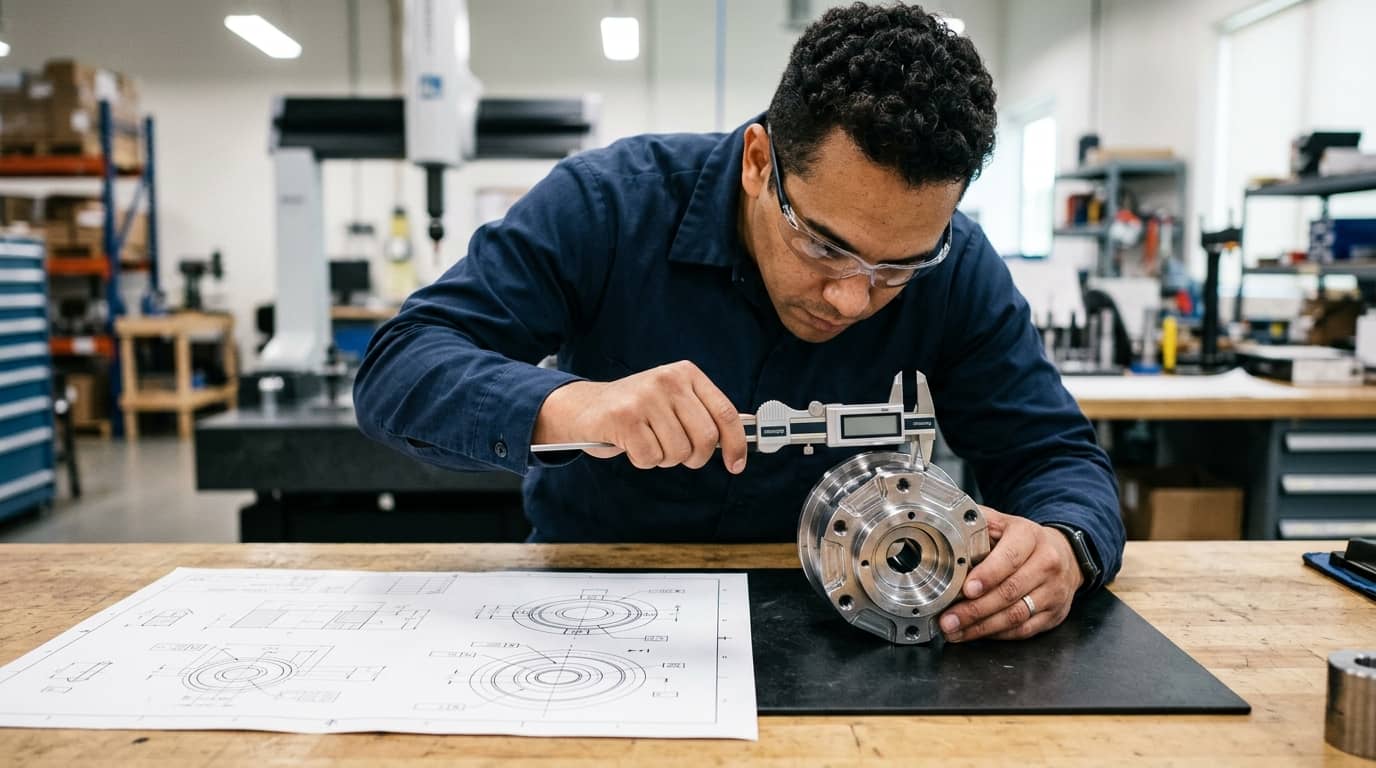
Covers verniers, micrometers, and gauge blocks for precise length measurement. Establishes baseline dimensional measurement skills used in all subsequent sections.
Lesson 3 • Angular and Geometric Measurement
Introduces protractors, sine bars, and autocollimators for angle and flatness measurement. Extends linear skills to multi-dimensional geometric assessment.
Lesson 4 • Coordinate Measuring Machines
Explains CMM hardware, probing strategies, and geometric dimensioning tolerancing evaluation. Integrates multiple dimensional measurements into a single automated workflow.
Lesson 5 • Surface Texture Measurement
Defines roughness parameters and explains stylus profilometer operation. Connects surface finish to functional performance in mechanical assemblies.
Chapter 4HideHide detailsSee detailsForce, Torque, and Pressure Measurement
Force, Torque, and Pressure Measurement
Lesson 1 • Dynamic Force and Pressure Analysis
Addresses frequency response, resonance, and impact loading in force and pressure systems. Prepares students for high-speed and transient mechanical measurement scenarios.
Lesson 2 • Pressure Transducer Technologies
Compares capacitive, piezoelectric, and resonant pressure transducers for static and dynamic use. Builds sensor selection skills for fluid and gas pressure applications.
Lesson 3 • Torque Measurement Techniques
Introduces reaction torque sensors, rotary transformers, and telemetry for rotating shafts. Extends force measurement principles to rotational mechanical systems.
Lesson 4 • Strain Gauge Principles and Application
Explains piezoresistive effect, gauge factor, and bonding techniques for strain gauges. Provides the sensing foundation for force, torque, and pressure instruments.
Lesson 5 • Load Cell Design and Calibration
Covers elastic element geometries, bridge configurations, and load cell calibration. Connects strain gauge theory to practical force measurement devices.
Chapter 5HideHide detailsSee detailsMotion, Vibration, and Acoustic Measurement
Motion, Vibration, and Acoustic Measurement
Lesson 1 • Velocity and Acceleration Transducers
Introduces velocity pickups, MEMS accelerometers, and piezoelectric accelerometers. Connects displacement sensing to higher-order motion quantities.
Lesson 2 • Displacement and Proximity Sensing
Covers LVDTs, capacitive sensors, and eddy-current probes for non-contact displacement. Establishes the motion measurement baseline for vibration and acoustic work.
Lesson 3 • Modal Analysis and Structural Testing
Covers impact hammer testing, frequency response functions, and mode shape extraction. Integrates motion and vibration measurements into structural dynamic characterization.
Lesson 4 • Vibration Signal Analysis
Applies FFT, power spectral density, and time-frequency methods to vibration data. Transforms raw accelerometer output into actionable mechanical health information.
Lesson 5 • Acoustic and Sound Measurement
Explains microphone types, sound level meters, and decibel scales for acoustic measurement. Extends vibration concepts to airborne and structure-borne sound.
Chapter 6HideHide detailsSee detailsThermal and Flow Measurement
Thermal and Flow Measurement
Lesson 1 • Heat Flux and Thermal Imaging
Introduces thin-film heat flux gauges and infrared thermography for surface temperature mapping. Extends point temperature measurement to spatial thermal field analysis.
Lesson 2 • Temperature Sensing Technologies
Compares thermocouples, RTDs, thermistors, and infrared sensors for temperature measurement. Establishes sensor selection criteria based on range, accuracy, and response time.
Lesson 3 • Flow Meter Technologies
Compares orifice plates, turbine meters, Coriolis meters, and ultrasonic flow meters. Builds practical selection and installation knowledge for diverse flow applications.
Lesson 4 • Fluid Flow Measurement Principles
Covers differential pressure, velocity, and mass flow measurement fundamentals. Provides the theoretical basis for selecting flow instruments in mechanical systems.
Lesson 5 • Thermal System Calibration and Validation
Details calibration baths, fixed-point cells, and flow calibration rigs for thermal and flow instruments. Ensures measurement traceability in thermal and fluid measurement systems.
Chapter 7HideHide detailsSee detailsAdvanced Sensor Integration and Smart Systems
Advanced Sensor Integration and Smart Systems
Lesson 1 • Wireless Sensor Networks for Machinery
Covers wireless protocols, energy harvesting, and network topology for industrial sensor nodes. Extends wired measurement systems to remote and rotating machinery applications.
Lesson 2 • Measurement System Validation and Qualification
Covers measurement system analysis, gauge R&R studies, and acceptance testing for integrated systems. Ensures the complete system meets performance requirements before deployment.
Lesson 3 • Embedded Signal Processing
Applies digital filters, feature extraction, and edge computing to on-sensor data processing. Reduces data transmission load and enables real-time decision making at the sensor level.
Lesson 4 • Condition Monitoring System Design
Integrates vibration, temperature, and load sensors into a unified condition monitoring platform. Applies all prior sensor knowledge to a complete industrial monitoring solution.
Lesson 5 • Multi-Sensor Data Fusion
Introduces Kalman filtering, complementary filtering, and Bayesian fusion for combining sensor outputs. Enables more accurate estimates than any single sensor can provide.
Chapter 8HideHide detailsSee detailsMeasurement System Design and Optimization
Measurement System Design and Optimization
Lesson 1 • Commissioning, Verification, and Handover
Details site acceptance testing, operator training, and documentation for system handover. Completes the design-to-deployment lifecycle for a professional measurement system.
Lesson 2 • Requirements Definition and Sensor Selection
Translates engineering measurement needs into quantitative sensor specifications. Establishes the design input process that drives all subsequent system decisions.
Lesson 3 • Reliability and Failure Mode Analysis
Applies FMEA and reliability block diagrams to measurement system components. Ensures the designed system meets uptime and safety requirements in service.
Lesson 4 • System Architecture and Layout Design
Covers signal routing, grounding schemes, and enclosure design for measurement systems. Converts sensor selection into a physically realizable, interference-resistant installation.
Lesson 5 • Uncertainty Budget for System Design
Constructs a full system-level uncertainty budget integrating all error sources. Applies Chapter 1 and Chapter 2 uncertainty methods to the complete designed system.
Your valid completion certificate
This course is for you:
Mechanical engineer: ready to move beyond basic instrumentation knowledge.
Test and validation technician: seeking deeper expertise in measurement system design.
Aerospace or automotive engineer: needing rigorous sensor integration and data analysis skills.
Maintenance engineer: wanting to build structured condition monitoring capabilities at work.
Graduate student: bridging academic theory with real industrial measurement practice.
Quality assurance engineer: aiming to strengthen metrology and uncertainty analysis competence.
Related Courses




FAQ
Who is Dedika?
Is the certificate valid in the United States?
Are the courses free?
What is the course workload?
What are the courses like?
How do the courses work?
What is the duration of the courses?
What is the cost or price of the courses?
What is an EAD or online course and how does it work?
PDF Course