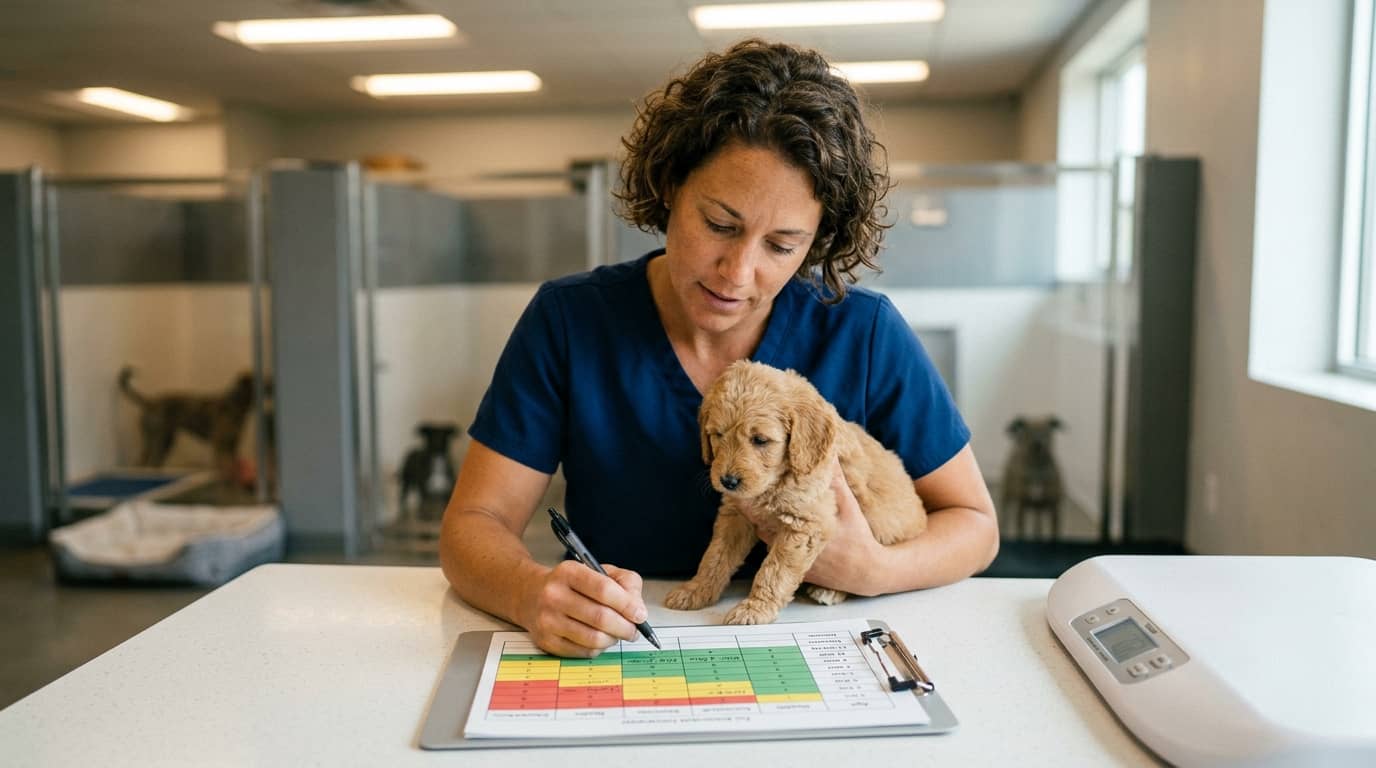
Canine Breeder Course
The Canine Breeder Course gives you the complete knowledge base to run a responsible, professional breeding programme from the ground up. You will master canine genetics, reproductive biology, whelping management, puppy development, and kennel operations. Whether you are starting out or levelling up, this course covers every stage of the breeding process with practical depth.
What you will learn:
This course covers everything a serious breeder needs to know, starting with canine genetics and heredity so you can make informed pairing decisions and reduce heritable disease in your lines. You will study the full reproductive cycle, ovulation timing, and both natural and assisted mating methods. Pregnancy monitoring, whelping support, and neonatal care are covered in detail so you can protect your dams and litters through the most critical stages. Puppy development, socialisation protocols, and temperament testing prepare you to place well-adjusted dogs in the right homes. You will also build the business skills to manage kennel operations, meet regulatory requirements, and grow a reputable breeding programme.
How you study in practice Canine Breeder Course
How you practise Canine Breeder Course
For companies looking to train their teams
With Dedika for businesses, the course includes exercises and examples tailored to your company and its specific needs.

Course content
8 Chapters • 38 LessonsDuration between 4 and 360 hours (you decide)
Chapter 1HideHide detailsSee detailsFoundations of Canine Breeding
Foundations of Canine Breeding
Lesson 1 • Breed Classification Systems
Examines major kennel club groupings and functional breed categories. Helps students match breed traits to intended purposes and owner lifestyles.
Lesson 2 • Canine Anatomy and Physiology Overview
Introduces skeletal, muscular, and organ systems relevant to breeding soundness. Builds anatomical vocabulary used in later health and genetics chapters.
Lesson 3 • Roles and Responsibilities of a Breeder
Defines ethical obligations, regulatory compliance, and community expectations for breeders. Frames the professional mindset required throughout the course.
Lesson 4 • History and Domestication of Dogs
Covers the evolutionary path from wolf to domestic dog and the role of selective breeding. Provides historical context that underpins all modern breeding decisions.
Chapter 2HideHide detailsSee detailsCanine Genetics and Heredity
Canine Genetics and Heredity
Lesson 1 • Polygenic and Complex Traits
Addresses traits controlled by multiple genes, including size, temperament, and hip structure. Connects genetic complexity to realistic breeding expectations.
Lesson 2 • Heritable Diseases and Genetic Testing
Identifies common autosomal, X-linked, and polygenic disorders in purebred dogs. Students learn to use genetic test results to reduce disease prevalence.
Lesson 3 • Coat Color and Trait Inheritance
Explains loci controlling coat colour, texture, and pattern in dogs. Students apply inheritance models to predict litter appearance.
Lesson 4 • Inbreeding, Linebreeding, and Outcrossing
Compares strategies for concentrating or diversifying genetics within a breeding programme. Students calculate coefficients of inbreeding and assess population risk.
Lesson 5 • Basic Principles of Genetics
Covers DNA structure, chromosomes, alleles, and Mendelian inheritance. Provides the genetic vocabulary needed for all subsequent breeding analysis.
Chapter 3HideHide detailsSee detailsCanine Reproductive Biology
Canine Reproductive Biology
Lesson 1 • Female Reproductive Cycle
Details the four stages of the oestrous cycle and associated hormonal changes. Accurate cycle knowledge is essential for timing successful matings.
Lesson 2 • Natural Mating and Assisted Reproduction
Compares natural tie breeding with artificial insemination techniques. Students choose the appropriate method based on pair compatibility and logistics.
Lesson 3 • Ovulation Timing and Fertile Window
Covers progesterone testing, vaginal cytology, and LH surge detection. Students select the optimal mating days to maximise conception rates.
Lesson 4 • Male Reproductive Physiology
Examines testicular function, spermatogenesis, and semen quality parameters. Provides the male-side knowledge needed for complete breeding pair assessment.
Chapter 4HideHide detailsSee detailsPregnancy, Whelping, and Neonatal Care
Pregnancy, Whelping, and Neonatal Care
Lesson 1 • Preparing the Whelping Environment
Details whelping box design, temperature control, and supply preparation. A well-prepared environment directly reduces neonatal mortality risk.
Lesson 2 • Normal and Assisted Whelping
Describes the three stages of labour, normal delivery signs, and when to intervene. Students distinguish routine whelping from emergencies requiring veterinary assistance.
Lesson 3 • Neonatal Assessment and Early Care
Covers Apgar scoring, colostrum intake, and neonatal health monitoring in the first weeks. Early intervention skills prevent the most common causes of puppy loss.
Lesson 4 • Canine Gestation and Prenatal Care
Covers fetal development stages, nutritional needs, and ultrasound monitoring during pregnancy. Establishes proactive dam care practices that reduce whelping complications.
Lesson 5 • Postpartum Dam Care
Addresses uterine involution, lactation support, and common postpartum complications. Healthy dam recovery ensures sustained milk production and litter welfare.
Chapter 5HideHide detailsSee detailsPuppy Development and Socialisation
Puppy Development and Socialisation
Lesson 1 • Socialisation Protocols and Exposure Plans
Designs systematic exposure to people, animals, sounds, and environments before placement. Proper socialisation reduces fear-based behaviour in adult dogs.
Lesson 2 • Temperament Testing and Puppy Matching
Applies standardised temperament assessments to profile individual puppies. Results guide placement decisions that align puppy traits with owner needs.
Lesson 3 • Developmental Stages of Puppies
Maps neonatal, transitional, socialisation, and juvenile periods with key milestones. Understanding stage-specific needs guides appropriate breeder interventions.
Lesson 4 • Early Neurological Stimulation
Introduces structured handling exercises that enhance stress resilience and neurological development. Applied from days 3–16 to maximise long-term adaptability.
Lesson 5 • Weaning and Nutritional Transition
Covers the gradual shift from dam's milk to solid food between weeks 3 and 7. Correct weaning reduces digestive stress and supports immune development.
Chapter 6HideHide detailsSee detailsCanine Health Management and Preventive Care
Canine Health Management and Preventive Care
Lesson 1 • Infectious Disease Recognition
Identifies clinical signs of major canine infectious diseases and appropriate response actions. Early recognition limits outbreak spread within a kennel.
Lesson 2 • Vaccination Protocols for Breeding Dogs
Covers core and non-core vaccines, maternal antibody interference, and timing schedules. Correct vaccination protects breeding stock and neonatal litters.
Lesson 3 • Parasite Prevention and Control
Addresses internal and external parasite life cycles, treatment options, and kennel sanitation. Parasite control is critical for litter health and zoonotic risk reduction.
Lesson 4 • Orthopaedic and Cardiac Health Screening
Covers hip and elbow evaluation, cardiac auscultation, and eye certification programmes. Screening results directly inform breeding pair selection decisions.
Lesson 5 • Nutrition for Breeding and Performance
Compares life-stage nutritional requirements for stud dogs, brood bitches, and growing puppies. Optimal nutrition supports reproductive performance and immune function.
Chapter 7HideHide detailsSee detailsKennel Operations and Business Management
Kennel Operations and Business Management
Lesson 1 • Staffing and Kennel Workflow
Covers hiring, training, and scheduling kennel staff to maintain consistent animal care. Effective workflow systems reduce errors and support staff retention.
Lesson 2 • Record-Keeping and Documentation Systems
Establishes breeding records, health certificates, pedigree files, and litter registration processes. Accurate records support regulatory audits and breeding programme analysis.
Lesson 3 • Kennel Facility Design and Biosecurity
Covers housing standards, ventilation, sanitation systems, and traffic flow for disease control. Facility design directly affects animal welfare and regulatory compliance.
Lesson 4 • Financial Planning and Pricing Strategy
Analyses breeding programme costs, revenue streams, and puppy pricing models. Financial literacy ensures long-term programme viability without compromising welfare.
Lesson 5 • Regulatory Compliance and Licensing
Identifies licensing categories, inspection standards, and animal welfare regulations applicable to breeders. Compliance protects the business and upholds industry credibility.
Chapter 8HideHide detailsSee detailsBreeding Programme Design and Evaluation
Breeding Programme Design and Evaluation
Lesson 1 • Defining Breeding Goals and Selection Criteria
Guides students in setting measurable breed improvement goals aligned with standards and health data. Clear goals prevent inconsistent selection decisions across generations.
Lesson 2 • Multi-Generation Breeding Planning
Constructs breeding plans across three or more generations to achieve cumulative improvement. Long-term planning prevents genetic bottlenecks and maintains diversity.
Lesson 3 • Litter Evaluation and Selection Decisions
Applies conformation, health, and temperament criteria to evaluate individual puppies within a litter. Objective evaluation informs which puppies advance the breeding programme.
Lesson 4 • Stud Dog and Brood Bitch Selection
Applies health clearances, pedigree analysis, and phenotypic evaluation to pair selection. Systematic selection maximises genetic progress towards programme goals.
Lesson 5 • Programme Review and Continuous Improvement
Establishes metrics, feedback loops, and annual review processes for ongoing programme refinement. Data-driven review distinguishes successful breeders from stagnant programmes.
Your valid completion certificate
This course is for you:
Aspiring breeders: ready to start their first programme with a solid foundation.
Hobbyist breeders: seeking structured knowledge to replace trial-and-error habits.
Veterinary technicians: expanding expertise into reproductive and breeding support roles.
Kennel owners: looking to formalise operations and meet professional compliance standards.
Career changers: transitioning from unrelated fields into the dog breeding industry.
Breed club members: aiming to contribute more meaningfully to breed health initiatives.
What our students say
Your lessons are perfect. I purchased the one-year package and finally have the opportunity to follow various topics of interest without needing to change platforms... I'm grateful for everything you do, I've already recommended you to other people...

I like how the lessons are straight to the point and how I can change chapters and skip content I don't need.

I like the content and the way videos are presented and transcribed, which speeds up the process!

The platform is fast, simple to use. The diversity of content and complementary videos really help with learning.

Top qualifications





FAQ
Who is Dedika?
Is the certificate valid in South Africa?
Are the courses free?
What is the course workload?
What are the courses like?
How do the courses work?
What is the duration of the courses?
What is the cost or price of the courses?
What is an EAD or online course and how does it work?
PDF Course