
Electrical and Mechanical Systems Course
Master the electrical and mechanical systems that keep industrial facilities running. This course covers everything from DC circuits and AC power to motors, fluid power, PLCs, and predictive maintenance. Whether you work in manufacturing, utilities, or facilities management, you'll gain the technical depth to solve real problems on the job.
What you will learn:
You will build a complete technical foundation covering electrical circuits, AC and DC power systems, transformers, and three-phase distribution. You will analyze mechanical power transmission components including gears, shafts, bearings, and belt drives. The course covers hydraulic and pneumatic system design, component selection, and fault diagnosis. You will learn to program PLCs, configure VFDs, and apply PID control to industrial processes. Maintenance strategy, vibration analysis, root cause analysis, and reliability-centered maintenance are also included. By the end, you will have the skills to design, operate, and maintain complex electrical and mechanical systems in industrial environments.
How you study in practice Electrical and Mechanical Systems Course
How you practice Electrical and Mechanical Systems Course
For companies looking to train their teams
With Dedika for businesses, the course includes exercises and examples tailored to your own business and the way your company needs.

Course Content
8 Chapters • 40 LessonsDuration between 4 and 360 hours (you decide)
Chapter 1HideHide detailsSee detailsFoundations of Electrical and Mechanical Systems
Foundations of Electrical and Mechanical Systems
Lesson 1 • Safety Principles and Hazard Awareness
Identifies electrical and mechanical hazards and introduces lockout/tagout and PPE protocols. Safety compliance is required before any hands-on work.
Lesson 2 • Fundamental Electrical Concepts
Introduces voltage, current, resistance, and Ohm's Law. These concepts underpin every electrical circuit and system covered later.
Lesson 3 • Fundamental Mechanical Concepts
Covers statics, dynamics, and basic machine elements. Connects Newton's laws to real mechanical system behavior.
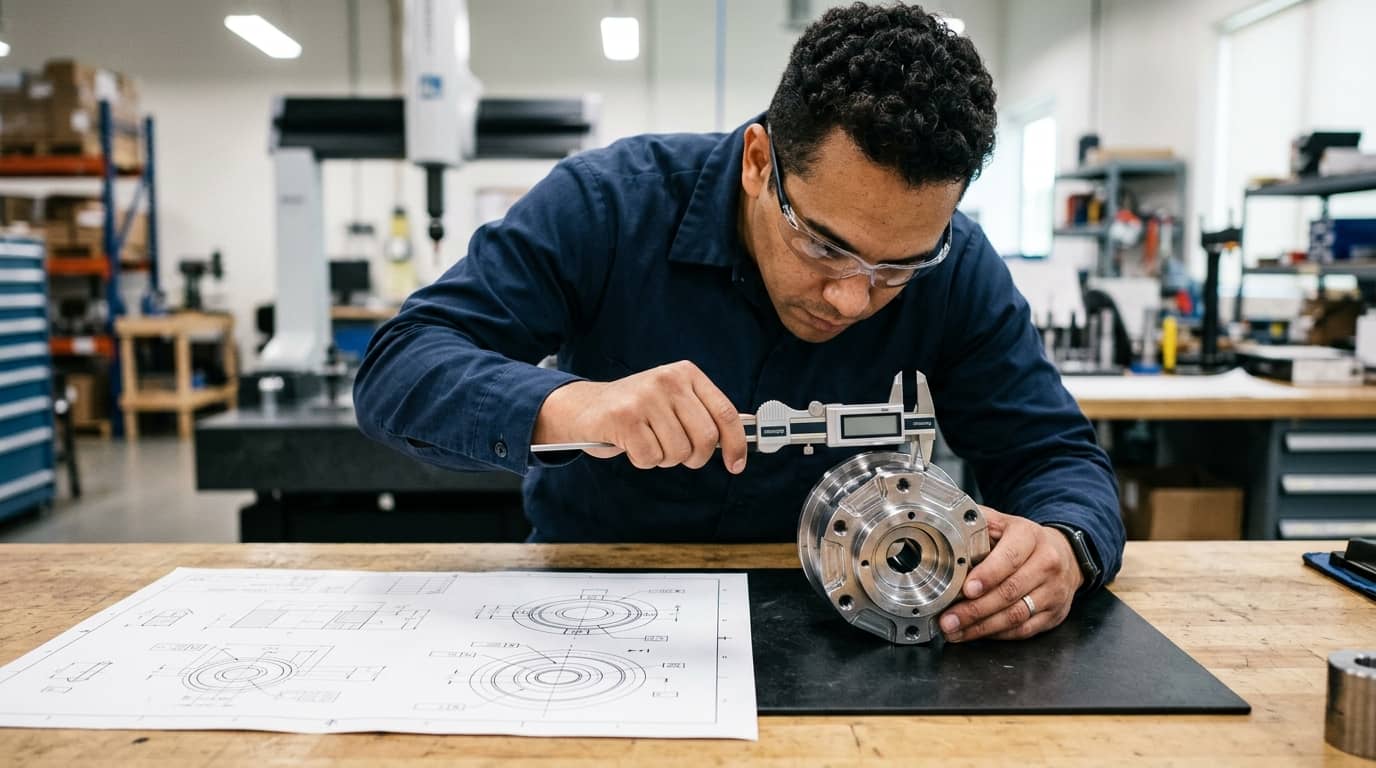
Lesson 4 • Reading Technical Drawings and Schematics
Teaches interpretation of electrical schematics and mechanical drawings. Enables students to extract design intent from standard documentation.
Lesson 5 • Core Physical Quantities and Units
Establishes SI and imperial units for force, energy, power, and charge. Provides the measurement language required for all subsequent technical analysis.
Chapter 2HideHide detailsSee detailsDC Circuits: Analysis and Application
DC Circuits: Analysis and Application
Lesson 1 • Kirchhoff's Laws and Network Analysis
Applies Kirchhoff's Voltage and Current Laws to multi-loop circuits. Enables systematic solution of circuits with multiple sources and branches.
Lesson 2 • Thevenin and Norton Equivalent Circuits
Simplifies complex networks into two-terminal equivalents for load analysis. Directly supports troubleshooting and circuit design tasks.
Lesson 3 • Series and Parallel Circuit Configurations
Analyzes voltage, current, and resistance in series and parallel arrangements. Forms the basis for understanding more complex network topologies.
Lesson 4 • DC Measurement Instruments and Techniques
Covers multimeter, ammeter, and voltmeter use in DC circuits. Accurate measurement is essential for verification and fault diagnosis.
Lesson 5 • Batteries, Sources, and Energy Storage
Examines DC voltage sources, battery chemistry, and energy storage characteristics. Provides context for powering and sizing electrical systems.
Chapter 3HideHide detailsSee detailsAC Circuits and Power Systems
AC Circuits and Power Systems
Lesson 1 • Impedance, Reactance, and AC Networks
Introduces inductive and capacitive reactance and combines them with resistance into impedance. Enables full AC circuit analysis using phasor methods.
Lesson 2 • AC Power: Real, Reactive, and Apparent
Distinguishes real, reactive, and apparent power and introduces the power factor. Power factor correction is a key industrial energy-efficiency skill.
Lesson 3 • Three-Phase Power Systems
Covers wye and delta configurations, line vs. phase quantities, and balanced load analysis. Three-phase systems power most industrial equipment.
Lesson 4 • AC Waveforms and Phasor Representation
Defines sinusoidal waveforms, frequency, amplitude, and phase relationships. Phasor notation simplifies AC calculations throughout the chapter.
Lesson 5 • Transformers and Voltage Conversion
Explains transformer operation, turns ratio, and efficiency. Transformers are central to power distribution and voltage adaptation in facilities.
Chapter 4HideHide detailsSee detailsElectrical Machines and Drive Systems
Electrical Machines and Drive Systems
Lesson 1 • Variable Frequency Drives and Soft Starters
Introduces VFD operation, parameter configuration, and energy savings. Soft starters reduce mechanical stress during motor starting.
Lesson 2 • AC Induction Motors
Analyzes rotating magnetic fields, slip, and torque-speed curves of induction motors. Induction motors are the most common industrial drive.
Lesson 3 • DC Motors and Generators
Explains DC machine construction, torque-speed characteristics, and excitation methods. Provides the baseline for comparing AC machine behavior.
Lesson 4 • Synchronous Machines and Generators
Covers synchronous motor and generator operation, excitation control, and grid connection. Essential for power generation and large drive applications.
Lesson 5 • Motor Protection and Sizing
Covers thermal overload, short-circuit protection, and motor sizing calculations. Proper protection prevents costly failures and downtime.
Chapter 5HideHide detailsSee detailsMechanical Power Transmission Systems
Mechanical Power Transmission Systems
Lesson 1 • Gear Systems and Gear Trains
Analyzes spur, helical, bevel, and worm gears for speed and torque conversion. Gear train ratios directly affect system performance.
Lesson 2 • Shafts, Keys, and Couplings
Covers shaft design, keyway sizing, and coupling selection for torque transmission. These elements connect prime movers to driven loads.
Lesson 3 • Bearings and Lubrication
Introduces rolling-element and plain bearings, load ratings, and lubrication requirements. Bearing selection and lubrication directly impact machine life.
Lesson 4 • Brakes, Clutches, and Overload Devices
Examines friction brakes, electromagnetic clutches, and torque limiters for controlled engagement. These devices protect machinery and enable precise motion control.
Lesson 5 • Belt and Chain Drive Systems
Covers V-belt, flat belt, and roller chain drives including tension and power ratings. Belt and chain drives offer flexible, low-cost power transmission.
Chapter 6HideHide detailsSee detailsFluid Power: Hydraulic and Pneumatic Systems
Fluid Power: Hydraulic and Pneumatic Systems
Lesson 1 • Hydraulic Control Valves and Circuits
Covers directional, pressure, and flow control valves and their circuit symbols. Valve selection and placement define system function and safety.
Lesson 2 • Fluid Power Fundamentals
Covers Pascal's Law, Bernoulli's principle, and fluid properties relevant to power systems. These principles govern all hydraulic and pneumatic behavior.
Lesson 3 • Pneumatic Components and Circuits
Introduces compressors, FRL units, pneumatic actuators, and control valves. Pneumatic systems are widely used for automation and tooling.
Lesson 4 • Hydraulic Pumps and Actuators
Analyzes gear, vane, and piston pumps alongside hydraulic cylinders and motors. Pump selection determines system pressure and flow capacity.
Lesson 5 • Fluid Power System Troubleshooting
Applies systematic diagnostic methods to hydraulic and pneumatic faults. Efficient troubleshooting minimizes downtime and prevents component damage.
Chapter 7HideHide detailsSee detailsControl Systems and Automation
Control Systems and Automation
Lesson 1 • Industrial Networking and HMI Integration
Covers fieldbus protocols, Ethernet-based networks, and HMI configuration. Networked control systems enable centralized monitoring and data collection.
Lesson 2 • Programmable Logic Controllers (PLCs)
Introduces PLC hardware, scan cycle, and ladder logic programming. PLCs are the primary control platform in industrial automation.
Lesson 3 • PID Control and Process Tuning
Explains proportional, integral, and derivative control actions and tuning methods. PID loops regulate temperature, pressure, speed, and flow in industry.
Lesson 4 • Sensors and Transducers
Covers position, temperature, pressure, and flow sensors used in industrial control. Accurate sensing is the foundation of reliable automation.
Lesson 5 • Control System Fundamentals
Defines open-loop and closed-loop control, feedback, and system response. These concepts apply to every automated machine and process.
Chapter 8HideHide detailsSee detailsMaintenance, Diagnostics, and Reliability
Maintenance, Diagnostics, and Reliability
Lesson 1 • Electrical Diagnostic Techniques
Applies insulation resistance testing, thermography, and power quality analysis to electrical faults. Early detection prevents catastrophic failures.
Lesson 2 • Root Cause Analysis and Failure Investigation
Introduces RCA methods including fishbone diagrams and fault trees to identify failure causes. Systematic analysis prevents recurrence of costly failures.
Lesson 3 • Maintenance Strategy Frameworks
Compares reactive, preventive, predictive, and reliability-centered maintenance approaches. Strategy selection balances cost, risk, and equipment criticality.
Lesson 4 • Maintenance Planning and Work Management
Covers work order systems, spare parts management, and maintenance scheduling. Effective planning maximizes equipment availability and resource efficiency.
Lesson 5 • Mechanical Diagnostic Techniques
Covers vibration analysis, oil analysis, and ultrasonic testing for mechanical condition monitoring. These tools identify faults before failure occurs.
Your valid completion certificate
This course is for you:
Maintenance technician: ready to move beyond reactive repairs into systems thinking.
Electrician: wanting to add mechanical and automation knowledge to their skillset.
Mechanical engineer: seeking structured grounding in electrical systems and controls.
Industrial operator: aiming to understand the equipment they run every shift.
Career changer: transitioning into skilled trades from an unrelated technical background.
Facilities supervisor: needing technical depth to manage contractors and equipment decisions.
What our students say
Your classes are perfect. I purchased the one-year package and finally have the opportunity to follow various topics of interest without needing to switch platforms... I thank you for everything you do, I've already recommended you to other people...

I like how the lessons are straight to the point and how I can switch chapters and skip content I don't need.

I like the content and the presentation style and video transcription, which speeds up the process!

The platform is fast, simple to use. The diversity of content and complementary videos really help with learning.

Top trainings




FAQ
Who is Dedika?
Is the certificate valid in United States?
Are the courses free?
What is the course workload?
What are the courses like?
How do the courses work?
What is the duration of the courses?
What is the cost or price of the courses?
What is an EAD or online course and how does it work?
PDF Course