
Forging Course
Master every stage of the forging process, from billet preparation and furnace control to closed-die sequencing and final certification. This course covers the equipment, materials, defect analysis, and quality standards used in real forge shops. Whether you're entering the trade or advancing your career, you'll build the hands-on knowledge employers in aerospace, automotive, and energy demand.
What you will learn:
You will learn how to select and prepare metals for forging, operate hammers and presses safely, and control furnace temperatures for steel, aluminum, titanium, and superalloys. The course covers open-die and closed-die techniques, die design fundamentals, and flash trimming procedures. You will study forging defects, apply non-destructive testing methods, and use statistical process control to maintain quality. Post-forging operations including heat treatment, straightening, and certification documentation are also covered. By the end, you will understand how every variable in the forging process affects the mechanical properties and dimensional accuracy of the finished part.
How you study in practice Forging Course
How you practice Forging Course
For companies looking to train their teams
With Dedika for businesses, the course includes exercises and examples tailored to your own business and the way your company needs.

Course Content
8 Chapters • 40 LessonsDuration between 4 and 360 hours (you decide)
Chapter 1HideHide detailsSee detailsFoundations of Metal Forging
Foundations of Metal Forging
Lesson 1 • Core Forging Terminology
Defines essential vocabulary used throughout the trade. Accurate terminology enables safe communication and precise instruction-following.
Lesson 2 • Industry Applications and Career Paths
Maps forging to aerospace, automotive, tooling, and energy sectors. Motivates learners by connecting skills to real employment contexts.
Lesson 3 • Metallurgical Principles for Forgers
Covers grain structure, plasticity, and how heat affects metal behavior. Links material science directly to forging outcomes.
Lesson 4 • Overview of Forging Methods
Introduces open-die, closed-die, roll, and press forging at a conceptual level. Sets the stage for deeper study in later chapters.
Lesson 5 • History and Evolution of Forging
Traces forging from ancient blacksmithing to modern industrial practice. Provides context for why techniques and equipment evolved as they did.
Chapter 2HideHide detailsSee detailsMetals and Materials for Forging
Metals and Materials for Forging
Lesson 1 • Material Traceability and Documentation
Establishes practices for heat number tracking, certifications, and material records. Traceability is mandatory in regulated industries.
Lesson 2 • Non-Ferrous Metals in Forging
Addresses aluminum, titanium, copper alloys, and nickel superalloys. Each material requires distinct temperature ranges and tooling strategies.
Lesson 3 • Billet Preparation and Inspection
Teaches cutting, surface conditioning, and pre-forge inspection of stock material. Proper preparation prevents defects and tool damage.
Lesson 4 • Carbon and Alloy Steel Grades
Examines low, medium, and high carbon steels plus common alloy additions. Connects grade selection to strength, toughness, and forgeability.
Lesson 5 • Stainless and Tool Steels
Covers austenitic, martensitic, and tool steel families and their forging challenges. Prepares students for high-value, precision forging work.
Chapter 3HideHide detailsSee detailsForging Equipment and Tooling
Forging Equipment and Tooling
Lesson 1 • Gravity and Power Drop Hammers
Explains board, air, and steam drop hammers including energy ratings and stroke control. Foundational equipment knowledge for open-die and impression work.
Lesson 2 • Auxiliary Tooling and Fixtures
Covers swages, fullers, flatters, mandrels, and holding fixtures. Auxiliary tools extend the range of shapes achievable on standard equipment.
Lesson 3 • Mechanical and Hydraulic Presses
Covers eccentric, knuckle-joint, and hydraulic press designs and their force-stroke profiles. Press selection directly affects dimensional accuracy.
Lesson 4 • Tooling Inspection and Replacement
Establishes criteria for die wear, cracking, and dimensional drift requiring action. Timely tooling replacement prevents scrap and equipment damage.
Lesson 5 • Die Design Fundamentals
Introduces flash gutters, draft angles, parting lines, and impression geometry. Good die design reduces defects and extends tool life.
Chapter 4HideHide detailsSee detailsHeating, Temperature Control, and Furnaces
Heating, Temperature Control, and Furnaces
Lesson 1 • Forging Temperature Ranges by Metal
Defines optimal forging windows for steel, aluminum, titanium, and superalloys. Working outside these ranges causes cracking or inadequate deformation.
Lesson 2 • Pyrometry and Temperature Measurement
Covers contact thermocouples, optical pyrometers, and infrared sensors for forging. Accurate measurement is the basis for process repeatability.
Lesson 3 • Furnace Types and Selection
Compares gas, electric, induction, and salt-bath furnaces for forging applications. Selection affects throughput, uniformity, and surface quality.
Lesson 4 • Soaking Time and Heat Uniformity
Teaches soak time calculation based on section thickness and alloy type. Uniform temperature throughout the billet ensures consistent deformation.
Lesson 5 • Atmosphere Control and Scale Prevention
Addresses oxidizing, reducing, and neutral atmospheres and their effects on billet surfaces. Controlling atmosphere reduces scale loss and decarburization.
Chapter 5HideHide detailsSee detailsOpen-Die Forging Techniques
Open-Die Forging Techniques
Lesson 1 • Bending and Straightening
Addresses hot bending over mandrels and swage blocks plus springback correction. Accurate bending requires understanding elastic recovery in hot metal.
Lesson 2 • Producing Basic Open-Die Shapes
Integrates upsetting, drawing, and bending into complete shape sequences. Students plan and execute multi-step operations to produce specified forms.
Lesson 3 • Drawing Out and Elongation
Covers reducing cross-section while increasing length using flat and V-dies. Drawing is fundamental to producing shafts, bars, and tapered forms.
Lesson 4 • Upsetting and Heading Operations
Teaches axial compression to increase cross-section and reduce height. Upsetting is the starting operation for flanges, discs, and preforms.
Lesson 5 • Punching, Drifting, and Piercing
Explains creating holes and cavities in hot billets using punches and drifts. These operations are essential for rings, hubs, and hollow components.
Chapter 6HideHide detailsSee detailsClosed-Die and Impression Forging
Closed-Die and Impression Forging
Lesson 1 • Lubrication in Closed-Die Forging
Addresses graphite, glass, and synthetic lubricant selection and application methods. Lubrication reduces friction, controls flash, and extends die life.
Lesson 2 • Die Setup and Alignment
Teaches mounting, shimming, and aligning upper and lower dies on hammers and presses. Misalignment causes mismatch defects and accelerated die wear.
Lesson 3 • Closed-Die Process Fundamentals
Explains metal flow within enclosed impressions, flash formation, and cavity fill. Understanding flow patterns is prerequisite to die setup and troubleshooting.
Lesson 4 • Flash Trimming and Part Removal
Covers hot and cold trimming dies, trim press setup, and safe part extraction. Trimming completes the closed-die cycle and prepares parts for inspection.
Lesson 5 • Blocker and Finisher Die Sequences
Covers multi-impression tooling from edger through blocker to finisher cavities. Proper sequencing minimizes die wear and ensures complete fill.
Chapter 7HideHide detailsSee detailsForging Defects and Quality Control
Forging Defects and Quality Control
Lesson 1 • Root-Cause Analysis of Defects
Applies fishbone diagrams and 5-Why analysis to forging defect scenarios. Systematic analysis prevents recurrence rather than just correcting symptoms.
Lesson 2 • Non-Destructive Testing Methods
Covers magnetic particle, dye penetrant, ultrasonic, and radiographic inspection. Each method targets specific defect types and depth ranges.
Lesson 3 • Dimensional Inspection Techniques
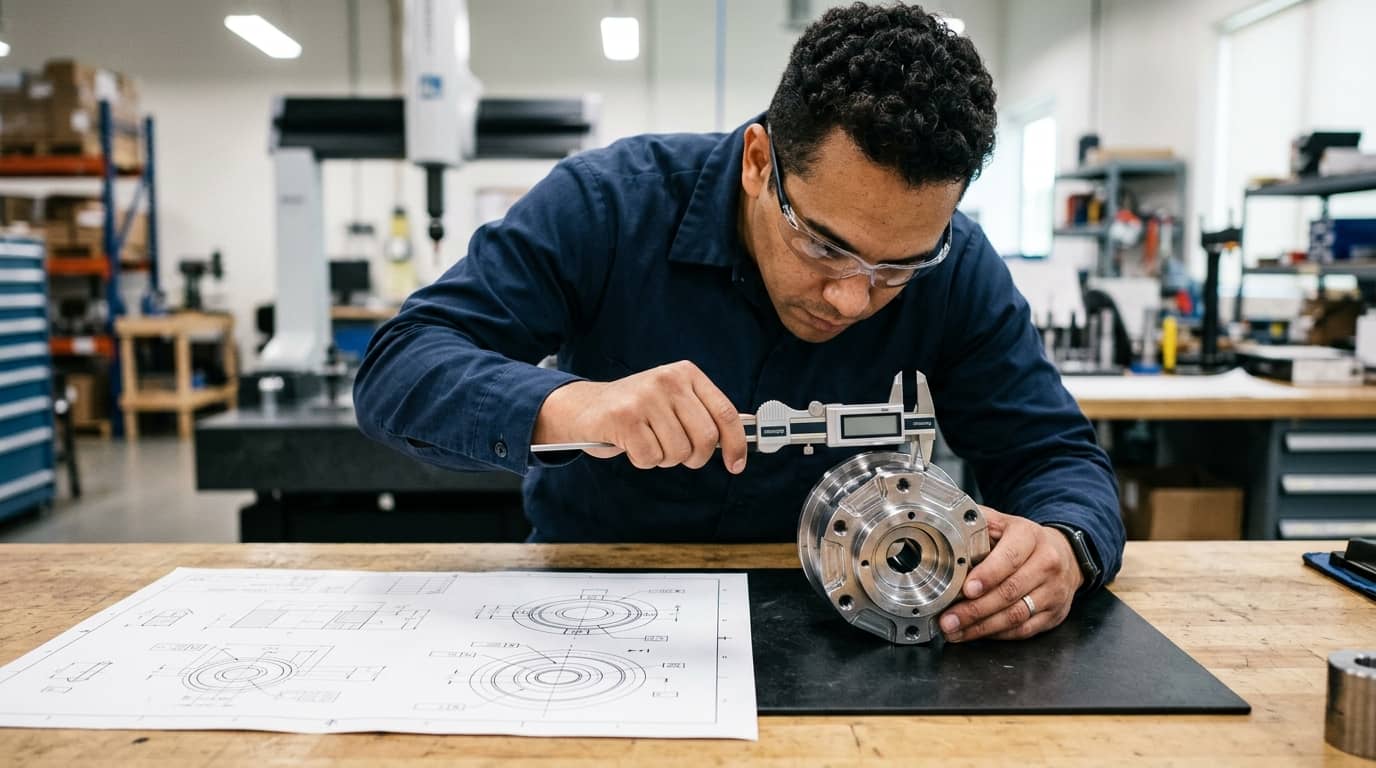
Teaches use of calipers, gauges, CMM, and optical comparators for forging measurement. Dimensional conformance is verified before heat treatment and machining.
Lesson 4 • Statistical Process Control in Forging
Introduces control charts, Cpk, and sampling plans for forging process monitoring. SPC shifts quality assurance from inspection to prevention.
Lesson 5 • Common Forging Defects Catalog
Describes laps, cold shuts, cracks, underfill, and scale pits with visual examples. Recognizing defects by appearance is the first step in corrective action.
Chapter 8HideHide detailsSee detailsPost-Forging Operations and Finishing
Post-Forging Operations and Finishing
Lesson 1 • Straightening and Sizing Operations
Covers press straightening, coining, and sizing to correct distortion after heat treatment. These operations bring forgings within final dimensional tolerances.
Lesson 2 • Hardening and Tempering Forgings
Teaches quench-and-temper cycles for achieving target hardness and toughness. Heat treatment parameters are alloy-specific and must be precisely controlled.
Lesson 3 • Final Inspection and Certification
Integrates dimensional, surface, and mechanical test results into a forging certification package. Certification documents compliance with customer and regulatory requirements.
Lesson 4 • Surface Cleaning and Descaling
Addresses shot blasting, acid pickling, and tumbling for scale and oxide removal. Clean surfaces are required for accurate inspection and coating adhesion.
Lesson 5 • Controlled Cooling and Annealing
Covers slow cooling, furnace annealing, and normalizing to relieve forging stresses. Controlled cooling prevents cracking and prepares parts for machining.
Your valid completion certificate
This course is for you:
Machinist: wants to understand upstream forging before parts reach the machine.
Manufacturing technician: needs structured forging knowledge to advance on the floor.
Quality inspector: seeks deeper process context behind the parts being evaluated.
Welding professional: looking to expand into hot metalworking and forge shop roles.
Engineering student: building practical process knowledge to complement academic training.
Career changer: entering industrial manufacturing and targeting forge shop employment.
What our students say
Your classes are perfect. I purchased the one-year package and finally have the opportunity to follow various topics of interest without needing to switch platforms... I thank you for everything you do, I've already recommended you to other people...

I like how the lessons are straight to the point and how I can switch chapters and skip content I don't need.

I like the content and the presentation style and video transcription, which speeds up the process!

The platform is fast, simple to use. The diversity of content and complementary videos really help with learning.

Top trainings




FAQ
Who is Dedika?
Is the certificate valid in United States?
Are the courses free?
What is the course workload?
What are the courses like?
How do the courses work?
What is the duration of the courses?
What is the cost or price of the courses?
What is an EAD or online course and how does it work?
PDF Course