
Machine Technology Course
Master the full range of machine technology skills — from reading engineering drawings and running manual lathes to programming CNC equipment and applying quality control methods. This course gives you the hands-on knowledge employers in manufacturing need right now. Whether you're starting out or leveling up, you'll finish ready to work.
What you will learn:
This course covers everything from shop safety and precision measurement to engine lathe operations, milling, grinding, and CNC programming. You'll learn how to read engineering drawings, select cutting tools, and produce parts that meet tight dimensional tolerances. Quality control topics include GD&T, statistical process control, and coordinate measuring machine use. Advanced sections address multi-axis machining, fixture design, process planning, and cost estimation. You'll also get exposure to CAD/CAM software, emerging automation technologies, and Industry 4.0 concepts that are reshaping modern manufacturing.
How you study in practice Machine Technology Course
How you practice Machine Technology Course
For companies looking to train their teams
With Dedika for businesses, the course includes exercises and examples tailored to your own business and the way your company needs.

Course Content
8 Chapters • 40 LessonsDuration between 4 and 360 hours (you decide)
Chapter 1HideHide detailsSee detailsFoundations of Machine Technology
Foundations of Machine Technology
Lesson 1 • Shop Safety and Hazard Control
Addresses personal protective equipment, machine guarding, and emergency procedures. Safety compliance underpins every hands-on activity in the course.
Lesson 2 • Measurement and Inspection Tools
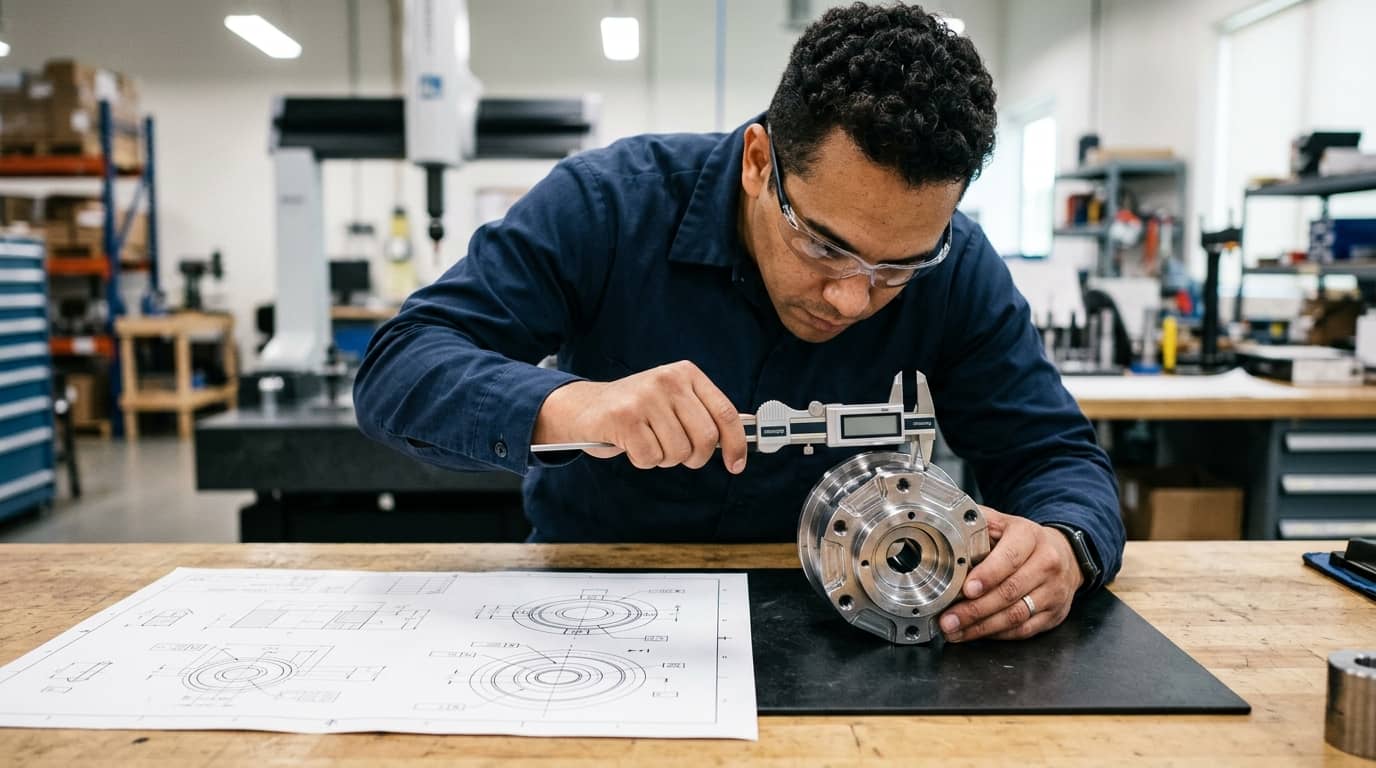
Introduces precision hand tools including micrometers, calipers, and gauges. Accurate measurement is foundational to producing parts within specification.
Lesson 3 • Introduction to Machine Technology
Covers the scope, history, and industrial role of machine technology. Establishes context for all subsequent technical content in the course.
Lesson 4 • Reading Engineering Drawings
Teaches orthographic projection, dimensioning standards, and tolerance notation. Drawing literacy is required for all subsequent machining operations.
Lesson 5 • Materials Used in Machining
Surveys ferrous metals, non-ferrous metals, and plastics commonly machined in industry. Material properties directly influence tooling and cutting parameter choices.
Chapter 2HideHide detailsSee detailsCutting Tools and Toolholding Systems
Cutting Tools and Toolholding Systems
Lesson 1 • Tool Inspection and Reconditioning
Teaches visual inspection, insert indexing, and HSS tool grinding. Timely tool maintenance prevents scrap and unplanned downtime.
Lesson 2 • Cutting Fluids and Lubrication
Examines coolant types, application methods, and maintenance practices. Correct fluid use extends tool life and improves surface finish.
Lesson 3 • Toolholding and Workholding Devices
Covers lathe tool posts, milling arbors, collets, and chucks. Rigid, accurate toolholding is essential for dimensional accuracy and operator safety.
Lesson 4 • Cutting Tool Geometry Fundamentals
Explains rake angles, relief angles, and cutting edge geometry. Geometry directly controls chip formation, tool life, and surface finish quality.
Lesson 5 • Carbide and High-Speed Steel Tools
Compares HSS and carbide insert grades, coatings, and application ranges. Proper grade selection reduces tool wear and improves productivity.
Chapter 3HideHide detailsSee detailsEngine Lathe Operations
Engine Lathe Operations
Lesson 1 • Lathe Components and Controls
Identifies headstock, carriage, tailstock, and feed mechanisms. Understanding machine anatomy enables safe setup and efficient operation.
Lesson 2 • Workpiece Setup and Alignment
Covers chuck mounting, between-centers setup, and runout correction. Proper alignment is prerequisite to achieving dimensional tolerances.
Lesson 3 • Drilling and Boring on the Lathe
Teaches center drilling, twist drilling, and single-point boring for internal features. Boring corrects hole location and achieves tight tolerances.
Lesson 4 • Thread Cutting on the Lathe
Covers external and internal thread cutting using the compound rest and threading dial. Thread accuracy is verified with gauges and thread wires.
Lesson 5 • Turning, Facing, and Grooving
Develops skill in straight turning, shoulder turning, facing, and groove cutting. These operations form the core of cylindrical part production.
Chapter 4HideHide detailsSee detailsMilling Machine Operations
Milling Machine Operations
Lesson 1 • Milling Machine Types and Controls
Distinguishes vertical, horizontal, and universal mills and their control systems. Machine familiarity enables safe, efficient setup and operation.
Lesson 2 • Workholding and Part Setup
Covers vise alignment, strap clamping, and rotary table use. Secure, accurate workholding prevents movement and ensures positional accuracy.
Lesson 3 • Drilling and Boring on the Mill
Covers spot drilling, peck drilling, and boring head use for precise hole location. Mill drilling complements lathe operations for prismatic parts.
Lesson 4 • Slot, Keyway, and Pocket Milling
Develops skill in cutting slots, keyways, and closed pockets with end mills. Accurate slot width and depth are critical for mating part fit.
Lesson 5 • Face Milling and Peripheral Milling
Teaches face mill and end mill selection, depth of cut, and feed direction. Correct climb vs. conventional milling choice affects finish and tool life.
Chapter 5HideHide detailsSee detailsGrinding and Finishing Operations
Grinding and Finishing Operations
Lesson 1 • Surface Grinding Techniques
Teaches magnetic chuck setup, wheel dressing, and cross-feed grinding passes. Surface grinding produces flat reference surfaces and close thickness tolerances.
Lesson 2 • Tool and Cutter Grinding
Covers offhand grinding and fixture-guided sharpening of drills, end mills, and lathe tools. Sharp, correctly ground tools are essential for quality and efficiency.
Lesson 3 • Honing, Lapping, and Superfinishing
Introduces abrasive finishing processes that improve bore geometry and surface texture beyond grinding capability. Process selection depends on tolerance and finish requirements.
Lesson 4 • Grinding Wheel Selection and Safety
Covers abrasive type, grit, grade, and bond selection for various materials. Wheel inspection and ring testing are mandatory safety steps before mounting.
Lesson 5 • Cylindrical Grinding Operations
Develops skill in external and internal cylindrical grinding between centers and with chucks. Cylindrical grinding achieves diameter tolerances unattainable by turning alone.
Chapter 6HideHide detailsSee detailsCNC Machine Fundamentals
CNC Machine Fundamentals
Lesson 1 • CNC Milling Operations
Programs contour milling, pocket cycles, and hole patterns on a CNC machining center. Cutter compensation ensures dimensional accuracy despite tool wear.
Lesson 2 • CNC Machine Architecture and Controls
Explains axes, servo drives, spindle motors, and the machine control unit. Understanding hardware enables effective troubleshooting and safe operation.
Lesson 3 • G-Code and M-Code Programming Basics
Introduces preparatory and miscellaneous codes for motion, spindle, and coolant control. Manual programming builds understanding that supports CAM-generated code review.
Lesson 4 • Coordinate Systems and Work Offsets
Covers absolute vs. incremental positioning, machine zero, and work coordinate offsets. Correct offset entry is critical for part location accuracy.
Lesson 5 • CNC Turning Operations
Applies G-code to produce turned diameters, faces, grooves, and threads on a CNC lathe. Canned cycles reduce programming time for repetitive features.
Chapter 7HideHide detailsSee detailsQuality Control and Inspection
Quality Control and Inspection
Lesson 1 • Statistical Process Control
Introduces control charts, process capability indices, and sampling plans. SPC enables proactive process adjustment before defects occur.
Lesson 2 • Geometric Dimensioning and Tolerancing
Interprets GD&T symbols for form, orientation, location, and runout on engineering drawings. GD&T provides unambiguous functional requirements for inspection.
Lesson 3 • Non-Destructive Testing Methods
Surveys dye penetrant, magnetic particle, and ultrasonic testing for surface and subsurface defects. NDT verifies part integrity without destroying the workpiece.
Lesson 4 • Advanced Measurement Instruments
Covers optical comparators, height gauges, and coordinate measuring machines for complex feature inspection. Instrument selection matches feature geometry and tolerance class.
Lesson 5 • Quality Systems and Documentation
Covers inspection records, first-article inspection reports, and quality management system requirements. Proper documentation supports traceability and continuous improvement.
Chapter 8HideHide detailsSee detailsAdvanced Machining and Process Planning
Advanced Machining and Process Planning
Lesson 1 • Cost Estimation and Lean Principles
Covers cycle time calculation, setup cost allocation, and waste reduction in machining cells. Lean thinking improves throughput without sacrificing quality.
Lesson 2 • Cutting Parameter Optimization
Applies speed, feed, and depth-of-cut relationships to maximize material removal rate while controlling tool life. Data-driven optimization reduces cost per part.
Lesson 3 • Multi-Axis Machining Concepts
Introduces 4-axis and 5-axis machining strategies for complex contoured surfaces. Multi-axis capability reduces setups and improves geometric accuracy.
Lesson 4 • Fixture Design Principles
Covers 3-2-1 locating, clamping force direction, and modular fixture components. Well-designed fixtures ensure repeatability across production runs.
Lesson 5 • Process Planning Fundamentals
Teaches operation sequencing, datum selection, and process sheet creation for multi-feature parts. Logical sequencing minimizes setups and preserves datum integrity.
Your valid completion certificate
This course is for you:
Recent high school graduates exploring skilled trades as a career path.
Career changers seeking stable, well-paying work in manufacturing industries.
Military veterans transitioning into civilian precision manufacturing roles.
Hobbyist metalworkers wanting to formalize and deepen their shop knowledge.
Assembly line workers aiming to move into machinist or operator positions.
Engineering students building practical shop skills to complement their coursework.
What our students say
Your classes are perfect. I purchased the one-year package and finally have the opportunity to follow various topics of interest without needing to switch platforms... I thank you for everything you do, I've already recommended you to other people...

I like how the lessons are straight to the point and how I can switch chapters and skip content I don't need.

I like the content and the presentation style and video transcription, which speeds up the process!

The platform is fast, simple to use. The diversity of content and complementary videos really help with learning.

Top trainings




FAQ
Who is Dedika?
Is the certificate valid in United States?
Are the courses free?
What is the course workload?
What are the courses like?
How do the courses work?
What is the duration of the courses?
What is the cost or price of the courses?
What is an EAD or online course and how does it work?
PDF Course