
Machining Technician Training
Get the hands-on technical training you need to work confidently in a modern machine shop. From reading engineering drawings and running engine lathes to programming CNC machines and applying quality control methods, this course covers the full machining workflow. Build job-ready skills that employers in manufacturing, aerospace, and industrial production are actively hiring for.
What you will learn:
Interpret engineering drawings, GD&T symbols, and tolerances to machine parts correctly.
Calculate cutting speeds, feed rates, and depths of cut for turning and milling operations.
Set up and operate engine lathes and vertical knee mills to produce dimensionally accurate parts.
Write and verify CNC G-code programs for facing, contouring, pocketing, threading, and drilling cycles.
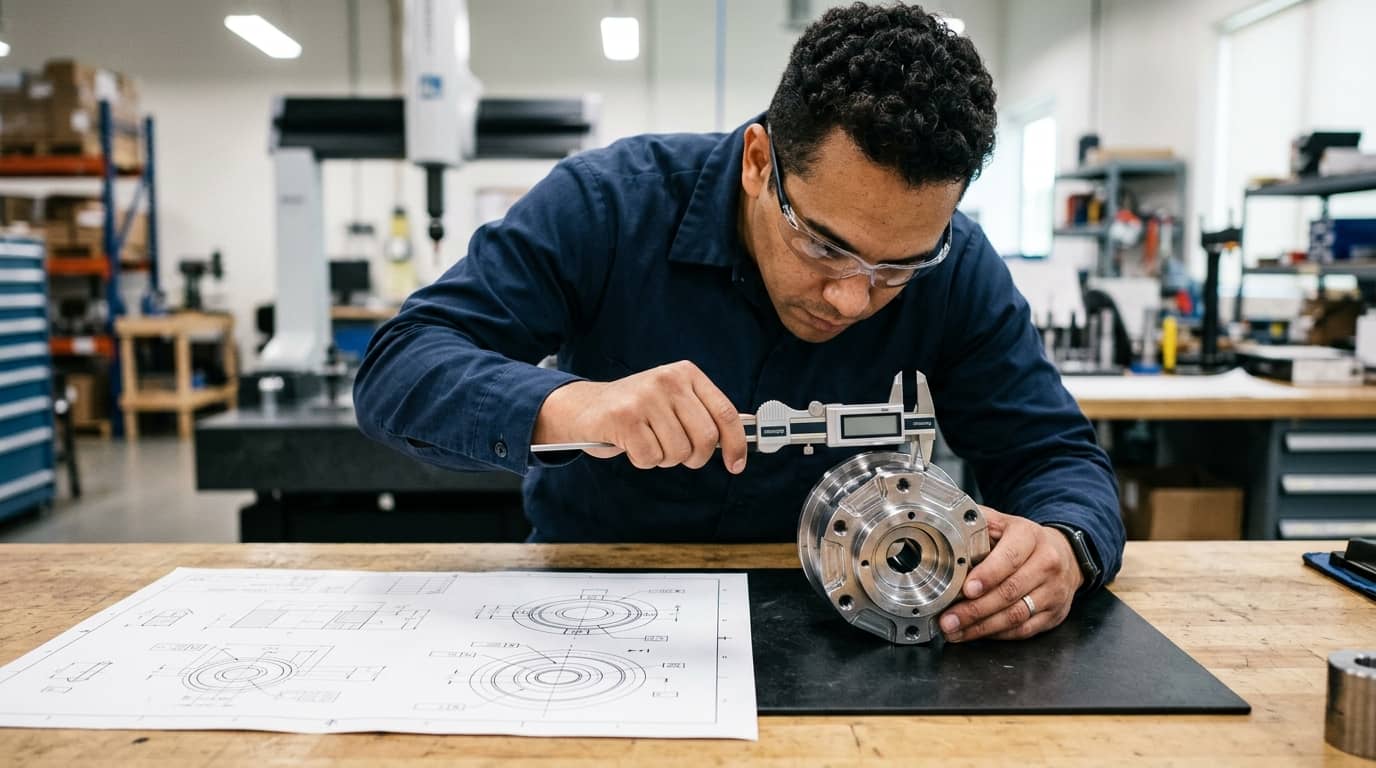
Apply precision measurement tools and statistical process control to ensure consistent part quality.
Follow machine shop safety protocols, including lockout/tagout, PPE selection, and hazard identification.
How you study in practice Machining Technician Training
How you practice Machining Technician Training
For companies looking to train their teams
With Dedika for businesses, the course includes exercises and examples tailored to your own business and the way your company needs.

Course Content
8 Chapters • 42 LessonsDuration between 4 and 360 hours (you decide)
Chapter 1HideHide detailsSee detailsMachining Fundamentals and Shop Safety
Machining Fundamentals and Shop Safety
Lesson 1 • Shop Organization and Housekeeping
Workplace organization principles, tool storage, and cleanliness standards that prevent accidents. Reinforces a disciplined work culture essential for precision machining.
Lesson 2 • Introduction to Machining Processes
Overview of subtractive manufacturing methods and their industrial applications. Establishes context for all subsequent machining skills covered in the course.
Lesson 3 • Reading Shop Documents and Standards
Interpretation of work orders, safety data sheets, and quality standards used daily in production. Prepares students to follow documented procedures throughout the course.
Lesson 4 • Shop Safety Rules and Hazard Awareness
Core safety regulations, hazard identification, and emergency procedures for machine shops. Directly enables safe participation in all hands-on lab activities.
Lesson 5 • Personal Protective Equipment
Selection, fitting, and maintenance of PPE required in machining environments. Ensures students protect themselves correctly before operating any equipment.
Chapter 2HideHide detailsSee detailsEngineering Drawings and Measurement
Engineering Drawings and Measurement
Lesson 1 • Surface Finish and Geometric Inspection
Surface roughness parameters, profilometers, and geometric inspection methods. Ensures students can verify surface quality and geometric accuracy on finished parts.
Lesson 2 • Geometric Dimensioning and Tolerancing
GD&T symbols, datums, and tolerance zones as applied to machined parts. Enables students to determine acceptable part variation and inspection criteria.
Lesson 3 • Measurement Systems and Unit Conversion
Inch and metric unit systems, conversion methods, and their use in machining contexts. Prepares students to work with drawings and machines in either measurement system.
Lesson 4 • Precision Measurement Tools
Hands-on use of calipers, micrometers, and dial indicators for dimensional verification. Connects drawing specifications to physical part inspection throughout the course.
Lesson 5 • Engineering Drawing Fundamentals
Orthographic projection, views, and drawing conventions used in manufacturing blueprints. Provides the visual literacy required to set up and machine any part correctly.
Chapter 3HideHide detailsSee detailsCutting Tools and Workholding Fundamentals
Cutting Tools and Workholding Fundamentals
Lesson 1 • Drill Bits and Hole-Making Tools
Twist drill geometry, point angles, and related hole-making tools including reamers and boring bars. Prepares students for accurate hole production on all machine types.
Lesson 2 • Tool Life, Wear, and Replacement
Identification of tool wear modes, tool life criteria, and replacement decision-making. Prevents scrapped parts and machine damage caused by worn tooling in production.
Lesson 3 • Cutting Tool Geometry and Materials
Rake angles, relief angles, and cutting edge geometry that govern chip formation and tool life. Establishes the theoretical basis for all tool selection decisions in later chapters.
Lesson 4 • Milling and Turning Tooling
End mills, face mills, turning inserts, and their holder systems for lathe and mill operations. Directly supports tooling decisions in the turning and milling chapters that follow.
Lesson 5 • Workholding Devices and Principles
Vises, chucks, collets, fixtures, and clamping principles that secure workpieces during cutting. Safe and accurate workholding is prerequisite to every machining operation in this course.
Chapter 4HideHide detailsSee detailsCutting Parameters and Process Planning
Cutting Parameters and Process Planning
Lesson 1 • Process Planning and Operation Sequencing
Developing a logical sequence of machining operations to produce a part efficiently and accurately. Students create process plans used in subsequent hands-on chapters.
Lesson 2 • Cutting Fluids and Coolant Application
Types of cutting fluids, their functions, and correct application methods for various materials. Proper coolant use extends tool life and improves surface finish in all operations.
Lesson 3 • Troubleshooting Cutting Problems
Diagnosing chatter, poor surface finish, and excessive tool wear through parameter adjustment. Builds systematic problem-solving skills applied throughout all machining chapters.
Lesson 4 • Cutting Speed and Spindle RPM
Relationship between cutting speed, workpiece diameter, and spindle RPM for turning and milling. Enables students to set machines correctly before making any cut.
Lesson 5 • Feed Rate and Depth of Cut
Feed per tooth, feed per revolution, and depth of cut selection for roughing and finishing. Connects cutting parameters to surface finish and material removal rate outcomes.
Chapter 5HideHide detailsSee detailsEngine Lathe Operations
Engine Lathe Operations
Lesson 1 • Facing, Turning, and Boring
Performing facing cuts, straight turning to diameter, and internal boring to specification. These are the primary material removal operations on the lathe.
Lesson 2 • Threading on the Lathe
Cutting external and internal threads using the lathe threading gearbox and single-point tool. Threading is a critical lathe skill required in many production and repair applications.
Lesson 3 • Taper Turning and Form Cutting
Producing external and internal tapers using compound rest, tailstock offset, and taper attachment. Expands part geometry capability beyond straight cylindrical features.
Lesson 4 • Lathe Components and Controls
Identification and function of headstock, carriage, tailstock, and lathe controls. Understanding machine anatomy is prerequisite to safe and accurate lathe operation.
Lesson 5 • Parting, Knurling, and Finishing
Parting off stock, producing knurled surfaces, and achieving specified surface finishes on the lathe. Completes the full range of engine lathe operations covered in this chapter.
Lesson 6 • Workpiece Setup and Alignment
Mounting workpieces in chucks and between centers, and aligning them for concentric turning. Correct setup prevents runout errors that propagate through all subsequent lathe cuts.
Chapter 6HideHide detailsSee detailsVertical Milling Machine Operations
Vertical Milling Machine Operations
Lesson 1 • Milling Machine Components and Controls
Identification of column, knee, saddle, table, and spindle head components and their controls. Machine familiarity is prerequisite to safe setup and accurate milling operations.
Lesson 2 • Slot, Pocket, and Profile Milling
Cutting slots, rectangular pockets, and contoured profiles using end mills. Expands part geometry capability to include internal and external milled features.
Lesson 3 • Workpiece Setup and Vise Alignment
Mounting and tramming a vise, indicating workpieces, and establishing datum surfaces on the mill. Accurate setup is the foundation of all dimensional accuracy in milling.
Lesson 4 • Face Milling and Surface Generation
Producing flat, square, and parallel surfaces using face mills and shell end mills. Surface generation is the most fundamental milling operation and enables all subsequent features.
Lesson 5 • Drilling, Reaming, and Boring on the Mill
Producing accurate holes by drilling, reaming, and boring using the milling machine spindle. Integrates hole-making with milled features for complete part production.
Chapter 7HideHide detailsSee detailsCNC Machining Fundamentals
CNC Machining Fundamentals
Lesson 1 • CNC Turning Programming
Writing turning programs for facing, OD turning, boring, grooving, and threading cycles. Applies G-code knowledge specifically to CNC lathe part production.
Lesson 2 • G-Code and M-Code Programming
Writing G-code programs using modal codes, coordinate words, and M-code commands. Direct programming skill is the core competency of this chapter and the entire CNC section.
Lesson 3 • CNC Machine Architecture and Controls
Axes, servo systems, machine controller interface, and CNC machine types used in production. Establishes the conceptual framework for all CNC programming and operation tasks.
Lesson 4 • Work Offsets and Tool Length Compensation
Setting work coordinate offsets, tool length offsets, and cutter radius compensation on the controller. Correct offset entry is essential for dimensional accuracy on every CNC part.
Lesson 5 • CNC Milling Programming and Verification
Writing milling programs for contours, pockets, and hole patterns with subprograms and loops. Verification methods prevent crashes and scrap before cutting actual workpieces.
Lesson 6 • CNC Setup, Operation, and First Article
Loading programs, setting offsets, running first articles, and making offset adjustments. Completes the full CNC workflow from program to inspected finished part.
Chapter 8HideHide detailsSee detailsQuality Control and Advanced Inspection
Quality Control and Advanced Inspection
Lesson 1 • Coordinate Measuring Machine Basics
CMM components, probe qualification, part alignment, and basic measurement routines. Provides access to high-accuracy inspection of complex geometric features on machined parts.
Lesson 2 • Quality Management Principles in Machining
Quality system concepts, inspection planning, and the cost of poor quality in machining production. Frames all inspection activities within a structured quality management approach.
Lesson 3 • Statistical Process Control Basics
Control charts, process capability indices, and variation analysis for machining processes. Enables students to monitor process stability and detect trends before defects occur.
Lesson 4 • Functional Gauging and Go/No-Go Gauges
Design logic and use of plug gauges, ring gauges, and thread gauges for attribute inspection. Provides fast, reliable pass/fail inspection methods used in high-volume production.
Lesson 5 • Root Cause Analysis and Corrective Action
Structured problem-solving methods to identify and eliminate sources of machining defects. Closes the quality loop by connecting inspection findings to process improvements.
Your valid completion certificate
This course is for you:
Recent high school graduates exploring skilled trades as a career path.
Career changers leaving office jobs to pursue hands-on manufacturing work.
Military veterans transitioning into civilian precision manufacturing roles.
Hobbyist machinists wanting to formalize and deepen their workshop knowledge.
Assembly line workers ready to move into higher-skilled machining positions.
Welding or fabrication workers expanding their capabilities into machined parts.
What our students say
Your classes are perfect. I purchased the one-year package and finally have the opportunity to follow various topics of interest without needing to switch platforms... I thank you for everything you do, I've already recommended you to other people...

I like how the lessons are straight to the point and how I can switch chapters and skip content I don't need.

I like the content and the presentation style and video transcription, which speeds up the process!

The platform is fast, simple to use. The diversity of content and complementary videos really help with learning.

Top trainings




FAQ
Who is Dedika?
Is the certificate valid in United States?
Are the courses free?
What is the course workload?
What are the courses like?
How do the courses work?
What is the duration of the courses?
What is the cost or price of the courses?
What is an EAD or online course and how does it work?
PDF Course