
Sheet Metal Shaping Training
Master every stage of sheet metal fabrication, from reading blueprints and cutting blanks to forming compound curves and assembling finished components. This training covers hand tools, power equipment, CNC processes, and quality inspection in one comprehensive program. Whether you're entering the trade or sharpening existing skills, you'll build the hands-on competency employers demand.
What you will learn:
You'll begin with material selection, shop safety, and layout, then progress to cutting, bending, rolling, and forming techniques such as shrinking, stretching, and English wheel work. Pattern development methods—parallel line, radial line, and triangulation—provide the geometry needed to lay out duct transitions, elbows, and tapered fittings. Joining covers riveting, spot welding, MIG/TIG welding, and mechanical fastening for reliable assemblies. The course also includes surface finishing, HVAC duct fabrication, automotive panel repair, and CNC press brake and turret punch operation. Dimensional inspection with calipers, height gauges, and CMM tools ensures each part meets tolerance. By course end, you'll possess a skill set for sheet metal fabrication workflow.
How you study in practice Sheet Metal Shaping Training
How you practice Sheet Metal Shaping Training
For companies looking to train their teams
With Dedika for businesses, the course includes exercises and examples tailored to your own business and the way your company needs.

Course Content
8 Chapters • 38 LessonsDuration between 4 and 360 hours (you decide)
Chapter 1HideHide detailsSee detailsFoundations of Sheet Metal Work
Foundations of Sheet Metal Work
Lesson 1 • Hand Tools and Their Uses
Surveys hammers, mallets, snips, and files used in basic sheet metal work. Proper tool selection and grip form the manual skill base for shaping operations.
Lesson 2 • Measuring and Marking Tools
Introduces precision layout tools including rules, scribes, squares, and dividers. Accurate marking directly determines part quality in every forming operation.
Lesson 3 • Sheet Metal Materials Overview
Covers common metals used in shaping: steel, aluminum, copper, and stainless. Establishes material selection criteria central to all subsequent forming decisions.
Lesson 4 • Reading Blueprints and Drawings
Teaches interpretation of orthographic views, dimensions, and tolerances on fabrication drawings. Blueprint literacy underpins accurate layout and forming in all core chapters.
Lesson 5 • Shop Safety and Personal Protection
Identifies hazards specific to sheet metal environments and required protective equipment. Safe habits established here apply throughout every hands-on chapter.
Chapter 2HideHide detailsSee detailsCutting and Shearing Techniques
Cutting and Shearing Techniques
Lesson 1 • Plasma and Laser Cutting Basics
Introduces CNC plasma and laser cutting parameters, kerf compensation, and nesting. These processes expand cutting capability for complex profiles introduced in later chapters.
Lesson 2 • Hand Snip Cutting Methods
Covers straight-cut, left-cut, and right-cut aviation snips for various contours. Correct snip selection prevents distortion and reduces rework in later forming steps.
Lesson 3 • Notching and Hole Cutting
Covers corner notchers, hole saws, and punch-and-die sets for interior cutouts. Precise notches and holes are prerequisites for flanging and assembly operations ahead.
Lesson 4 • Power Shear Operation
Teaches setup, blade clearance, and feed technique on bench and foot-operated shears. Consistent shear cuts establish square blanks essential for accurate bending.
Chapter 3HideHide detailsSee detailsBending and Folding Operations
Bending and Folding Operations
Lesson 1 • Press Brake Setup and Use
Teaches punch and die selection, tonnage calculation, and CNC back-gauge programming on a press brake. Press brake skills enable high-volume, repeatable bending introduced in advanced chapters.
Lesson 2 • Radius and Curved Bending
Introduces roll bending, bump bending, and radius dies for producing curved flanges and arcs. Curved bends are foundational for the compound-form work covered in later chapters.
Lesson 3 • Box and Pan Brake Operation
Covers finger selection, back-gauge setting, and bend sequence on a box-and-pan brake. Proper sequence prevents finger interference and produces accurate multi-bend parts.
Lesson 4 • Bend Allowance and K-Factor
Explains the math behind material stretch during bending and how K-factor affects flat-blank length. Accurate calculations prevent scrap and are applied in every bending section.
Lesson 5 • Hem and Seam Forming
Covers open, closed, and teardrop hems plus Pittsburgh and snap-lock seams. Hems and seams strengthen edges and are required for duct and enclosure work ahead.
Chapter 4HideHide detailsSee detailsRolling and Forming Curved Shapes
Rolling and Forming Curved Shapes
Lesson 1 • Slip Roll Machine Fundamentals
Explains roll geometry, pinch adjustment, and feed technique for producing cylinders. Consistent roll setup is the prerequisite for cone and compound-curve work in this chapter.
Lesson 2 • Planishing and Surface Smoothing
Covers planishing hammers, dollies, and power planishers for refining formed surfaces. Smooth, consistent surfaces are required before finishing operations covered in later chapters.
Lesson 3 • English Wheel Basics
Introduces upper and lower wheel selection, tracking patterns, and pressure control for compound curves. The English wheel produces smooth, stretched panels used in automotive and aerospace forming.
Lesson 4 • Cone and Taper Rolling
Teaches layout of cone developments and asymmetric roll adjustment for tapered forms. Cone rolling skills are directly applied in duct transitions and decorative panel work.
Chapter 5HideHide detailsSee detailsShrinking and Stretching Metal
Shrinking and Stretching Metal
Lesson 1 • Shrinking Techniques
Covers tucking, shrinker machines, and heat shrinking to reduce surface area in buckled areas. Controlled shrinking is essential for fitting panels to compound-curved structures.
Lesson 2 • Combining Shrink and Stretch
Demonstrates how alternating shrink and stretch operations produce saddle and compound curves. This combined approach is the core skill for freeform panel shaping in advanced chapters.
Lesson 3 • Stretching Techniques
Teaches hammer-over-stake, stretcher machine, and shot-bag stretching to increase surface area. Stretching creates the raised forms and domed panels used in decorative and structural applications.
Lesson 4 • Principles of Metal Movement
Explains grain structure, work hardening, and how stress directs metal flow during forming. Understanding metal movement prevents cracking and guides technique choices throughout this chapter.
Lesson 5 • Annealing and Stress Relief
Covers torch annealing procedures for steel, aluminum, and copper to restore workability. Proper annealing prevents cracking during aggressive forming and is required before rework.
Chapter 6HideHide detailsSee detailsPattern Development and Layout
Pattern Development and Layout
Lesson 1 • Parallel Line Development
Teaches stretchout layout for prisms and cylinders using parallel projection. Parallel line development is the fastest method for rectangular and round duct sections.
Lesson 2 • CAD-Assisted Pattern Generation
Introduces 2D CAD and sheet metal software for automated flat-pattern unfolding and nesting. CAD tools accelerate layout and reduce error for complex parts developed in advanced chapters.
Lesson 3 • Radial Line Development
Covers apex-based layout for cones and pyramids using radial projection. Radial development produces accurate tapered transitions used in duct and vessel fabrication.
Lesson 4 • Elbow and Miter Layout
Demonstrates miter-line construction for round and rectangular elbows at various angles. Elbow layout is a high-frequency task in HVAC and industrial duct fabrication.
Lesson 5 • Triangulation Development
Applies true-length diagrams and triangulation to develop oblique transitions and warped surfaces. Triangulation handles shapes that parallel and radial methods cannot accurately develop.
Chapter 7HideHide detailsSee detailsJoining and Assembly Methods
Joining and Assembly Methods
Lesson 1 • Sealing and Leak Testing
Covers sealant application, pressure testing, and smoke testing for duct and vessel assemblies. Leak-free joints are a quality requirement verified before any surface finishing is applied.
Lesson 2 • Spot Welding Applications
Covers electrode selection, pressure, and weld schedule for resistance spot welding. Spot welding provides fast, clean lap joints used in automotive and appliance panel assembly.
Lesson 3 • MIG and TIG Welding for Sheet Metal
Teaches low-heat MIG and TIG settings, tack sequence, and distortion control for thin sheet. Welding skills enable permanent, gas-tight joints required in vessel and enclosure fabrication.
Lesson 4 • Riveting Techniques
Covers solid and blind rivet selection, hole sizing, and bucking bar technique. Riveted joints are the primary structural fastening method in aerospace and duct assemblies.
Lesson 5 • Mechanical Fastening Methods
Introduces self-tapping screws, clinch nuts, and structural adhesives for non-welded assemblies. Mechanical fastening is essential where heat distortion or disassembly requirements prohibit welding.
Chapter 8HideHide detailsSee detailsAdvanced Forming and Quality Control
Advanced Forming and Quality Control
Lesson 1 • Hydroforming and Deep Drawing
Covers blank holder force, draw ratio, and lubricant selection for deep-drawn and hydroformed parts. These high-deformation processes produce seamless hollow forms used in aerospace and automotive work.
Lesson 2 • Dimensional Inspection Methods
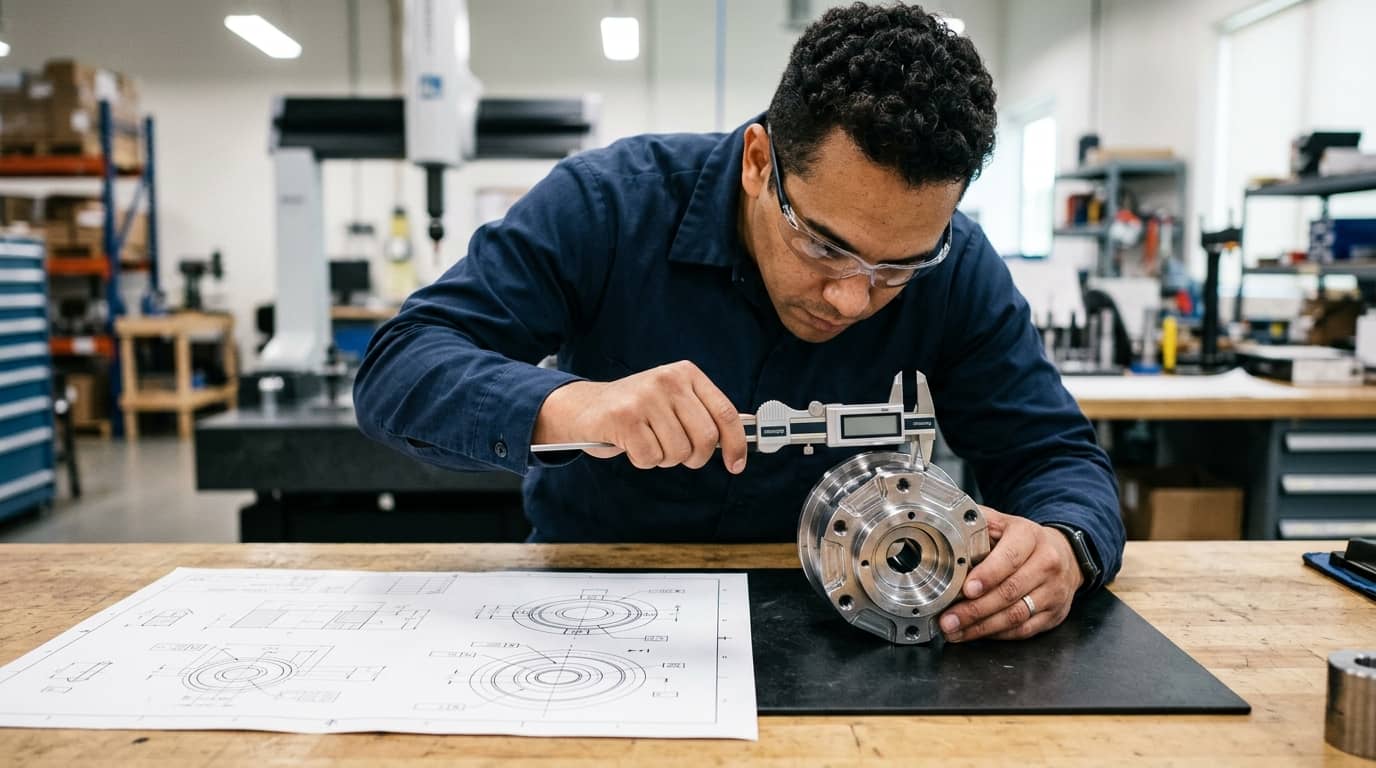
Covers calipers, height gauges, CMM use, and go/no-go gauges for verifying formed part dimensions. Systematic inspection catches errors before assembly and reduces costly rework.
Lesson 3 • Spinning and Flow Forming
Teaches mandrel selection, tool path, and feed rate for lathe spinning and CNC flow forming. Spinning produces axisymmetric hollow parts with superior surface finish and wall uniformity.
Lesson 4 • Rework and Corrective Forming
Demonstrates techniques for straightening, re-forming, and blending defective areas without scrapping parts. Effective rework skills reduce material waste and meet delivery schedules.
Lesson 5 • Surface Quality Standards
Defines acceptable surface finish, scratch limits, and dent criteria for various end-use applications. Surface standards guide final inspection and determine whether rework or finishing is required.
Your valid completion certificate
This course is for you:
Aspiring fabricators: ready to build a hands-on trade career from scratch.
HVAC technicians: wanting to fabricate custom ductwork and fittings independently.
Automotive hobbyists: eager to shape and repair body panels with confidence.
Career changers: seeking a skilled trade with strong employment demand.
Maintenance workers: needing sheet metal skills to handle in-house fabrication tasks.
Vocational students: looking to reinforce classroom theory with structured practical training.
What our students say
Your classes are perfect. I purchased the one-year package and finally have the opportunity to follow various topics of interest without needing to switch platforms... I thank you for everything you do, I've already recommended you to other people...

I like how the lessons are straight to the point and how I can switch chapters and skip content I don't need.

I like the content and the presentation style and video transcription, which speeds up the process!

The platform is fast, simple to use. The diversity of content and complementary videos really help with learning.

Top trainings




FAQ
Who is Dedika?
Is the certificate valid in United States?
Are the courses free?
What is the course workload?
What are the courses like?
How do the courses work?
What is the duration of the courses?
What is the cost or price of the courses?
What is an EAD or online course and how does it work?
PDF Course