
Thermoplastics Injection Operator Course
Get the hands-on knowledge you need to operate injection molding machines with confidence and precision. This course covers everything from machine anatomy and resin handling to process setup, defect analysis, and mold maintenance. Whether you're new to the production floor or looking to sharpen your skills, you'll build the technical foundation that employers demand.
What you will learn:
Identify injection molding machine components and explain each assembly's role in the production cycle.
Configure critical process parameters, including temperature, injection speed, and clamp force, for consistent output.
Handle, dry, and blend thermoplastic resins correctly to prevent moisture-related defects and contamination.
Recognize common part defects, trace each to its root cause, and apply structured corrective actions.
Perform safe mold installation, routine cleaning, and systematic changeover to maximize machine uptime.
Apply scientific molding principles and basic statistical process control to support continuous quality improvement.
How you study in practice Thermoplastics Injection Operator Course
How you practice Thermoplastics Injection Operator Course
For companies looking to train their teams
With Dedika for businesses, the course includes exercises and examples tailored to your own business and the way your company needs.

Course Content
8 Chapters • 34 LessonsDuration between 4 and 360 hours (you decide)
Chapter 1HideHide detailsSee detailsIntroduction to Injection Molding
Introduction to Injection Molding
Lesson 1 • Workplace Safety Essentials
Establishes mandatory safety practices for operating injection molding equipment. Connects hazard awareness to regulatory compliance and injury prevention on the production floor.
Lesson 2 • Injection Molding Machine Anatomy
Identifies all major machine assemblies and their functional roles. Provides the vocabulary and spatial understanding needed to operate and communicate about equipment.
Lesson 3 • Thermoplastics Fundamentals
Covers polymer chemistry basics, thermoplastic vs. thermoset distinctions, and material behavior under heat. Establishes material science context for all subsequent machine operation topics.
Lesson 4 • The Injection Molding Cycle
Traces each phase of the production cycle from mold close to part ejection. Understanding cycle sequence is prerequisite to setting and optimizing process parameters.
Chapter 2HideHide detailsSee detailsRaw Material Handling and Preparation
Raw Material Handling and Preparation
Lesson 1 • Colorants, Additives, and Regrind
Addresses blending masterbatch colorants, functional additives, and regrind into virgin resin. Correct ratios and regrind limits preserve mechanical properties and color consistency.
Lesson 2 • Moisture and Its Effects on Resins
Explains how absorbed moisture degrades polymer chains during processing and causes surface defects. Moisture awareness motivates correct drying protocols covered in the next section.
Lesson 3 • Resin Identification and Storage
Teaches how to read material data sheets and label resins correctly in storage. Accurate identification prevents cross-contamination and ensures traceability throughout production.
Lesson 4 • Drying Equipment and Procedures
Covers operation of hopper dryers, desiccant dryers, and compressed-air dryers. Correct drying time and temperature settings are linked directly to part quality outcomes.
Chapter 3HideHide detailsSee detailsMold Setup and Installation
Mold Setup and Installation
Lesson 1 • Mold Mounting and Alignment
Covers crane and hoist use, clamping plate alignment, and torque specifications for mold bolts. Proper alignment ensures uniform clamping force and prevents flash and mold damage.
Lesson 2 • Mold Connections and Commissioning
Teaches connection of cooling water, hydraulic cores, and hot-runner wiring after mounting. Verifying all connections before startup prevents leaks, short shots, and mold damage.
Lesson 3 • Pre-Installation Inspection
Establishes a systematic checklist for inspecting molds before mounting on the machine. Catching damage or contamination before installation prevents costly production interruptions.
Lesson 4 • Mold Types and Construction
Introduces two-plate, three-plate, and hot-runner mold designs and their operational differences. Understanding mold construction informs correct setup and troubleshooting decisions.
Chapter 4HideHide detailsSee detailsProcess Parameter Setup
Process Parameter Setup
Lesson 1 • Temperature Settings and Control
Covers barrel zone temperatures, nozzle temperature, and mold temperature controller setup. Temperature accuracy directly governs melt quality, cycle time, and part surface finish.
Lesson 2 • Pack, Hold, and Cooling Parameters
Addresses pack pressure, hold time, and cooling time settings that govern dimensional stability. These parameters control shrinkage, sink marks, and internal stress in finished parts.
Lesson 3 • Clamp Force and Mold Protection
Calculates required clamp tonnage and configures mold protection pressure and speed limits. Correct clamp force prevents flash while mold protection prevents costly mold damage.
Lesson 4 • Injection Speed and Pressure
Explains injection velocity profiles, peak injection pressure, and transfer position selection. Balancing speed and pressure prevents short shots, flash, and excessive shear stress.
Lesson 5 • Screw and Plasticating Parameters
Sets screw speed, back pressure, decompression, and suck-back to control melt homogeneity. Proper plasticating parameters prevent drool, air entrapment, and inconsistent shot weight.
Chapter 5HideHide detailsSee detailsMachine Operation and Production Startup
Machine Operation and Production Startup
Lesson 1 • Manual and Semi-Automatic Operation
Practices individual machine movements in manual mode before progressing to semi-automatic cycles. Manual control builds operator confidence and enables safe troubleshooting during production.
Lesson 2 • In-Process Monitoring and Adjustments
Teaches operators to read process trend data and make minor adjustments within approved limits. Proactive monitoring prevents drift from specification and reduces scrap generation.
Lesson 3 • Achieving Automatic Production Mode
Guides the transition to fully automatic cycling after part quality is confirmed. Stable automatic production requires verified parameters, consistent cycle time, and reliable ejection.
Lesson 4 • Pre-Production Verification Checklist
Performs systematic checks of temperatures, pressures, safety devices, and material readiness before starting. A complete checklist prevents startup defects and unplanned downtime.
Chapter 6HideHide detailsSee detailsPart Quality Inspection and Defect Analysis
Part Quality Inspection and Defect Analysis
Lesson 1 • Dimensional and Structural Defects
Addresses warpage, short shots, flash, and sink-related dimensional failures and their process origins. Structural defects often require parameter changes beyond cosmetic correction strategies.
Lesson 2 • Common Cosmetic Defects
Identifies splay, sink marks, weld lines, burn marks, and surface blemishes with their visual signatures. Recognizing cosmetic defects enables rapid parameter correction before scrap accumulates.
Lesson 3 • Defect Root Cause and Corrective Action
Applies systematic cause-and-effect analysis to link defects to material, machine, mold, or process variables. Structured corrective action prevents recurrence and supports process documentation.
Lesson 4 • Dimensional and Visual Inspection Methods
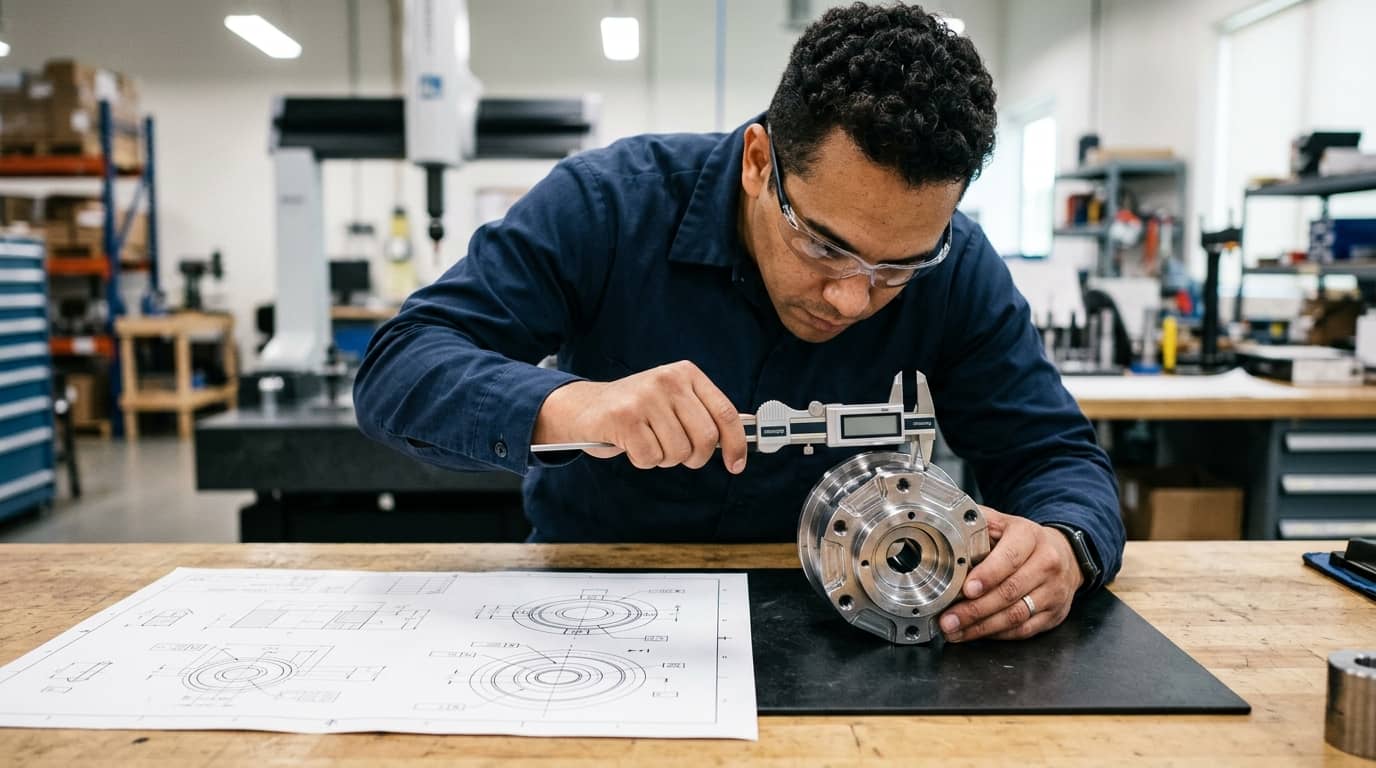
Covers use of calipers, gauges, and visual standards to evaluate part conformance. Consistent inspection methods ensure defects are caught before parts reach downstream operations.
Chapter 7HideHide detailsSee detailsMold Care, Maintenance, and Changeover
Mold Care, Maintenance, and Changeover
Lesson 1 • Routine Mold Cleaning Procedures
Covers safe cleaning of cavity surfaces, vents, and ejector pins using approved solvents and tools. Regular cleaning prevents buildup that causes cosmetic defects and vent blockage.
Lesson 2 • Identifying Mold Wear and Damage
Trains operators to spot parting line wear, ejector pin galling, and cavity damage during production. Early damage identification prevents defective parts and costly emergency repairs.
Lesson 3 • Efficient Mold Changeover Techniques
Applies single-minute exchange principles to reduce mold changeover time without sacrificing safety. Faster changeovers increase machine availability and reduce production scheduling pressure.
Lesson 4 • Mold Corrosion Prevention and Storage
Teaches rust inhibitor application, moisture purging, and proper storage conditions for idle molds. Correct preservation prevents corrosion damage that degrades part surface quality.
Chapter 8HideHide detailsSee detailsAdvanced Process Optimization
Advanced Process Optimization
Lesson 1 • Cycle Time Reduction Strategies
Identifies opportunities to reduce cooling time, dry cycle time, and robot extraction time safely. Cycle time reduction increases output without compromising part quality or mold integrity.
Lesson 2 • Scientific Molding Principles
Introduces decoupled molding methodology separating fill, pack, and hold phases for independent control. Scientific molding provides a repeatable framework for process development and optimization.
Lesson 3 • Process Capability and Statistical Control
Applies basic statistical process control charts to monitor critical part dimensions over time. Understanding capability indices helps operators recognize when processes need adjustment or escalation.
Lesson 4 • Documentation and Process Standardization
Creates and maintains process setup sheets, parameter records, and change logs for repeatability. Standardized documentation enables consistent startups across shifts and operators.
Lesson 5 • Energy Efficiency in Injection Molding
Examines energy consumption patterns of barrel heating, hydraulics, and cooling systems. Reducing energy waste lowers operating cost and supports sustainability targets without sacrificing output.
Your valid completion certificate
This course is for you:
Entry-level production worker: eager to move beyond general labor into skilled machine operation.
Career changer from another trade: bringing mechanical aptitude and wanting a new specialty.
Recent manufacturing program graduate: ready to connect classroom theory to real production floor practice.
Experienced press operator: seeking formal knowledge to back up years of hands-on intuition.
Quality technician in plastics: wanting deeper process understanding to improve inspection decisions.
Maintenance apprentice in a molding facility: building context around the equipment they service daily.
What our students say
Your classes are perfect. I purchased the one-year package and finally have the opportunity to follow various topics of interest without needing to switch platforms... I thank you for everything you do, I've already recommended you to other people...

I like how the lessons are straight to the point and how I can switch chapters and skip content I don't need.

I like the content and the presentation style and video transcription, which speeds up the process!

The platform is fast, simple to use. The diversity of content and complementary videos really help with learning.

Top trainings




FAQ
Who is Dedika?
Is the certificate valid in United States?
Are the courses free?
What is the course workload?
What are the courses like?
How do the courses work?
What is the duration of the courses?
What is the cost or price of the courses?
What is an EAD or online course and how does it work?
PDF Course