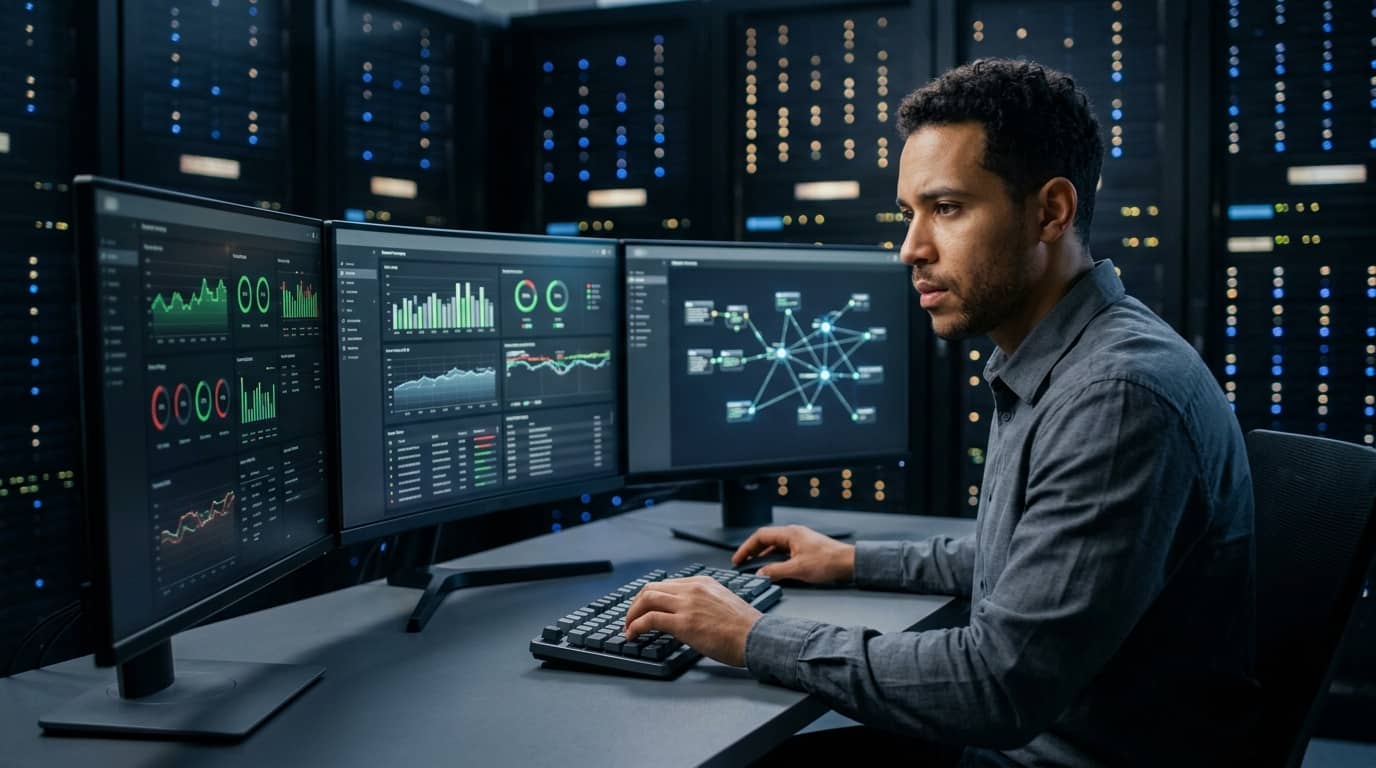
System Center Training
Master Microsoft System Center from deployment to advanced automation in one comprehensive training program. You'll configure SCCM, SCOM, SCVMM, and Orchestrator across real enterprise scenarios. This course gives IT administrators the hands-on skills to manage, monitor, and automate complex infrastructure at scale.
What you will learn:
This course covers every major System Center component, starting with architecture fundamentals and moving through deployment, configuration, and automation. You will install and manage SCCM for endpoint control, patch management, and OS deployment. You will configure SCOM to monitor servers, applications, and network devices with custom alerts and dashboards. SCVMM topics include host management, VM provisioning, and private cloud fabric design. You will also build Orchestrator runbooks to automate workflows across products and implement SCSM for structured IT service management. Security hardening, PowerShell automation, hybrid Azure integration, and disaster recovery planning round out the full curriculum.
How you study in practice System Center Training
How you practice System Center Training
For companies looking to train their teams
With Dedika for businesses, the course includes exercises and examples tailored to your own business and the way your company needs.

Course Content
8 Chapters • 37 LessonsDuration between 4 and 360 hours (you decide)
Chapter 1HideHide detailsSee detailsIntroduction to System Center Suite
Introduction to System Center Suite
Lesson 1 • System Center Architecture Fundamentals
Examine the shared architectural patterns across System Center products. Prepares students for component-specific deployment topics.
Lesson 2 • Overview of System Center Products
Survey all major System Center components and their management domains. Establishes the product map used throughout the course.
Lesson 3 • Planning a System Center Environment
Identify prerequisites and design considerations before deployment. Ensures students can scope a real-world implementation.
Lesson 4 • Enterprise IT Management Concepts
Define key IT management principles that System Center addresses. Connects business needs to technical solutions.
Chapter 2HideHide detailsSee detailsDeploying System Center Configuration Manager
Deploying System Center Configuration Manager
Lesson 1 • SCCM Site Hierarchy Design
Define primary, secondary, and central administration sites. Establishes the structural foundation for all SCCM operations.
Lesson 2 • Software Distribution and Patch Management
Deploy applications and software updates to managed endpoints. Demonstrates SCCM's core value in endpoint lifecycle management.
Lesson 3 • Client Discovery and Deployment
Configure discovery methods and deploy the SCCM client to managed devices. Enables endpoint visibility required for all management tasks.
Lesson 4 • Operating System Deployment with SCCM
Build and deploy OS images using task sequences and PXE boot. Extends SCCM skills to full endpoint provisioning scenarios.
Lesson 5 • Installing the SCCM Infrastructure
Execute a step-by-step SCCM installation including prerequisites and SQL setup. Builds the working lab environment used in later chapters.
Chapter 3HideHide detailsSee detailsManaging Endpoints with SCCM
Managing Endpoints with SCCM
Lesson 1 • Compliance Settings and Baselines
Create configuration items and baselines to enforce desired endpoint states. Connects policy requirements to automated remediation.
Lesson 2 • Hardware and Software Inventory
Enable and customize inventory collection across managed devices. Provides the data foundation for compliance and asset management.
Lesson 3 • Endpoint Protection Management
Deploy and manage antimalware policies through SCCM's Endpoint Protection role. Centralizes security posture management for all clients.
Lesson 4 • Role-Based Administration in SCCM
Configure security roles and scopes to delegate SCCM administration. Ensures least-privilege access across large teams.
Chapter 4HideHide detailsSee detailsSystem Center Operations Manager Fundamentals
System Center Operations Manager Fundamentals
Lesson 1 • SCOM Architecture and Installation
Identify SCOM server roles and complete a base installation. Establishes the monitoring platform for subsequent configuration tasks.
Lesson 2 • Agent Deployment and Management Groups
Deploy SCOM agents and organize monitored resources into management groups. Enables structured monitoring across diverse environments.
Lesson 3 • Alerts, Notifications, and Escalations
Configure alert rules, notification channels, and escalation workflows. Translates monitoring data into actionable operational responses.
Lesson 4 • Dashboards and Reporting in SCOM
Build operational dashboards and schedule reports for stakeholder visibility. Completes the monitoring lifecycle from detection to communication.
Lesson 5 • Management Packs and Monitoring Rules
Import and configure management packs to monitor specific technologies. Management packs are the primary mechanism for extending SCOM coverage.
Chapter 5HideHide detailsSee detailsAdvanced SCOM Monitoring Scenarios
Advanced SCOM Monitoring Scenarios
Lesson 1 • Network Device Monitoring
Discover and monitor network infrastructure using SCOM's network monitoring feature. Extends visibility to switches, routers, and firewalls.
Lesson 2 • Cross-Platform and Linux Monitoring
Deploy SCOM agents to Linux and Unix systems for heterogeneous monitoring. Ensures consistent visibility across mixed OS environments.
Lesson 3 • Performance Tuning and Scalability
Optimize SCOM for large-scale deployments using resource pools and grooming. Maintains monitoring reliability as environments grow.
Lesson 4 • Distributed Application Monitoring
Model multi-tier applications as distributed application objects in SCOM. Provides service-level visibility beyond individual server health.
Chapter 6HideHide detailsSee detailsSystem Center Virtual Machine Manager
System Center Virtual Machine Manager
Lesson 1 • Service Templates and Cloud Fabric
Build multi-tier service templates and define private cloud resources. Advances SCVMM use toward infrastructure-as-a-service delivery.
Lesson 2 • Host and Cluster Management
Add Hyper-V hosts and clusters to SCVMM and manage their resources. Enables centralized control of the compute fabric.
Lesson 3 • SCVMM Installation and Configuration
Install SCVMM and connect it to hypervisor hosts and storage. Establishes the management fabric for all virtualization tasks.
Lesson 4 • Networking and Storage Fabric
Configure logical networks, VLANs, and storage classifications in SCVMM. Provides the network and storage abstraction layer for VM workloads.
Lesson 5 • Virtual Machine Provisioning
Create VM templates and deploy virtual machines from the library. Standardizes VM builds and accelerates provisioning workflows.
Chapter 7HideHide detailsSee detailsSystem Center Orchestrator and Automation
System Center Orchestrator and Automation
Lesson 1 • Integration Packs for System Center
Deploy integration packs to connect Orchestrator with SCCM, SCOM, and SCVMM. Enables cross-product automation and closed-loop remediation.
Lesson 2 • Building Runbooks with Standard Activities
Use built-in activities to create logic-driven automation workflows. Develops core runbook authoring skills applicable to any scenario.
Lesson 3 • Orchestrator Architecture and Installation
Install Orchestrator and understand its runbook server and designer components. Provides the automation platform for all subsequent runbook work.
Lesson 4 • Advanced Orchestration Patterns
Apply nested runbooks, junction activities, and scheduling for complex automation. Prepares students for enterprise-grade orchestration design.
Lesson 5 • Runbook Testing and Deployment
Test, publish, and monitor runbooks in production environments. Ensures automation reliability before operational handoff.
Chapter 8HideHide detailsSee detailsSystem Center Service Manager and ITSM
System Center Service Manager and ITSM
Lesson 1 • SCSM Reporting and Analytics
Generate ITSM reports and OLAP cube analyses from the data warehouse. Provides management visibility into service performance and trends.
Lesson 2 • SCSM Architecture and Deployment
Install SCSM management servers, data warehouse, and the Self-Service Portal. Establishes the ITSM platform for all workflow configuration.
Lesson 3 • Change and Release Management
Build change request workflows with approval gates and risk assessment. Enforces controlled change processes across the IT environment.
Lesson 4 • Service Catalog and Request Fulfillment
Publish service offerings and configure fulfillment workflows in the portal. Enables end-user self-service and reduces manual intake effort.
Lesson 5 • Incident and Problem Management
Configure incident classification, routing, and escalation workflows in SCSM. Delivers structured incident resolution aligned with service targets.
Your valid completion certificate
This course is for you:
Systems administrators: ready to centralize endpoint and server management at scale.
IT infrastructure engineers: expanding their skill set into Microsoft's management ecosystem.
Help desk leads: moving into a more technical, infrastructure-focused career path.
Junior cloud engineers: building on-premises foundations before tackling hybrid environments.
IT consultants: needing billable expertise across the full System Center product suite.
Career changers from networking: transitioning into Windows systems and endpoint management roles.
What our students say
Your classes are perfect. I purchased the one-year package and finally have the opportunity to follow various topics of interest without needing to switch platforms... I thank you for everything you do, I've already recommended you to other people...

I like how the lessons are straight to the point and how I can switch chapters and skip content I don't need.

I like the content and the presentation style and video transcription, which speeds up the process!

The platform is fast, simple to use. The diversity of content and complementary videos really help with learning.

Top trainings





FAQ
Who is Dedika?
Is the certificate valid in United States?
Are the courses free?
What is the course workload?
What are the courses like?
How do the courses work?
What is the duration of the courses?
What is the cost or price of the courses?
What is an EAD or online course and how does it work?
PDF Course