
Infant First Aid Course
When an infant is in danger, every second counts — and knowing exactly what to do can save a life. This Infant First Aid Course gives parents, caregivers, and childcare professionals the hands-on skills to respond to real emergencies with confidence and precision.
What you will learn:
This course covers everything you need to respond effectively when an infant's life is at risk. You will learn how to perform CPR, use an AED with pediatric pads, and clear a blocked airway using back blows and chest thrusts. You will also develop skills to manage bleeding, burns, seizures, allergic reactions, and poisoning. Additional topics include SIDS prevention, fall and head injury assessment, drowning response, and fever management. By the end, you will know how to assess any emergency scene, take the right action immediately, and support caregivers under stress.
How you study in practice Infant First Aid Course
How you practice Infant First Aid Course
For companies looking to train their teams
With Dedika for businesses, the course includes exercises and examples tailored to your own business and the way your company needs.

Course Content
8 Chapters • 34 LessonsDuration between 4 and 360 hours (you decide)
Chapter 1HideHide detailsSee detailsFoundations of Infant First Aid
Foundations of Infant First Aid
Lesson 1 • Understanding Infant Anatomy Basics
Covers key anatomical differences between infants and adults relevant to first aid. Grounds all subsequent techniques in accurate physiological context.
Lesson 2 • Scene Safety and Initial Assessment
Teaches responders to evaluate environmental hazards before approaching an infant. Connects situational awareness to safe, effective intervention.
Lesson 3 • Recognizing Signs of Infant Distress
Identifies behavioral and physical cues indicating an infant needs immediate help. Builds observational skills foundational to all emergency responses.
Lesson 4 • Legal and Ethical Responsibilities
Outlines duty-of-care principles and consent considerations for infant first aid. Ensures learners act within ethical and regulatory boundaries.
Chapter 2HideHide detailsSee detailsInfant Cardiopulmonary Resuscitation
Infant Cardiopulmonary Resuscitation
Lesson 1 • CPR Cycles and Handoff Protocols
Establishes the 30:2 and 15:2 compression-to-breath ratios and transition to AED or EMS. Learners practice sustained CPR and safe handoff to arriving responders.
Lesson 2 • Checking Responsiveness and Breathing
Teaches the tap-and-shout check and look-listen-feel breathing assessment. Establishes the decision point that triggers CPR initiation.
Lesson 3 • Chest Compression Technique
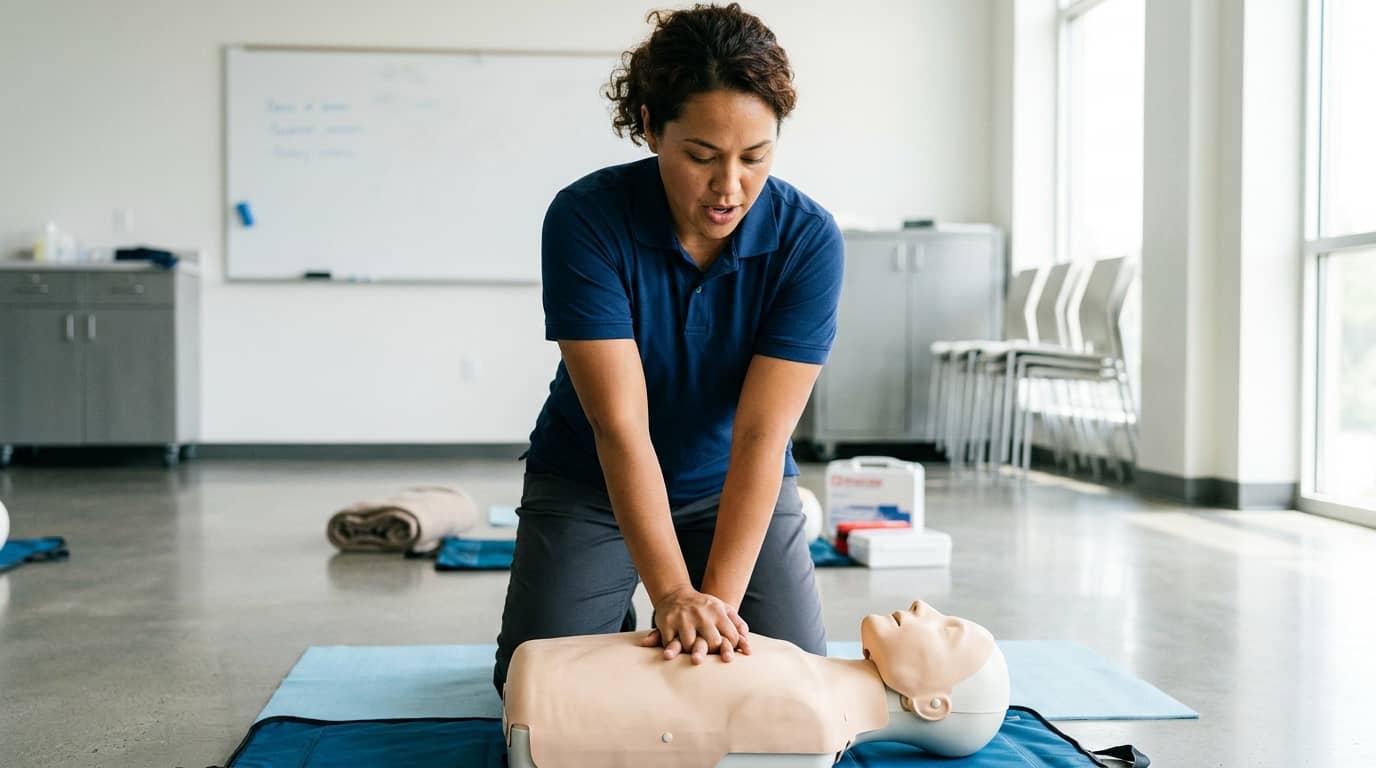
Instructs two-finger and two-thumb encircling compression methods with correct depth and rate. Accurate compressions maintain circulation until advanced help arrives.
Lesson 4 • Positioning the Infant for CPR
Covers correct placement on a firm, flat surface and neutral head-tilt positioning. Proper positioning prevents airway obstruction and maximizes compression effectiveness.
Lesson 5 • Rescue Breaths for Infants
Demonstrates mouth-to-mouth-and-nose technique with appropriate breath volume. Correct rescue breaths restore oxygenation without causing lung injury.
Chapter 3HideHide detailsSee detailsAutomated External Defibrillator Use
Automated External Defibrillator Use
Lesson 1 • Preparing the Infant for AED Use
Covers skin preparation, pad placement, and ensuring no one touches the infant during analysis. Correct preparation maximizes shock delivery and prevents injury.
Lesson 2 • Operating the AED Step by Step
Walks through power-on, prompt-following, shock delivery, and immediate CPR resumption. Sequential practice builds muscle memory for high-stress situations.
Lesson 3 • Post-Shock Care and AED Limitations
Addresses continued monitoring, repeat shock cycles, and scenarios where AED is ineffective. Learners understand AED as one tool within a broader resuscitation chain.
Lesson 4 • AED Fundamentals for Infants
Explains how AEDs detect shockable rhythms and why pediatric settings differ from adult. Establishes the rationale for infant-specific pad placement and energy levels.
Chapter 4HideHide detailsSee detailsAirway Obstruction and Choking Relief
Airway Obstruction and Choking Relief
Lesson 1 • Identifying Choking in Infants
Distinguishes mild from severe airway obstruction using observable signs. Accurate identification determines whether intervention or monitoring is appropriate.
Lesson 2 • Back Blow Technique
Teaches correct prone positioning on the forearm and five firm back blows. Proper technique dislodges foreign objects without injuring the infant's spine.
Lesson 3 • Managing Unconscious Choking Infants
Covers transition to CPR when a choking infant loses consciousness. Integrates airway-check steps into the CPR sequence to clear visible objects.
Lesson 4 • Chest Thrust Technique
Instructs supine positioning and five chest thrusts as the follow-up to back blows. Chest thrusts increase intrathoracic pressure to expel persistent obstructions.
Chapter 5HideHide detailsSee detailsBleeding Control and Wound Care
Bleeding Control and Wound Care
Lesson 1 • Direct Pressure and Hemostasis
Teaches applying firm, sustained direct pressure using sterile materials to stop bleeding. Effective hemostasis prevents hypovolemic shock in small infants.
Lesson 2 • Types of Wounds in Infants
Classifies abrasions, lacerations, punctures, and avulsions common in infants. Understanding wound type guides appropriate first aid response.
Lesson 3 • Bandaging Infant Wounds
Covers roller bandage and adhesive dressing application sized for infant limbs and head. Proper bandaging secures dressings without restricting circulation.
Lesson 4 • Recognizing Internal Bleeding
Identifies signs of internal hemorrhage including abdominal rigidity and shock indicators. Early recognition enables rapid EMS activation before visible blood loss occurs.
Chapter 6HideHide detailsSee detailsBurns, Scalds, and Skin Emergencies
Burns, Scalds, and Skin Emergencies
Lesson 1 • Cooling and First Aid for Burns
Instructs cool-running-water application for 20 minutes and safe clothing removal. Correct cooling reduces tissue damage and prevents hypothermia in infants.
Lesson 2 • Classifying Burn Severity in Infants
Distinguishes superficial, partial-thickness, and full-thickness burns using visual criteria. Severity classification drives cooling duration and referral decisions.
Lesson 3 • Sunburn and Skin Reactions
Addresses sunburn, allergic skin reactions, and contact dermatitis in infants. Learners distinguish minor reactions from anaphylaxis triggers requiring urgent care.
Lesson 4 • Chemical and Electrical Burns
Covers flushing chemical burns and isolating electrical sources before contact. These burn types require modified approaches to prevent rescuer injury.
Chapter 7HideHide detailsSee detailsSeizures, Fever, and Neurological Events
Seizures, Fever, and Neurological Events
Lesson 1 • Safe Management During a Seizure
Teaches protective positioning, hazard removal, and timing the seizure duration. Safe management prevents secondary injury without restraining the infant.
Lesson 2 • Understanding Febrile Seizures
Explains the physiological link between rapid fever rise and seizure activity in infants. Accurate understanding reduces panic and supports calm, effective response.
Lesson 3 • Fever Management in Infants
Addresses cooling measures, hydration, and when fever indicates serious infection. Learners apply evidence-based fever management without masking critical symptoms.
Lesson 4 • Post-Seizure Care and Monitoring
Covers the postictal phase, airway monitoring, and reassurance of caregivers. Post-seizure assessment determines whether emergency transport is necessary.
Lesson 5 • Breath-Holding Spells and Fainting
Distinguishes breath-holding spells from seizures and syncope in infants. Correct identification prevents unnecessary interventions and guides caregiver education.
Chapter 8HideHide detailsSee detailsAllergic Reactions and Anaphylaxis
Allergic Reactions and Anaphylaxis
Lesson 1 • Common Infant Allergen Triggers
Covers food, insect sting, latex, and medication triggers most prevalent in infants. Knowing triggers supports prevention and rapid cause identification during emergencies.
Lesson 2 • Epinephrine Auto-Injector Administration
Instructs correct site selection, injection technique, and post-injection monitoring for infant auto-injectors. Timely epinephrine delivery is the primary life-saving intervention in anaphylaxis.
Lesson 3 • Recognizing Allergic Reactions
Identifies mild, moderate, and severe allergic responses using skin, respiratory, and systemic signs. Grading severity determines the urgency and type of intervention.
Lesson 4 • Positioning and Supportive Care
Covers positioning for anaphylactic shock, airway monitoring, and keeping the infant calm. Supportive care bridges the gap between epinephrine administration and EMS arrival.
Your valid completion certificate
This course is for you:
New parent: eager to feel genuinely prepared before bringing a baby home.
Nanny or au pair: responsible for infant safety during unsupervised daily care.
Daycare educator: required to hold current infant emergency response certification.
Pediatric volunteer: supporting infant welfare programs in community health settings.
Foster caregiver: caring for infants with potentially unknown or complex medical histories.
Maternity nurse: expanding clinical skills to include structured first aid competencies.
What our students say
Your classes are perfect. I purchased the one-year package and finally have the opportunity to follow various topics of interest without needing to switch platforms... I thank you for everything you do, I've already recommended you to other people...

I like how the lessons are straight to the point and how I can switch chapters and skip content I don't need.

I like the content and the presentation style and video transcription, which speeds up the process!

The platform is fast, simple to use. The diversity of content and complementary videos really help with learning.

Top trainings




FAQ
Who is Dedika?
Is the certificate valid in United States?
Are the courses free?
What is the course workload?
What are the courses like?
How do the courses work?
What is the duration of the courses?
What is the cost or price of the courses?
What is an EAD or online course and how does it work?
PDF Course