
Metalworker Training
Get the hands-on metalworking skills employers actually need on the shop floor. This course covers everything from shop safety and precision measurement to welding, machining, and quality inspection. Whether you're starting out or filling gaps in your trade knowledge, this training gives you the technical foundation to work confidently with metal.
What your team will master:
You'll learn how to read engineering drawings, identify metals, and apply the correct safety protocols before you ever pick up a tool. From there, you'll develop hands-on skills in hand tools, power tools, and cutting processes including plasma, oxyfuel, and mechanical methods. You'll practice SMAW, GMAW, and GTAW welding techniques and learn how to inspect your welds against industry standards. The course also covers press brake operation, roll forming, lathe and milling machine setup, and CNC basics. You'll finish with assembly methods, surface preparation, protective coatings, and dimensional inspection using professional gauging equipment.
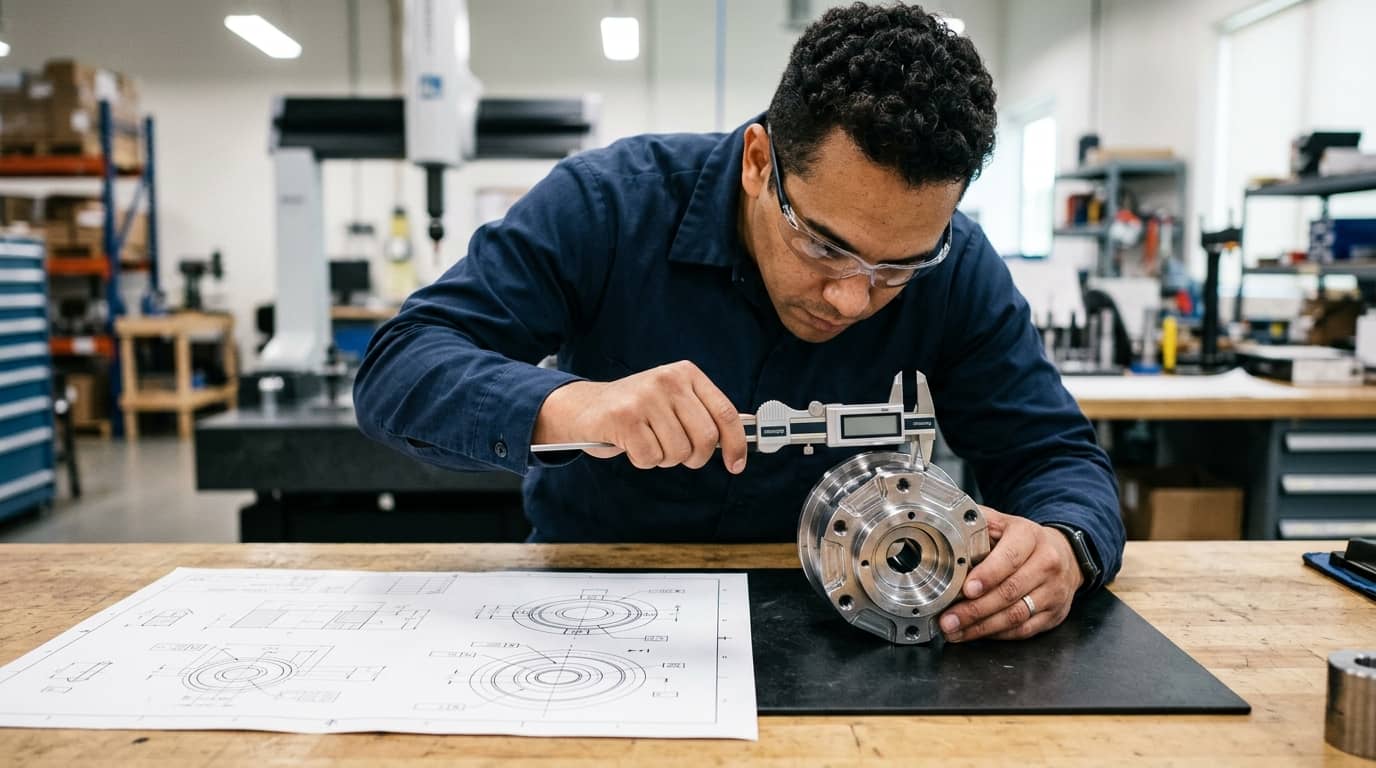
How your team learns in practice Metalworker Training
How your team practices Metalworker Training
Professionals from these companies study at Dedika



Course Content
8 Chapters • 40 LessonsDuration between 4 and 360 hours (you decide)
Chapter 1HideHide detailsSee detailsMetalworking Foundations and Shop Safety
Metalworking Foundations and Shop Safety
Lesson 1 • Shop Environment and Layout
Introduces the organization of a metalworking shop, tool zones, and workflow paths. Proper layout knowledge reduces hazards and improves efficiency.
Lesson 2 • Properties of Common Metals
Covers ferrous and non-ferrous metals, their physical and mechanical properties. Builds the material literacy needed for all subsequent fabrication decisions.
Lesson 3 • Hazard Recognition and Control
Teaches identification of mechanical, thermal, and chemical hazards in the shop. Students apply the hierarchy of controls to reduce risk before starting work.
Lesson 4 • Reading Drawings and Specifications
Introduces engineering drawings, symbols, and tolerances used in metalworking. Accurate drawing interpretation is essential for producing correct parts.
Lesson 5 • Personal Protective Equipment
Covers selection, fitting, and maintenance of PPE for metalworking tasks. Correct PPE use is the first line of defense against shop injuries.
Chapter 2HideHide detailsSee detailsHand Tools and Measurement
Hand Tools and Measurement
Lesson 1 • Surface Finishing by Hand
Covers deburring, polishing, and surface conditioning using hand methods. Clean, deburred edges are required before assembly and inspection.
Lesson 2 • Cutting and Chipping Hand Tools
Covers hacksaws, files, chisels, and snips for manual metal removal and shaping. Proper technique ensures clean cuts and extends tool life.
Lesson 3 • Clamping and Workholding Devices
Introduces vises, clamps, and V-blocks for securing workpieces during hand operations. Stable workholding is critical for accuracy and operator safety.
Lesson 4 • Layout and Marking Techniques
Teaches scribing, center-punching, and layout fluid application for accurate part marking. Precise layout prevents costly errors during cutting and forming.
Lesson 5 • Precision Measuring Instruments
Covers rules, calipers, micrometers, and gauges used to verify dimensions. Accurate measurement underpins every fabrication and machining task.
Chapter 3HideHide detailsSee detailsPower Tools and Portable Equipment
Power Tools and Portable Equipment
Lesson 1 • Power Tool Maintenance and Inspection
Covers pre-use inspection, lubrication, and storage of portable power tools. Routine maintenance prevents failures and extends equipment service life.
Lesson 2 • Reciprocating and Jig Saws
Covers blade selection and cutting technique for straight and curved metal cuts. These tools extend cutting capability beyond straight hacksaw work.
Lesson 3 • Portable Drills and Drill Bits
Teaches bit selection, speed settings, and drilling technique for various metals. Proper drilling prevents work-hardening, bit breakage, and inaccurate holes.
Lesson 4 • Pneumatic and Hydraulic Tools
Introduces air-powered chisels, riveters, and hydraulic presses used in fabrication. Students connect, operate, and maintain pneumatic and hydraulic circuits safely.
Lesson 5 • Angle Grinders and Abrasive Wheels
Covers wheel selection, guard adjustment, and grinding technique for cutting and finishing. Correct abrasive use prevents wheel failure and surface damage.
Chapter 4HideHide detailsSee detailsMetal Cutting Processes
Metal Cutting Processes
Lesson 1 • Abrasive Cutoff and Waterjet Overview
Introduces abrasive cutoff wheels and waterjet cutting principles for hard materials. Students understand process selection criteria based on material and tolerance needs.
Lesson 2 • Plasma Arc Cutting
Teaches plasma torch setup, consumable selection, and cutting of conductive metals. Plasma cutting delivers faster, cleaner cuts than oxyfuel on thin to medium stock.
Lesson 3 • Oxyfuel Cutting Fundamentals
Covers gas cylinder handling, torch setup, and flame cutting of ferrous metals. Oxyfuel cutting is the baseline thermal process for structural steel work.
Lesson 4 • Mechanical Cutting: Shears and Saws
Covers power shears, band saws, and cold saws for straight and contour cutting. Mechanical cutting produces burr-free edges without heat-affected zones.
Lesson 5 • Cut Quality Inspection and Correction
Teaches measurement and visual inspection of cut edges for squareness and surface quality. Students correct out-of-tolerance cuts using grinding and filing methods.
Chapter 5HideHide detailsSee detailsWelding Processes and Techniques
Welding Processes and Techniques
Lesson 1 • Gas Tungsten Arc Welding
Covers tungsten preparation, filler rod selection, and GTAW technique on thin and precision work. GTAW produces the highest-quality welds on stainless steel and aluminum.
Lesson 2 • Weld Joint Design and Fit-Up
Introduces joint types, groove geometry, and fit-up tolerances required before welding. Correct fit-up directly determines weld quality and reduces distortion.
Lesson 3 • Gas Metal Arc Welding
Teaches wire selection, shielding gas setup, and GMAW technique for production welding. GMAW offers higher deposition rates and is widely used in fabrication shops.
Lesson 4 • Shielded Metal Arc Welding
Covers electrode selection, machine setup, and SMAW technique on flat and horizontal positions. SMAW is the foundational arc process used across structural and repair work.
Lesson 5 • Weld Inspection and Defect Correction
Covers visual inspection criteria, common defects, and repair methods for welds. Students identify porosity, undercut, and incomplete fusion and apply corrective action.
Chapter 6HideHide detailsSee detailsMetal Forming and Bending
Metal Forming and Bending
Lesson 1 • Bending Theory and Bend Allowance
Covers neutral axis, springback, and bend allowance calculations for sheet and plate. Accurate calculations prevent scrap and ensure parts meet final dimensions.
Lesson 2 • Straightening and Distortion Correction
Covers flame straightening, press straightening, and peening to correct warped metal. Distortion control is essential after welding and forming operations.
Lesson 3 • Roll Forming and Plate Rolling
Covers three-roll and four-roll machine setup for producing cylinders and cones. Rolling is used for pressure vessels, ducts, and structural curved sections.
Lesson 4 • Tube and Pipe Bending
Introduces mandrel bending, rotary draw, and compression bending for tube and pipe. Correct technique prevents wall thinning, wrinkling, and ovality.
Lesson 5 • Press Brake Operation
Teaches tooling selection, back gauge setup, and bending sequence on a press brake. The press brake is the primary forming machine for sheet and light plate work.
Chapter 7HideHide detailsSee detailsMachining Operations
Machining Operations
Lesson 1 • Lathe Setup and Turning Operations
Covers workholding, tool selection, and turning, facing, and parting on the engine lathe. The lathe is the most versatile single-point cutting machine in the shop.
Lesson 2 • Drilling, Reaming, and Tapping
Teaches drill press setup, reaming for precision holes, and tapping internal threads. Accurate hole production is required for fasteners, pins, and press fits.
Lesson 3 • Cutting Fluids and Tool Life
Covers coolant types, application methods, and tool wear monitoring for machining. Proper fluid use extends tool life and improves surface finish quality.
Lesson 4 • Threading on the Lathe
Teaches single-point threading, thread chasing, and thread measurement on the lathe. Accurate threads are critical for fastened and pressure-containing assemblies.
Lesson 5 • Milling Machine Operations
Covers workholding, cutter selection, and face milling, slotting, and contouring. Milling produces flat surfaces, slots, and complex profiles on metal parts.
Chapter 8HideHide detailsSee detailsAssembly, Finishing, and Quality Control
Assembly, Finishing, and Quality Control
Lesson 1 • Non-Destructive Testing Overview
Introduces visual, dye penetrant, and magnetic particle testing for weld and part inspection. NDT methods detect surface and near-surface defects without damaging the part.
Lesson 2 • Surface Preparation and Cleaning
Teaches abrasive blasting, chemical cleaning, and mechanical surface prep before coating. Proper surface preparation is the most critical factor in coating adhesion.
Lesson 3 • Protective Coatings and Finishes
Covers primer, paint, and galvanizing systems for corrosion protection of metal parts. Coating selection depends on service environment, substrate, and durability requirements.
Lesson 4 • Mechanical Fastening Methods
Covers bolted joints, rivets, and threaded inserts for assembling metal structures. Correct fastener selection and torque application ensure structural integrity.
Lesson 5 • Dimensional Inspection Techniques
Teaches use of gauges, squares, and coordinate measurement for final part inspection. Dimensional verification confirms that parts meet drawing tolerances before delivery.
Your valid completion certificate
This course is for you:
Career changers: seeking a stable, hands-on trade with strong hiring demand.
Recent high school graduates: exploring skilled trades before committing to college.
Construction laborers: wanting to add certified metalworking skills to their resume.
Hobbyist fabricators: ready to move beyond basic projects into professional-grade techniques.
Military veterans: translating mechanical aptitude into civilian manufacturing careers.
Maintenance technicians: needing formal metalworking knowledge to handle fabrication tasks.
Related courses




FAQ
Who is Dedika?
Is the certificate valid in United States?
Are the courses free?
What is the course workload?
What are the courses like?
How do the courses work?
What is the duration of the courses?
What is the cost or price of the courses?
What is an EAD or online course and how does it work?
PDF Course