
Metalworking Course
Master every core metalworking skill — from hand tools and welding to lathe turning and CNC basics — in one comprehensive course built for real shop environments. You'll work through cutting, forming, threading, milling, heat treatment, and precision inspection with the depth that employers actually demand. This is the complete hands-on foundation serious metalworkers need to advance their careers.
What your team will master:
This course covers metalworking from the ground up, starting with shop safety, metal identification, and precision measurement before moving into cutting, drilling, threading, and bench forming. You will learn SMAW, MIG, and TIG welding techniques and how to inspect your welds to industry standards. Lathe and milling machine operations teach you to produce cylindrical and flat parts to tight tolerances. Supplementary modules cover blueprint reading, GD&T, heat treatment, CNC introduction, and shop math so you can handle real production challenges. By the end, you will have the technical knowledge and practical skills to perform confidently across a professional metalworking shop.
How your team learns in practice Metalworking Course
How your team practices Metalworking Course
Professionals from these companies study at Dedika



Course Content
8 Chapters • 40 LessonsDuration between 4 and 360 hours (you decide)
Chapter 1HideHide detailsSee detailsMetalworking Foundations and Safety
Metalworking Foundations and Safety
Lesson 1 • Introduction to Metals and Alloys
Covers ferrous and non-ferrous metals, their properties, and common industrial uses. Builds the material literacy needed for all subsequent fabrication decisions.
Lesson 2 • Shop Safety and Personal Protection
Teaches hazard identification, PPE selection, and emergency procedures specific to metal shops. Ensures students can assess and mitigate risk before touching any equipment.
Lesson 3 • Measurement and Layout Fundamentals
Covers rules, calipers, squares, and scribers for accurate metal layout. Precision measurement underpins every cutting and forming operation in later chapters.
Lesson 4 • Workplace Organization and Ergonomics
Addresses bench height, tool placement, and fatigue reduction in a metal shop. Proper ergonomics prevents injury and sustains productivity across long work sessions.
Lesson 5 • Hand Tools and Their Uses
Introduces files, hammers, chisels, and layout tools used in manual metalwork. Correct tool selection and grip technique are emphasized throughout.
Chapter 2HideHide detailsSee detailsMetal Cutting Techniques
Metal Cutting Techniques
Lesson 1 • Plasma Arc Cutting Basics
Covers plasma cutter setup, consumable selection, and technique for clean cuts on various metals. Contrasts plasma with oxy-fuel to guide process selection.
Lesson 2 • Oxy-Fuel Cutting Fundamentals
Explains gas pressures, tip selection, and torch technique for cutting mild steel. Students connect flame chemistry to cut quality and kerf control.
Lesson 3 • Hacksaw and Band Saw Operations
Teaches blade selection, tension, and feed rate for straight and contour cuts. Connects accurate sawing to reduced finishing time in downstream operations.
Lesson 4 • Shearing and Nibbling Sheet Metal
Covers bench shears, foot-operated shears, and nibblers for sheet stock. Students learn to produce straight and curved cuts without distorting thin material.
Lesson 5 • Angle Grinder Cutting and Grinding
Introduces disc selection, guard use, and controlled cutting with angle grinders. Safe body positioning and disc inspection are reinforced as non-negotiable habits.
Chapter 3HideHide detailsSee detailsDrilling, Tapping, and Threading
Drilling, Tapping, and Threading
Lesson 1 • Drill Press Setup and Operation
Covers speed selection, work-holding, and feed pressure for drilling metal accurately. Proper setup prevents drill walk, breakage, and workpiece spin.
Lesson 2 • Die Threading External Fasteners
Explains die selection, stock chamfering, and technique for cutting external threads. Connects thread class to fit requirements in assembled components.
Lesson 3 • Twist Drill Geometry and Selection
Explains point angles, helix angles, and coatings for drilling different metals. Correct drill selection directly affects hole quality and tool life.
Lesson 4 • Hand Tapping Internal Threads
Covers tap drill sizing, tap sequence, and technique for cutting clean internal threads. Students learn to recover from tap breakage and inspect thread quality.
Lesson 5 • Reaming and Countersinking Holes
Teaches reaming for precision fit and countersinking for fastener seating. These operations refine drilled holes to meet assembly and finish requirements.
Chapter 4HideHide detailsSee detailsBench Work and Metal Forming
Bench Work and Metal Forming
Lesson 1 • Vise Work and Bench Clamping
Covers jaw selection, soft jaw use, and clamping strategies for bench operations. Secure work-holding is the prerequisite for all accurate bench forming tasks.
Lesson 2 • Riveting and Mechanical Fastening
Teaches solid and blind rivet installation, hole preparation, and joint inspection. Riveted joints are compared to welded and bolted alternatives for application guidance.
Lesson 3 • Filing to Dimension and Finish
Teaches draw filing, cross filing, and checking flatness to achieve dimensional accuracy. Filing skill directly supports fit-up quality in welding and assembly.
Lesson 4 • Straightening Warped Metal
Covers identifying warp, using a surface plate, and controlled hammer blows to restore flatness. Straightening is essential before layout and precision machining.
Lesson 5 • Bending Sheet and Bar Stock
Explains bend allowance, springback, and tooling for bending sheet and bar metal. Accurate bending reduces rework and ensures parts meet angular tolerances.
Chapter 5HideHide detailsSee detailsWelding Processes and Techniques
Welding Processes and Techniques
Lesson 1 • Welding Safety and Equipment Setup
Covers arc flash protection, fume extraction, and machine setup for welding operations. Safety compliance is established before any arc is struck.
Lesson 2 • MIG Welding Setup and Technique
Explains wire feed speed, voltage, and shielding gas selection for MIG welding. Students weld butt, lap, and T-joints on mild steel and thin sheet.
Lesson 3 • Weld Inspection and Quality Control
Teaches visual inspection criteria, distortion measurement, and basic destructive testing. Students connect weld quality to structural integrity and rework cost.
Lesson 4 • Shielded Metal Arc Welding (SMAW)
Teaches electrode selection, amperage setting, and bead technique for stick welding. SMAW is practiced on flat and horizontal joints before progressing to other positions.
Lesson 5 • TIG Welding Fundamentals
Covers tungsten preparation, filler rod selection, and foot pedal amperage control for TIG. Precision TIG technique is applied to stainless steel and aluminum joints.
Chapter 6HideHide detailsSee detailsLathe Operations and Turning
Lathe Operations and Turning
Lesson 1 • Lathe Threading Operations
Covers gear train setup, compound rest angle, and half-nut engagement for cutting threads. Students cut both external and internal threads to specified pitch and class.
Lesson 2 • Taper Turning and Boring
Explains compound rest, tailstock offset, and taper attachment methods for taper turning. Boring bar technique is introduced for enlarging and finishing internal diameters.
Lesson 3 • Work-Holding on the Lathe
Covers three-jaw chucks, four-jaw chucks, faceplates, and between-centers mounting. Correct work-holding prevents runout and ensures concentricity in turned parts.
Lesson 4 • Turning, Facing, and Parting
Teaches roughing and finishing cuts, facing to length, and parting off stock. Students calculate cutting speed and feed for different metals and tool materials.
Lesson 5 • Lathe Components and Controls
Identifies headstock, carriage, tailstock, and feed mechanisms and explains their functions. Understanding machine anatomy enables safe setup and efficient operation.
Chapter 7HideHide detailsSee detailsMilling Machine Operations
Milling Machine Operations
Lesson 1 • Indexing and Angular Milling
Covers direct, simple, and differential indexing with a dividing head for equally spaced features. Students mill flats, hexagons, and gear tooth spaces using indexing.
Lesson 2 • Work-Holding and Fixturing for Milling
Covers milling vises, strap clamps, and angle plates for securing workpieces. Rigid fixturing prevents chatter and maintains dimensional accuracy during cutting.
Lesson 3 • End Milling and Face Milling
Teaches cutter selection, depth of cut, and feed direction for end and face milling. Climb vs. conventional milling is explained in relation to surface finish and tool life.
Lesson 4 • Slot Milling and Keyway Cutting
Explains slot drill selection, plunge entry, and feed strategy for cutting slots and keyways. Accurate slot dimensions are critical for shaft and hub assembly fits.
Lesson 5 • Milling Machine Types and Controls
Distinguishes vertical, horizontal, and universal mills and explains table, knee, and quill controls. Machine familiarity is the foundation for safe and accurate milling.
Chapter 8HideHide detailsSee detailsSurface Finishing and Quality Inspection
Surface Finishing and Quality Inspection
Lesson 1 • Surface Grinding Operations
Explains magnetic chuck use, wheel selection, and infeed for precision surface grinding. Students grind flat surfaces to tight parallelism and surface finish requirements.
Lesson 2 • Bench and Pedestal Grinding
Teaches wheel dressing, tool rest adjustment, and grinding technique for sharpening and shaping. Wheel condition and work rest gap are enforced as critical safety parameters.
Lesson 3 • Dimensional Inspection and Reporting
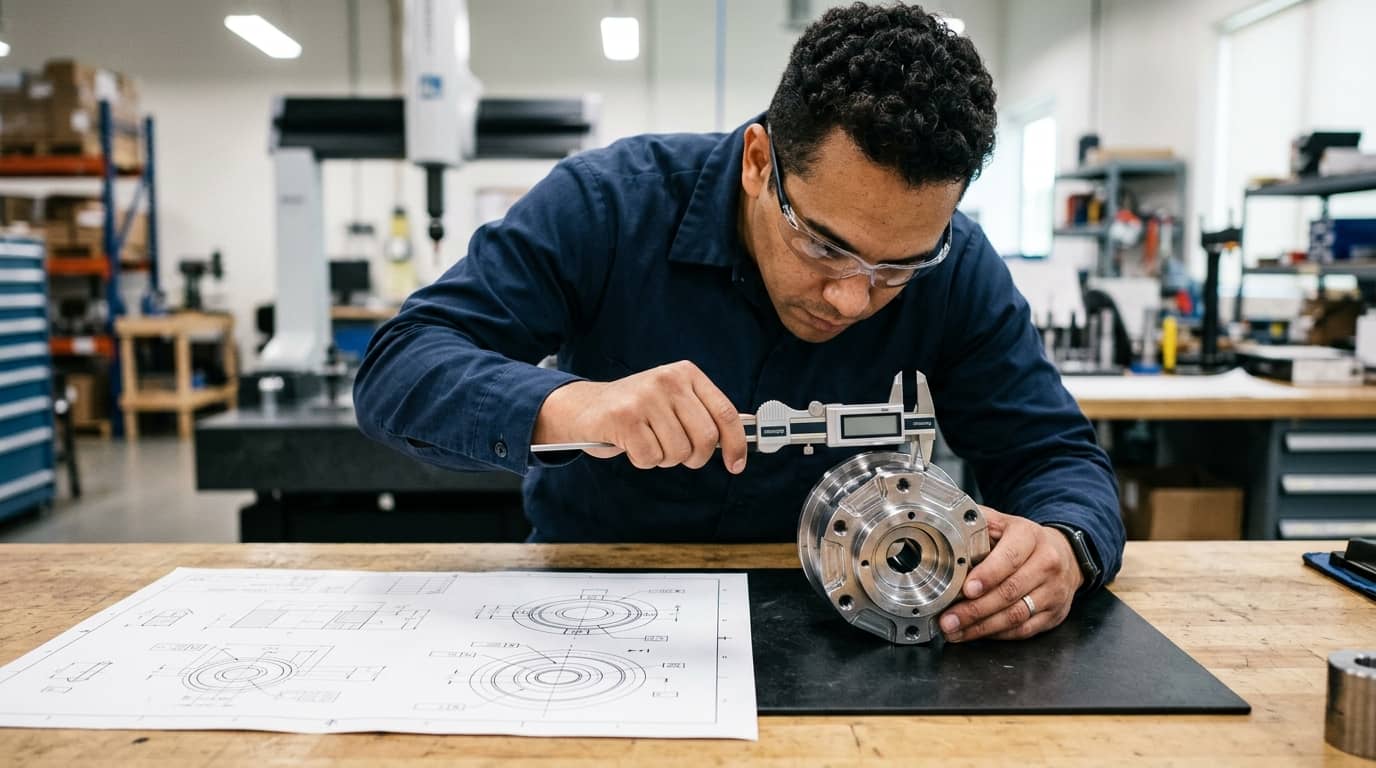
Teaches micrometer, height gauge, and CMM use for verifying finished part dimensions. Inspection data is recorded and interpreted against engineering drawing tolerances.
Lesson 4 • Abrasive Finishing and Polishing
Covers progressive grit sanding, lapping, and buffing to achieve specified surface roughness. Surface finish is linked to functional requirements such as sealing and corrosion resistance.
Lesson 5 • Protective Coatings and Treatments
Introduces painting, powder coating, anodizing, and plating as corrosion and wear protection. Students select coatings based on service environment and dimensional impact.
Your valid completion certificate
This course is for you:
Aspiring machinist: wants structured training before entering a trade program.
Career changer: leaving an unrelated field to pursue skilled manufacturing work.
Hobbyist fabricator: builds metal projects at home and wants professional-level technique.
Military veteran: transitioning to civilian manufacturing with transferable mechanical aptitude.
Welding student: already learning one process and wants broader metalworking competency.
Maintenance technician: handles metal repairs on the job and needs deeper foundational knowledge.
Related courses




FAQ
Who is Dedika?
Is the certificate valid in United States?
Are the courses free?
What is the course workload?
What are the courses like?
How do the courses work?
What is the duration of the courses?
What is the cost or price of the courses?
What is an EAD or online course and how does it work?
PDF Course