
Plastic Mold Toolmaker Course
Master every stage of plastic injection mold toolmaking, from reading engineering drawings and selecting mold steels to machining cavities, assembling molds, and running first-shot tryouts. This course gives you the hands-on technical knowledge that mold shops demand, covering conventional machining, CNC, EDM, mold design, maintenance, and troubleshooting in one comprehensive program.
What your team will master:
You will build a complete understanding of injection mold construction, starting with plastic materials, mold anatomy, and toolmaker safety. You will learn to read mold blueprints, apply GD&T tolerances, and use precision measurement instruments including CMMs. The course covers mold steel grades, heat treatment, and surface coatings, then moves into lathe, milling, grinding, CNC, and EDM operations. You will design gating, cooling, ejection, and side-action systems, then assemble and trial-run a full mold. Preventive maintenance, repair welding, and defect troubleshooting round out your skill set for real production environments.
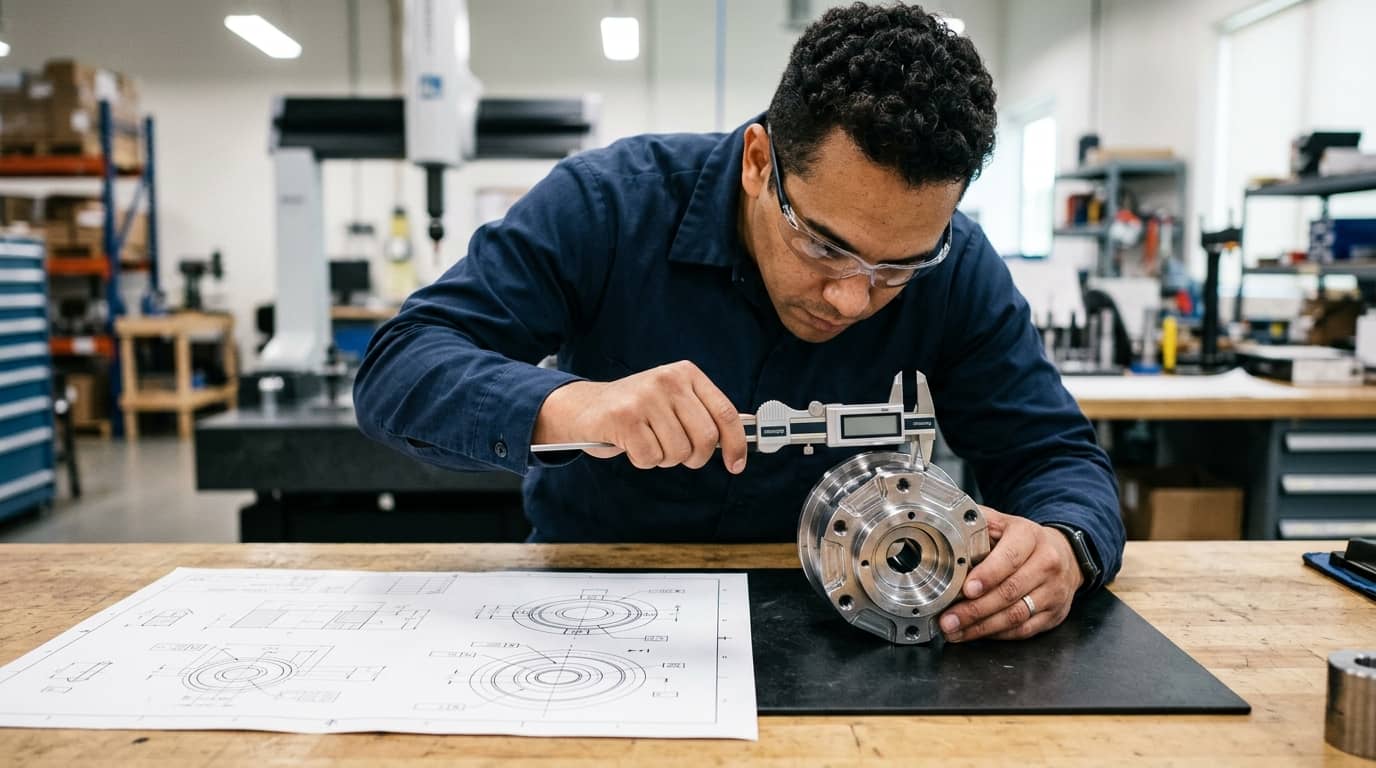
How your team learns in practice Plastic Mold Toolmaker Course
How your team practices Plastic Mold Toolmaker Course
Professionals from these companies study at Dedika



Course Content
8 Chapters • 37 LessonsDuration between 4 and 360 hours (you decide)
Chapter 1HideHide detailsSee detailsFoundations of Plastic Mold Toolmaking
Foundations of Plastic Mold Toolmaking
Lesson 1 • Anatomy of an Injection Mold
Identifies every standard mold component and its function. Provides the vocabulary needed for blueprint reading and shop communication.
Lesson 2 • Toolmaker Roles and Shop Safety
Defines toolmaker responsibilities within a mold shop hierarchy. Safety protocols for machinery, chemicals, and lifting are established here.
Lesson 3 • Introduction to Plastic Molding Processes
Covers injection, compression, and blow molding fundamentals. Establishes process context for all subsequent toolmaking decisions.
Lesson 4 • Plastic Materials and Their Properties
Examines thermoplastics, thermosets, and elastomers relevant to mold design. Material selection directly affects mold steel choice and cavity finish.
Chapter 2HideHide detailsSee detailsEngineering Drawings and Metrology
Engineering Drawings and Metrology
Lesson 1 • Dimensional Tolerancing for Mold Components
Explains bilateral, unilateral, and limit tolerances applied to mold fits. Tolerance stack-up analysis prevents assembly interference.
Lesson 2 • Precision Measurement Instruments
Covers micrometers, calipers, dial indicators, and CMM basics. Proper instrument use ensures components meet drawing specifications.
Lesson 3 • Reading Mold Engineering Drawings
Teaches orthographic projection, section views, and GD&T symbols used in mold drawings. Correct interpretation prevents costly machining errors.
Lesson 4 • Inspection Techniques for Mold Parts
Applies measurement instruments to verify mold component geometry. Systematic inspection routines catch defects before assembly.
Chapter 3HideHide detailsSee detailsMold Steel Selection and Heat Treatment
Mold Steel Selection and Heat Treatment
Lesson 1 • Heat Treatment Processes
Explains hardening, tempering, annealing, and stress relieving for mold steels. Proper sequencing prevents distortion and cracking in finished components.
Lesson 2 • Steel Hardness and Machinability
Relates Rockwell hardness values to machinability and wear resistance. Balancing hardness against machinability guides steel selection decisions.
Lesson 3 • Mold Steel Grades and Classifications
Surveys P-series, H-series, D-series, and stainless mold steels. Each grade's composition determines its suitability for specific resin types.
Lesson 4 • Surface Treatments and Coatings
Covers nitriding, PVD coatings, chrome plating, and texturing for mold surfaces. Surface treatments enhance wear resistance and part release.
Chapter 4HideHide detailsSee detailsConventional Machining for Mold Components
Conventional Machining for Mold Components
Lesson 1 • Milling Operations for Mold Plates
Covers face milling, end milling, pocket milling, and slot cutting on mold plates. Proper fixturing and climb milling technique improve surface finish.
Lesson 2 • Surface and Cylindrical Grinding
Teaches surface grinding of mold plates and cylindrical grinding of cores and pins. Grinding achieves the tight tolerances and finishes that milling cannot.
Lesson 3 • Workholding and Fixturing Strategies
Designs and selects vises, clamps, angle plates, and custom fixtures for mold work. Rigid, repeatable fixturing is essential for multi-operation mold components.
Lesson 4 • Drilling, Reaming, and Tapping
Covers precision hole-making for cooling channels, ejector pins, and fasteners. Correct drill geometry and cutting fluid use prevent breakage and oversize holes.
Lesson 5 • Lathe Operations for Mold Parts
Applies turning, boring, threading, and facing to produce round mold components. Correct speeds, feeds, and tool geometry ensure dimensional accuracy.
Chapter 5HideHide detailsSee detailsCNC Machining and EDM for Mold Cavities
CNC Machining and EDM for Mold Cavities
Lesson 1 • Wire EDM for Precision Mold Components
Applies wire EDM to cut inserts, slides, and lifters to tight tolerances. Wire EDM produces burr-free, accurate profiles in hardened tool steel.
Lesson 2 • CNC Milling Fundamentals for Mold Work
Covers G-code structure, coordinate systems, and toolpath strategies for 3-axis mold cavities. Proper toolpath selection minimizes cycle time and tool wear.
Lesson 3 • CAM Software for Mold Cavity Machining
Uses CAM software to generate toolpaths from 3D mold models. Simulation and verification prevent collisions and ensure correct stock removal.
Lesson 4 • Sinker EDM for Complex Cavity Features
Explains electrode design, dielectric fluid, and spark gap control for sinker EDM. EDM machines ribs, sharp corners, and hardened steel features that cutters cannot reach.
Lesson 5 • 5-Axis Machining for Advanced Mold Geometry
Introduces simultaneous 5-axis strategies for undercuts, complex parting surfaces, and deep ribs. Reduces electrode count and improves surface quality on complex molds.
Chapter 6HideHide detailsSee detailsMold Design Principles and Component Engineering
Mold Design Principles and Component Engineering
Lesson 1 • Ejection System Design
Selects and positions ejector pins, blades, sleeves, and stripper plates for reliable part release. Ejector layout must balance force without marking part surfaces.
Lesson 2 • Parting Line and Draft Angle Design
Determines optimal parting line location and draft angles for clean part release. Poor parting line placement causes flash, undercuts, and ejection damage.
Lesson 3 • Cooling System Design and Analysis
Designs conformal and conventional cooling circuits to achieve uniform mold temperature. Efficient cooling is the single largest lever for reducing cycle time.
Lesson 4 • Gate and Runner System Design
Designs sprue, runner, and gate systems to balance fill, minimize waste, and control pressure. Gate type and location directly affect part quality and cycle time.
Lesson 5 • Side Actions: Slides and Lifters
Engineers cam-driven slides and angled lifters to form and release external and internal undercuts. Correct geometry prevents binding, galling, and premature wear.
Chapter 7HideHide detailsSee detailsMold Assembly, Fitting, and Tryout
Mold Assembly, Fitting, and Tryout
Lesson 1 • Mold Correction and Dimensional Adjustment
Diagnoses dimensional deviations and applies steel-safe corrections to cavity dimensions. Iterative correction cycles bring parts within drawing tolerance.
Lesson 2 • Mold Component Fitting and Benchwork
Covers hand filing, stoning, lapping, and spotting to achieve precise component fits. Benchwork quality determines mold sealing, alignment, and part surface finish.
Lesson 3 • Mold Tryout on the Injection Machine
Runs first shots to evaluate fill, balance, flash, and part dimensions. Systematic process window development separates mold issues from process issues.
Lesson 4 • Mold Assembly Sequence and Procedures
Establishes the correct build sequence to avoid interference and damage during assembly. Torque specifications and alignment checks are applied at each stage.
Lesson 5 • Mold Qualification and Sign-Off
Validates mold performance against dimensional, cosmetic, and cycle-time requirements. Formal sign-off transfers the mold to production with documented evidence.
Chapter 8HideHide detailsSee detailsMold Maintenance, Repair, and Troubleshooting
Mold Maintenance, Repair, and Troubleshooting
Lesson 1 • Mold Repair Techniques
Applies TIG welding, laser welding, and insert replacement to restore damaged mold components. Repair method selection depends on steel grade, location, and required hardness.
Lesson 2 • Common Mold Failure Modes
Identifies wear, fatigue cracking, corrosion, and galling as primary mold failure mechanisms. Understanding failure modes guides both repair strategy and future design improvements.
Lesson 3 • Mold Storage and Long-Term Preservation
Covers rust prevention, cavity protection, and proper storage conditions for idle molds. Correct preservation prevents costly refurbishment when molds return to production.
Lesson 4 • Troubleshooting Molded Part Defects
Links part defects such as short shots, sink marks, and warpage to mold-related root causes. Systematic diagnosis prevents misattributing mold problems to process settings.
Lesson 5 • Preventive Maintenance Programs
Establishes inspection intervals, lubrication schedules, and cleaning procedures for production molds. Structured PM programs prevent catastrophic failures and extend mold life.
Your valid completion certificate
This course is for you:
Machinists: seeking to specialize in the higher-paying mold toolmaking trade.
Manufacturing technicians: wanting to understand mold construction from the inside out.
Plastics industry workers: ready to move from operating machines to building them.
Career changers: drawn to precision trades and looking for a structured entry point.
Apprentice toolmakers: needing a comprehensive reference to accelerate their shop training.
Quality inspectors: aiming to diagnose mold-related defects rather than just document them.
Related courses




FAQ
Who is Dedika?
Is the certificate valid in United States?
Are the courses free?
What is the course workload?
What are the courses like?
How do the courses work?
What is the duration of the courses?
What is the cost or price of the courses?
What is an EAD or online course and how does it work?
PDF Course