
Vegetarian and Vegan Chef Course
Take your cooking to a professional level with a comprehensive programme covering everything from plant-based nutrition science to advanced plating and menu development. Master global vegan traditions, fermentation, pastry, and modernist techniques — all built around real kitchen skills. This course is designed for chefs and serious cooks ready to lead in the fastest-growing segment of the food industry.
What you'll learn:
You will build a complete foundation in plant-based nutrition, ingredient sourcing, and professional cooking techniques across eight core chapters. You will learn classical and global cooking methods, create a full repertoire of vegan sauces and condiments, and master egg-free and dairy-free baking from scratch. The curriculum also covers fermentation, food safety, sustainable sourcing, and emerging food technologies. By the final chapter, you will design, cost, and present an original vegan tasting menu ready for a professional portfolio. Every skill you develop is directly applicable to restaurant kitchens, catering operations, and menu consulting.
How you study in practice Vegetarian and Vegan Chef Course
How you practise Vegetarian and Vegan Chef Course
For businesses looking to train their team
With Dedika for businesses, the course includes exercises and examples tailored to your own business and the way your company needs.

Course content
8 Chapters • 37 LessonsDuration between 4 and 360 hours (you decide)
Chapter 1HideHide detailsSee detailsFoundations of Plant-Based Nutrition
Foundations of Plant-Based Nutrition
Lesson 1 • Protein Combining and Complementarity
Teaches amino acid profiles of plant proteins and strategic pairing. Enables chefs to build nutritionally complete dishes from whole-food ingredients.
Lesson 2 • Micronutrients and Common Deficiencies
Identifies vitamins and minerals at risk in vegan diets. Guides ingredient selection to prevent nutritional gaps in menu planning.
Lesson 3 • Macronutrients in Plant-Based Diets
Covers protein, carbohydrate, and fat roles in vegan nutrition. Establishes the nutritional baseline needed for all recipe development in this course.
Lesson 4 • Reading and Applying Nutritional Labels
Develops skills for interpreting ingredient and nutrition data on packaged goods. Supports informed sourcing decisions throughout the course.
Chapter 2HideHide detailsSee detailsPlant-Based Pantry and Ingredient Mastery
Plant-Based Pantry and Ingredient Mastery
Lesson 1 • Vegetables, Fungi, and Sea Vegetables
Covers seasonal produce, mushroom varieties, and edible seaweeds as flavour and umami sources. Connects ingredient knowledge to texture and taste outcomes.
Lesson 2 • Speciality Vegan Ingredients
Introduces tofu, tempeh, seitan, nutritional yeast, and miso. These ingredients are essential for replicating savoury depth and protein density.
Lesson 3 • Herbs, Spices, and Flavour Builders
Catalogues fresh and dried aromatics, spice blends, and condiments that define plant-based cuisine globally. Directly supports seasoning skills in later chapters.
Lesson 4 • Legumes, Grains, and Pseudograins
Surveys dried and canned legumes, whole grains, and pseudograins like quinoa. Forms the starch and protein backbone of the plant-based pantry.
Lesson 5 • Nuts, Seeds, and Plant-Based Oils
Examines fat-rich ingredients for flavour, texture, and nutrition. Provides the foundation for sauces, dressings, and dairy substitutes covered later.
Chapter 3HideHide detailsSee detailsEssential Knife and Prep Techniques
Essential Knife and Prep Techniques
Lesson 1 • Mise en Place and Batch Prep
Establishes organised prep workflows, labelling, and storage for high-volume plant-based kitchens. Efficiency here directly reduces waste and service time.
Lesson 2 • Classical Vegetable Cuts
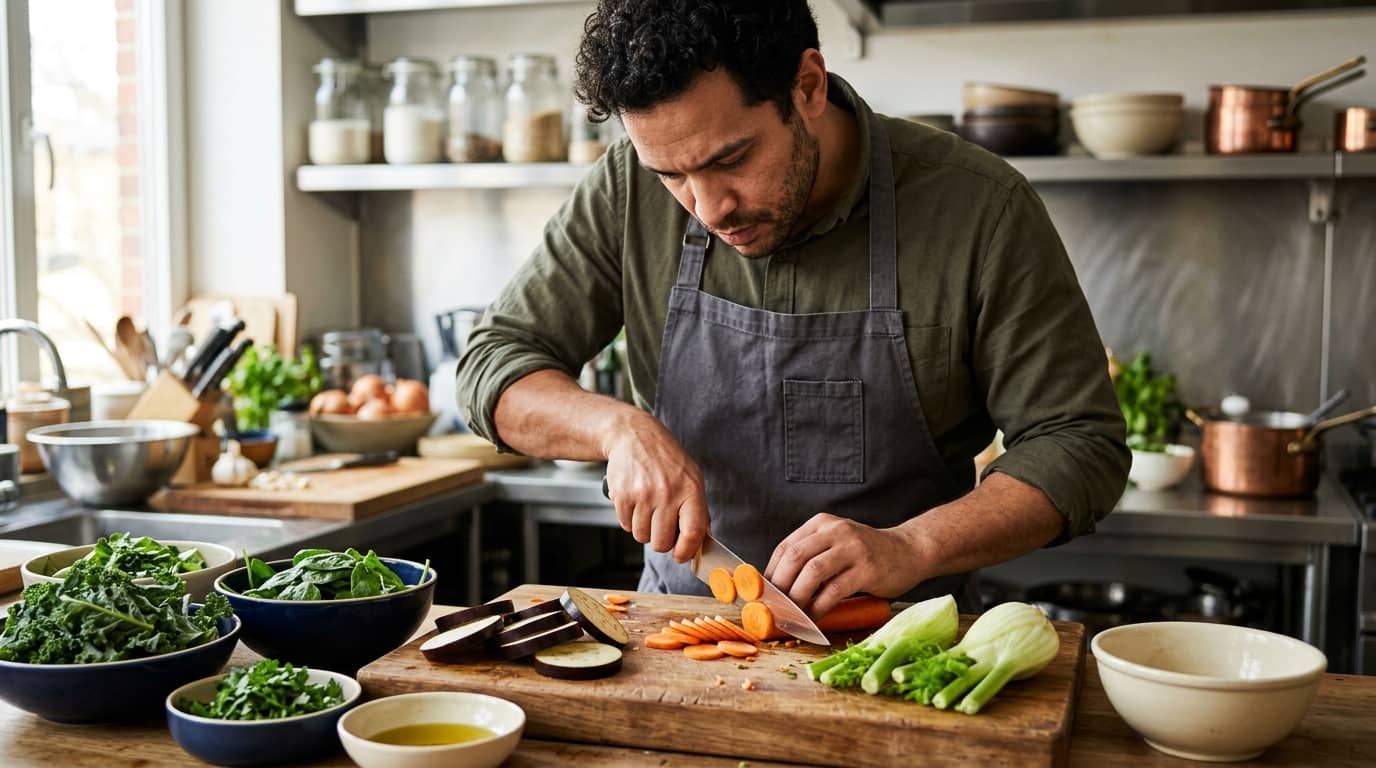
Teaches julienne, brunoise, chiffonade, and other standard cuts with plant-based produce. Uniform cuts ensure even cooking and professional plate presentation.
Lesson 3 • Breaking Down Challenging Produce
Addresses hard squash, root vegetables, artichokes, and tropical fruits. Builds confidence with dense or awkward ingredients common in vegan menus.
Lesson 4 • Knife Selection and Maintenance
Covers knife types, honing, and sharpening for vegetable-focused work. Proper tool care underpins every prep technique taught in this chapter.
Chapter 4HideHide detailsSee detailsCore Cooking Methods for Plant Foods
Core Cooking Methods for Plant Foods
Lesson 1 • Dry-Heat Methods
Covers roasting, grilling, sautéing, and pan-searing plant-based ingredients. Develops caramelisation and Maillard reaction skills critical to vegan flavour depth.
Lesson 2 • Frying and Crisping Techniques
Covers deep-frying, shallow-frying, and air-frying plant-based foods. Teaches oil management and batter formulation for consistent crunch without animal products.
Lesson 3 • Moist-Heat and Combination Methods
Teaches boiling, steaming, braising, and pressure cooking for legumes and vegetables. Connects moisture control to texture outcomes in soups and stews.
Lesson 4 • Raw and Low-Heat Preparations
Introduces raw cuisine, dehydration, and cold-processing techniques. Expands the chef's repertoire beyond heat-based cooking for raw menus and garnishes.
Lesson 5 • Stocks, Broths, and Flavour Bases
Builds vegetable stocks, mushroom broths, and kombu dashi as foundational liquids. These bases underpin sauces, soups, and braises throughout the curriculum.
Chapter 5HideHide detailsSee detailsSauces, Dressings, and Condiments
Sauces, Dressings, and Condiments
Lesson 1 • Mother Sauces Adapted for Vegan Cooking
Reimagines classical French mother sauces using plant-based fats and milks. Provides a structured framework for derivative sauce development.
Lesson 2 • Fermented and Umami-Rich Condiments
Teaches miso glazes, tamari reductions, and fermented hot sauces. Adds savoury depth that compensates for the absence of meat-based umami.
Lesson 3 • Emulsified Dressings and Vinaigrettes
Covers stable and broken emulsions using mustard, lecithin, and aquafaba. Directly applicable to salads, grain bowls, and plated starters.
Lesson 4 • Nut and Seed-Based Sauces
Develops tahini, cashew cream, almond romesco, and similar preparations. These sauces replace dairy-based richness across multiple menu applications.
Chapter 6HideHide detailsSee detailsGlobal Plant-Based Cuisine Traditions
Global Plant-Based Cuisine Traditions
Lesson 1 • South and Southeast Asian Traditions
Covers Indian dal, Thai curries, and Indonesian tempeh dishes. Demonstrates how ancient plant-based traditions solve modern vegan menu challenges.
Lesson 2 • African and Caribbean Plant-Based Cooking
Introduces West African stews, Ethiopian injera dishes, and Caribbean rice plates. Expands the chef's global toolkit with underrepresented culinary traditions.
Lesson 3 • Latin American Plant-Based Dishes
Explores Mexican, Peruvian, and Brazilian plant-based staples using corn, beans, and chiles. Builds cross-cultural flavour literacy for diverse menu design.
Lesson 4 • Middle Eastern and Mediterranean Traditions
Covers hummus, falafel, mezze, and grain-based dishes from the region. Showcases legume and olive oil mastery as a model for plant-based cooking.
Lesson 5 • East Asian Plant-Based Cooking
Examines Chinese Buddhist cuisine, Japanese shojin ryori, and Korean banchan. Highlights umami-forward techniques using fermented and sea-based ingredients.
Chapter 7HideHide detailsSee detailsVegan Baking and Pastry Fundamentals
Vegan Baking and Pastry Fundamentals
Lesson 1 • Cakes, Cookies, and Muffins
Applies vegan substitutions to classic batter-based baked goods. Focuses on achieving correct texture, rise, and flavour without eggs or dairy.
Lesson 2 • Dairy Substitutes in Baking
Covers plant milks, vegan butters, and coconut cream in baked applications. Teaches fat and moisture adjustments needed when replacing dairy.
Lesson 3 • Egg Replacers and Their Functions
Analyses flax eggs, aquafaba, chia, and commercial replacers by functional role. Understanding egg function is the prerequisite for successful vegan baking.
Lesson 4 • Vegan Pastry and Tart Shells
Teaches shortcrust, pâte sucrée, and choux pastry adapted for vegan ingredients. Provides the pastry foundation for dessert plating in the advanced chapter.
Lesson 5 • Vegan Bread and Yeast Baking
Develops skills in lean and enriched vegan breads, including sourdough and brioche-style loaves. Builds on fermentation concepts introduced in the pantry chapter.
Chapter 8HideHide detailsSee detailsAdvanced Plating and Menu Development
Advanced Plating and Menu Development
Lesson 1 • Recipe Costing and Menu Pricing
Applies food cost percentage, yield calculations, and pricing strategy to vegan menus. Ensures commercial viability of the dishes developed throughout the course.
Lesson 2 • Texture and Contrast Engineering
Teaches deliberate use of crispy, creamy, chewy, and crunchy elements in one dish. Addresses the common challenge of monotonous texture in vegan cooking.
Lesson 3 • Principles of Professional Plating
Covers composition, colour contrast, height, and negative space for plant-based dishes. Translates culinary skill into visual impact on the plate.
Lesson 4 • Tasting Menu Structure and Flow
Designs multi-course vegan tasting menus with logical flavour and portion progression. Applies nutritional knowledge from Chapter 1 to full-menu balance.
Lesson 5 • Capstone Menu Design Project
Students develop, cost, and present a complete original vegan tasting menu. Synthesises all core competencies into a portfolio-ready professional deliverable.
Your valid completion certificate
This course is for you:
Culinary school graduates: ready to specialise in a high-demand niche.
Restaurant cooks: wanting to lead a dedicated plant-based kitchen station.
Personal chefs: expanding their client offerings to include vegan menus.
Food bloggers: seeking professional technique to back their plant-based content.
Career changers: entering the food industry through a growing culinary movement.
Catering professionals: adding structured vegan programming to their service portfolio.
What our students say
Your lessons are perfect. I purchased the one-year package and finally have the opportunity to follow various topics of interest without needing to change platforms... I'm grateful for everything you do, I've already recommended you to other people...

I like how the lessons are straight to the point and how I can change chapters and skip content I don't need.

I like the content and the way videos are presented and transcribed, which speeds up the process!

The platform is fast and simple to use. The diversity of content and complementary videos really help with learning.

Top upskilling courses




FAQ
Who is Dedika?
Is the certificate valid in Australia?
Are the courses free?
What is the course workload?
What are the courses like?
How do the courses work?
What is the duration of the courses?
What is the cost or price of the courses?
What is an EAD or online course and how does it work?
PDF Course