
Hearing Aid Fitting and Audiology Course
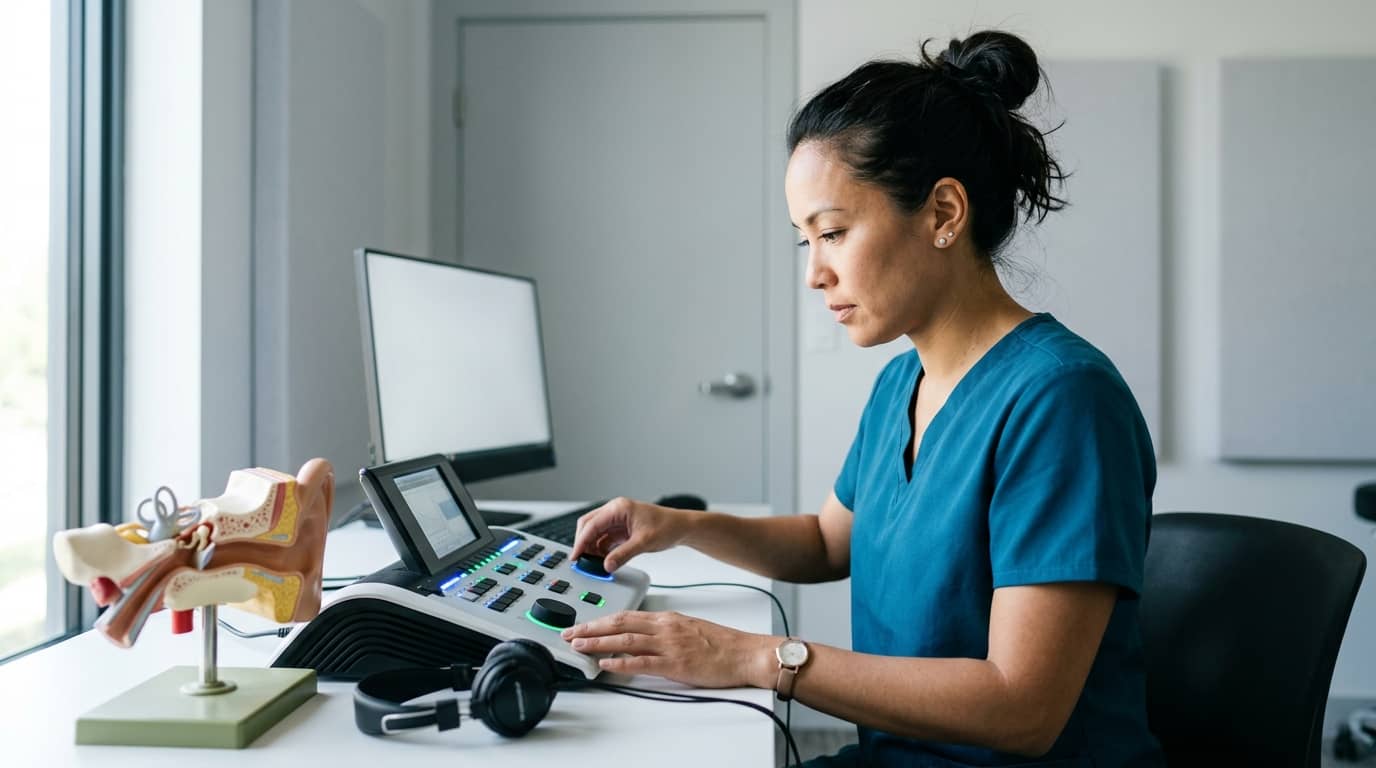
Master the full clinical workflow of hearing aid fitting, from audiometric assessment and device selection to real-ear verification and patient counseling. This course covers evidence-based prescriptive methods, advanced signal processing, and outcome measurement tools used by practicing audiologists. Whether you're entering the field or expanding your clinical skills, you'll gain the technical knowledge and hands-on protocols needed to deliver better patient outcomes.
What you will learn:
This course takes you through every stage of professional hearing aid fitting and audiology practice. You will learn how to perform and interpret audiometric tests, select appropriate hearing aid styles and technology, and apply prescriptive formulas such as NAL-NL2 and DSL v5. You will develop hands-on skills in earmold impression taking, real-ear measurement, and fitting software operation. The curriculum also covers tinnitus management, pediatric audiology, cochlear implant candidacy, and teleaudiology. By the end, you will be equipped to measure outcomes, counsel patients effectively, and manage a compliant audiology practice.
How you study in practice Hearing Aid Fitting and Audiology Course
How you practise Hearing Aid Fitting and Audiology Course
For companies looking to train their team
With Dedika for Business, the course includes exercises and examples tailored to your own business and the way your company needs.

Course Content
8 Chapters • 36 LessonsDuration between 4 and 360 hours (you decide)
Chapter 1HideHide detailsSee detailsFoundations of Audiology and Hearing Science
Foundations of Audiology and Hearing Science
Lesson 1 • Physics of Sound and Hearing
Explains frequency, intensity, wavelength, and decibel scales. Connects acoustic principles to audiometric measurement and hearing aid design.
Lesson 2 • Anatomy of the Auditory System
Covers outer, middle, and inner ear structures and their functional roles. Establishes anatomical vocabulary used throughout all clinical procedures.
Lesson 3 • Classification of Hearing Loss
Defines conductive, sensorineural, and mixed hearing loss types by etiology and audiometric profile. Guides appropriate intervention selection.
Lesson 4 • Physiology of Normal Hearing
Describes transduction from mechanical vibration to neural signals. Provides the physiological baseline for identifying pathological deviations.
Chapter 2HideHide detailsSee detailsAudiometric Assessment and Interpretation
Audiometric Assessment and Interpretation
Lesson 1 • Audiogram Interpretation and Case Analysis
Synthesizes multi-test results into a diagnostic impression and candidacy determination. Prepares students to translate findings into fitting targets.
Lesson 2 • Pure-Tone Audiometry Procedures
Teaches air and bone conduction testing using standardized protocols. Accurate thresholds form the basis for all subsequent fitting calculations.
Lesson 3 • Speech Audiometry
Covers speech recognition threshold and word recognition score testing. Results quantify functional hearing ability beyond pure-tone sensitivity.
Lesson 4 • Immittance and Tympanometry
Explains tympanometry, acoustic reflex testing, and Eustachian tube function assessment. Identifies middle ear pathology affecting fitting candidacy.
Lesson 5 • Otoacoustic Emissions Testing
Introduces transient and distortion-product OAE measurement and interpretation. Differentiates cochlear from retrocochlear pathology before fitting.
Chapter 3HideHide detailsSee detailsHearing Aid Technology and Components
Hearing Aid Technology and Components
Lesson 1 • Hearing Aid Styles and Form Factors
Compares BTE, RIC, ITE, ITC, CIC, and IIC styles by acoustic and ergonomic properties. Matches style to degree of loss and patient lifestyle.
Lesson 2 • Advanced Signal Processing Features
Covers noise reduction, feedback management, directional processing, and frequency lowering. Students evaluate feature appropriateness for individual patient profiles.
Lesson 3 • Wireless Connectivity and Accessories
Reviews Bluetooth, proprietary wireless protocols, and remote microphone accessories. Expands understanding of hearing aid use in complex listening environments.
Lesson 4 • Digital Signal Processing Fundamentals
Explains analog-to-digital conversion, DSP chips, and processing channels. Establishes the technical basis for programming and fine-tuning decisions.
Lesson 5 • Microphones, Receivers, and Amplifiers
Details microphone directional modes, receiver output limits, and amplifier classes. Component knowledge informs troubleshooting and performance optimization.
Chapter 4HideHide detailsSee detailsEarmold and Coupling Systems
Earmold and Coupling Systems
Lesson 1 • Earmold Impression Techniques
Teaches otoscopic inspection, otoblock placement, and impression material injection. Accurate impressions are prerequisite to well-fitting custom earmolds.
Lesson 2 • Earmold Materials and Styles
Compares hard acrylic, soft silicone, and hybrid earmold materials by retention and acoustic properties. Material choice affects comfort and acoustic seal.
Lesson 3 • Open and Slim-Tube Fittings
Covers open-dome and slim-tube coupling for mild-to-moderate high-frequency loss. Balances occlusion reduction with adequate gain delivery.
Lesson 4 • Acoustic Modifications and Venting
Explains vent diameter, horn bores, and dampers as acoustic tuning tools. Modifications shape the frequency response delivered to the ear canal.
Chapter 5HideHide detailsSee detailsPrescriptive Fitting Methods and Targets
Prescriptive Fitting Methods and Targets
Lesson 1 • Fitting Verification for Special Populations
Adapts real-ear procedures for pediatric, elderly, and cognitively impaired patients. Ensures prescriptive targets are met when behavioral feedback is limited.
Lesson 2 • Prescriptive Formula Principles
Compares NAL-NL2, DSL v5, and proprietary prescriptive approaches by underlying rationale. Selecting the correct formula optimizes audibility for each patient.
Lesson 3 • Matching Gain to Prescriptive Targets
Demonstrates adjusting hearing aid gain to match real-ear targets across frequencies. Systematic matching ensures audibility of soft, average, and loud speech.
Lesson 4 • Real-Ear Measurement Setup and Procedures
Teaches probe-tube placement, calibration, and stimulus selection for real-ear measures. Accurate probe placement is critical to valid verification data.
Chapter 6HideHide detailsSee detailsHearing Aid Programming and Fine-Tuning
Hearing Aid Programming and Fine-Tuning
Lesson 1 • Bilateral Fitting and Binaural Coordination
Addresses binaural fitting balance, inter-ear communication, and binaural beamforming setup. Optimizes spatial hearing and listening effort for bilateral users.
Lesson 2 • Feature Configuration and Programs
Configures noise reduction, directional modes, and multiple listening programs. Tailored programs improve performance across diverse listening environments.
Lesson 3 • Gain and Compression Adjustments
Covers channel-by-channel gain edits, compression knee-point changes, and output limiting. Adjustments address audibility and loudness comfort simultaneously.
Lesson 4 • Fitting Software Navigation and Setup
Introduces audiogram entry, device detection, and initial program creation in fitting software. Efficient software use reduces chair time and patient fatigue.
Lesson 5 • Systematic Fine-Tuning Protocols
Applies structured complaint-driven fine-tuning using patient feedback and real-ear data. Reduces trial-and-error adjustments and improves first-fit success rates.
Chapter 7HideHide detailsSee detailsOutcome Measurement and Validation
Outcome Measurement and Validation
Lesson 1 • Soundfield Audiometry and Aided Thresholds
Measures aided thresholds in a soundfield to confirm audibility of speech frequencies. Particularly critical for pediatric fittings where behavioral feedback is limited.
Lesson 2 • Validated Outcome Questionnaires
Introduces HHIE, COSI, APHAB, and IOI-HA as standardized benefit measures. Questionnaire data quantify subjective benefit and guide counseling priorities.
Lesson 3 • Functional Speech Testing in Noise
Uses QuickSIN, HINT, and BKB-SIN to measure aided speech-in-noise performance. Results validate real-world benefit beyond quiet-environment audiometry.
Lesson 4 • Counseling Based on Outcome Data
Translates outcome scores into patient-centered counseling and fitting revision decisions. Closes the loop between measurement data and clinical action.
Chapter 8HideHide detailsSee detailsPatient Counseling and Rehabilitation
Patient Counseling and Rehabilitation
Lesson 1 • Communication Strategies and Repair
Trains patients and partners in active listening, repair strategies, and environmental modifications. Reduces communication breakdowns beyond device performance alone.
Lesson 2 • Long-Term Follow-Up and Maintenance
Establishes a follow-up schedule for device maintenance, reprogramming, and outcome reassessment. Ongoing care sustains benefit as hearing and lifestyle needs evolve.
Lesson 3 • Auditory Training and Acclimatization
Structures a graduated listening schedule and auditory training exercises for new users. Systematic acclimatization improves long-term speech understanding outcomes.
Lesson 4 • Hearing Aid Orientation and Handling
Teaches insertion, removal, battery management, and basic controls to new users. Hands-on orientation builds confidence and reduces early device returns.
Lesson 5 • Initial Counseling and Expectation Setting
Guides patients through diagnosis disclosure, device benefits, and realistic limitations. Accurate expectations reduce early abandonment and dissatisfaction.
Your valid completion certificate
This course is for you:
Hearing instrument specialist: seeking deeper clinical and diagnostic knowledge.
Audiology assistant: ready to advance toward independent fitting responsibilities.
ENT clinic technician: wanting structured training in amplification and patient care.
Recent health sciences graduate: building a specialty in hearing rehabilitation services.
Speech-language pathologist: expanding scope to include hearing device management.
Career changer: transitioning into audiology from another allied health profession.
What our students say
Your classes are perfect. I purchased the one-year package and finally have the opportunity to follow various topics of interest without needing to switch platforms... I thank you for everything you do, I've already recommended you to other people...

I like how the lessons are straight to the point and how I can change chapters and skip content I don't need.

I like the content and the presentation style and video transcription, which speeds up the process!

The platform is fast, simple to use. The diversity of content and complementary videos really help with learning.

Top training programs









FAQ
Who is Dedika?
Is the certificate valid in Canada?
Are the courses free?
What is the course workload?
What are the courses like?
How do the courses work?
What is the duration of the courses?
What is the cost or price of the courses?
What is an EAD or online course and how does it work?
PDF Course