
Hearing Aid Specialist Training Course
Launch a rewarding career as a Hearing Aid Specialist with the comprehensive training you need to assess patients, fit devices, and deliver real results. This course covers everything from audiometry and hearing aid technology to counseling, compliance, and practice management. Whether you're entering the field or formalizing your skills, this program gives you the clinical foundation employers and licensing boards expect.
What you will learn:
This course takes you through every core competency required to work as a Hearing Aid Specialist. You will learn how to perform and interpret audiometric evaluations, select and program hearing aids, take earmold impressions, and verify fittings using real-ear measurement. You will also develop patient counseling skills, master troubleshooting and follow-up protocols, and understand how to manage tinnitus and assistive listening device recommendations. Regulatory compliance, ethical practice, and business fundamentals are covered so you can operate confidently in any clinical or practice setting.
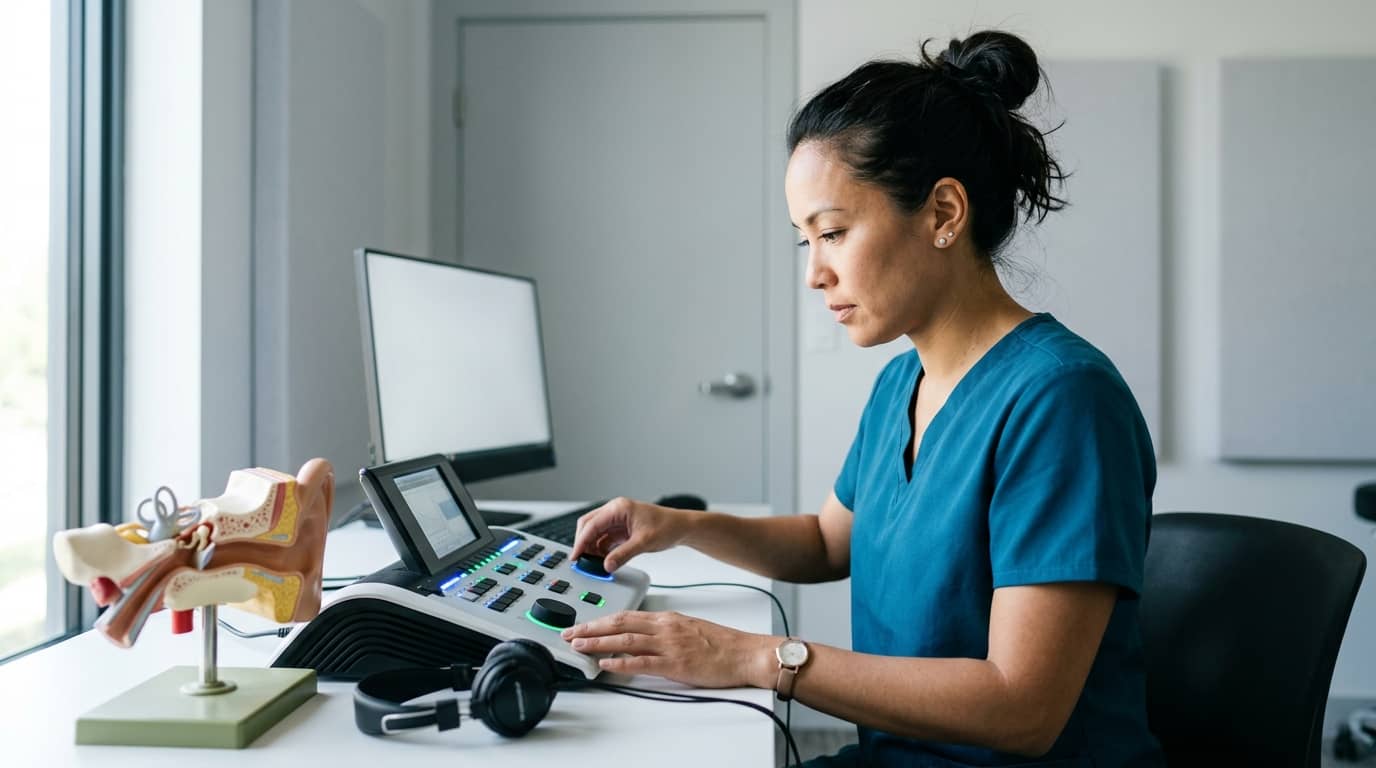
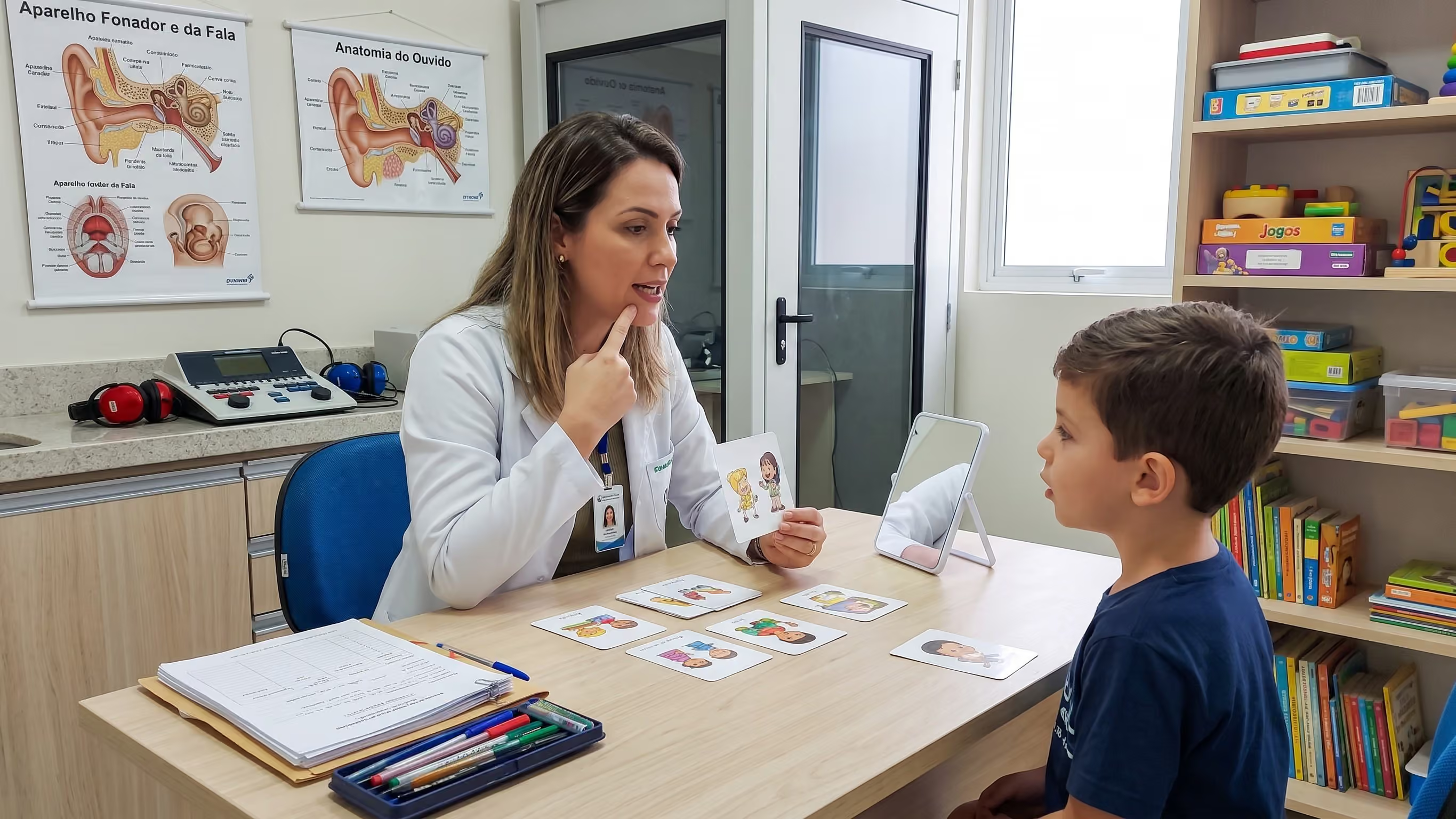
How you study in practice Hearing Aid Specialist Training Course
How you practise Hearing Aid Specialist Training Course
For companies looking to train their team
With Dedika for Business, the course includes exercises and examples tailored to your own business and the way your company needs.

Course Content
8 Chapters • 39 LessonsDuration between 4 and 360 hours (you decide)
Chapter 1HideHide detailsSee detailsFoundations of Hearing and Audiology
Foundations of Hearing and Audiology
Lesson 1 • Physics of Sound and Acoustics
Explains frequency, intensity, wavelength, and decibel measurement. Provides the acoustic framework needed to interpret audiometric data.
Lesson 2 • Introduction to Hearing Loss
Classifies conductive, sensorineural, and mixed hearing loss by site of lesion. Prepares students to recognize loss types during clinical assessment.
Lesson 3 • Anatomy of the Auditory System
Covers outer, middle, and inner ear structures and their roles in sound transmission. Establishes anatomical vocabulary used throughout the course.
Lesson 4 • Physiology of Normal Hearing
Describes how mechanical vibration converts to neural signals in the cochlea. Links physiology to clinical expectations for normal hearing thresholds.
Chapter 2HideHide detailsSee detailsHearing Assessment and Audiometry
Hearing Assessment and Audiometry
Lesson 1 • Speech Audiometry
Covers speech recognition threshold and word recognition score testing. Results validate pure-tone findings and guide hearing aid candidacy decisions.
Lesson 2 • Audiogram Interpretation and Reporting
Trains systematic audiogram analysis and professional report writing. Accurate interpretation drives appropriate referral and amplification recommendations.
Lesson 3 • Pure-Tone Audiometry Procedures
Teaches air and bone conduction testing using standard threshold-seeking methods. Accurate threshold determination is the core skill of audiometric evaluation.
Lesson 4 • Audiometric Equipment and Calibration
Introduces audiometers, sound booths, and calibration standards. Proper equipment setup ensures valid and reliable test results.
Lesson 5 • Immittance and Tympanometry
Explains tympanometry and acoustic reflex testing for middle ear assessment. Findings differentiate conductive pathology from sensorineural loss.
Chapter 3HideHide detailsSee detailsHearing Aid Technology and Components
Hearing Aid Technology and Components
Lesson 1 • Digital Signal Processing Features
Covers noise reduction, feedback management, compression, and frequency lowering. These features directly affect patient satisfaction and speech intelligibility.
Lesson 2 • Hearing Aid Styles and Form Factors
Surveys behind-the-ear, receiver-in-canal, in-the-ear, and completely-in-canal styles. Style selection balances degree of loss, dexterity, and cosmetic preference.
Lesson 3 • Core Components and Signal Path
Explains microphone, amplifier, receiver, and battery roles in the signal chain. Understanding component function supports troubleshooting and patient education.
Lesson 4 • Hearing Aid Selection Criteria
Applies audiometric, lifestyle, and physical factors to device selection decisions. Systematic selection improves fitting outcomes and reduces return rates.
Lesson 5 • Wireless Connectivity and Accessories
Introduces Bluetooth streaming, remote microphones, and telecoil technology. Connectivity options expand hearing aid utility in challenging listening environments.
Chapter 4HideHide detailsSee detailsEarmold and Coupling Systems
Earmold and Coupling Systems
Lesson 1 • Dome and Open Fitting Systems
Covers dome styles, receiver-in-canal coupling, and open fitting acoustics. Open fittings suit mild-to-moderate high-frequency losses and reduce occlusion.
Lesson 2 • Impression Materials and Techniques
Covers silicone and foam impression materials, mixing ratios, and injection methods. Correct technique produces accurate impressions that minimize remake rates.
Lesson 3 • Earmold Materials and Styles
Compares hard acrylic, soft vinyl, and silicone earmold materials by acoustic and comfort properties. Material choice affects retention, feedback, and patient comfort.
Lesson 4 • Ear Canal Anatomy for Impressions
Reviews ear canal shape, landmarks, and contraindications for impression taking. Anatomical awareness prevents injury and ensures accurate impression depth.
Lesson 5 • Acoustic Modifications and Venting
Explains vent diameter, horn bores, and dampers as tools for shaping frequency response. Acoustic modifications fine-tune amplification without reprogramming.
Chapter 5HideHide detailsSee detailsHearing Aid Fitting and Verification
Hearing Aid Fitting and Verification
Lesson 1 • Functional Gain and Soundfield Verification
Uses soundfield audiometry to measure aided thresholds and functional gain. Soundfield verification supplements real-ear data, especially for pediatric patients.
Lesson 2 • Hearing Aid Programming Software
Covers manufacturer fitting software navigation, parameter adjustment, and data logging. Software proficiency enables precise customization of amplification for each patient.
Lesson 3 • Prescriptive Fitting Methods
Introduces NAL and DSL prescriptive targets and their clinical rationale. Prescriptive methods provide an objective starting point for hearing aid programming.
Lesson 4 • Output Limiting and Loudness Comfort
Establishes maximum output limits using loudness discomfort levels and coupler measures. Protecting residual hearing and ensuring comfort are essential fitting goals.
Lesson 5 • Real-Ear Measurement Procedures
Teaches probe microphone placement, REUR, REAR, and REIG measurement protocols. Real-ear measurement confirms that prescribed gain is delivered at the eardrum.
Chapter 6HideHide detailsSee detailsHearing Aid Orientation and Counseling
Hearing Aid Orientation and Counseling
Lesson 1 • Patient Needs Assessment and Goal Setting
Uses validated questionnaires to identify listening priorities and self-perceived handicap. Goal setting aligns fitting decisions with patient-centered outcomes.
Lesson 2 • Acclimatization and Wearing Schedules
Explains gradual acclimatization strategies and progressive wearing schedules. Structured acclimatization improves acceptance and reduces early device rejection.
Lesson 3 • Hearing Aid Maintenance and Care
Covers daily cleaning, moisture protection, and battery management routines. Consistent maintenance extends device lifespan and prevents performance degradation.
Lesson 4 • Device Handling and Insertion Skills
Trains patients in insertion, removal, and orientation of hearing aids and earmolds. Hands-on practice during orientation reduces early return visits.
Lesson 5 • Communication Strategies and Aural Rehabilitation
Teaches active listening strategies, speechreading cues, and environmental modifications. Rehabilitation extends benefit beyond amplification alone.
Chapter 7HideHide detailsSee detailsFollow-Up, Outcome Measurement, and Troubleshooting
Follow-Up, Outcome Measurement, and Troubleshooting
Lesson 1 • Repair, Warranty, and Loss Procedures
Covers in-office repair, manufacturer return processes, warranty claims, and loss replacement. Efficient repair management maintains patient trust and practice revenue.
Lesson 2 • Reprogramming Based on Patient Feedback
Translates patient complaints into targeted software adjustments using a structured protocol. Responsive reprogramming improves satisfaction and reduces device abandonment.
Lesson 3 • Common Hearing Aid Problems and Solutions
Identifies causes and solutions for feedback, weak output, distortion, and dead devices. Systematic troubleshooting reduces unnecessary manufacturer repairs.
Lesson 4 • Outcome Measurement Tools
Applies validated questionnaires to quantify benefit, satisfaction, and residual handicap. Outcome data justify fitting decisions and guide further adjustments.
Lesson 5 • Structured Follow-Up Appointment Protocol
Defines the schedule, agenda, and documentation for post-fitting follow-up visits. Consistent follow-up identifies problems early and reinforces patient adherence.
Chapter 8HideHide detailsSee detailsRegulatory Compliance and Professional Practice
Regulatory Compliance and Professional Practice
Lesson 1 • Licensure and Scope of Practice
Defines hearing aid specialist licensure requirements, renewal, and scope boundaries. Understanding scope prevents unauthorized practice and protects patient safety.
Lesson 2 • Patient Privacy and Health Information
Covers patient health information privacy obligations, consent, and secure record keeping. Compliance protects patients and shields the practice from regulatory penalties.
Lesson 3 • Medical Referral and Red Flag Conditions
Identifies audiometric and case history findings that require physician referral before fitting. Timely referral protects patients and fulfills regulatory obligations.
Lesson 4 • Business Compliance and Documentation
Addresses trial period requirements, contract disclosures, and clinical record standards. Proper documentation protects the practice during audits and disputes.
Lesson 5 • Ethical Standards and Professional Conduct
Applies professional codes of ethics to common clinical dilemmas in hearing aid practice. Ethical decision-making builds patient trust and professional reputation.
Your valid completion certificate
This course is for you:
Career changers: seeking a stable, patient-facing healthcare specialty to enter.
Medical assistants: ready to specialize in a focused audiology-adjacent clinical role.
Pharmacy technicians: looking to transition into a higher-impact patient care field.
Recent high school graduates: pursuing a vocational healthcare career without a four-year degree.
Hearing instrument trainees: needing structured knowledge to pass their state licensing exam.
Military veterans: applying service-connected audiology exposure to a civilian clinical career.
What our students say
Your classes are perfect. I purchased the one-year package and finally have the opportunity to follow various topics of interest without needing to switch platforms... I thank you for everything you do, I've already recommended you to other people...

I like how the lessons are straight to the point and how I can change chapters and skip content I don't need.

I like the content and the presentation style and video transcription, which speeds up the process!

The platform is fast, simple to use. The diversity of content and complementary videos really help with learning.

Top training programs









FAQ
Who is Dedika?
Is the certificate valid in Canada?
Are the courses free?
What is the course workload?
What are the courses like?
How do the courses work?
What is the duration of the courses?
What is the cost or price of the courses?
What is an EAD or online course and how does it work?
PDF Course