
Hearing Aid Technology & Fitting Course
Master the complete clinical workflow of hearing aid technology and fitting, from audiometric assessment to real-ear verification and long-term patient care. This course covers device components, prescriptive methods, programming software, and outcome validation using evidence-based standards. Build the hands-on skills and technical knowledge needed to fit hearing aids with confidence and precision.
What you will learn:
Gain a solid understanding of ear anatomy, hearing loss classification, and sound physics as they relate to device selection and fitting. Learn to conduct and interpret audiometric tests, take earmold impressions, and apply prescriptive methods such as NAL‑NL2 and DSL v5. The course covers digital signal processing, compression, wireless connectivity, and hearing‑aid programming via fitting software. Practice real‑ear measurement to verify devices meet clinical targets across the speech spectrum. Pediatric fitting protocols, tinnitus sound therapy, cochlear‑implant candidacy, and assistive listening devices are also covered. Finish with counseling, documentation, and practice‑management skills for professional clinical practice.
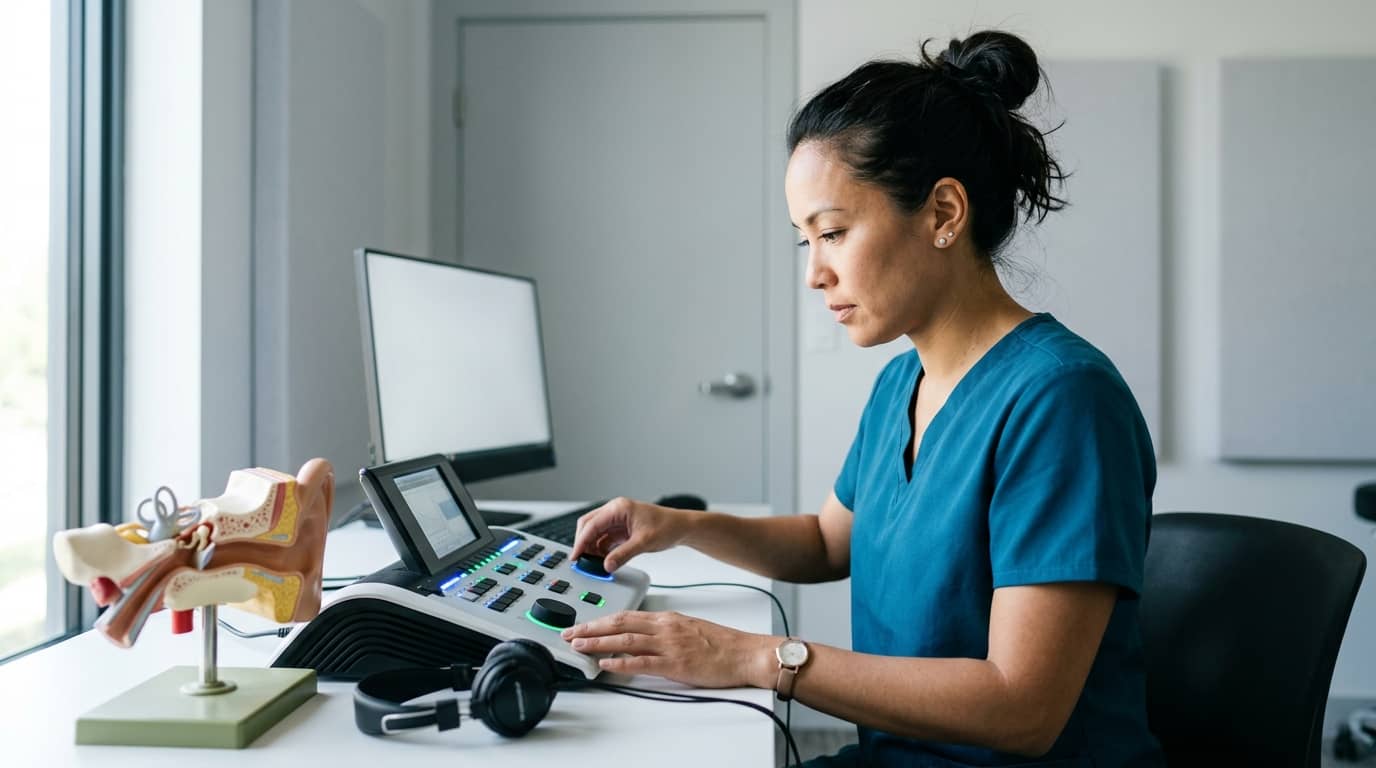
How you study in practice Hearing Aid Technology & Fitting Course
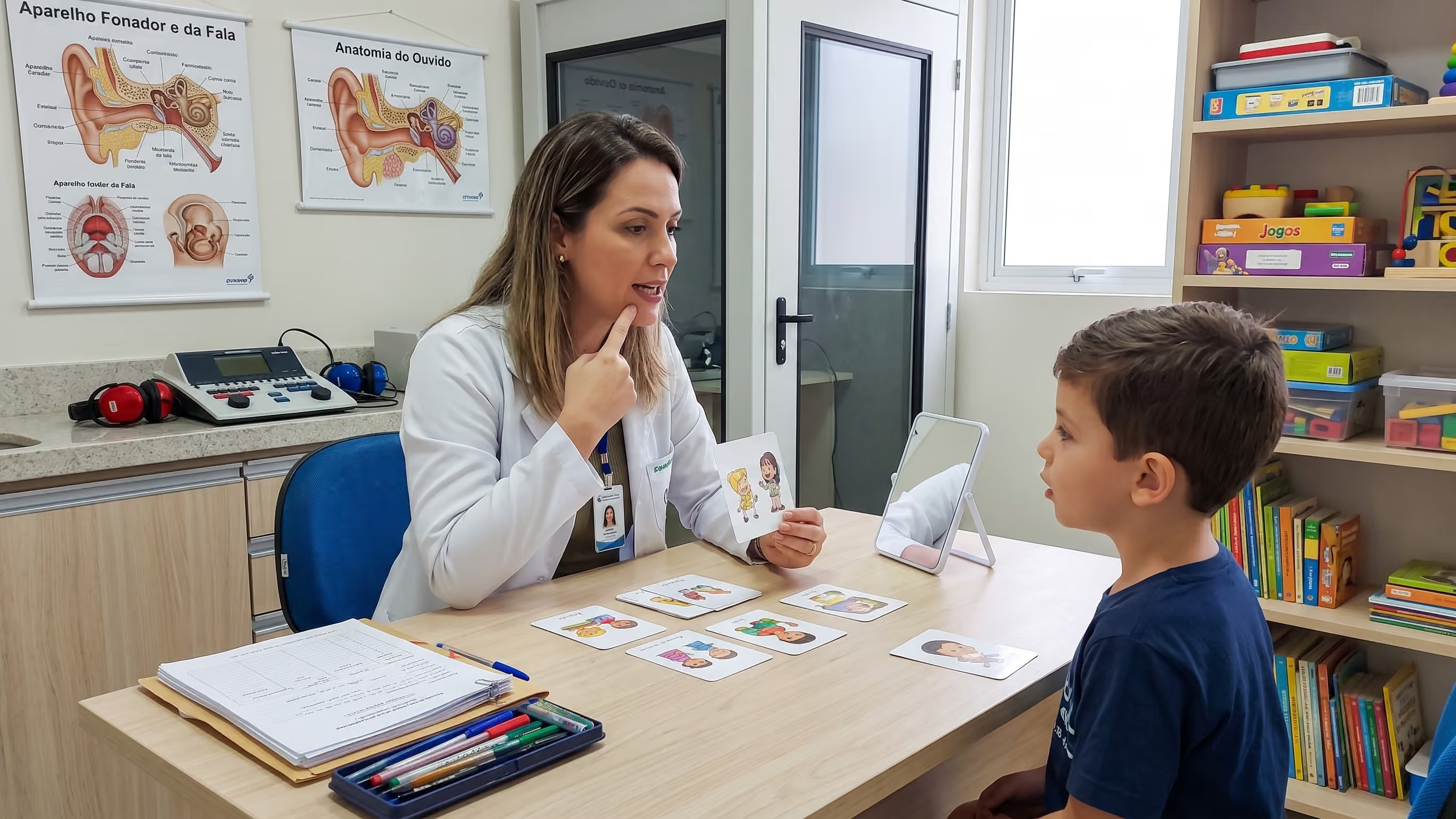
How you practise Hearing Aid Technology & Fitting Course
For companies looking to train their team
With Dedika for Business, the course includes exercises and examples tailored to your own business and the way your company needs.

Course Content
8 Chapters • 39 LessonsDuration between 4 and 360 hours (you decide)
Chapter 1HideHide detailsSee detailsFoundations of Hearing and Audiology
Foundations of Hearing and Audiology
Lesson 1 • Anatomy of the Auditory System
Covers outer, middle, and inner ear structures and their roles in sound transmission. Establishes anatomical vocabulary used throughout the course.
Lesson 2 • Classification of Hearing Loss
Defines conductive, sensorineural, and mixed loss types by etiology and audiometric pattern. Guides appropriate device and referral decisions.
Lesson 3 • Physics of Sound and Acoustics
Explains frequency, intensity, wavelength, and decibel scales as they apply to hearing. Provides the acoustic vocabulary needed for device selection.
Lesson 4 • Psychoacoustics and Loudness Perception
Examines how the brain interprets loudness, pitch, and temporal cues. Connects perceptual phenomena to hearing aid gain and compression design.
Chapter 2HideHide detailsSee detailsAudiometric Assessment and Interpretation
Audiometric Assessment and Interpretation
Lesson 1 • Speech Audiometry Measures
Explains speech recognition threshold and word recognition score testing and their clinical significance. These scores predict aided benefit and validate fitting outcomes.
Lesson 2 • Immittance and Otoscopic Evaluation
Introduces tympanometry, acoustic reflexes, and otoscopy as pre-fitting screening tools. Identifies contraindications and referral needs before device fitting.
Lesson 3 • Pediatric and Special Population Testing
Adapts audiometric protocols for infants, children, and difficult-to-test adults. Ensures accurate threshold data across all patient populations.
Lesson 4 • Reading and Plotting the Audiogram
Covers audiogram symbols, axis conventions, and pattern recognition for common loss configurations. Accurate plotting prevents fitting errors.
Lesson 5 • Pure-Tone Audiometry Procedures
Teaches air and bone conduction testing protocols, masking rules, and threshold determination. Results form the audiogram used in all fitting calculations.
Chapter 3HideHide detailsSee detailsHearing Aid Technology and Components
Hearing Aid Technology and Components
Lesson 1 • Wireless Connectivity and Accessories
Reviews Bluetooth, telecoil, and proprietary wireless protocols used in modern devices. Connectivity features expand patient communication options and fitting flexibility.
Lesson 2 • Digital Signal Processing Fundamentals
Covers analog-to-digital conversion, channel-based processing, and feedback cancellation algorithms. DSP architecture determines programmable fitting flexibility.
Lesson 3 • Hearing Aid Styles and Form Factors
Compares behind-the-ear, receiver-in-canal, in-the-ear, and completely-in-canal styles by indication and cosmetics. Matches style to patient anatomy and loss degree.
Lesson 4 • Core Electronic Components
Explains microphones, amplifiers, receivers, and batteries as the signal chain. Component knowledge supports troubleshooting and patient education.
Lesson 5 • Compression and Gain Processing
Explains wide dynamic range compression, attack and release times, and compression ratios. These parameters directly shape audibility and comfort across listening levels.
Chapter 4HideHide detailsSee detailsEarmold and Coupling Systems
Earmold and Coupling Systems
Lesson 1 • Dome and Thin-Tube Coupling Systems
Covers open, closed, and power dome selection for receiver-in-canal fittings. Dome choice balances occlusion, feedback risk, and low-frequency gain.
Lesson 2 • Earmold Materials and Styles
Compares hard acrylic, soft silicone, and hybrid earmold materials by retention, comfort, and acoustic properties. Material choice affects long-term patient compliance.
Lesson 3 • Ear Canal Anatomy for Impressions
Reviews ear canal shape, landmarks, and contraindications relevant to impression taking. Anatomical awareness prevents injury and ensures accurate mold fit.
Lesson 4 • Acoustic Modifications and Venting
Explains vent diameter, horn bores, and dampers as tools to shape frequency response at the ear. Acoustic modifications fine-tune real-ear output without reprogramming.
Lesson 5 • Ear Impression Techniques
Teaches otoblock placement, silicone material mixing, and injection technique for accurate impressions. Impression quality directly determines earmold fit and acoustic seal.
Chapter 5HideHide detailsSee detailsPrescriptive Fitting Methods and Targets
Prescriptive Fitting Methods and Targets
Lesson 1 • DSL v5 Prescriptive Method
Covers DSL v5 targets optimized for children and adults, including loudness comfort and upper limit of comfortable loudness. Preferred for pediatric fittings requiring audibility across the speech spectrum.
Lesson 2 • NAL-NL2 Prescriptive Method
Explains NAL-NL2 input variables, gain calculations, and output targets for adults and children. Widely adopted in clinical practice as a validated prescriptive standard.
Lesson 3 • Prescriptive Method Principles
Introduces the rationale behind prescriptive fitting, including audibility, comfort, and loudness normalization goals. Establishes why targets are preferred over subjective adjustment alone.
Lesson 4 • Manufacturer First-Fit Algorithms
Evaluates proprietary first-fit algorithms relative to validated prescriptive targets. Clinicians learn when manufacturer defaults are acceptable and when manual adjustment is required.
Lesson 5 • Special Fitting Considerations
Addresses target modifications for severe-to-profound loss, single-sided deafness, and experienced users. Adapts standard prescriptions to complex audiometric and patient profiles.
Chapter 6HideHide detailsSee detailsReal-Ear Measurement and Verification
Real-Ear Measurement and Verification
Lesson 1 • Real-Ear Measurement Equipment Setup
Covers probe tube placement, reference microphone positioning, and loudspeaker calibration for accurate measurements. Proper setup prevents systematic measurement errors.
Lesson 2 • Matching Prescriptive Targets
Teaches how to overlay real-ear aided response curves onto NAL-NL2 or DSL targets and adjust programming to close gaps. Target matching confirms audibility across the speech spectrum.
Lesson 3 • Output Limiting and OSPL90 Verification
Measures maximum output and verifies it does not exceed the patient's uncomfortable loudness level. Protects residual hearing and ensures comfort at high input levels.
Lesson 4 • Coupler Measurements and ANSI Standards
Introduces 2-cc coupler testing and standardized electroacoustic analysis for quality control and troubleshooting. Coupler data validates device performance against manufacturer specifications.
Lesson 5 • REUG, REAG, and REIG Measures
Explains unaided gain measures including real-ear unaided gain and real-ear insertion gain as baseline references. These measures contextualize aided gain relative to the unaided ear.
Chapter 7HideHide detailsSee detailsHearing Aid Programming and Fine-Tuning
Hearing Aid Programming and Fine-Tuning
Lesson 1 • Compression Parameter Adjustment
Modifies compression thresholds, ratios, and time constants to match patient loudness preferences. Compression tuning resolves complaints about sounds being too loud or too soft.
Lesson 2 • Systematic Response to Patient Complaints
Provides a structured troubleshooting framework linking specific complaints to fitting parameter adjustments. Systematic problem-solving reduces unnecessary return visits.
Lesson 3 • Noise Reduction and Feature Programming
Adjusts noise reduction strength, wind noise management, and impulse noise suppression settings. Feature calibration balances speech clarity with listening comfort.
Lesson 4 • Fitting Software Navigation
Introduces the layout and workflow of typical hearing aid fitting software platforms. Efficient software navigation reduces fitting time and minimizes programming errors.
Lesson 5 • Programming Directional Microphone Systems
Configures fixed, adaptive, and beamforming directional modes for different listening environments. Directional programming significantly improves speech-in-noise performance.
Chapter 8HideHide detailsSee detailsOutcome Validation and Follow-Up Care
Outcome Validation and Follow-Up Care
Lesson 1 • Long-Term Follow-Up and Maintenance
Establishes recall schedules, device cleaning protocols, and performance re-verification procedures. Ongoing care maintains fitting accuracy as hearing and device performance change over time.
Lesson 2 • Hearing Aid Orientation and User Training
Teaches patients device handling, insertion, battery management, and cleaning routines. Effective orientation reduces early returns and improves daily use compliance.
Lesson 3 • Functional Listening Validation
Uses aided speech-in-noise tests and sound-field audiometry to objectively confirm real-world benefit. Functional measures complement subjective reports with measurable performance data.
Lesson 4 • Acclimatization and Counseling Plans
Designs structured acclimatization schedules and counseling strategies for new users adjusting to amplification. Gradual exposure improves long-term adoption and satisfaction.
Lesson 5 • Subjective Outcome Questionnaires
Administers and scores validated tools such as the APHAB, COSI, and IOI-HA to quantify patient-reported benefit. Questionnaire data benchmarks outcomes and identifies unmet needs.
Your valid completion certificate
This course is for you:
Hearing instrument specialist: seeking deeper clinical grounding and technical expertise.
Audiology assistant: ready to expand scope and support licensed audiologists more effectively.
ENT clinic technician: wanting structured training in device fitting and patient counseling.
Career changer from healthcare: entering hearing care with transferable patient interaction skills.
Recent audiology graduate: bridging the gap between academic training and real clinical practice.
International audiologist: updating skills to align with current evidence-based fitting standards.
What our students say
Your classes are perfect. I purchased the one-year package and finally have the opportunity to follow various topics of interest without needing to switch platforms... I thank you for everything you do, I've already recommended you to other people...

I like how the lessons are straight to the point and how I can change chapters and skip content I don't need.

I like the content and the presentation style and video transcription, which speeds up the process!

The platform is fast, simple to use. The diversity of content and complementary videos really help with learning.

Top training programs









FAQ
Who is Dedika?
Is the certificate valid in Canada?
Are the courses free?
What is the course workload?
What are the courses like?
How do the courses work?
What is the duration of the courses?
What is the cost or price of the courses?
What is an EAD or online course and how does it work?
PDF Course