
Equipment Inspector Course
The Equipment Inspector Course gives you the technical knowledge and hands-on skills to inspect industrial machinery, pressure systems, and lifting equipment to professional standards. You will master hazard recognition, NDT methods, defect evaluation, and inspection documentation from the ground up. Whether you are entering the field or formalising years of experience, this course builds the competence employers and regulators expect.
What you will learn:
This course covers every stage of the equipment inspection process, from pre-inspection planning and hazard identification to defect evaluation and final reporting. You will learn how to read technical documentation, apply visual and non-destructive testing methods, and assess equipment condition using industry-standard criteria. The curriculum includes risk-based inspection planning, corrosion assessment, pressure equipment requirements, and quality assurance practices. You will also develop the communication skills needed to deliver findings clearly to operators, engineers, and management. By the end, you will be equipped to perform thorough, defensible inspections across a wide range of industrial equipment types.
How you study in a practical way Equipment Inspector Course
How you practise Equipment Inspector Course
For companies looking to train their teams
With Dedika for businesses, the course includes exercises and examples tailored to your own business and the way your company needs.

Course content
8 Chapters • 39 LessonsDuration between 4 and 360 hours (you decide)
Chapter 1HideHide detailsSee detailsFoundations of Equipment Inspection
Foundations of Equipment Inspection
Lesson 1 • Inspection Planning Fundamentals
This section introduces the concept of structured inspection planning before any physical activity begins. It prepares students to approach inspections systematically rather than reactively.
Lesson 2 • Inspector Ethics and Professional Conduct
This section covers impartiality, conflict of interest, and ethical decision-making unique to inspection work. It establishes the behavioural baseline expected throughout the course.
Lesson 3 • Regulatory and Standards Framework
This section introduces the regulatory landscape governing equipment inspection, including industry standards bodies and compliance obligations. It connects regulatory awareness to daily inspection decisions.
Lesson 4 • The Inspector's Role and Purpose
This section defines what equipment inspection is and why it exists within industrial and commercial operations. It grounds all subsequent learning in professional purpose and accountability.
Chapter 2HideHide detailsSee detailsEquipment Types and Technical Literacy
Equipment Types and Technical Literacy
Lesson 1 • Mechanical Equipment Fundamentals
This section covers rotating machinery, drive systems, and structural mechanical components common across industries. It provides the component-level vocabulary needed for accurate defect identification.
Lesson 2 • Pressure and Fluid Systems
This section examines vessels, piping, valves, and fluid-handling equipment subject to pressure-related hazards. It connects system design principles to inspection risk priorities.
Lesson 3 • Lifting and Material Handling Equipment
This section covers cranes, hoists, forklifts, and rigging hardware as a distinct high-risk equipment category. It highlights the unique inspection criteria and load-rating concepts for lifting gear.
Lesson 4 • Electrical and Control Systems Overview
This section introduces electrical panels, motors, sensors, and control logic relevant to equipment inspection. It establishes safe boundaries for inspectors working near energised systems.
Lesson 5 • Reading Technical Documentation
This section teaches interpretation of engineering drawings, P&IDs, equipment manuals, and data plates. It enables inspectors to verify equipment against its design intent and specifications.
Chapter 3HideHide detailsSee detailsHazard Recognition and Risk Assessment
Hazard Recognition and Risk Assessment
Lesson 1 • Risk Assessment Principles
This section covers likelihood-consequence matrices, risk ranking, and tolerance thresholds used in inspection contexts. It connects risk scores to actionable inspection decisions and reporting priorities.
Lesson 2 • Pre-Inspection Safety Briefing
This section covers how to conduct and document a safety briefing before entering an inspection area. It reinforces the habit of communicating hazards to all parties before work begins.
Lesson 3 • Hazard Identification Methods
This section introduces systematic approaches to spotting physical, chemical, electrical, and ergonomic hazards. It builds the observational discipline that underpins safe and thorough inspections.
Lesson 4 • Inspector Personal Safety Controls
This section establishes the personal protective equipment, lockout/tagout, and safe work practices required during inspections. It ensures inspectors can protect themselves while assessing hazardous equipment.
Lesson 5 • Failure Mode Analysis for Inspectors
This section introduces failure mode and effects analysis adapted for field inspection use. It enables inspectors to anticipate where and how equipment is most likely to fail.
Chapter 4HideHide detailsSee detailsVisual and Physical Inspection Techniques
Visual and Physical Inspection Techniques
Lesson 1 • Surface Defect Identification
This section trains recognition of cracks, corrosion, wear, deformation, and contamination on equipment surfaces. It provides the defect vocabulary needed for accurate condition reporting.
Lesson 2 • Systematic Visual Examination
This section establishes a structured visual inspection methodology covering surface condition, geometry, and alignment. It prevents missed defects by imposing a repeatable observation sequence.
Lesson 3 • Fastener and Joint Inspection
This section covers inspection of bolted joints, welds, and mechanical connections for integrity and proper assembly. It addresses the high failure risk associated with improperly maintained connections.
Lesson 4 • Operational Observation Techniques
This section teaches how to safely observe equipment during operation to detect vibration, noise, heat, and leaks. It extends inspection capability beyond static examination to dynamic performance assessment.
Lesson 5 • Dimensional and Tolerance Verification
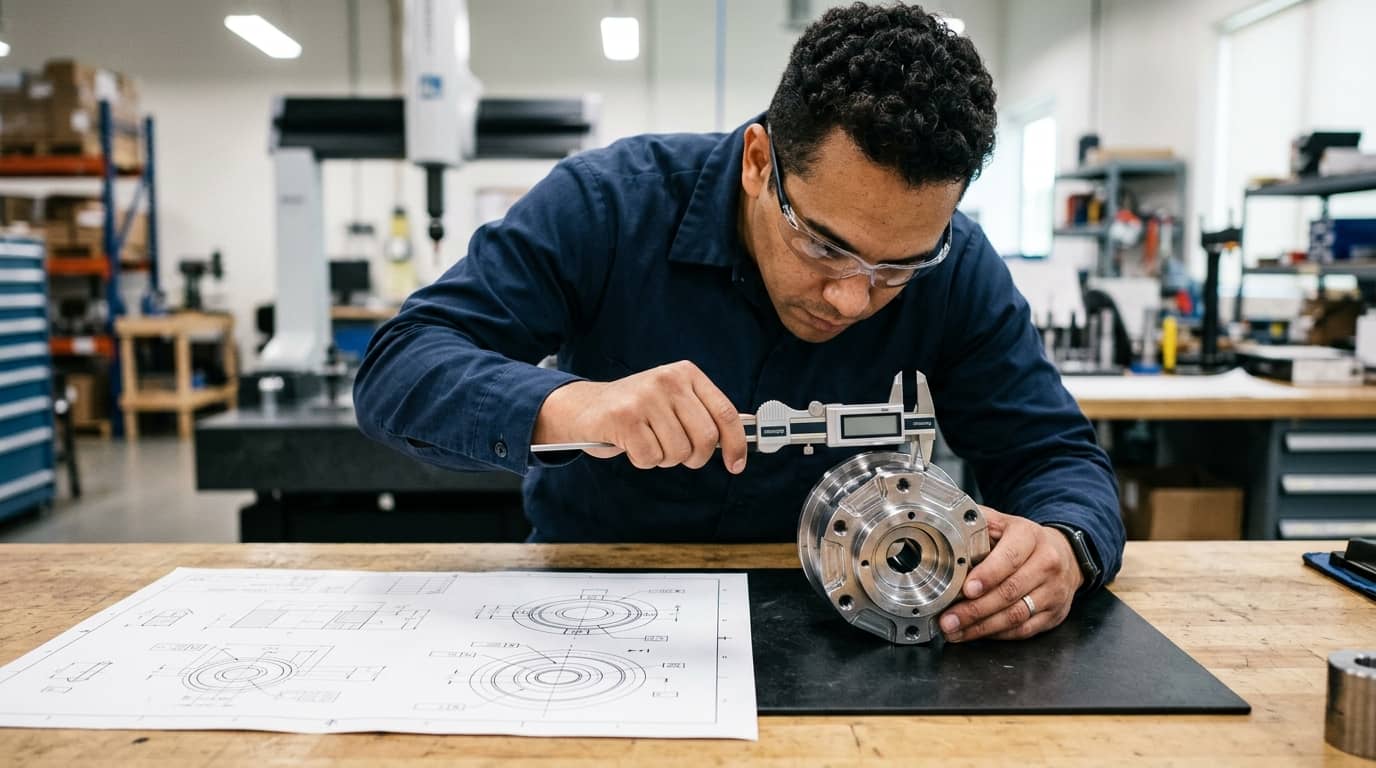
This section covers the use of calipers, micrometers, gauges, and straightedges to verify critical dimensions. It connects measured values to manufacturer tolerances and acceptance criteria.
Chapter 5HideHide detailsSee detailsNon-Destructive Testing Methods
Non-Destructive Testing Methods
Lesson 1 • Radiographic Testing Overview
This section covers X-ray and gamma-ray radiography principles, safety requirements, and image interpretation basics. It establishes the inspector's role in radiographic operations without requiring operator certification.
Lesson 2 • Ultrasonic Testing Principles
This section introduces pulse-echo and through-transmission ultrasonic methods for thickness and flaw detection. It connects wave physics to practical scanner operation and reading interpretation.
Lesson 3 • Liquid Penetrant and Magnetic Particle Testing
This section covers the procedures, materials, and interpretation criteria for PT and MT surface-defect methods. It builds competence in the two most widely used contact NDT techniques.
Lesson 4 • Visual and Remote Visual Inspection Tools
This section covers borescopes, videoscopes, drones, and camera systems used to access confined or inaccessible areas. It extends visual inspection capability to locations unreachable by direct observation.
Lesson 5 • NDT Fundamentals and Method Selection
This section establishes the principles behind NDT and the criteria for choosing among available methods. It prevents misapplication by linking method capabilities to specific defect types and materials.
Chapter 6HideHide detailsSee detailsCondition Assessment and Defect Evaluation
Condition Assessment and Defect Evaluation
Lesson 1 • Defect Classification Systems
This section introduces standardised defect classification scales and condition rating frameworks used across industries. It provides a common language for communicating equipment condition to stakeholders.
Lesson 2 • Fitness-for-Service Assessment
This section covers the principles of fitness-for-service evaluation for equipment with known defects or degradation. It enables inspectors to support engineering decisions on continued equipment operation.
Lesson 3 • Condition Trending and Predictive Indicators
This section introduces trend analysis using sequential inspection data to predict future equipment condition. It shifts inspector thinking from snapshot assessment to longitudinal equipment health monitoring.
Lesson 4 • Corrosion Assessment and Measurement
This section focuses on quantifying corrosion extent, depth, and rate using measurement data and inspection history. It connects corrosion data to remaining wall thickness and structural adequacy.
Lesson 5 • Structural Integrity Evaluation
This section covers load-bearing capacity assessment, deformation limits, and structural defect significance. It equips inspectors to flag structural concerns requiring engineering review.
Chapter 7HideHide detailsSee detailsInspection Documentation and Reporting
Inspection Documentation and Reporting
Lesson 1 • Records Management and Traceability
This section covers filing systems, retention schedules, version control, and audit trail requirements for inspection records. It ensures long-term accessibility and integrity of inspection data.
Lesson 2 • Photographic and Visual Evidence
This section teaches how to capture, label, and integrate photographic evidence into inspection records. It ensures visual documentation meets evidentiary and technical communication standards.
Lesson 3 • Inspection Record Fundamentals
This section covers the required elements of an inspection record, including identification data, findings, and sign-off. It establishes documentation habits that support traceability and audit readiness.
Lesson 4 • Inspection Report Writing
This section covers report structure, technical writing style, and the communication of findings and recommendations. It produces reports that are actionable for maintenance planners and management.
Lesson 5 • Non-Conformance and Deficiency Reporting
This section introduces formal non-conformance reporting processes and deficiency tracking systems. It connects inspection findings to corrective action workflows and closure verification.
Chapter 8HideHide detailsSee detailsAdvanced Inspection Planning and Management
Advanced Inspection Planning and Management
Lesson 1 • Risk-Based Inspection Planning
This section covers risk-based inspection methodology to prioritise equipment and allocate inspection resources efficiently. It integrates risk assessment outputs from earlier chapters into a structured inspection programme.
Lesson 2 • Inspection Data Analysis and KPIs
This section introduces key performance indicators and data analysis techniques for evaluating inspection programme effectiveness. It enables data-driven decisions on programme adjustments and resource allocation.
Lesson 3 • Inspection Programme Development
This section teaches how to build a comprehensive inspection programme covering scope, schedules, methods, and responsibilities. It produces a programme document suitable for organisational adoption and regulatory review.
Lesson 4 • Continuous Improvement in Inspection Programmes
This section covers root cause analysis of inspection failures, lessons-learned processes, and programme revision cycles. It embeds a culture of continuous improvement into inspection programme management.
Lesson 5 • Contractor and Third-Party Inspection Management
This section covers qualification, oversight, and performance management of contracted inspection service providers. It ensures consistent quality when inspection work is delegated to external parties.
Your valid completion certificate
This course is for you:
Maintenance technician: ready to move into a dedicated inspection role professionally.
Reliability engineer: seeking structured inspection methodology to complement existing technical expertise.
HSE officer: expanding scope to include formal equipment condition assessment responsibilities.
Plant operator: wanting to understand inspection standards that govern daily equipment decisions.
Career changer: entering the industrial sector with transferable technical or trade experience.
Independent contractor: building verifiable inspection credentials to win third-party assessment work.
What our students say
Your classes are perfect. I purchased the one-year package and finally have the opportunity to follow various topics of my interest without needing to change platforms... I thank you for everything you do, I've already recommended you to other people...

I like how the lessons are straight to the point and how I can change chapters and skip content that I don't need.

I like the content and the way of presentation and video transcription, which speeds up the process!

The platform is fast, simple to use. The diversity of content and complementary videos help a lot in learning.

Top qualifications



FAQs
Who is Dedika?
Is the certificate valid in India?
Are the courses free?
What is the course workload?
What are the courses like?
How do the courses work?
What is the duration of the courses?
What is the cost or price of the courses?
What is an EAD or online course and how does it work?
PDF Course