
Industrial Machinery Maintenance Course
Master the skills that keep industrial machinery running safely and efficiently. This course covers everything from workplace safety and mechanical systems to electrical controls and predictive maintenance technologies. You will gain hands-on knowledge that employers in manufacturing, processing, and heavy industry demand from qualified maintenance technicians.
What you will learn:
You will learn how to safely isolate energy sources, inspect and service mechanical components, and maintain hydraulic and pneumatic systems. The course covers preventive and predictive maintenance strategies, including vibration analysis, thermographic inspection, and oil sampling. You will also work with electrical motors, variable frequency drives, PLCs, and control panels. Maintenance planning, root cause analysis, and CMMS software are included to round out your skill set. By the end, you will have the technical knowledge to reduce downtime, extend equipment life, and perform maintenance work to professional standards.
How you study in a practical way Industrial Machinery Maintenance Course
How you practise Industrial Machinery Maintenance Course
For companies looking to train their teams
With Dedika for businesses, the course includes exercises and examples tailored to your own business and the way your company needs.

Course content
8 Chapters • 40 LessonsDuration between 4 and 360 hours (you decide)
Chapter 1HideHide detailsSee detailsWorkplace Safety and Regulatory Compliance
Workplace Safety and Regulatory Compliance
Lesson 1 • Regulatory Compliance Fundamentals
Explains how workplace safety regulations, inspection records, and incident reporting apply to maintenance teams. Compliance protects workers and avoids operational shutdowns.
Lesson 2 • Lockout/Tagout Procedures
Details energy isolation steps for electrical, hydraulic, pneumatic, and thermal sources. Proper lockout/tagout prevents accidental machine startup during service.
Lesson 3 • Confined Space and Elevated Work Safety
Addresses permit requirements, atmospheric testing, and fall protection for high-risk work areas. These controls are mandatory before entering or working at height.
Lesson 4 • Personal Protective Equipment
Guides selection, inspection, and correct use of PPE for common maintenance environments. Matching PPE to specific hazards reduces injury risk.
Lesson 5 • Hazard Identification and Risk Assessment
Covers systematic methods for spotting mechanical, electrical, and chemical hazards. Risk assessment skills underpin every maintenance procedure in the course.
Chapter 2HideHide detailsSee detailsFoundations of Industrial Machinery
Foundations of Industrial Machinery
Lesson 1 • Electrical Systems in Machinery
Introduces motors, control panels, sensors, and wiring fundamentals relevant to maintenance. Provides the electrical literacy needed for safe troubleshooting.
Lesson 2 • Core Mechanical Components
Covers shafts, bearings, gears, couplings, and fasteners as fundamental building blocks. Understanding these parts is prerequisite for all maintenance tasks.
Lesson 3 • Industrial Machinery Overview
Introduces major categories of industrial machines and their roles in production. Establishes vocabulary used throughout the course.
Lesson 4 • Fluid Power Fundamentals
Explains hydraulic and pneumatic principles that drive actuators and controls. Connects fluid power concepts to machine motion and force transmission.
Lesson 5 • Machine Documentation and Manuals
Teaches how to locate, read, and apply manufacturer manuals, parts lists, and schematics. Accurate documentation use reduces errors during maintenance.
Chapter 3HideHide detailsSee detailsMaintenance Tools and Measurement
Maintenance Tools and Measurement
Lesson 1 • Precision Measurement Instruments
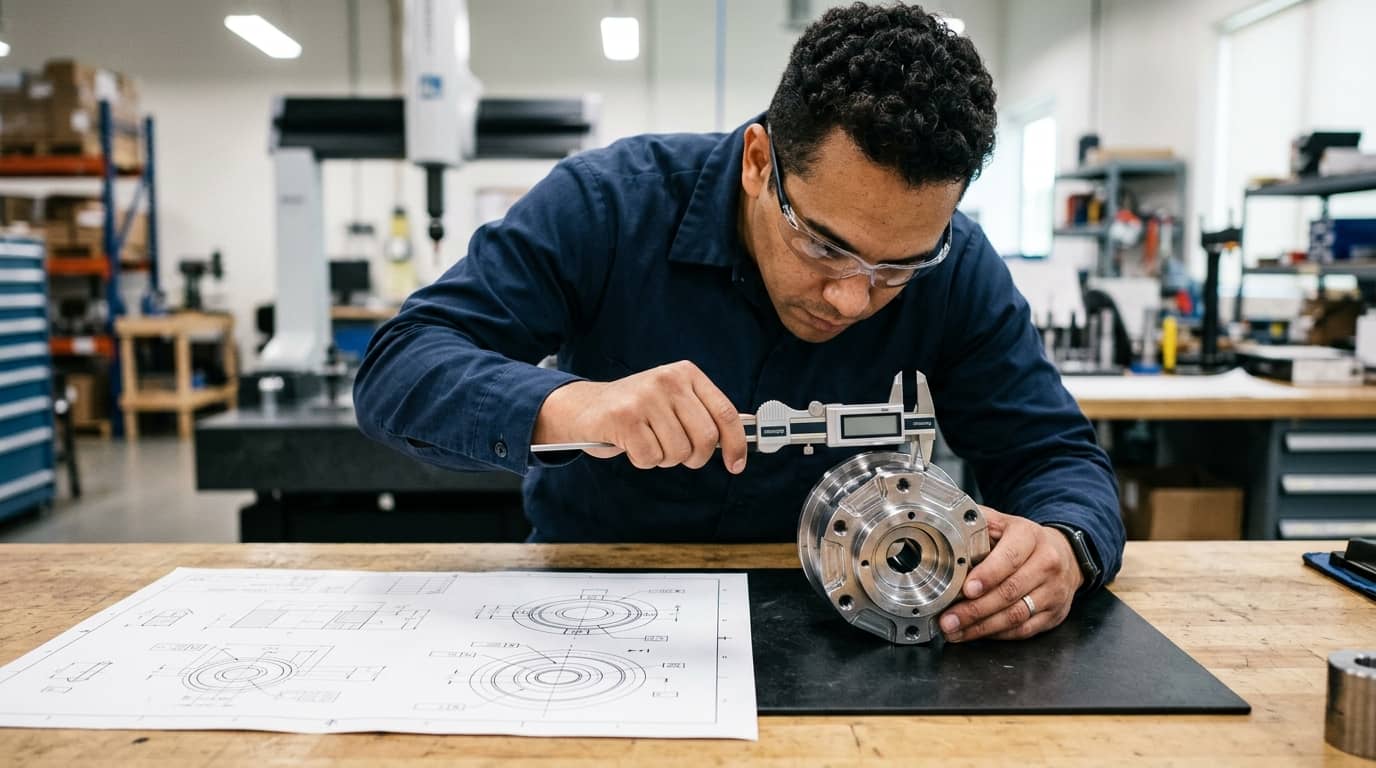
Teaches use of calipers, micrometers, dial indicators, and feeler gauges for dimensional checks. Accurate measurement is the basis for fit, tolerance, and alignment decisions.
Lesson 2 • Hand Tools for Maintenance
Covers wrenches, screwdrivers, pliers, hammers, and specialty tools with correct usage techniques. Proper tool selection prevents fastener damage and personal injury.
Lesson 3 • Alignment and Leveling Tools
Covers straightedges, precision levels, laser aligners, and dial indicator rigs for shaft alignment. Correct alignment extends bearing and coupling life significantly.
Lesson 4 • Tool Care and Calibration
Explains cleaning, storage, calibration schedules, and out-of-tolerance procedures for all tools. Calibrated tools ensure measurement reliability and regulatory compliance.
Lesson 5 • Power and Pneumatic Tools
Introduces drills, grinders, impact wrenches, and pneumatic tools with safe operating practices. Power tool competency speeds maintenance tasks without sacrificing safety.
Chapter 4HideHide detailsSee detailsPreventive Maintenance Programs
Preventive Maintenance Programs
Lesson 1 • Filter, Belt, and Fluid Service
Details replacement intervals and procedures for filters, drive belts, and hydraulic or coolant fluids. Timely service of consumables prevents secondary component damage.
Lesson 2 • PM Scheduling and Work Orders
Teaches how to build PM schedules, generate work orders, and track completion in a maintenance system. Scheduling discipline converts PM plans into consistent executed actions.
Lesson 3 • Lubrication Management
Covers lubricant types, viscosity selection, application methods, and contamination control. Correct lubrication is the single highest-impact PM activity for most machines.
Lesson 4 • Preventive Maintenance Principles
Defines PM goals, cost-benefit logic, and the difference between time-based and usage-based intervals. This framework guides all scheduling decisions in the chapter.
Lesson 5 • Inspection Routines and Checklists
Builds structured inspection checklists covering visual, auditory, and tactile checks for common machines. Consistent inspections catch developing faults before failure occurs.
Chapter 5HideHide detailsSee detailsMechanical Systems Maintenance
Mechanical Systems Maintenance
Lesson 1 • Gearbox and Reducer Service
Covers gearbox inspection, oil analysis, seal replacement, and gear wear evaluation. Gearbox health directly impacts torque delivery and downstream equipment reliability.
Lesson 2 • Seals, Gaskets, and Packing
Addresses static and dynamic seal types, surface preparation, and correct installation to prevent leaks. Seal integrity is critical for fluid containment and machine longevity.
Lesson 3 • Bearing Maintenance and Replacement
Covers bearing removal, inspection, selection, installation, and preload adjustment. Bearings are the most frequently replaced mechanical component in industrial machinery.
Lesson 4 • Belt, Chain, and Gear Drives
Teaches inspection, tensioning, alignment, and replacement of V-belts, chains, and gear sets. Drive system condition directly affects power transmission efficiency and component life.
Lesson 5 • Couplings and Shaft Alignment
Details coupling types, installation, and precision shaft alignment using dial indicators and laser tools. Misalignment is a leading cause of bearing and seal premature failure.
Chapter 6HideHide detailsSee detailsHydraulic and Pneumatic System Maintenance
Hydraulic and Pneumatic System Maintenance
Lesson 1 • Hydraulic Fluid Management
Addresses fluid cleanliness standards, contamination sources, filtration, and fluid change procedures. Fluid quality is the primary driver of hydraulic component service life.
Lesson 2 • Pressure Testing and Performance Verification
Teaches gauge installation, pressure and flow testing, and comparison against design specifications. Verification confirms that repaired circuits meet original performance requirements.
Lesson 3 • Hydraulic Circuit Inspection
Teaches systematic visual and pressure-based inspection of pumps, valves, cylinders, and hoses. Circuit inspection is the starting point for all hydraulic fault diagnosis.
Lesson 4 • Pneumatic System Maintenance
Details air preparation units, valve service, cylinder maintenance, and leak detection in pneumatic circuits. Clean, dry, regulated air is essential for reliable pneumatic operation.
Lesson 5 • Hydraulic Component Replacement
Covers safe depressurisation, component removal, seal kit installation, and system refill procedures. Correct replacement restores flow, pressure, and actuator performance.
Chapter 7HideHide detailsSee detailsElectrical and Control System Maintenance
Electrical and Control System Maintenance
Lesson 1 • Electrical Safety and Isolation
Reinforces arc flash awareness, voltage testing, and electrical lockout before any panel work. Electrical isolation is non-negotiable before touching live circuit components.
Lesson 2 • Motor Inspection and Testing
Covers winding resistance, insulation resistance, and current draw tests for AC and DC motors. Motor testing identifies degradation before catastrophic winding failure occurs.
Lesson 3 • Control Panel and Wiring Maintenance
Teaches terminal tightening, contactor inspection, relay testing, and wire labelling in control panels. Panel integrity prevents nuisance trips and unplanned production stops.
Lesson 4 • Variable Frequency Drive Maintenance
Addresses VFD inspection, parameter verification, cooling system service, and fault code interpretation. VFDs control motor speed and torque, making their reliability critical.
Lesson 5 • Sensors, PLCs, and Fault Diagnosis
Introduces sensor calibration, PLC I/O testing, and using ladder logic to trace electrical faults. PLC-based diagnosis accelerates fault isolation in automated machinery.
Chapter 8HideHide detailsSee detailsPredictive Maintenance and Reliability
Predictive Maintenance and Reliability
Lesson 1 • Reliability-Centered Maintenance Strategy
Applies RCM logic to select the best maintenance strategy for each failure mode based on consequence and detectability. RCM aligns maintenance effort with actual risk and business impact.
Lesson 2 • Thermographic Inspection
Covers infrared camera operation, emissivity settings, and thermal pattern interpretation for electrical and mechanical components. Thermal anomalies reveal overloads and friction before failure.
Lesson 3 • Vibration Analysis Fundamentals
Explains vibration measurement, frequency spectra, and common fault signatures for rotating equipment. Vibration data is the most widely used predictive maintenance indicator.
Lesson 4 • Oil and Lubricant Analysis
Teaches sampling procedures, laboratory report interpretation, and corrective actions based on wear metal and contamination data. Oil analysis extends component life and prevents unplanned failures.
Lesson 5 • Ultrasonic and Motor Current Analysis
Introduces airborne and structure-borne ultrasound for leak and bearing detection, plus motor current signature analysis. These tools complement vibration and thermal data for complete coverage.
Your valid completion certificate
This course is for you:
Maintenance technicians: looking to formalize and deepen their existing shop-floor skills.
Production operators: wanting to cross-train into a dedicated maintenance technician role.
Military veterans: translating mechanical or electrical service experience into civilian industry jobs.
Recent trade school graduates: ready to apply foundational skills in a real industrial context.
Career changers: coming from construction or automotive and pivoting toward manufacturing maintenance.
Reliability engineers: seeking hands-on technical grounding to complement their analytical responsibilities.
What our students say
Your classes are perfect. I purchased the one-year package and finally have the opportunity to follow various topics of my interest without needing to change platforms... I thank you for everything you do, I've already recommended you to other people...

I like how the lessons are straight to the point and how I can change chapters and skip content that I don't need.

I like the content and the way of presentation and video transcription, which speeds up the process!

The platform is fast, simple to use. The diversity of content and complementary videos help a lot in learning.

Top qualifications



FAQs
Who is Dedika?
Is the certificate valid in India?
Are the courses free?
What is the course workload?
What are the courses like?
How do the courses work?
What is the duration of the courses?
What is the cost or price of the courses?
What is an EAD or online course and how does it work?
PDF Course