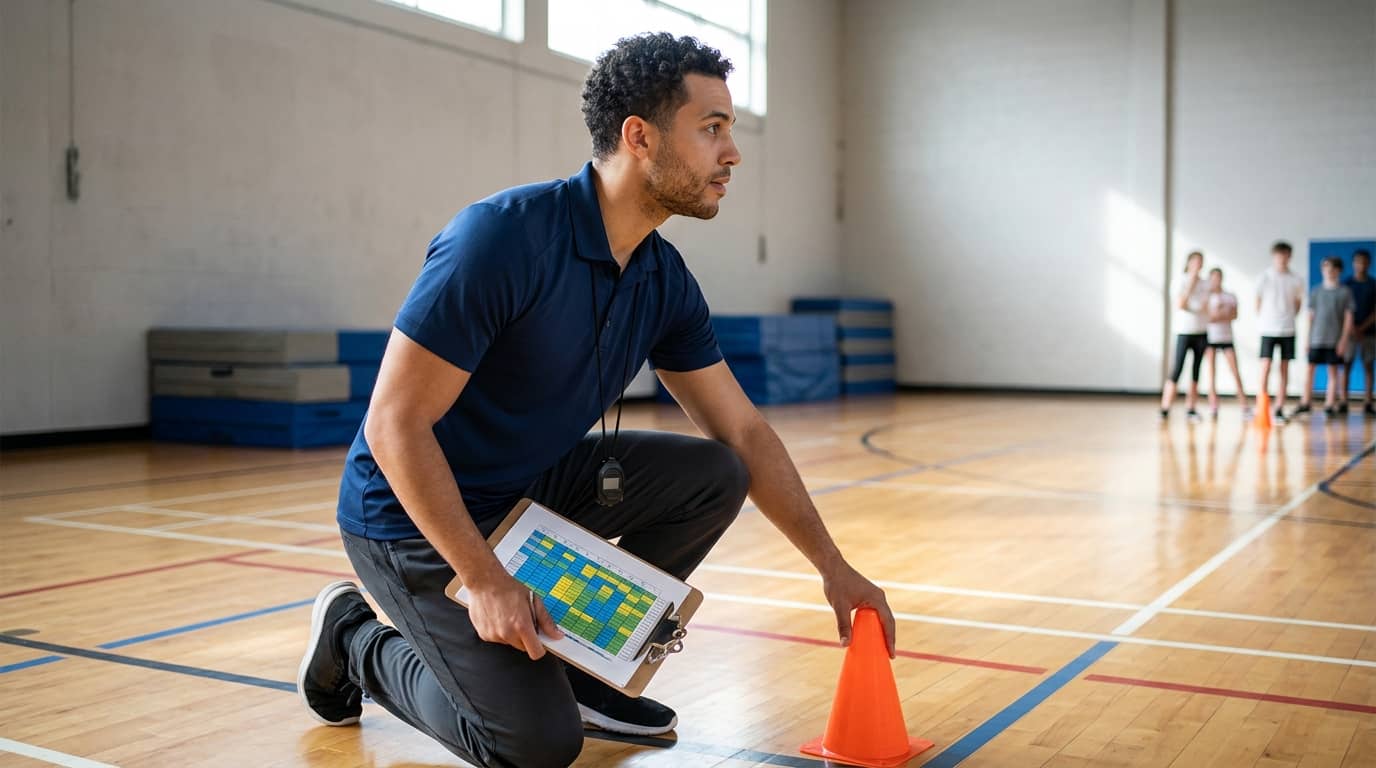
Physical Education Instructor Course
Become the PE instructor students remember for life. This course gives you the science, planning tools, and classroom strategies to teach physical education with confidence and purpose. From anatomy and motor learning to lesson design and injury prevention, every skill you need is here.
What you will learn:
This course covers the full scope of physical education instruction, from foundational anatomy and exercise physiology to advanced program design and periodization. You will learn how to assess student fitness, set measurable goals, and build lesson plans aligned to national PE standards. The curriculum includes motor learning theory, differentiated instruction, and evidence-based behavior management strategies. You will also gain practical knowledge in adapted PE, sport psychology, nutrition fundamentals, and technology integration. By the end, you will have the tools to design safe, inclusive, and effective PE programs for any age group.
How you study in a practical way Physical Education Instructor Course
How you practice Physical Education Instructor Course
For companies who want to train their team
With Dedika for businesses, the course includes exercises and examples tailored to your own business and the way your company needs.

Course content
8 Chapters • 40 LessonsDuration between 4 and 360 hours (you decide)
Chapter 1HideHide detailsSee detailsFoundations of Physical Education
Foundations of Physical Education
Lesson 1 • Human Growth and Development
Examines physical, cognitive, and psychosocial development across age groups. Enables instructors to match activities to developmental readiness.
Lesson 2 • History and Philosophy of PE
Traces PE's evolution from ancient physical culture to modern curricula. Grounds instructors in the values and purposes that shape contemporary program design.
Lesson 3 • Professional Roles and Ethics
Defines the PE instructor's responsibilities, ethical obligations, and professional standards. Prepares instructors to model integrity and maintain professional conduct.
Lesson 4 • Introduction to Exercise Physiology
Covers how the body responds to acute exercise and adapts to training. Connects physiological principles to effective program design.
Lesson 5 • Basic Anatomy for Instructors
Introduces skeletal, muscular, and joint structures relevant to movement. Provides anatomical vocabulary needed for safe exercise instruction.
Chapter 2HideHide detailsSee detailsMotor Learning and Skill Development
Motor Learning and Skill Development
Lesson 1 • Theories of Motor Learning
Presents schema theory, dynamic systems theory, and ecological approaches to skill learning. Connects each theory to practical instructional decisions.
Lesson 2 • Practice Design and Variability
Examines blocked, random, and variable practice structures and their effects on retention. Instructors select practice types to match learning goals.
Lesson 3 • Fundamental Movement Skills
Identifies locomotor, non-locomotor, and manipulative skills as the building blocks of physical literacy. Guides instructors in assessing and developing these skills.
Lesson 4 • Motivation and Engagement in Skill Learning
Applies self-determination theory and achievement goal theory to sustain learner motivation. Instructors create environments that foster autonomy and mastery orientation.
Lesson 5 • Feedback and Instruction Techniques
Covers augmented feedback types, timing, and frequency for skill refinement. Connects feedback strategies to observable improvements in student performance.
Chapter 3HideHide detailsSee detailsFitness Components and Assessment
Fitness Components and Assessment
Lesson 1 • Fitness Testing Protocols
Presents standardized tests for each fitness component, including validity and reliability considerations. Prepares instructors to administer and interpret assessments accurately.
Lesson 2 • Goal Setting Based on Assessment
Applies SMART goal frameworks to fitness data to create individualized targets. Connects assessment outcomes directly to program planning in subsequent chapters.
Lesson 3 • Health-Related Fitness Components
Defines cardiovascular endurance, muscular strength, muscular endurance, flexibility, and body composition. Establishes the framework for comprehensive fitness programming.
Lesson 4 • Pre-Participation Health Screening
Covers health history questionnaires, risk stratification, and medical clearance procedures. Ensures instructors identify contraindications before fitness testing or training.
Lesson 5 • Interpreting and Recording Data
Teaches data recording, normative comparison, and criterion-referenced standards. Instructors translate raw scores into actionable programming decisions.
Chapter 4HideHide detailsSee detailsExercise Programming and Periodization
Exercise Programming and Periodization
Lesson 1 • Periodization Models
Introduces linear, undulating, and block periodization models for long-term planning. Instructors apply periodization to prevent plateaus and peak performance at target dates.
Lesson 2 • Principles of Training
Applies overload, progression, specificity, reversibility, and individuality to program design. These principles form the scientific backbone of all subsequent programming decisions.
Lesson 3 • Cardiovascular Training Design
Covers intensity zones, training methods, and volume guidelines for aerobic development. Instructors prescribe cardio programs matched to individual fitness levels and goals.
Lesson 4 • Resistance Training Program Design
Presents load, volume, rest, and exercise selection variables for strength and hypertrophy. Instructors construct safe, effective resistance programs for diverse populations.
Lesson 5 • Flexibility and Mobility Programming
Distinguishes static, dynamic, and proprioceptive neuromuscular facilitation stretching and their applications. Instructors integrate flexibility work into warm-up and cool-down routines.
Chapter 5HideHide detailsSee detailsInstructional Planning and Lesson Design
Instructional Planning and Lesson Design
Lesson 1 • Lesson Plan Structure and Components
Details the components of an effective PE lesson: warm-up, skill focus, activity, and cool-down. Instructors sequence activities to maximize learning time and transitions.
Lesson 2 • Curriculum Frameworks and Standards
Examines national and institutional PE standards as the basis for curriculum alignment. Instructors map learning outcomes to recognized competency frameworks.
Lesson 3 • Differentiated Instruction in PE
Presents strategies for modifying tasks, equipment, and rules to meet diverse learner needs. Ensures all students experience success and challenge within the same lesson.
Lesson 4 • Unit Planning and Scope and Sequence
Guides instructors in building multi-week units with coherent skill progressions and assessments. Connects individual lessons to long-term curriculum goals.
Lesson 5 • Writing Effective Learning Objectives
Applies Bloom's taxonomy to craft measurable psychomotor, cognitive, and affective objectives. Clear objectives guide lesson structure and assessment design.
Chapter 6HideHide detailsSee detailsTeaching Strategies and Classroom Management
Teaching Strategies and Classroom Management
Lesson 1 • Behavior Management Strategies
Presents proactive and reactive strategies for managing student behavior in gym settings. Instructors establish routines and respond consistently to maintain a positive climate.
Lesson 2 • Spectrum of Teaching Styles
Introduces Mosston's spectrum from command to self-teaching styles and their appropriate uses. Instructors select styles that match lesson objectives and student readiness.
Lesson 3 • Effective Communication in PE
Covers verbal, non-verbal, and visual communication techniques for large active groups. Instructors deliver clear instructions and maintain student attention during movement.
Lesson 4 • Creating an Inclusive PE Environment
Addresses cultural responsiveness, gender equity, and disability inclusion in PE. Instructors build environments where every student feels valued and capable.
Lesson 5 • Organizing Space, Equipment, and Groups
Teaches efficient setup, distribution, and retrieval of equipment and strategic grouping methods. Reduces transition time and maximizes student engagement and safety.
Chapter 7HideHide detailsSee detailsSafety, Injury Prevention, and First Aid
Safety, Injury Prevention, and First Aid
Lesson 1 • Risk Management in Physical Education
Covers hazard identification, risk assessment, and documentation practices for PE facilities. Instructors apply systematic risk management to prevent accidents before they occur.
Lesson 2 • First Aid and Emergency Response
Trains instructors in RICE protocol, CPR, AED use, and emergency action plan execution. Prepares instructors to stabilize injured students until medical help arrives.
Lesson 3 • Common PE Injuries and Recognition
Identifies sprains, strains, fractures, concussions, and heat-related illnesses common in PE. Instructors recognize signs and symptoms to initiate appropriate responses.
Lesson 4 • Supervision and Legal Responsibilities
Examines supervision standards, negligence concepts, and documentation requirements for PE instructors. Instructors understand their legal obligations and protective practices.
Lesson 5 • Injury Prevention Principles
Presents warm-up, cool-down, load management, and technique correction as injury prevention tools. Instructors integrate prevention strategies into every lesson.
Chapter 8HideHide detailsSee detailsAssessment, Reflection, and Professional Growth
Assessment, Reflection, and Professional Growth
Lesson 1 • Using Data to Improve Instruction
Applies student performance data and assessment results to adjust teaching strategies. Instructors close the feedback loop between assessment outcomes and lesson redesign.
Lesson 2 • Reflective Teaching Practice
Introduces reflective frameworks such as Schon's reflection-in-action and reflection-on-action. Instructors use structured reflection to identify strengths and areas for growth.
Lesson 3 • Career Development and Lifelong Learning
Maps pathways for professional certification, advanced credentials, and leadership in PE. Instructors build a personal development plan to sustain growth throughout their careers.
Lesson 4 • Assessment Types in Physical Education
Distinguishes formative, summative, and authentic assessment and their roles in PE. Instructors select assessment types aligned to psychomotor, cognitive, and affective objectives.
Lesson 5 • Rubric Design and Grading
Guides instructors in creating analytic and holistic rubrics for movement and fitness tasks. Ensures grading is transparent, consistent, and aligned to learning objectives.
Your valid completion certificate
This course is for you:
Fitness trainer: wants to transition into school-based PE teaching roles.
Recent kinesiology graduate: ready to apply academic knowledge in real classrooms.
Youth sports coach: seeking formal credentials to expand professional opportunities.
Career changer: passionate about health and working meaningfully with young people.
Paraprofessional educator: supporting PE classes and wanting deeper instructional expertise.
Community recreation leader: aiming to bring structured physical programming to schools.
What our students say
Your classes are perfect. I purchased the one-year package and finally have the opportunity to follow various topics of my interest without needing to change platforms... I thank you for everything you do, I've already recommended you to other people...

I like how the lessons are straight to the point and how I can switch chapters and skip content I don't need.

I like the content and the way videos are presented and transcribed, which speeds up the process!

The platform is fast, simple to use. The diversity of content and complementary videos really help with learning.

Top trainings





FAQs
Who is Dedika?
Is the certificate valid in the Philippines?
Are the courses free?
What is the course workload?
What are the courses like?
How do the courses work?
What is the duration of the courses?
What is the cost or price of the courses?
What is an EAD or online course and how does it work?
PDF Course