
Motorcycle Instructor Course
Become a certified motorcycle instructor with the skills to train riders safely and professionally. This course covers everything from adult learning theory and off-road fundamentals to on-road coaching and formal assessment. You will graduate ready to deliver complete rider training programmes that meet regulatory standards and protect every trainee in your care.
What you will learn:
This course gives you a complete foundation in motorcycle instruction, covering professional standards, safety management, and structured teaching methods. You will learn how to plan and deliver lessons for novice and experienced riders, manage risk in live traffic environments, and use proven communication techniques on and off the road. You will also master formal assessment procedures, adaptive instruction strategies, and the use of digital tools to enhance your training delivery. By the end, you will have the knowledge and practical frameworks to run effective, compliant rider training programmes.
How you study in practice Motorcycle Instructor Course
How you practise Motorcycle Instructor Course
For companies looking to train their teams
With Dedika for Businesses, the course includes exercises and examples tailored to your own business and the specific needs of your company.

Course content
8 Chapters • 35 LessonsDuration between 4 and 360 hours (you decide)
Chapter 1HideHide detailsSee detailsFoundations of Motorcycle Instruction
Foundations of Motorcycle Instruction
Lesson 1 • Rider Training Regulatory Framework
Covers the national and local regulatory structures that govern approved rider training programmes. Connects compliance knowledge to daily instructional practice.
Lesson 2 • The Motorcycle Instructor Role
Defines the instructor's professional identity, legal obligations, and ethical duties. Sets the baseline for all subsequent teaching responsibilities covered in the course.
Lesson 3 • Personal Protective Equipment for Training
Specifies PPE standards for both instructors and trainees during all training phases. Reinforces the instructor's responsibility to enforce equipment compliance.
Lesson 4 • Training Site Safety Standards
Establishes minimum safety requirements for off-road training areas and on-road routes. Ensures instructors can assess and maintain a safe learning environment.
Chapter 2HideHide detailsSee detailsAdult Learning and Instructional Theory
Adult Learning and Instructional Theory
Lesson 1 • Lesson Planning and Objectives
Teaches how to write measurable learning objectives and structure a complete lesson plan. Directly supports the practical teaching sessions in later chapters.
Lesson 2 • Instructional Models for Riding Skills
Introduces structured teaching models such as explain-demonstrate-practice-debrief. Provides a repeatable framework instructors apply across all skill modules.
Lesson 3 • How Adults Learn Motor Skills
Examines cognitive and physical stages of motor skill acquisition relevant to riding. Grounds lesson planning in evidence-based learning science.
Lesson 4 • Motivation and Learner Engagement
Addresses intrinsic and extrinsic motivation factors that affect trainee performance. Equips instructors to sustain engagement throughout multi-session courses.
Chapter 3HideHide detailsSee detailsCommunication Skills for Instructors
Communication Skills for Instructors
Lesson 1 • Verbal Instruction Techniques
Covers clear briefing language, command vocabulary, and explanation structure for riding tasks. Reduces misunderstanding that can cause trainee errors on the range.
Lesson 2 • Radio and Intercom Communication
Trains instructors to use radio and helmet intercom systems effectively during on-road sessions. Ensures real-time guidance without distracting the trainee.
Lesson 3 • Feedback Delivery and Debriefing
Teaches structured feedback methods that reinforce correct behaviour and correct errors constructively. Connects debrief quality to trainee retention and confidence.
Lesson 4 • Demonstration as a Teaching Tool
Establishes how physical demonstration sets a visual model for trainees to replicate. Links demonstration quality directly to trainee skill accuracy.
Chapter 4HideHide detailsSee detailsTeaching Off-Road Fundamental Skills
Teaching Off-Road Fundamental Skills
Lesson 1 • Slow-Speed Manoeuvre Coaching
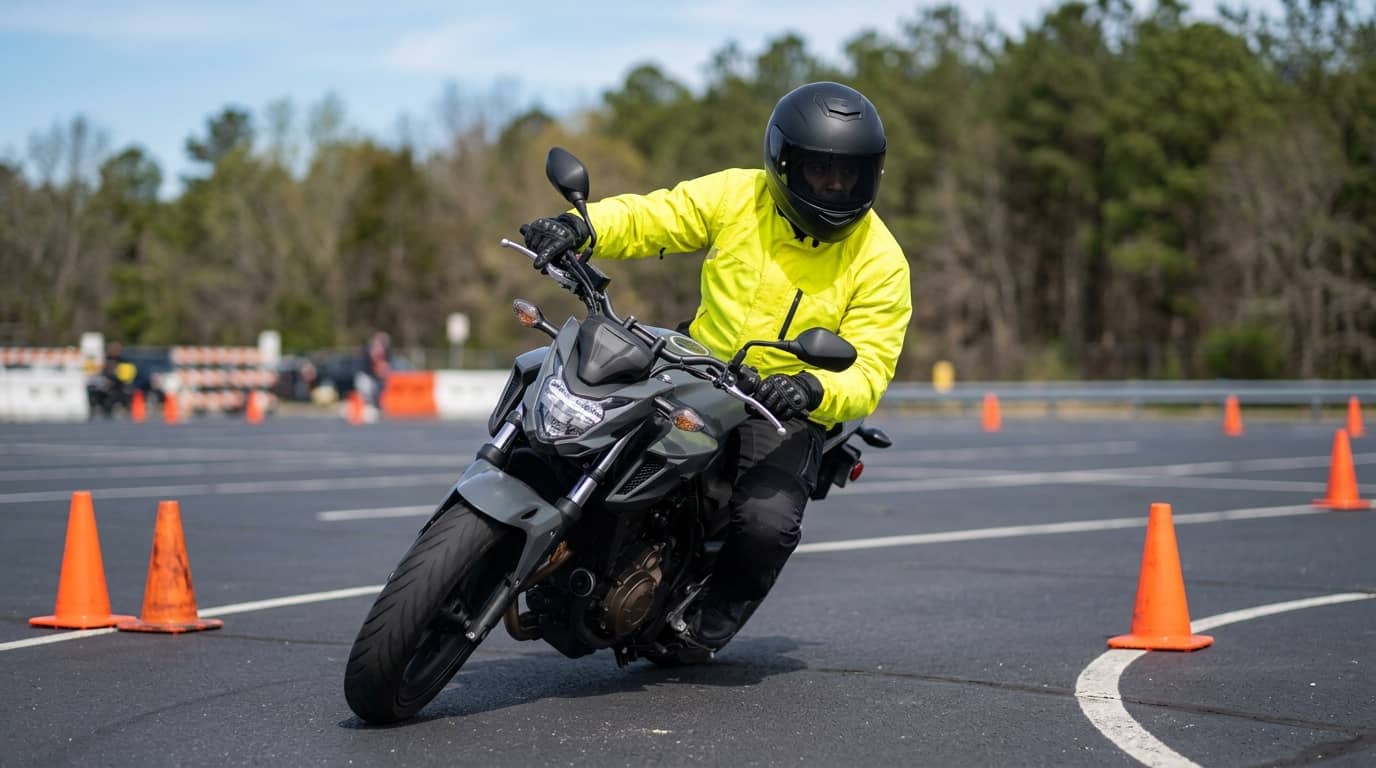
Covers U-turns, figure-eights, and tight turns within a confined space. Develops the precise throttle-brake-clutch coordination required for urban riding.
Lesson 2 • Emergency Stop and Hazard Response
Teaches the emergency braking exercise and introduces hazard awareness at low speed. Prepares trainees for the critical safety skills assessed in licensing tests.
Lesson 3 • Machine Familiarisation and Controls
Guides trainees through motorcycle components, controls, and pre-ride checks before any movement. Establishes the safety baseline for all subsequent riding exercises.
Lesson 4 • Gear Changing and Speed Progression
Introduces sequential gear changes and controlled acceleration within the training area. Bridges off-road skill development to on-road readiness.
Lesson 5 • Balance, Clutch, and First Movement
Introduces the friction zone, balance point, and first controlled forward movement. These are the critical first skills that determine novice confidence and safety.
Chapter 5HideHide detailsSee detailsManaging Risk and Trainee Safety
Managing Risk and Trainee Safety
Lesson 1 • Dynamic Risk Management on Road
Develops real-time risk judgement skills for instructors supervising live traffic riding. Enables rapid intervention decisions that prevent trainee collisions.
Lesson 2 • Risk Assessment for Training Activities
Applies formal risk assessment methodology to off-road and on-road training scenarios. Produces written risk assessments that satisfy regulatory and organisational requirements.
Lesson 3 • Safeguarding Vulnerable Trainees
Addresses safeguarding obligations when training young or vulnerable adult riders. Connects safeguarding policy to the instructor's professional duty of care.
Lesson 4 • Incident and Accident Response
Covers immediate response procedures for falls, collisions, and medical emergencies during training. Ensures instructors act correctly under pressure to minimise harm.
Chapter 6HideHide detailsSee detailsTeaching On-Road Riding Skills
Teaching On-Road Riding Skills
Lesson 1 • Transitioning Trainees to Public Roads
Establishes criteria and procedures for moving trainees from the training area to live traffic. Ensures the transition is safe, planned, and legally compliant.
Lesson 2 • Rural and High-Speed Road Coaching
Addresses cornering technique, speed management, and following distance on rural and faster roads. Extends trainee competence beyond urban environments.
Lesson 3 • Overtaking and Hazard Perception
Teaches safe overtaking criteria and develops trainee hazard perception on open roads. Builds the anticipation skills that reduce collision risk.
Lesson 4 • Night and Low-Visibility Riding
Introduces the additional hazards and adaptations required for riding in reduced visibility. Prepares instructors to brief and supervise night-riding sessions.
Lesson 5 • Junctions, Roundabouts, and Positioning
Covers coaching points for approach, observation, and road position at junctions and roundabouts. Directly addresses the highest-risk scenarios for novice riders.
Chapter 7HideHide detailsSee detailsAssessing Trainee Competence
Assessing Trainee Competence
Lesson 1 • Conducting the Practical Riding Assessment
Details the structure, conduct, and documentation of the formal practical riding test. Ensures consistent, fair, and legally defensible assessment outcomes.
Lesson 2 • Formative Assessment During Training
Covers ongoing observation techniques and progress checks used throughout training sessions. Enables instructors to adjust teaching before the summative assessment.
Lesson 3 • Assessment Principles and Validity
Establishes the concepts of validity, reliability, and fairness in competence assessment. Grounds all assessment decisions in professional and regulatory standards.
Lesson 4 • Delivering Assessment Results
Teaches how to communicate pass and fail outcomes clearly and professionally. Connects result delivery to trainee development and next-step planning.
Chapter 8HideHide detailsSee detailsAdvanced Instruction and Course Delivery
Advanced Instruction and Course Delivery
Lesson 1 • Instructor Standardisation and Moderation
Covers inter-rater reliability, standardisation meetings, and moderation of assessment decisions. Ensures consistent quality across multiple instructors within a training organisation.
Lesson 2 • Managing Mixed-Ability Groups
Provides strategies for differentiating instruction when trainees progress at different rates. Maintains safety and engagement across the full ability range.
Lesson 3 • Designing a Complete Training Programme
Integrates lesson plans, assessment points, and progression criteria into a coherent course structure. Produces a full course plan ready for regulatory approval.
Lesson 4 • Quality Assurance and Self-Evaluation
Establishes processes for monitoring and improving personal instructional performance over time. Connects self-evaluation to continuing professional development requirements.
Lesson 5 • Coaching Experienced Riders
Adapts instructional approach for riders with prior experience seeking advanced qualifications. Addresses ingrained habits and resistance to technique change.
Your valid completion certificate
This course is for you:
Experienced riders: ready to turn riding expertise into a teaching profession.
Driving instructors: looking to add motorcycle training to their existing qualifications.
Military or police riders: transitioning their advanced skills into civilian instructor roles.
Motorcycle enthusiasts: passionate about safety culture and mentoring newer riders.
Career changers: seeking a hands-on profession with clear licensing and career pathways.
Training coordinators: responsible for managing fleet rider safety and staff competency programmes.
What our students say
Your lessons are perfect. I purchased the one-year package and finally have the opportunity to follow various topics of my interest without needing to change platforms... I'm grateful for everything you do, I've already recommended you to other people...

I like how the lessons are straight to the point and how I can change chapters and skip content I don't need.

I like the content and the way videos are presented and transcribed, which speeds up the process!

The platform is fast, simple to use. The diversity of content and complementary videos help a lot with learning.

Top trainings




FAQs
Who is Dedika?
Is the certificate valid in Pakistan?
Are the courses free?
What is the course workload?
What are the courses like?
How do the courses work?
What is the duration of the courses?
What is the cost or price of the courses?
What is an EAD or online course and how does it work?
PDF Course