
Motorcycle Riding Course
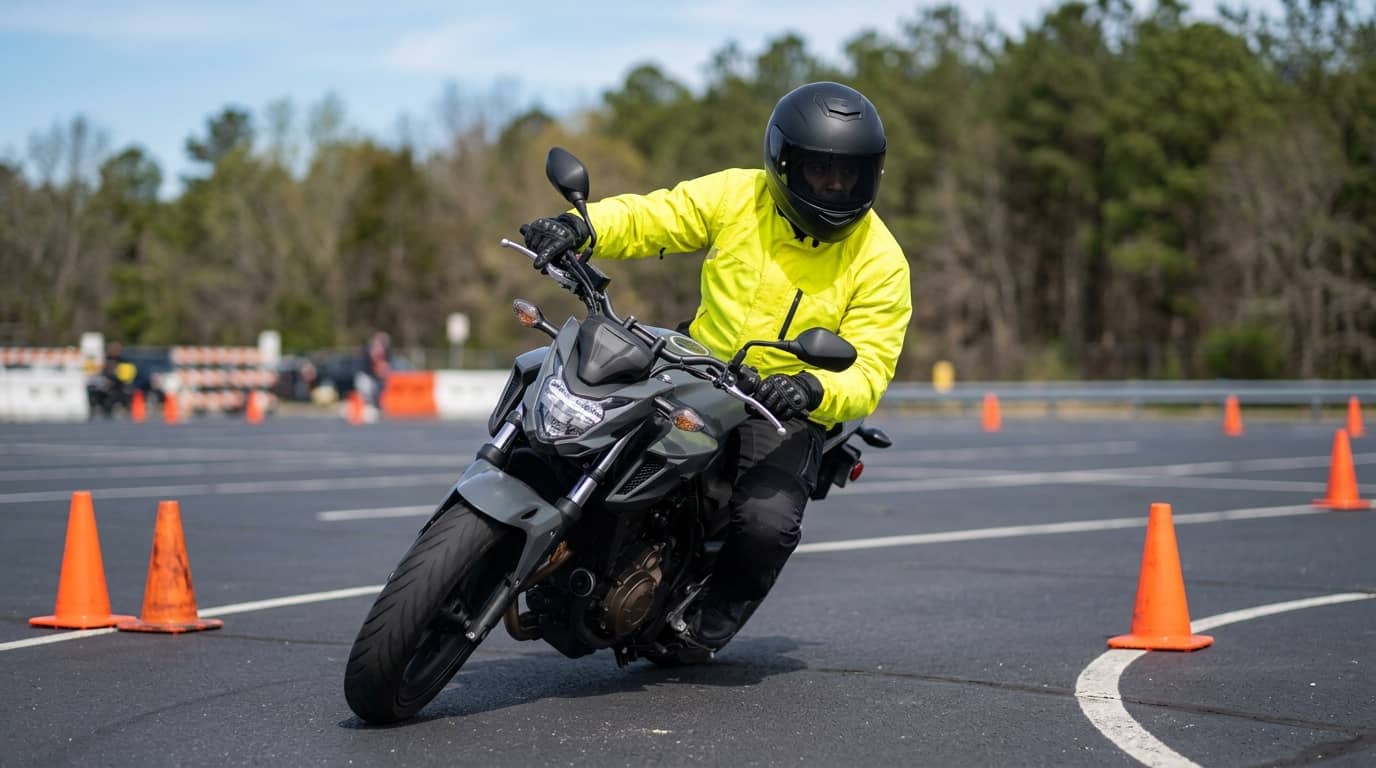
This motorcycle riding course takes you from zero seat time to confident, street-ready skills. You will master everything from basic controls and pre-ride inspections to advanced cornering, emergency manoeuvres, and adverse-condition riding. Whether you are a first-time rider or sharpening rusty skills, this course gives you the knowledge and technique to ride safely every time you throw a leg over.
What you will learn:
You will start with motorcycle controls, protective gear, and the T-CLOCS inspection method so you never mount an unsafe bike. From there, you will build smooth clutch and throttle coordination, progressive braking, and low-speed manoeuvring skills. The course covers urban traffic strategies, intersection management, and lane positioning to keep you visible and protected on city streets. You will also train for emergencies, including countersteering, skid recovery, and maximum-effort braking. Advanced sections tackle wet weather, night riding, highway merging, and group riding protocols. By the end, you will apply the SIPDE hazard-management process automatically on every ride.
How you study in practice Motorcycle Riding Course
How you practise Motorcycle Riding Course
For companies looking to train their teams
With Dedika for Businesses, the course includes exercises and examples tailored to your own business and the specific needs of your company.

Course content
8 Chapters • 38 LessonsDuration between 4 and 360 hours (you decide)
Chapter 1HideHide detailsSee detailsMotorcycle Fundamentals and Safety Mindset
Motorcycle Fundamentals and Safety Mindset
Lesson 1 • Risk Awareness and Rider Psychology
Examine how perception, attitude, and complacency create crash risk. Riders develop a hazard-anticipation mindset that supports every skill taught later.
Lesson 2 • Controls and Instrumentation
Map hand and foot controls to their mechanical functions. Accurate control identification prevents input errors during riding exercises.
Lesson 3 • Protective Gear Selection
Evaluate helmets, jackets, gloves, boots, and pants against recognised safety standards. Proper gear selection directly reduces injury severity in a crash.
Lesson 4 • Anatomy of a Motorcycle
Identify every major component group and understand its function. This knowledge anchors all subsequent control and maintenance topics.
Chapter 2HideHide detailsSee detailsPre-Ride Inspection and Bike Setup
Pre-Ride Inspection and Bike Setup
Lesson 1 • Ergonomic Adjustment and Fit
Adjust mirrors, handlebars, and footpegs to match rider dimensions. Correct ergonomics reduce fatigue and improve precise control input.
Lesson 2 • T-CLOCS Inspection Method
Apply the T-CLOCS checklist to tyres, controls, lights, oil, chassis, and stands. Systematic inspection catches defects before they become on-road hazards.
Lesson 3 • Fueling and Starting Procedures
Execute safe fuelling, choke use, and cold-start sequences. Correct startup habits prevent flooding, fuel spills, and electrical faults.
Lesson 4 • Identifying and Reporting Defects
Distinguish minor wear from safety-critical faults and document findings accurately. Timely defect reporting prevents mechanical failures during rides.
Chapter 3HideHide detailsSee detailsBasic Motorcycle Control Skills
Basic Motorcycle Control Skills
Lesson 1 • Low-Speed Maneuvering
Execute tight turns, U-turns, and figure-eights at walking pace. Low-speed control mastery builds the balance and coordination needed for urban riding.
Lesson 2 • Mounting, Dismounting, and Balance
Practice safe mounting and dismounting techniques and static balance. Stable bike handling at rest is the foundation for all dynamic manoeuvres.
Lesson 3 • Throttle Management and Gear Shifting
Apply smooth throttle inputs and execute upshifts and downshifts at correct speeds. Proper gear selection maintains engine braking and rider control.
Lesson 4 • Friction Zone and Clutch Control
Locate and exploit the clutch friction zone for smooth takeoffs and stops. Precise clutch modulation eliminates stalling and jerky acceleration.
Lesson 5 • Straight-Line Braking Fundamentals
Apply front and rear brakes progressively to achieve controlled stops. Balanced braking technique prevents wheel lock and reduces stopping distance.
Chapter 4HideHide detailsSee detailsCornering Technique and Body Positioning
Cornering Technique and Body Positioning
Lesson 1 • Vision and Line Selection
Use target fixation avoidance and proper sight lines to choose the safest cornering path. Good vision technique directly improves line accuracy and hazard detection.
Lesson 2 • Cornering Physics and Traction
Explain centripetal force, lean angle, and traction limits in curves. Understanding these forces guides every cornering decision a rider makes.
Lesson 3 • Challenging Corner Scenarios
Handle decreasing-radius, off-camber, and multi-apex corners with adapted technique. Exposure to complex curves builds the judgement needed for real-road riding.
Lesson 4 • Body Positioning Techniques
Apply neutral, lean-with, and hang-off positions to match cornering demands. Correct body position reduces required lean angle and improves stability.
Lesson 5 • Entry Speed and Braking Before Corners
Set correct entry speed using trail braking and pre-corner deceleration. Arriving at the correct speed prevents mid-corner panic braking.
Chapter 5HideHide detailsSee detailsUrban and Traffic Riding Skills
Urban and Traffic Riding Skills
Lesson 1 • Hazard Identification and Response
Detect road surface hazards, parked-car doors, and pedestrian conflicts early. Timely hazard identification allows smooth avoidance rather than emergency reaction.
Lesson 2 • Communicating with Other Road Users
Use signals, horn, headlight modulation, and eye contact to communicate intent clearly. Proactive communication reduces the chance of being overlooked by other drivers.
Lesson 3 • Intersection Management
Identify and respond to the unique hazards present at intersections and driveways. Intersections account for a large share of motorcycle crashes and demand heightened attention.
Lesson 4 • Following Distance and Space Management
Maintain adequate following distance and manage a protective space cushion around the motorcycle. Adequate space provides reaction time to avoid sudden hazards.
Lesson 5 • Lane Positioning and Visibility
Select lane positions that maximise rider visibility and minimise blind-spot exposure. Strategic positioning is the primary tool for being seen by other drivers.
Chapter 6HideHide detailsSee detailsEmergency Maneuvers and Crash Avoidance
Emergency Maneuvers and Crash Avoidance
Lesson 1 • Skid Recognition and Recovery
Identify front and rear wheel skids and apply correct recovery inputs immediately. Early skid recognition prevents a recoverable slide from becoming a crash.
Lesson 2 • Countersteering Mastery
Understand and apply countersteering as the primary steering input above walking speed. Deliberate countersteering practice replaces instinctive but incorrect steering responses.
Lesson 3 • Maximum-Effort Braking
Apply maximum braking force without wheel lock on varied surfaces. Consistent threshold braking technique is the single most effective crash-avoidance skill.
Lesson 4 • Emergency Swerving
Execute a rapid lane change to avoid a stationary or moving obstacle. Swerving at speed requires precise countersteering input and immediate stabilisation.
Lesson 5 • Crash Preparation and Self-Protection
Apply body protection techniques when a crash becomes unavoidable. Correct crash posture and gear use significantly reduce injury severity.
Chapter 7HideHide detailsSee detailsRiding in Adverse Conditions
Riding in Adverse Conditions
Lesson 1 • Night Riding Strategies
Manage reduced visibility, glare, and fatigue during night-time riding. Adapted speed and lighting use maintain hazard detection capability after dark.
Lesson 2 • Wind and Crosswind Management
Maintain stability and lane position when exposed to gusts and sustained crosswinds. Anticipating wind effects prevents sudden lane departures on open roads.
Lesson 3 • Gravel, Sand, and Loose Surfaces
Apply smooth, upright technique when encountering loose surface material. Correct inputs prevent wheel spin and slides on unpredictable low-traction surfaces.
Lesson 4 • Wet Weather Riding Techniques
Adjust speed, braking, and cornering for reduced traction on wet roads. Wet-weather skill prevents the disproportionate crash rate riders face in rain.
Lesson 5 • Extreme Temperature and Fatigue Management
Recognise heat exhaustion, hypothermia, and fatigue symptoms that impair riding. Proactive management of physical state prevents performance degradation on long rides.
Chapter 8HideHide detailsSee detailsAdvanced Riding Strategy and Hazard Management
Advanced Riding Strategy and Hazard Management
Lesson 1 • Group Riding Protocols
Coordinate safe formation riding, passing, and communication within a group. Group riding introduces unique hazards that require specific protocols beyond solo riding.
Lesson 2 • Highway and High-Speed Riding
Manage lane changes, merging, and sustained high-speed stability on multi-lane roads. Highway riding demands expanded scanning range and precise lane management.
Lesson 3 • Rural and Mountain Road Riding
Apply advanced cornering and hazard management on winding, isolated rural roads. Remote riding adds consequence to errors and demands greater self-sufficiency.
Lesson 4 • Personal Risk Assessment and Ride Planning
Evaluate personal fitness, route conditions, and environmental factors before every ride. Structured pre-ride assessment is the final layer of crash prevention strategy.
Lesson 5 • SIPDE Process in Practice
Apply the Scan, Identify, Predict, Decide, Execute framework continuously while riding. Systematic SIPDE use converts raw hazard data into timely, correct rider actions.
Your valid completion certificate
This course is for you:
First-time riders: eager to start motorcycling with a structured, safe foundation.
Commuters: looking to add a motorcycle as a practical, fuel-efficient daily option.
Returning riders: who stepped away and want to rebuild confidence and update skills.
Outdoor enthusiasts: drawn to weekend touring and adventure riding on open roads.
Young adults: pursuing a motorcycle endorsement as their first independent transportation.
Delivery and courier workers: considering a motorcycle to expand their earning opportunities.
What our students say
Your lessons are perfect. I purchased the one-year package and finally have the opportunity to follow various topics of my interest without needing to change platforms... I'm grateful for everything you do, I've already recommended you to other people...

I like how the lessons are straight to the point and how I can change chapters and skip content I don't need.

I like the content and the way videos are presented and transcribed, which speeds up the process!

The platform is fast, simple to use. The diversity of content and complementary videos help a lot with learning.

Top trainings




FAQs
Who is Dedika?
Is the certificate valid in Pakistan?
Are the courses free?
What is the course workload?
What are the courses like?
How do the courses work?
What is the duration of the courses?
What is the cost or price of the courses?
What is an EAD or online course and how does it work?
PDF Course