
Calibration Course
Master every stage of the calibration process — from metrology fundamentals and uncertainty analysis to hands-on electrical, dimensional, temperature, and pressure calibrations. This course equips technicians and quality professionals with the technical skills and documentation practices required to run a compliant, audit-ready calibration program.
What you will learn:
Build a solid foundation in metrology concepts, calibration terminology, and international standards, then move to measurement uncertainty analysis and budget construction. The course covers calibration of electrical instruments, dimensional tools, and temperature and pressure equipment using standard reference methods. Learn to write controlled procedures, maintain accurate records, and issue proper certificates. Program management includes interval optimization, recall systems, out‑of‑tolerance investigations, and audit preparation. Additional topics address accreditation, statistical analysis, calibration software, regulated industries, and emerging technologies like automated systems and predictive calibration.
How you study in practice Calibration Course
How you practice Calibration Course
For companies that want to train their team
With Dedika for Business, the course includes exercises and examples tailored to your own business and the way your company needs.

Course content
8 Chapters • 41 LessonsDuration between 4 and 360 hours (you decide)
Chapter 1HideHide detailsSee detailsFoundations of Measurement and Calibration
Foundations of Measurement and Calibration
Lesson 1 • Why Calibration Matters
Explains the business, safety, and quality drivers behind calibration programs. Connects instrument accuracy to product quality and regulatory compliance.
Lesson 2 • Key Calibration Terminology
Introduces standardized terms such as accuracy, precision, resolution, and bias. Accurate use of these terms is essential for reading and writing calibration records.
Lesson 3 • Introduction to Metrology Concepts
Defines measurement science terms and units used throughout calibration work. Provides the shared language needed for all subsequent technical content.
Lesson 4 • Overview of Calibration Standards
Surveys international and industry calibration standards and their hierarchy. Students understand how national standards connect to working instruments.
Lesson 5 • Roles and Responsibilities in Calibration
Defines who owns, performs, and approves calibration activities within an organization. Clarifies accountability structures students will operate within.
Chapter 2HideHide detailsSee detailsMeasurement Uncertainty Fundamentals
Measurement Uncertainty Fundamentals
Lesson 1 • Type A and Type B Evaluations
Distinguishes statistical (Type A) from non-statistical (Type B) uncertainty evaluation methods. Both types are combined to form a complete uncertainty budget.
Lesson 2 • Uncertainty Budgets in Practice
Guides students through building a complete uncertainty budget for a real measurement. Reinforces all prior uncertainty concepts through applied documentation.
Lesson 3 • Expanded Uncertainty and Coverage Factors
Explains how to apply coverage factors to obtain expanded uncertainty at stated confidence levels. This is the value reported on calibration certificates.
Lesson 4 • Sources of Measurement Uncertainty
Categorizes uncertainty contributors including the instrument, operator, environment, and method. Recognizing sources is the first step toward quantifying them.
Lesson 5 • Combining Uncertainty Components
Applies the law of propagation of uncertainty to combine individual components. Students calculate combined standard uncertainty from multiple sources.
Chapter 3HideHide detailsSee detailsCalibration Equipment and Reference Standards
Calibration Equipment and Reference Standards
Lesson 1 • Selecting the Right Reference Standard
Applies the test uncertainty ratio concept to choose references with adequate accuracy. Incorrect selection is a leading cause of invalid calibration results.
Lesson 2 • Reference Standard Inventory Management
Establishes processes for labeling, tracking, and controlling calibration reference assets. Proper inventory control prevents use of expired or unauthorized standards.
Lesson 3 • Handling and Storage of Standards
Covers proper handling, storage conditions, and transport procedures for reference standards. Mishandling degrades accuracy and can invalidate traceability.
Lesson 4 • Maintaining Traceability of Standards
Explains how to sustain an unbroken traceability chain through scheduled recalibration. Students manage reference calibration due dates and certificates.
Lesson 5 • Types of Calibration Reference Equipment
Surveys common reference instruments including deadweight testers, decade boxes, and reference thermometers. Matching the reference to the measurand is emphasized.
Chapter 4HideHide detailsSee detailsCalibration Procedures and Documentation
Calibration Procedures and Documentation
Lesson 1 • Calibration Record Requirements
Defines mandatory data fields for calibration records including as-found and as-left readings. Complete records enable traceability and support corrective action decisions.
Lesson 2 • Calibration Certificates and Reports
Explains the required content and format of calibration certificates issued to customers. Students distinguish between calibration reports and test reports.
Lesson 3 • Writing Clear Calibration Instructions
Applies technical writing principles to produce unambiguous, actionable calibration steps. Clarity reduces technician error and supports consistent execution.
Lesson 4 • Document Control for Calibration
Applies document control principles to manage procedure versions and record retention. Controlled documents prevent use of obsolete instructions during calibration.
Lesson 5 • Anatomy of a Calibration Procedure
Breaks down the required elements of a written calibration procedure including scope, equipment, and steps. Well-structured procedures ensure consistent, repeatable results.
Chapter 5HideHide detailsSee detailsPerforming Electrical Instrument Calibration
Performing Electrical Instrument Calibration
Lesson 1 • Calibrating Insulation and Continuity Testers
Explains calibration of high-voltage insulation resistance and low-resistance continuity instruments. Safety precautions for high-voltage reference setups are addressed.
Lesson 2 • Calibrating Oscilloscopes
Guides students through vertical gain, timebase, and trigger calibration for oscilloscopes. Oscilloscope calibration requires specialized signal sources and careful setup.
Lesson 3 • Evaluating Electrical Calibration Results
Applies acceptance criteria and uncertainty analysis to determine calibration pass or fail. Students decide on adjustment, labeling, and out-of-tolerance reporting.
Lesson 4 • Calibrating Digital Multimeters
Covers DC voltage, AC voltage, resistance, and current calibration points for multimeters. Students apply reference sources and record as-found and as-left data.
Lesson 5 • Calibrating Clamp Meters and Current Probes
Addresses the unique setup requirements for calibrating clamp-style current instruments. Proper conductor positioning and reference current source use are emphasized.
Chapter 6HideHide detailsSee detailsPerforming Dimensional and Mechanical Calibration
Performing Dimensional and Mechanical Calibration
Lesson 1 • Calibrating Dial Indicators and Gauges
Addresses repeatability, hysteresis, and linearity checks for dial indicators. Proper fixture setup ensures the indicator is loaded consistently during calibration.
Lesson 2 • Calibrating Torque Tools and Instruments
Explains static and dynamic torque calibration using torque analyzers and reference transducers. Torque direction and loading rate affect measurement results.
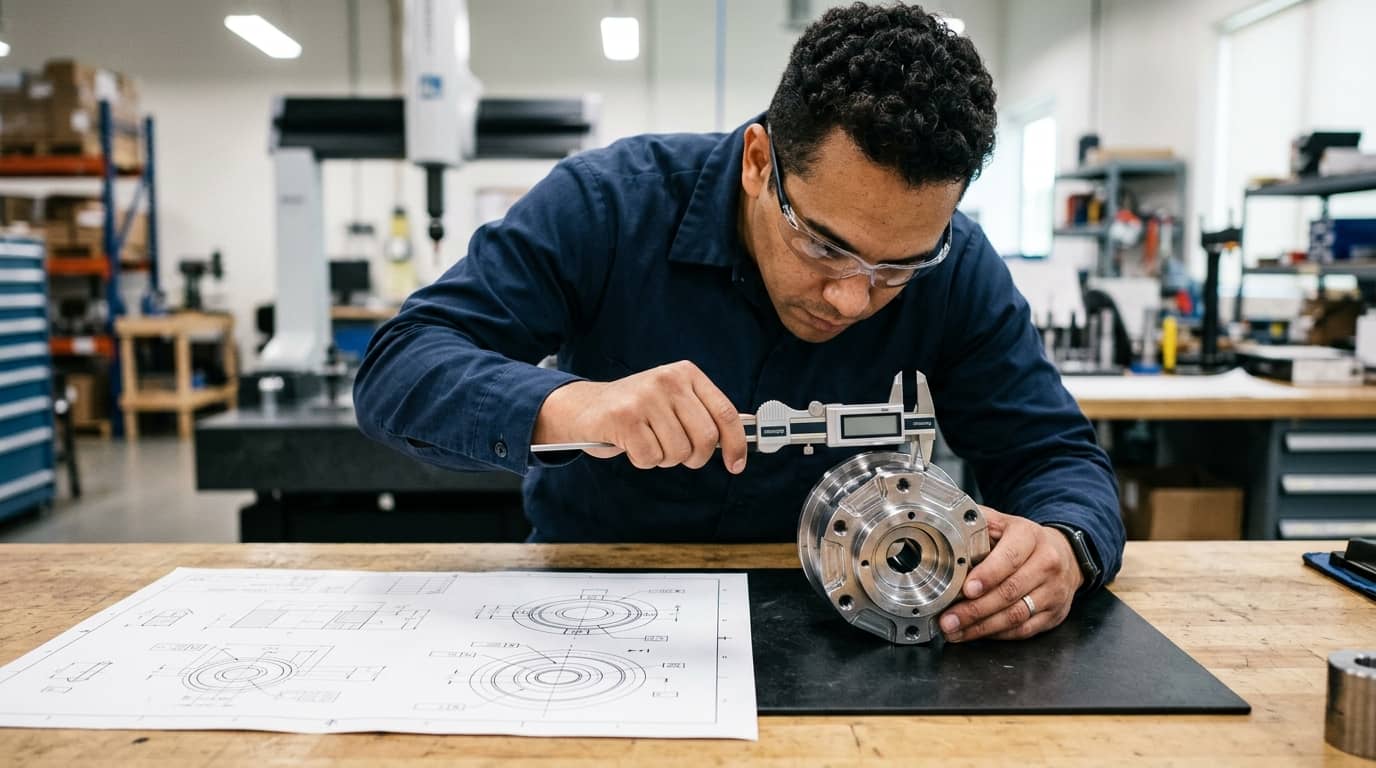
Lesson 3 • Calibrating Calipers and Micrometers
Covers gauge block use, zero setting, and multi-point verification for calipers and micrometers. Correct jaw contact and reading technique are critical skills.
Lesson 4 • Surface Finish and Hardness Instrument Calibration
Introduces calibration of surface roughness testers and hardness testing machines. Reference specimens and certified blocks are the primary calibration artifacts.
Lesson 5 • Calibrating Force and Weighing Instruments
Covers deadweight and reference load cell methods for force and balance calibration. Eccentric loading and environmental vibration are key error sources.
Chapter 7HideHide detailsSee detailsPerforming Temperature and Pressure Calibration
Performing Temperature and Pressure Calibration
Lesson 1 • Calibrating Thermometers and Thermal Imagers
Addresses liquid-in-glass, digital, and infrared thermometer calibration methods. Emissivity settings and blackbody source use are specific to infrared calibration.
Lesson 2 • Environmental Conditions During Calibration
Explains how temperature, humidity, and vibration affect temperature and pressure calibration. Students monitor and record conditions to validate calibration results.
Lesson 3 • Calibrating Differential Pressure Instruments
Covers the unique setup for calibrating differential pressure transmitters and manometers. Proper isolation and equalization valve sequencing prevents instrument damage.
Lesson 4 • Calibrating Pressure Gauges and Transmitters
Explains deadweight tester and reference gauge methods for pressure instrument calibration. Fluid type, head correction, and leak checks are procedural requirements.
Lesson 5 • Calibrating Thermocouples and RTDs
Covers dry-block calibrator and liquid bath use for thermocouple and RTD calibration. Immersion depth and thermal equilibrium are critical to accurate results.
Chapter 8HideHide detailsSee detailsCalibration Program Management and Continuous Improvement
Calibration Program Management and Continuous Improvement
Lesson 1 • Continuous Improvement in Calibration
Applies root cause analysis and corrective action tools to recurring calibration problems. Students close the improvement loop through verification and effectiveness checks.
Lesson 2 • Preparing for Calibration Audits
Prepares students to present calibration records, procedures, and evidence during audits. Audit readiness requires organized documentation and trained personnel.
Lesson 3 • Building a Calibration Recall System
Establishes processes for scheduling, tracking, and recalling instruments due for calibration. Effective recall prevents use of out-of-date instruments in production.
Lesson 4 • Calibration Interval Optimization
Applies historical calibration data to adjust intervals based on instrument stability. Interval optimization balances calibration cost against measurement risk.
Lesson 5 • Out-of-Tolerance and Impact Assessment
Defines the process for investigating out-of-tolerance findings and assessing product impact. Systematic impact assessment protects product quality and customer confidence.
Lesson 6 • Calibration Program Metrics and KPIs
Identifies key performance indicators for monitoring calibration program health. Metrics drive management decisions and support continuous improvement initiatives.
Your valid completion certificate
This course is for you:
Calibration technician: seeking structured knowledge to back up hands-on experience.
Quality inspector: responsible for instrument control but lacking formal metrology training.
Manufacturing engineer: needing to evaluate and improve an existing calibration program.
Lab technician: transitioning into a dedicated metrology or standards-focused role.
Career changer: entering precision industries from a general technical or trades background.
Quality manager: overseeing calibration compliance without deep technical expertise yet.
What our students say
Your classes are perfect. I purchased the one-year package and finally have the opportunity to follow various topics of my interest without needing to switch platforms... I thank you for everything you do, I've already recommended you to other people...

I like how the lessons are straight to the point and how I can switch chapters and skip content I don't need.

I like the content and the presentation style and video transcription, which speeds up the process!

The platform is fast, simple to use. The diversity of content and complementary videos really help with learning.

Top trainings




FAQ
Who is Dedika?
Is the certificate valid in the United States?
Are the courses free?
What is the course workload?
What are the courses like?
How do the courses work?
What is the duration of the courses?
What is the cost or price of the courses?
What is an EAD or online course and how does it work?
PDF Course