
Industrial Mechanical Maintenance Course
Master the hands-on skills that keep industrial machinery running at peak performance. This course covers everything from bearings, seals, and pumps to precision alignment, hydraulic systems, and predictive maintenance strategies. Whether you're starting out or leveling up, you'll gain the technical knowledge employers need on the plant floor.
What you will learn:
You'll build a complete foundation in industrial mechanical maintenance, starting with hand tools, safety protocols, and engineering drawings. From there, you'll move into power transmission systems, bearing selection and installation, and seal and gasket repair. You'll learn to maintain and troubleshoot centrifugal pumps, compressors, and hydraulic and pneumatic circuits. Precision shaft alignment using both dial indicators and laser systems is covered in full detail. The course also trains you in predictive maintenance tools including vibration analysis, infrared thermography, and oil analysis. By the end, you'll have the practical skills to reduce downtime, extend equipment life, and perform at a professional level in any industrial maintenance role.
How you study in practice Industrial Mechanical Maintenance Course
How you practice Industrial Mechanical Maintenance Course
For companies that want to train their team
With Dedika for Business, the course includes exercises and examples tailored to your own business and the way your company needs.

Course content
8 Chapters • 39 LessonsDuration between 4 and 360 hours (you decide)
Chapter 1HideHide detailsSee detailsFoundations of Industrial Maintenance
Foundations of Industrial Maintenance
Lesson 1 • Introduction to Engineering Drawings
Explains orthographic views, section cuts, and dimension notation used in mechanical drawings. Drawing literacy enables technicians to plan repairs and order correct parts.
Lesson 2 • Workplace Safety Fundamentals
Covers hazard recognition, personal protective equipment, and lockout/tagout procedures. Safety compliance underpins every hands-on task in this course.
Lesson 3 • Reading Technical Documents
Teaches interpretation of equipment manuals, parts lists, and maintenance schedules. Accurate document reading reduces errors during all subsequent repair tasks.
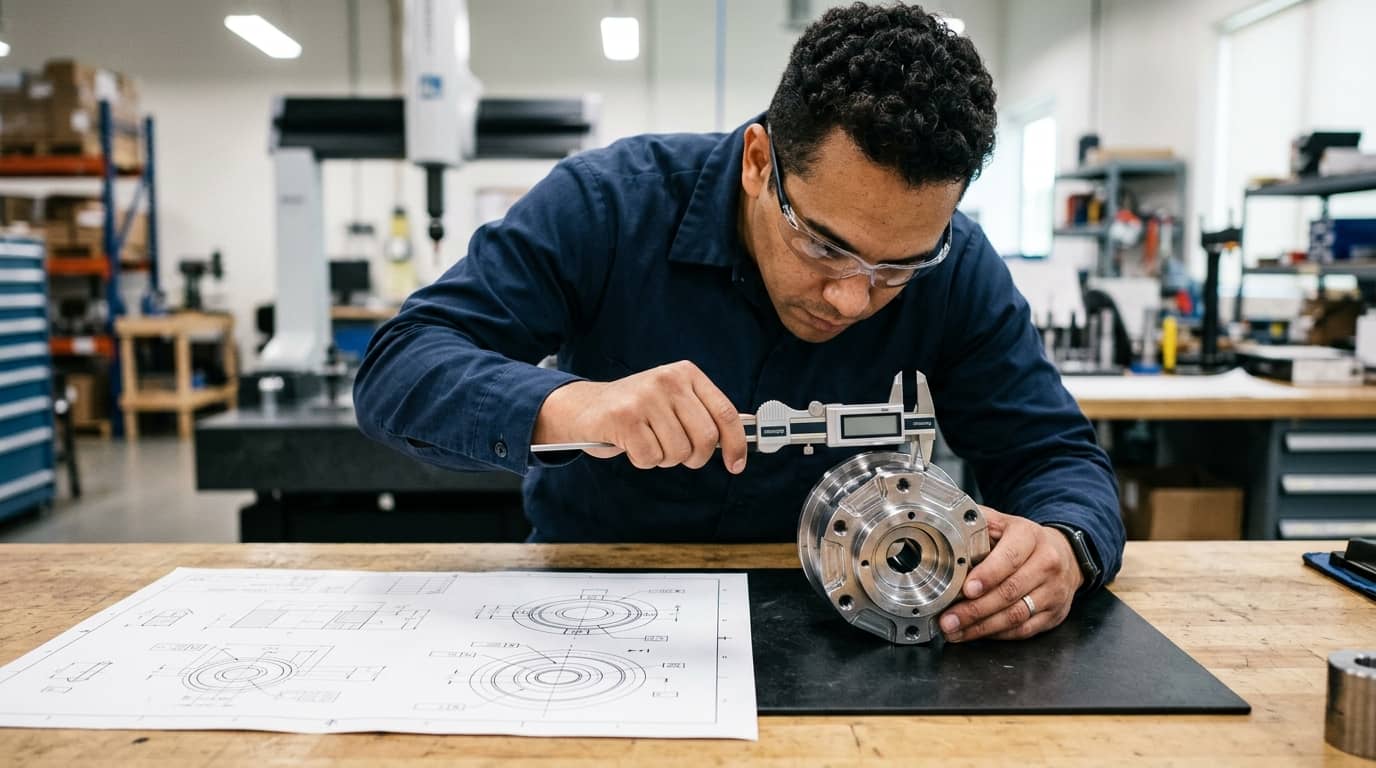
Lesson 4 • Hand Tools and Measuring Instruments
Introduces correct selection, use, and care of common hand tools and precision measuring devices. Proper tool use is prerequisite to all mechanical repair work.
Lesson 5 • The Industrial Maintenance Role
Defines the maintenance technician's responsibilities within production environments. Connects job scope to plant reliability and uptime goals.
Chapter 2HideHide detailsSee detailsMechanical Principles and Power Transmission
Mechanical Principles and Power Transmission
Lesson 1 • Shafts, Keys, and Couplings
Examines shaft design, keyway fits, and coupling types used to connect rotating components. Correct assembly prevents misalignment and premature wear.
Lesson 2 • Clutches and Brakes
Describes friction clutch and industrial brake designs, adjustment methods, and wear indicators. These components control start-stop cycles and must be maintained for safe operation.
Lesson 3 • Gear Drives and Gearboxes
Introduces spur, helical, bevel, and worm gear geometry along with gearbox inspection procedures. Gear knowledge enables accurate diagnosis of noise and wear patterns.
Lesson 4 • Core Mechanics for Technicians
Reviews force, torque, work, and power as applied to industrial machinery. These principles form the analytical basis for diagnosing mechanical problems.
Lesson 5 • Belt and Chain Drive Systems
Covers V-belt, flat-belt, and roller-chain drives including tensioning and speed ratio calculations. Proper tensioning directly affects drive life and energy efficiency.
Chapter 3HideHide detailsSee detailsBearings: Selection, Installation, and Maintenance
Bearings: Selection, Installation, and Maintenance
Lesson 1 • Bearing Types and Load Ratings
Classifies rolling-element and plain bearings by geometry, load direction, and speed capability. Correct bearing selection prevents premature failure under operating loads.
Lesson 2 • Bearing Failure Analysis
Identifies spalling, brinelling, corrosion, and misalignment damage patterns on failed bearings. Root-cause analysis prevents repeat failures and guides corrective action.
Lesson 3 • Bearing Installation Techniques
Demonstrates cold-press, heat-mounting, and hydraulic methods for safe bearing installation. Proper technique prevents damage to raceways and rolling elements during fitting.
Lesson 4 • Bearing Fits and Tolerances
Explains interference and clearance fits for inner and outer rings on shafts and housings. Correct fits prevent creep, fretting, and premature race wear.
Lesson 5 • Bearing Lubrication Management
Covers grease and oil lubrication selection, quantity, and relubrication intervals for rolling bearings. Correct lubrication accounts for the majority of bearing life extension.
Chapter 4HideHide detailsSee detailsSeals, Gaskets, and Fluid Containment
Seals, Gaskets, and Fluid Containment
Lesson 1 • Static Sealing Methods
Covers gasket materials, O-ring groove design, and flange face preparation for leak-free joints. Static seal integrity is foundational to safe pressurized system operation.
Lesson 2 • Dynamic Shaft Seals
Examines lip seals, mechanical face seals, and labyrinth designs for rotating and reciprocating shafts. Proper installation prevents lubricant loss and contaminant ingress.
Lesson 3 • Seal Failure Diagnosis and Prevention
Identifies causes of seal failure including shaft runout, contamination, and improper installation. Systematic diagnosis reduces repeat seal failures and unplanned downtime.
Lesson 4 • Packing and Compression Seals
Addresses braided packing, V-ring stacks, and compression packing for valves and pump stuffing boxes. Correct packing adjustment balances leak control against shaft wear.
Chapter 5HideHide detailsSee detailsPumps and Compressors: Maintenance and Repair
Pumps and Compressors: Maintenance and Repair
Lesson 1 • Reciprocating Compressor Maintenance
Addresses valve inspection, piston ring replacement, and cylinder bore measurement for reciprocating compressors. Proper valve and ring condition directly controls compression efficiency.
Lesson 2 • Positive-Displacement Pump Maintenance
Covers gear, vane, and piston pump designs with inspection and clearance-setting procedures. These pumps require precise clearances to maintain volumetric efficiency.
Lesson 3 • Centrifugal Pump Fundamentals
Explains impeller action, pump curves, and system head to predict pump operating points. Understanding pump-system interaction is essential for diagnosing flow and pressure problems.
Lesson 4 • Pump and Compressor Troubleshooting
Applies systematic fault-tree analysis to diagnose low flow, excessive noise, and overheating in fluid machines. Structured troubleshooting reduces mean time to repair.
Lesson 5 • Centrifugal Pump Disassembly and Repair
Guides technicians through safe pump teardown, wear ring inspection, and mechanical seal replacement. Correct reassembly restores rated flow and prevents premature failure.
Chapter 6HideHide detailsSee detailsShaft Alignment and Precision Maintenance
Shaft Alignment and Precision Maintenance
Lesson 1 • Laser Alignment Systems
Covers laser-optic alignment tool setup, data entry, and live move guidance for coupled machines. Laser systems improve speed and accuracy over dial indicator methods.
Lesson 2 • Alignment Fundamentals and Terminology
Defines parallel, angular, and combined misalignment and their effects on machinery components. Clear terminology enables accurate communication of alignment conditions.
Lesson 3 • Thermal Growth Compensation
Explains how operating temperature changes shaft centerlines and how to apply pre-set offsets. Thermal compensation ensures alignment is maintained at operating conditions.
Lesson 4 • Dial Indicator Alignment Methods
Teaches rim-and-face and reverse-dial indicator setups for measuring and correcting misalignment. Dial methods remain widely used and build foundational measurement discipline.
Lesson 5 • Soft Foot Correction and Shimming
Identifies and corrects parallel, angular, and induced soft foot before performing final alignment. Uncorrected soft foot invalidates alignment readings and causes frame distortion.
Chapter 7HideHide detailsSee detailsHydraulic and Pneumatic Systems Maintenance
Hydraulic and Pneumatic Systems Maintenance
Lesson 1 • Hydraulic and Pneumatic Troubleshooting
Applies pressure and flow testing with gauges and flow meters to isolate faults in fluid power circuits. Systematic testing reduces diagnostic time and prevents unnecessary component replacement.
Lesson 2 • Hydraulic Component Maintenance
Covers inspection and service of hydraulic pumps, directional valves, cylinders, and accumulators. Component-level maintenance restores system performance and prevents catastrophic failure.
Lesson 3 • Pneumatic System Maintenance
Addresses air preparation units, directional valves, cylinders, and flow controls in pneumatic circuits. Clean, dry, regulated air is the foundation of reliable pneumatic operation.
Lesson 4 • Reading Hydraulic Circuit Diagrams
Teaches ISO symbol recognition and circuit tracing for pumps, valves, actuators, and lines. Diagram literacy is required before any hydraulic troubleshooting can begin.
Lesson 5 • Hydraulic System Fundamentals
Reviews Pascal's law, flow, pressure, and power relationships in hydraulic circuits. These principles underpin diagnosis of every hydraulic system malfunction.
Chapter 8HideHide detailsSee detailsPredictive Maintenance and Reliability Strategies
Predictive Maintenance and Reliability Strategies
Lesson 1 • Vibration Analysis Fundamentals
Introduces vibration measurement units, frequency spectra, and common fault signatures for rotating machinery. Early vibration detection prevents catastrophic bearing and gear failures.
Lesson 2 • Oil and Lubricant Analysis
Explains viscosity testing, particle counting, and wear metal analysis to assess lubricant and machine condition. Oil analysis detects internal wear before external symptoms appear.
Lesson 3 • Maintenance Strategy Overview
Compares reactive, preventive, predictive, and reliability-centered maintenance strategies by cost and effectiveness. Selecting the right strategy for each asset optimizes maintenance investment.
Lesson 4 • Infrared Thermography Applications
Covers thermal camera operation, emissivity settings, and interpretation of hot spots in mechanical and electrical equipment. Thermography identifies friction, overload, and insulation faults non-invasively.
Lesson 5 • Building a Predictive Maintenance Program
Guides creation of equipment routes, alarm limits, trending databases, and work order integration for a PdM program. A structured program converts data into timely, cost-effective maintenance actions.
Your valid completion certificate
This course is for you:
Entry-level factory worker: eager to move from labor into skilled trades.
Military veteran: translating hands-on mechanical experience into civilian plant roles.
HVAC or plumbing technician: expanding expertise into broader industrial machinery systems.
Production operator: wanting to cross-train and take on maintenance responsibilities officially.
Recent trade school graduate: ready to deepen competency before entering the workforce.
Career changer: coming from construction or automotive and pivoting to plant maintenance.
What our students say
Your classes are perfect. I purchased the one-year package and finally have the opportunity to follow various topics of my interest without needing to switch platforms... I thank you for everything you do, I've already recommended you to other people...

I like how the lessons are straight to the point and how I can switch chapters and skip content I don't need.

I like the content and the presentation style and video transcription, which speeds up the process!

The platform is fast, simple to use. The diversity of content and complementary videos really help with learning.

Top trainings




FAQ
Who is Dedika?
Is the certificate valid in the United States?
Are the courses free?
What is the course workload?
What are the courses like?
How do the courses work?
What is the duration of the courses?
What is the cost or price of the courses?
What is an EAD or online course and how does it work?
PDF Course