
Thermoforming Training
Master every stage of the thermoforming process, from sheet loading and heating to trimming and quality inspection. This training covers materials, equipment, tooling, and process control so you can run production with confidence. Whether you work on the floor or oversee a forming line, you'll build the hands-on knowledge that gets results.
What you will learn:
This course covers the complete thermoforming process, including plastic material properties, machine types, heating systems, forming techniques, and post-forming operations. You will learn how to control key process variables, diagnose and fix common defects, and apply quality inspection methods to finished parts. The curriculum also addresses mold design principles, scrap reduction, regulatory compliance, and sustainability practices. Advanced topics include design of experiments, statistical process control, and automation technologies used on modern thermoforming lines. By the end, you will have the technical knowledge to optimize processes, reduce waste, and maintain consistent part quality in a production environment.
How you study in practice Thermoforming Training
How you practice Thermoforming Training
For companies that want to train their team
With Dedika for Business, the course includes exercises and examples tailored to your own business and the way your company needs.

Course content
8 Chapters • 39 LessonsDuration between 4 and 360 hours (you decide)
Chapter 1HideHide detailsSee detailsFoundations of Thermoforming
Foundations of Thermoforming
Lesson 1 • Introduction to Plastic Forming Processes
Contrasts thermoforming with injection molding, blow molding, and extrusion. Establishes why thermoforming is chosen for specific part geometries and production volumes.
Lesson 2 • Key Process Variables
Identifies temperature, pressure, vacuum, cycle time, and sheet tension as primary control variables. Explains how each variable influences part quality.
Lesson 3 • Core Thermoforming Process Stages
Walks through sheet loading, heating, forming, trimming, and stacking in sequence. Connects each stage to downstream quality outcomes.
Lesson 4 • Workplace Safety Fundamentals
Covers hazard recognition specific to thermoforming environments including heat, pinch points, and fumes. Establishes safe work habits before hands-on training begins.
Chapter 2HideHide detailsSee detailsThermoplastic Sheet Materials
Thermoplastic Sheet Materials
Lesson 1 • Sheet Gauges, Tolerances, and Grades
Explains nominal versus actual gauge, tolerance bands, and how gauge variation affects heating uniformity. Links sheet specification to machine setup parameters.
Lesson 2 • Material Storage and Conditioning
Covers moisture absorption, pre-drying requirements, and proper storage conditions for hygroscopic resins. Prevents surface defects caused by improper material handling.
Lesson 3 • Common Thermoforming Resins
Profiles ABS, HIPS, PET, PETG, PP, HDPE, and PVC in terms of forming temperature, clarity, and end-use suitability. Enables informed material selection decisions.
Lesson 4 • Polymer Chemistry Basics for Operators
Introduces amorphous versus semi-crystalline polymer structures and their forming windows. Provides the chemical context needed to interpret material data sheets.
Lesson 5 • Material Testing and Incoming Inspection
Introduces visual inspection, thickness measurement, and basic mechanical tests for incoming sheet. Establishes a quality gate before material enters production.
Chapter 3HideHide detailsSee detailsThermoforming Equipment and Tooling
Thermoforming Equipment and Tooling
Lesson 1 • Plug Assists and Pressure Boxes
Explains how plug assists pre-stretch sheet to improve wall thickness distribution. Introduces pressure boxes for twin-sheet and pressure-forming applications.
Lesson 2 • Mold Materials and Construction
Covers aluminum, epoxy, wood, and composite mold materials with respect to heat transfer, durability, and cost. Helps students evaluate tooling options for prototype and production runs.
Lesson 3 • Trimming and Cutting Equipment
Surveys steel-rule dies, router trimmers, punch presses, and robotic cutting cells. Links trimming method selection to part geometry and production volume.
Lesson 4 • Machine Types and Configurations
Compares cut-sheet, roll-fed, and inline thermoformers by throughput, part size, and automation level. Guides machine selection for different production scenarios.
Lesson 5 • Heating Systems and Oven Zones
Details radiant, convection, and contact heating technologies and their zone control strategies. Connects heater configuration to uniform sheet temperature profiles.
Chapter 4HideHide detailsSee detailsHeating and Sheet Temperature Control
Heating and Sheet Temperature Control
Lesson 1 • Heating Cycle Time Optimization
Balances throughput goals against the need for full sheet heat soak. Introduces methods to reduce cycle time without sacrificing part quality.
Lesson 2 • Heat Transfer Principles in Thermoforming
Applies conduction, convection, and radiation concepts to sheet heating. Provides the physics foundation for understanding oven zone settings.
Lesson 3 • Forming Window Identification
Defines the forming window as the temperature range between adequate softening and degradation. Teaches how to determine and verify the window for each resin.
Lesson 4 • Oven Zone Setup and Profiling
Guides students through setting top and bottom heater zones to achieve uniform sheet temperature. Addresses edge-to-center temperature gradients and correction strategies.
Lesson 5 • Temperature-Related Defect Diagnosis
Catalogs webbing, thinning, blistering, and orange peel as temperature-driven defects. Provides a structured diagnostic approach to identify root causes.
Chapter 5HideHide detailsSee detailsForming Techniques and Process Control
Forming Techniques and Process Control
Lesson 1 • Process Parameter Documentation
Establishes the practice of recording all forming parameters in a setup sheet for repeatability. Links parameter documentation to first-article approval and production sign-off.
Lesson 2 • Twin-Sheet Thermoforming
Introduces simultaneous forming of two sheets to create hollow, structural parts. Covers sheet alignment, bonding pressure, and weld line integrity.
Lesson 3 • Pressure Forming Process Control
Extends vacuum forming with positive air pressure to achieve sharper detail and thinner walls. Addresses pressure box setup, sealing, and pressure ramp profiles.
Lesson 4 • Vacuum Forming Fundamentals
Covers mold draw, vacuum application timing, and sheet drape behavior. Establishes vacuum forming as the baseline technique for all subsequent forming methods.
Lesson 5 • Plug-Assist Forming Techniques
Integrates plug assist motion with vacuum or pressure to redistribute material before final forming. Teaches plug geometry selection and timing optimization.
Chapter 6HideHide detailsSee detailsCooling, Demolding, and Trimming
Cooling, Demolding, and Trimming
Lesson 1 • Warpage and Shrinkage Control
Identifies causes of warpage including uneven cooling, residual stress, and material orientation. Provides corrective strategies such as fixtures, cooling adjustments, and annealing.
Lesson 2 • Trimming Methods and Tolerances
Applies trimming equipment knowledge to achieve dimensional tolerances on finished parts. Covers die setup, router path programming, and trim quality inspection.
Lesson 3 • Scrap Reduction and Regrind Management
Quantifies trim skeleton and off-spec part scrap and introduces regrind blending practices. Connects scrap reduction to material cost and sustainability goals.
Lesson 4 • Demolding and Part Release
Covers draft angles, mold release agents, and ejector pin placement for reliable part release. Addresses sticking, distortion, and surface marking during demolding.
Lesson 5 • Cooling Principles and Mold Temperature
Explains how mold temperature and cooling time affect crystallinity, shrinkage, and residual stress. Guides students in setting mold temperature controllers for each resin.
Chapter 7HideHide detailsSee detailsQuality Control and Inspection
Quality Control and Inspection
Lesson 1 • Statistical Process Control Basics
Introduces control charts, Cpk, and sampling plans to monitor process stability over time. Enables operators to detect process drift before defects reach the customer.
Lesson 2 • Visual and Surface Quality Standards
Defines cosmetic defect classifications including scratches, sink marks, and contamination. Establishes accept/reject criteria using visual limit samples.
Lesson 3 • Non-Conformance and Corrective Action
Establishes a formal non-conformance reporting process and root-cause analysis methodology. Closes the quality loop by linking defect data back to process improvements.
Lesson 4 • Wall Thickness Measurement
Uses ultrasonic gauges and cross-section analysis to map wall thickness distribution. Links thickness data to forming parameter adjustments.
Lesson 5 • Dimensional Inspection Techniques
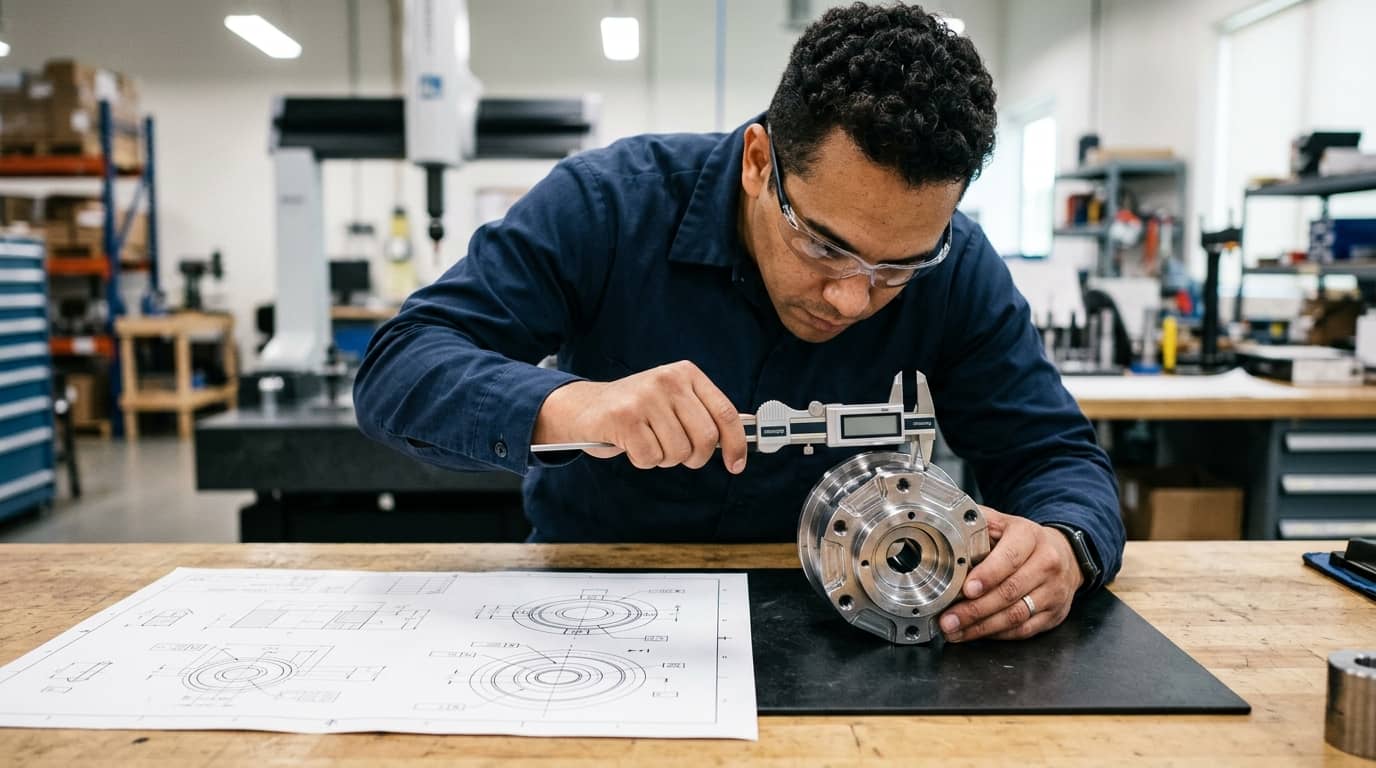
Applies calipers, CMM, and optical comparators to verify part dimensions against engineering drawings. Establishes measurement system accuracy as a prerequisite for process control.
Chapter 8HideHide detailsSee detailsAdvanced Process Optimization and Troubleshooting
Advanced Process Optimization and Troubleshooting
Lesson 1 • Systematic Troubleshooting Methodology
Introduces a structured eight-step troubleshooting framework adapted for thermoforming. Prevents trial-and-error approaches that waste material and machine time.
Lesson 2 • Process Capability and Continuous Improvement
Uses Cp, Cpk, and OEE metrics to quantify process performance and set improvement targets. Embeds a continuous improvement culture through structured review cadences.
Lesson 3 • Wall Thickness Optimization Strategies
Combines plug geometry, heating profiles, and mold design changes to maximize minimum wall thickness. Addresses deep-draw parts where thinning is the primary quality risk.
Lesson 4 • Cycle Time Reduction Without Quality Loss
Identifies cycle time bottlenecks in heating, forming, cooling, and trimming stages. Applies lean principles to eliminate non-value-added time while maintaining part quality.
Lesson 5 • Design of Experiments for Process Optimization
Applies factorial and response-surface DOE methods to identify optimal forming parameter combinations. Reduces the number of trials needed to achieve target quality metrics.
Your valid completion certificate
This course is for you:
Machine operators: ready to move beyond routine tasks into process ownership.
Production supervisors: needing a stronger technical foundation to lead forming lines.
Plastics engineering students: bridging classroom theory with real manufacturing practice.
Maintenance technicians: wanting to understand forming processes to reduce equipment downtime.
Quality inspectors: expanding their scope to include thermoforming-specific defect analysis.
Career changers: entering plastics manufacturing from other industrial or technical backgrounds.
What our students say
Your classes are perfect. I purchased the one-year package and finally have the opportunity to follow various topics of my interest without needing to switch platforms... I thank you for everything you do, I've already recommended you to other people...

I like how the lessons are straight to the point and how I can switch chapters and skip content I don't need.

I like the content and the presentation style and video transcription, which speeds up the process!

The platform is fast, simple to use. The diversity of content and complementary videos really help with learning.

Top trainings




FAQ
Who is Dedika?
Is the certificate valid in the United States?
Are the courses free?
What is the course workload?
What are the courses like?
How do the courses work?
What is the duration of the courses?
What is the cost or price of the courses?
What is an EAD or online course and how does it work?
PDF Course