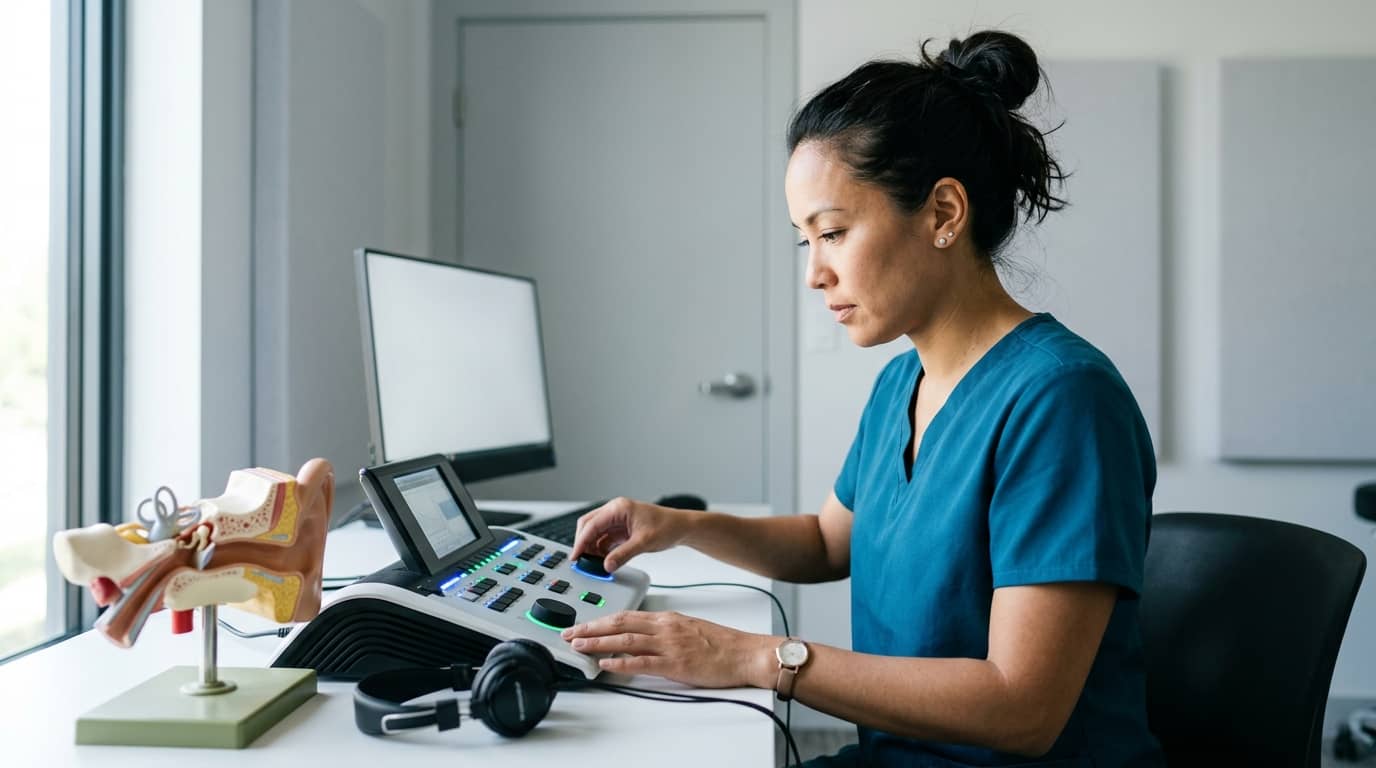
Speech and Hearing Course
Master the full scope of speech-language pathology and audiology — from anatomy and acoustics to clinical assessment and evidence-based treatment. This course equips you with the diagnostic skills, intervention strategies, and professional competencies needed to evaluate and treat communication disorders across the lifespan. Whether you're entering the field or advancing your clinical expertise, this is the comprehensive foundation your career demands.
What you will learn:
You will build a thorough understanding of the anatomy and physiology underlying speech production and hearing, then apply that knowledge to acoustic analysis and audiological testing procedures. You will learn to assess and diagnose the full range of speech, language, and hearing disorders in children and adults using standardised tools and clinical frameworks. The course covers hearing aid technology, cochlear implants, and aural rehabilitation programme design. You will also study evidence-based intervention approaches for articulation, fluency, voice, language, and acquired communication disorders. Additional topics include AAC systems, dysphagia management, tinnitus treatment, telepractice, multicultural considerations, and professional ethics.
How you study in practice Speech and Hearing Course
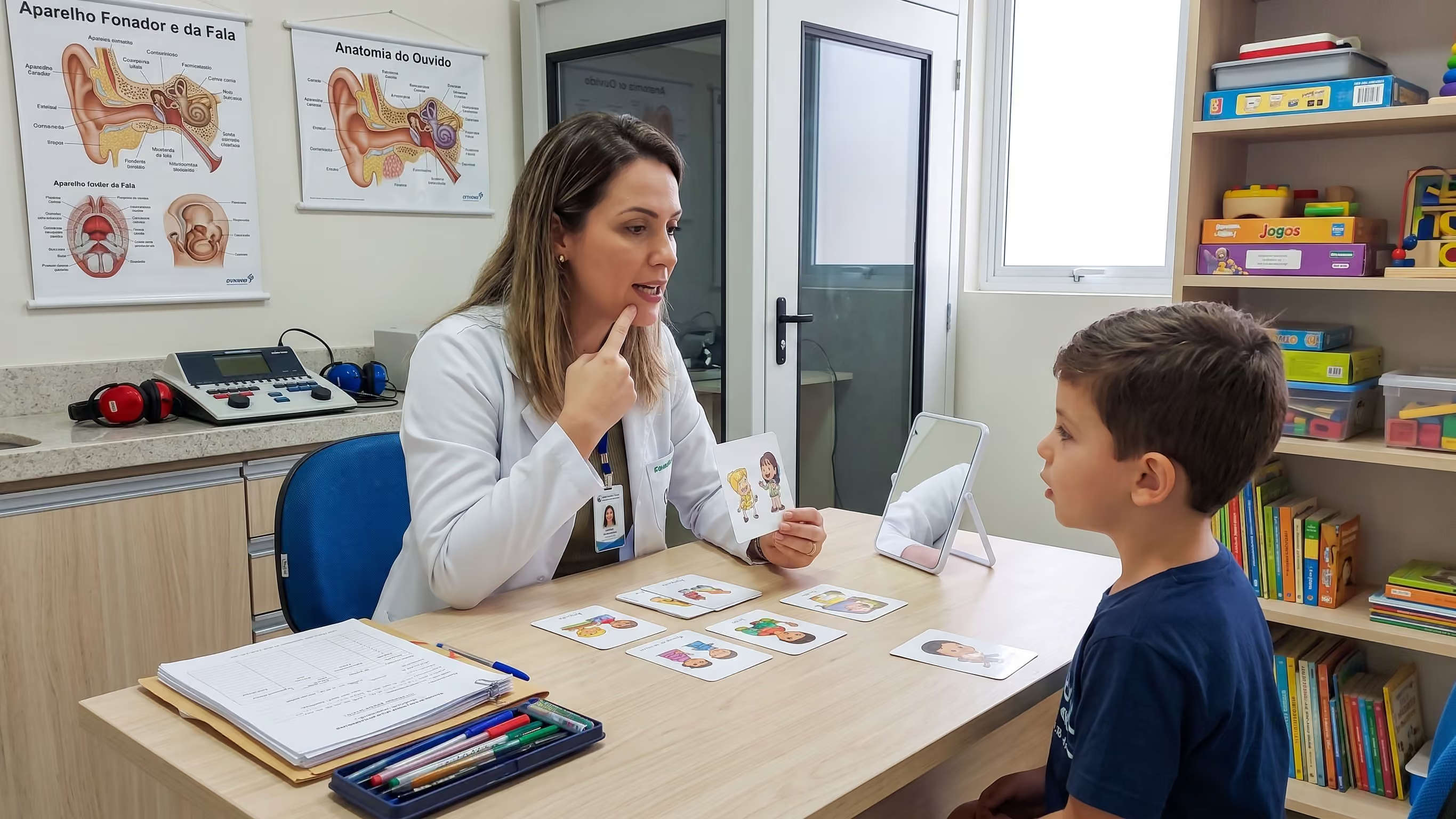
How you practise Speech and Hearing Course
For companies looking to train their teams
With Dedika for businesses, the course includes exercises and examples tailored to your company and its specific needs.

Course content
8 Chapters • 39 LessonsDuration between 4 and 360 hours (you decide)
Chapter 1HideHide detailsSee detailsFoundations of Human Communication
Foundations of Human Communication
Lesson 1 • Communication Development Across the Lifespan
Traces normal speech, language, and hearing milestones from infancy through older adulthood. Provides a developmental baseline for identifying disorders.
Lesson 2 • Physiology of Hearing
Describes how mechanical vibration converts to neural signals via the cochlea and auditory nerve. Grounds students in the biological basis of hearing sensitivity.
Lesson 3 • Anatomy of the Auditory System
Examines outer, middle, and inner ear structures and their roles in sound transmission. Links structural knowledge to hearing function covered later.
Lesson 4 • Physiology of Speech Production
Explains how respiration, phonation, resonance, and articulation coordinate to produce intelligible speech. Prepares students for acoustic analysis in later chapters.
Lesson 5 • Anatomy of the Speech Mechanism
Covers respiratory, laryngeal, and articulatory structures involved in speech production. Establishes anatomical vocabulary used throughout the course.
Chapter 2HideHide detailsSee detailsAcoustics and Psychoacoustics
Acoustics and Psychoacoustics
Lesson 1 • Basic Principles of Sound
Introduces frequency, amplitude, wavelength, and phase as fundamental acoustic properties. Establishes the physical vocabulary needed for audiometric and speech analysis.
Lesson 2 • Instrumentation and Calibration
Introduces audiometers, sound level meters, and acoustic calibration standards. Ensures students can verify equipment accuracy before clinical use.
Lesson 3 • Acoustic Analysis of Speech
Examines spectral characteristics of vowels, consonants, and prosody using spectrographic tools. Connects acoustic patterns to articulatory gestures studied in Chapter 1.
Lesson 4 • Psychoacoustic Principles
Covers loudness, pitch, and timbre perception, including masking and critical bands. Explains how perceptual phenomena affect audiometric test interpretation.
Chapter 3HideHide detailsSee detailsHearing Assessment Fundamentals
Hearing Assessment Fundamentals
Lesson 1 • Pure-Tone Audiometry
Teaches air and bone conduction threshold testing using standard and modified procedures. Forms the cornerstone of the audiological test battery.
Lesson 2 • Speech Audiometry
Covers speech recognition threshold and word recognition score testing. Validates pure-tone findings and assesses functional hearing ability.
Lesson 3 • Audiological Report Writing
Structures findings into professional reports with diagnosis, degree, and configuration of hearing loss. Prepares students for interdisciplinary communication.
Lesson 4 • Immittance Audiometry
Explains tympanometry and acoustic reflex testing to assess middle ear function. Differentiates conductive from sensorineural pathology.
Lesson 5 • Paediatric Hearing Assessment
Adapts audiological procedures for infants and young children using behavioural and physiological methods. Addresses developmental considerations in test selection.
Chapter 4HideHide detailsSee detailsAdvanced Audiological Diagnostics
Advanced Audiological Diagnostics
Lesson 1 • Auditory Steady-State Response
Introduces ASSR for frequency-specific threshold estimation in difficult-to-test populations. Complements ABR findings for hearing aid fitting decisions.
Lesson 2 • Auditory Brainstem Response
Teaches ABR recording, waveform identification, and threshold estimation. Differentiates cochlear from retrocochlear pathology using latency analysis.
Lesson 3 • Central Auditory Processing Assessment
Evaluates auditory processing abilities beyond peripheral hearing sensitivity. Identifies processing deficits affecting speech understanding in noise.
Lesson 4 • Otoacoustic Emissions Testing
Covers transient and distortion-product OAE recording and interpretation. Assesses outer hair cell function independent of patient response.
Lesson 5 • Vestibular Assessment Overview
Introduces videonystagmography and rotary chair testing for balance system evaluation. Connects vestibular and auditory anatomy from Chapter 1.
Chapter 5HideHide detailsSee detailsSpeech and Language Disorders
Speech and Language Disorders
Lesson 1 • Voice Disorders
Classifies organic, functional, and neurogenic voice disorders by aetiology and perceptual features. Introduces laryngoscopic and acoustic voice evaluation.
Lesson 2 • Articulation and Phonological Disorders
Distinguishes motor-based articulation errors from phonological pattern disorders. Provides classification frameworks used in clinical diagnosis.
Lesson 3 • Language Disorders in Children
Covers developmental language disorder, late language emergence, and specific language impairment. Links language deficits to academic and social outcomes.
Lesson 4 • Acquired Language Disorders
Covers aphasia, right hemisphere disorder, and traumatic brain injury communication deficits. Addresses neurological bases and standardised assessment tools.
Lesson 5 • Fluency Disorders
Examines stuttering and cluttering, including core behaviours, secondary behaviours, and affective components. Prepares students for comprehensive fluency evaluation.
Chapter 6HideHide detailsSee detailsSpeech and Language Intervention
Speech and Language Intervention
Lesson 1 • Language Intervention Approaches
Covers milieu teaching, narrative intervention, and grammar-focused approaches for language disorders. Addresses both child-directed and naturalistic service delivery.
Lesson 2 • Aphasia and Acquired Disorder Rehabilitation
Applies constraint-induced language therapy, script training, and AAC to acquired communication disorders. Addresses functional communication in real-world contexts.
Lesson 3 • Fluency and Voice Therapy
Presents stuttering modification, fluency shaping, and voice hygiene programmes. Integrates behavioural and psychosocial components of treatment.
Lesson 4 • Articulation and Phonology Treatment
Applies traditional articulation therapy, minimal pairs, and cycles approaches to phonological disorders. Matches treatment selection to disorder type and severity.
Lesson 5 • Principles of Evidence-Based Practice
Integrates research evidence, clinical expertise, and client values into treatment decisions. Establishes the decision-making framework applied in all intervention sections.
Chapter 7HideHide detailsSee detailsHearing Rehabilitation and Amplification
Hearing Rehabilitation and Amplification
Lesson 1 • Hearing Aid Technology and Selection
Covers hearing aid styles, signal processing features, and candidacy criteria. Prepares students to match device technology to individual hearing profiles.
Lesson 2 • Cochlear Implants and Bone-Anchored Devices
Introduces cochlear implant candidacy, surgical process, and post-implant mapping. Extends amplification knowledge to surgical hearing solutions.
Lesson 3 • Counselling in Audiological Practice
Applies informational and personal adjustment counselling to hearing loss acceptance and device use. Integrates family and caregiver involvement in rehabilitation.
Lesson 4 • Aural Rehabilitation Programmes
Designs structured programmes combining auditory training, speechreading, and communication strategies. Addresses adults and children with hearing loss.
Lesson 5 • Hearing Aid Fitting and Verification
Teaches prescriptive fitting methods, real-ear measurement, and functional gain verification. Ensures amplification targets are met before dispensing.
Chapter 8HideHide detailsSee detailsProfessional Practice and Clinical Management
Professional Practice and Clinical Management
Lesson 1 • Caseload and Workload Management
Applies caseload versus workload models to prioritise services and prevent burnout. Addresses scheduling, productivity standards, and service delivery models.
Lesson 2 • Clinical Documentation and Billing
Covers SOAP notes, progress reports, and procedural coding for clinical services. Ensures accurate records that support continuity of care and reimbursement.
Lesson 3 • Continuing Competence and Professional Growth
Establishes habits of reflective practice, continuing education, and professional portfolio development. Prepares graduates for lifelong learning in a changing field.
Lesson 4 • Interprofessional Collaboration
Builds skills for effective teamwork with physicians, educators, and allied health professionals. Addresses role clarity and shared decision-making in team settings.
Lesson 5 • Ethical Principles in Practice
Applies professional codes of ethics to clinical decision-making and boundary management. Prepares students to resolve conflicts between competing ethical obligations.
Your valid completion certificate
This course is for you:
Undergraduate student: building a science foundation before applying to graduate programmes.
Career changer: moving from education or healthcare into communication sciences professionally.
Audiology assistant: seeking deeper theoretical grounding to support licensed supervising audiologists.
Special education teacher: expanding knowledge of communication disorders affecting students daily.
International clinician: updating credentials to meet North American diagnostic and practice standards.
Healthcare aide: preparing to collaborate more effectively with speech and hearing specialists.
What our students say
Your lessons are perfect. I purchased the one-year package and finally have the opportunity to follow various topics of interest without needing to change platforms... I'm grateful for everything you do, I've already recommended you to other people...

I like how the lessons are straight to the point and how I can change chapters and skip content I don't need.

I like the content and the way videos are presented and transcribed, which speeds up the process!

The platform is fast, simple to use. The diversity of content and complementary videos really help with learning.

Top qualifications







FAQ
Who is Dedika?
Is the certificate valid in South Africa?
Are the courses free?
What is the course workload?
What are the courses like?
How do the courses work?
What is the duration of the courses?
What is the cost or price of the courses?
What is an EAD or online course and how does it work?
PDF Course