
Hearing Aid Technician Training
Launch a hands-on career in hearing healthcare with the comprehensive Hearing Aid Technician Training programme. From ear anatomy and audiogram interpretation to device programming, earmold fabrication, and client counselling, every core competency is covered in practical detail. Whether you're entering the field or formalising existing clinic experience, this training gives you the technical foundation and professional skills employers expect.
What you will learn:
Interpret audiograms and classify hearing loss types to support accurate device selection decisions.
Perform real-ear measurement procedures and match programmed gain to prescriptive fitting targets.
Fabricate and modify earmolds and custom shells using impression techniques and quality inspection criteria.
Configure hearing aid fitting software, adjust compression settings, and create environment-specific listening programmes.
Conduct routine maintenance, bench repairs, and electroacoustic testing to keep devices performing to specification.
Apply professional ethics, infection control protocols, and documentation standards required for regulatory compliance.
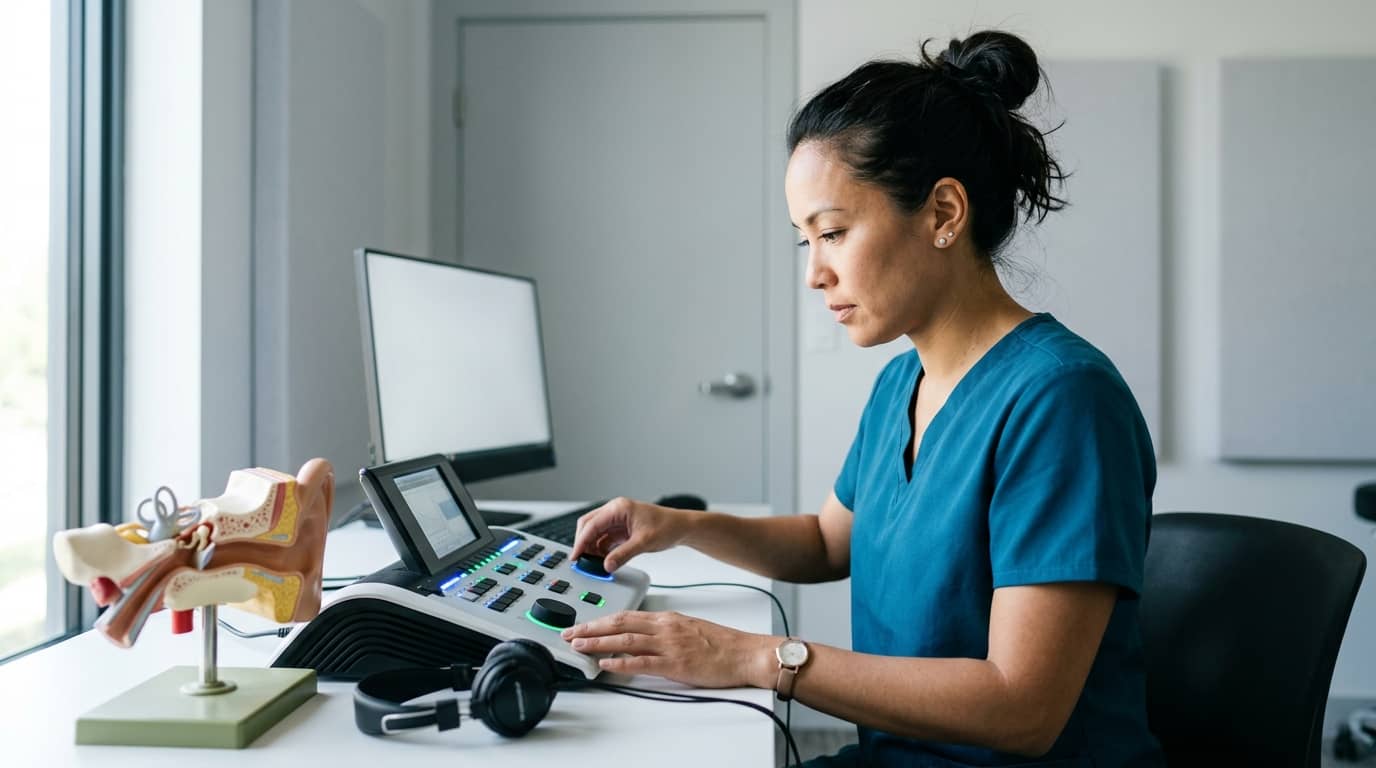
How you study in practice Hearing Aid Technician Training
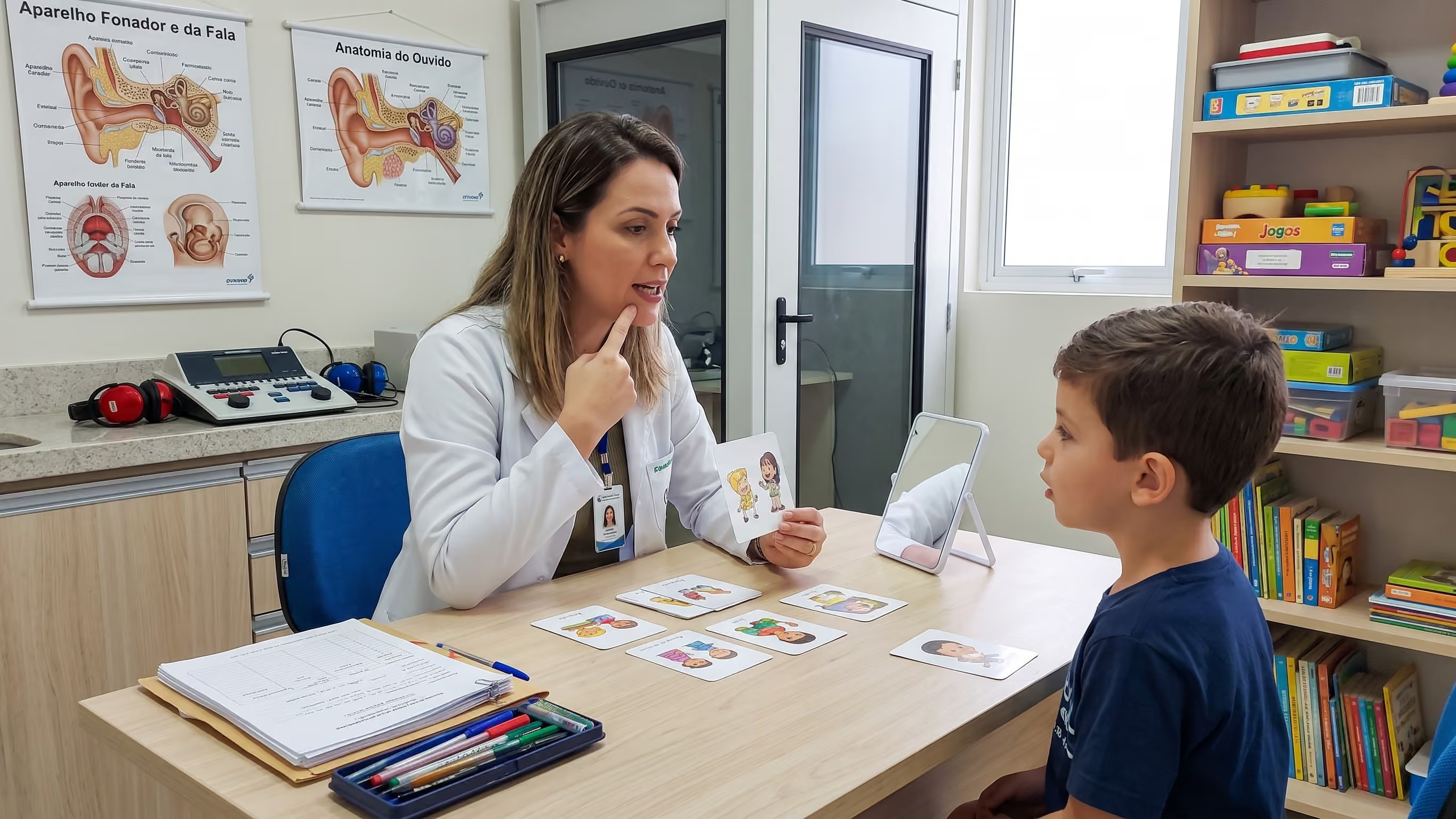
How you practise Hearing Aid Technician Training
For companies looking to train their teams
With Dedika for businesses, the course includes exercises and examples tailored to your company and its specific needs.

Course content
8 Chapters • 37 LessonsDuration between 4 and 360 hours (you decide)
Chapter 1HideHide detailsSee detailsFoundations of Hearing and Audiology
Foundations of Hearing and Audiology
Lesson 1 • Physics of Sound and Hearing
Explains frequency, amplitude, decibels, and sound wave behaviour. Connects acoustic principles to how hearing aids capture and process sound.
Lesson 2 • Types and Causes of Hearing Loss
Differentiates conductive, sensorineural, and mixed hearing loss by origin and audiological profile. Prepares technicians to match device solutions to loss type.
Lesson 3 • Anatomy of the Human Ear
Covers outer, middle, and inner ear structures and their roles in sound transmission. Establishes anatomical vocabulary used throughout the entire course.
Lesson 4 • Reading and Interpreting Audiograms
Teaches audiogram symbols, axes, and threshold markings for both ears. Technicians use audiogram data to guide device selection and fitting.
Chapter 2HideHide detailsSee detailsHearing Aid Technology Overview
Hearing Aid Technology Overview
Lesson 1 • Digital Signal Processing Fundamentals
Explains analogue-to-digital conversion, compression, and noise reduction algorithms. Provides the technical basis for programming decisions covered in later chapters.
Lesson 2 • Wireless Connectivity and Accessories
Covers Bluetooth, proprietary wireless protocols, and remote microphone accessories. Prepares technicians to configure and troubleshoot connected hearing systems.
Lesson 3 • Hearing Aid Selection Criteria
Applies audiogram data and lifestyle factors to device selection decisions. Bridges product knowledge to client-centred fitting practice.
Lesson 4 • Hearing Aid Styles and Form Factors
Surveys behind-the-ear, in-the-ear, receiver-in-canal, and implantable styles. Connects physical form to candidacy criteria established in Chapter 1.
Lesson 5 • Core Components of a Hearing Aid
Identifies microphones, amplifiers, receivers, batteries, and processors within a device. Understanding components enables accurate troubleshooting and repair.
Chapter 3HideHide detailsSee detailsEarmold and Shell Fabrication
Earmold and Shell Fabrication
Lesson 1 • Ear Impression Materials and Techniques
Covers silicone and foam impression materials, mixing ratios, and injection methods. Accurate impressions are the foundation of well-fitting earmolds and custom shells.
Lesson 2 • Earmold Design and Venting Options
Explains full-shell, skeleton, canal, and open earmold designs and their acoustic effects. Vent selection directly impacts gain, occlusion, and feedback.
Lesson 3 • Custom Shell Fabrication Process
Walks through 3D scanning, UV curing, and traditional acrylic shell production methods. Technicians learn quality checkpoints at each fabrication stage.
Lesson 4 • Earmold Modifications and Repairs
Teaches buffing, canal trimming, vent drilling, and tubing replacement on existing earmolds. Modification skills reduce remake costs and improve client satisfaction.
Chapter 4HideHide detailsSee detailsHearing Aid Fitting and Verification
Hearing Aid Fitting and Verification
Lesson 1 • Functional Gain and Sound Field Testing
Uses aided and unaided sound field thresholds to estimate functional benefit when probe-tube equipment is unavailable. Provides an alternative verification method for field settings.
Lesson 2 • Fitting Software and Programming
Explains manufacturer fitting software navigation, audiogram entry, and programme creation. Software proficiency is required for all subsequent programming and fine-tuning tasks.
Lesson 3 • Real-Ear Measurement Procedures
Covers probe tube placement, REUR, REAG, REIG, and REAR measurements. Real-ear data confirms that programmed gain matches prescriptive targets in the client's ear.
Lesson 4 • Prescriptive Fitting Targets
Introduces NAL-NL2, DSL, and proprietary prescriptive methods and their underlying rationale. Targets guide initial programming before real-ear verification.
Lesson 5 • Fitting Outcome Validation
Applies speech perception tests and self-report questionnaires to confirm real-world benefit. Validation distinguishes verification success from meaningful client improvement.
Chapter 5HideHide detailsSee detailsHearing Aid Programming and Fine-Tuning
Hearing Aid Programming and Fine-Tuning
Lesson 1 • Gain and Compression Adjustments
Teaches channel-specific gain changes, compression ratio, and knee-point modifications. These adjustments resolve loudness complaints and improve soft-sound audibility.
Lesson 2 • Troubleshooting Programming Issues
Diagnoses and resolves common software errors, connectivity failures, and unexpected output behaviours. Systematic troubleshooting reduces chair time and client frustration.
Lesson 3 • Directional Microphone Configuration
Programmes fixed, adaptive, and binaural beamforming directional modes for different environments. Directional settings improve signal-to-noise ratio in challenging listening situations.
Lesson 4 • Environment-Specific Programme Creation
Builds dedicated programmes for music, telephone, restaurant, and outdoor use. Multiple programmes address the varied acoustic demands clients encounter daily.
Lesson 5 • Feedback and Noise Management
Configures feedback cancellation strength, noise reduction aggressiveness, and wind noise suppression. Proper settings prevent whistling without sacrificing speech clarity.
Chapter 6HideHide detailsSee detailsHearing Aid Maintenance and Repair
Hearing Aid Maintenance and Repair
Lesson 1 • Tubing and Receiver Replacement
Demonstrates standard and thin-tube replacement, receiver wire swapping, and dome selection. Tubing and receiver integrity directly affect sound quality and feedback.
Lesson 2 • Electroacoustic Analysis and Testing
Uses a hearing aid test box to measure OSPL90, full-on gain, frequency response, and distortion. Test box data confirms device performance meets manufacturer specifications.
Lesson 3 • Routine Cleaning and Care Procedures
Covers wax filter replacement, microphone port cleaning, and moisture removal protocols. Daily and weekly care routines prevent the majority of device failures.
Lesson 4 • Bench Repair and Component Replacement
Teaches microphone, receiver, and volume control replacement using bench tools. Bench repair skills reduce manufacturer return rates and turnaround time.
Lesson 5 • Battery and Power System Service
Addresses zinc-air battery handling, rechargeable system maintenance, and battery door repair. Power system faults are the most frequent cause of client complaints.
Chapter 7HideHide detailsSee detailsClient Counselling and Orientation
Client Counselling and Orientation
Lesson 1 • Setting Realistic Expectations
Explains acclimatisation periods, background noise limitations, and bilateral fitting benefits. Accurate expectations reduce dissatisfaction and early device abandonment.
Lesson 2 • Aural Rehabilitation Basics
Introduces listening strategies, communication tactics, and group rehabilitation programme referrals. Aural rehabilitation extends benefit beyond what amplification alone provides.
Lesson 3 • Hearing Aid Orientation and Instruction
Guides clients through insertion, removal, battery change, and cleaning of their specific device. Hands-on orientation reduces early return visits and builds client confidence.
Lesson 4 • Counselling Clients with Special Needs
Adapts counselling approaches for paediatric, elderly, and cognitively impaired clients. Tailored communication ensures all client groups receive effective device orientation.
Chapter 8HideHide detailsSee detailsProfessional Practice and Regulatory Compliance
Professional Practice and Regulatory Compliance
Lesson 1 • Regulatory and Warranty Compliance
Explains device registration, warranty claim procedures, and consumer protection obligations. Compliance with regulatory requirements prevents legal and financial penalties.
Lesson 2 • Continuing Education and Certification
Outlines certification pathways, continuing education requirements, and professional association membership. Ongoing education maintains competency and supports career advancement.
Lesson 3 • Scope of Practice and Professional Ethics
Defines the technician's authorised tasks versus audiologist-only procedures and ethical boundaries. Clear scope awareness prevents unauthorised practice and liability.
Lesson 4 • Infection Control in the Clinic
Applies hand hygiene, surface disinfection, and instrument sterilisation protocols to hearing care settings. Infection control protects clients and staff from cross-contamination.
Lesson 5 • Client Records and Documentation
Covers intake forms, audiogram filing, fitting records, and service logs required for compliance. Accurate records support continuity of care and regulatory audits.
Your valid completion certificate
This course is for you:
Audiology assistant: wants to formalise skills and take on greater clinical duties.
Medical receptionist: ready to transition into a hands-on patient-facing technical role.
Healthcare aide: looking to specialise in a growing allied health discipline.
Career changer: drawn to a stable healthcare field with clear skill requirements.
Hearing aid dispenser trainee: needs structured foundational training before licensure exams.
ENT clinic support staff: seeking deeper device knowledge to better serve patients.
What our students say
Your lessons are perfect. I purchased the one-year package and finally have the opportunity to follow various topics of interest without needing to change platforms... I'm grateful for everything you do, I've already recommended you to other people...

I like how the lessons are straight to the point and how I can change chapters and skip content I don't need.

I like the content and the way videos are presented and transcribed, which speeds up the process!

The platform is fast, simple to use. The diversity of content and complementary videos really help with learning.

Top qualifications








FAQ
Who is Dedika?
Is the certificate valid in South Africa?
Are the courses free?
What is the course workload?
What are the courses like?
How do the courses work?
What is the duration of the courses?
What is the cost or price of the courses?
What is an EAD or online course and how does it work?
PDF Course